A dark manicure rarely turns on the deepest shade in the bottle. The telling part is often at the edge: a line catching a pointed tip, a narrow reflection breaking a wine surface, or a texture changing the way charcoal receives light. In a deep palette, a small difference in finish can do more than another color because it decides whether the set looks flat, polished, smoky, or jewel-like.
Read the design by asking what its smallest visible feature is doing. Some marks create a pause, some guide the eye, and some keep a solid color from becoming heavy. The practical adaptation is usually to preserve that one consequence and quiet everything around it, whether that means a shorter silhouette, one accent finger, or more dark space left untouched. That keeps a complicated idea readable in ordinary light.
Ribbed charcoal texture on an almond shape
Medium almond nails use a charcoal-gray surface with narrow vertical ribs running from the base toward the tip. The dark color is familiar, but the repeated grooves change how light travels across it, giving the set a tactile rhythm without adding a separate motif. The shape stays softly tapered, so the texture reads as a directional layer rather than as a heavy horizontal block.
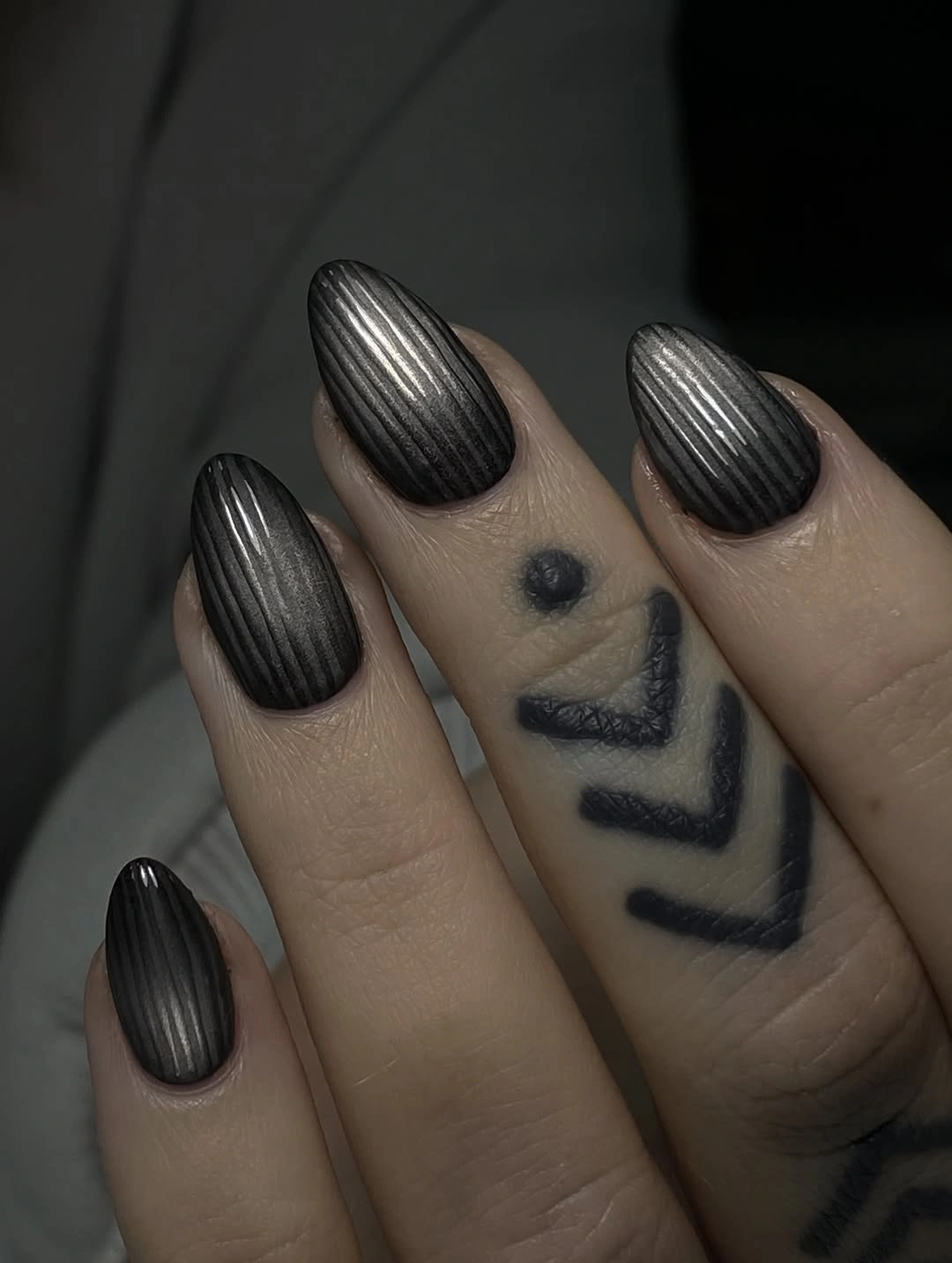
Keep the texture on two or three fingers if you want a less intense version, then use a smooth charcoal or sheer gray beside it for relief. A shorter almond will make the ribs look denser, so wider spacing or a single textured accent can preserve the open feeling. Silver rings, black fabric, gray knits, and muted green all support the cool surface without introducing another competing pattern.
The most important detail is the direction of the grooves, not their number. If a shorter nail cannot hold many lines cleanly, remove some and keep the rhythm vertical rather than compressing them into a dark blur. The finish may also show uneven edges more clearly than a plain color, so the manicure gains its strength from controlled spacing and a consistent almond outline.
Deep forest green with a clean glossy edge
Long almond nails are painted a deep forest green with a smooth glossy surface, and the dark color is allowed to remain completely uninterrupted. The small detail that matters is the clean edge around each pointed nail: it gives the saturated green a polished boundary and keeps the reflected highlight broad. Silver rings add a cool counterpoint, but the manicure itself depends on silhouette and finish rather than decoration.
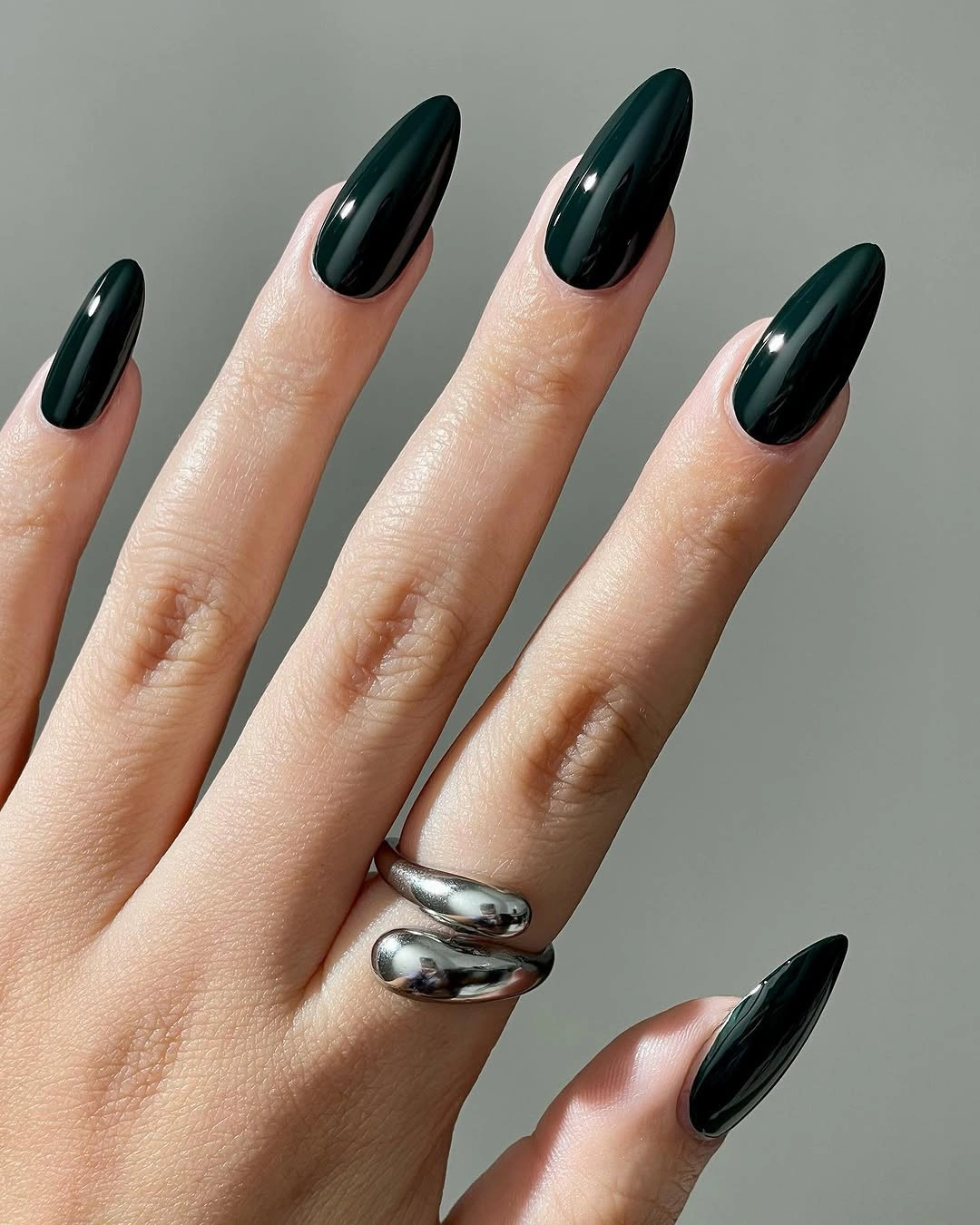
For a more compact set, move the same green to a medium almond or use the full shade on three nails with a sheer gray accent. A rounded tip will make the color feel softer, while a longer point will intensify its directional quality. The dark green can accompany black, denim, cream, silver, or muted plum, and it does not need a second motif to look considered.
On a long shape, glossy dark polish makes the sidewalls and tip especially visible, so consistency becomes the quiet technical-looking detail even when no method is known. Keep the surface smooth and let the length provide the drama. If daily tasks make the point impractical, shortening the almond changes the impact less than replacing the color, because the deep green and its reflective edge remain the visual identity.
Glossy plum on a compact almond
Medium almond nails carry a single dark plum color with a rounded glossy reflection. There is no painted accent to distract from the small decision at the perimeter: the curved edge follows the finger and lets the rich color look compact rather than severe. The manicure demonstrates how a deep shade can feel soft when the shape is not overly long and the finish remains smooth.
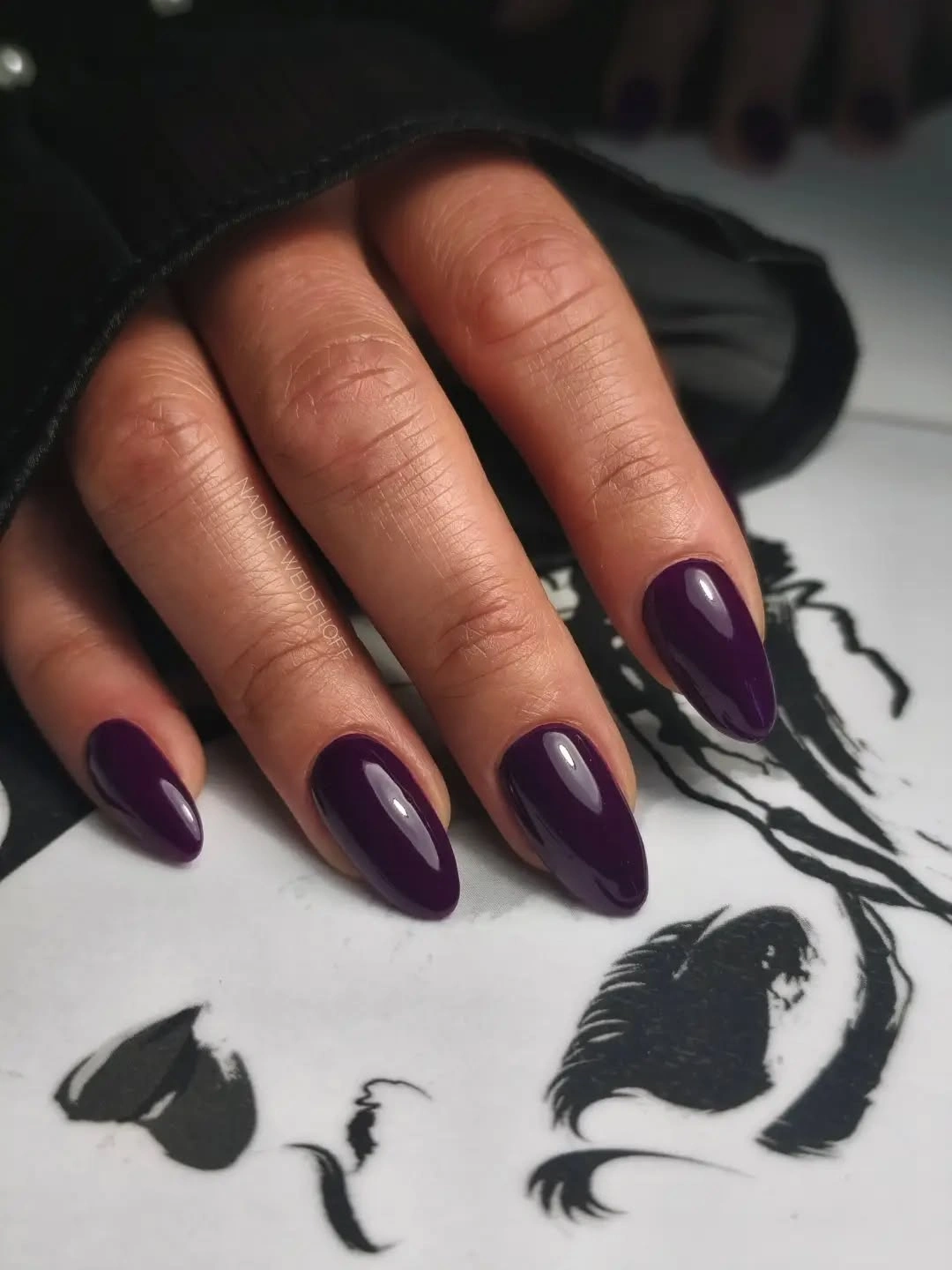
Use the plum on every finger for the most direct version, or leave one nail sheer and repeat the shade as a narrow tip. A short rounded square would make the same color more graphic, while a longer almond would push it toward a sharper evening effect. Pairing it with black, slate gray, soft pink, silver, or a warm brown keeps the focus on the color without requiring a matching accessory.
With a single dark color, the shape and reflection are the only places for the eye to rest, so uneven length will be more noticeable than it would be in a busy set. Keep the corners and tips aligned, and avoid adding glitter just to create movement. The understated quality comes from allowing the plum to change through light while the outline stays controlled.
Smoky marbling inside long pointed tips
Long pointed nails use a translucent base with smoky black and gray marbling, plus pale metallic-looking streaks that appear suspended across the surface. The concentrated detail is not an all-over print; it gathers in cloudy patches and leaves darker edges around the pointed outline. That placement gives the manicure depth while keeping the transparent areas available as visual relief.
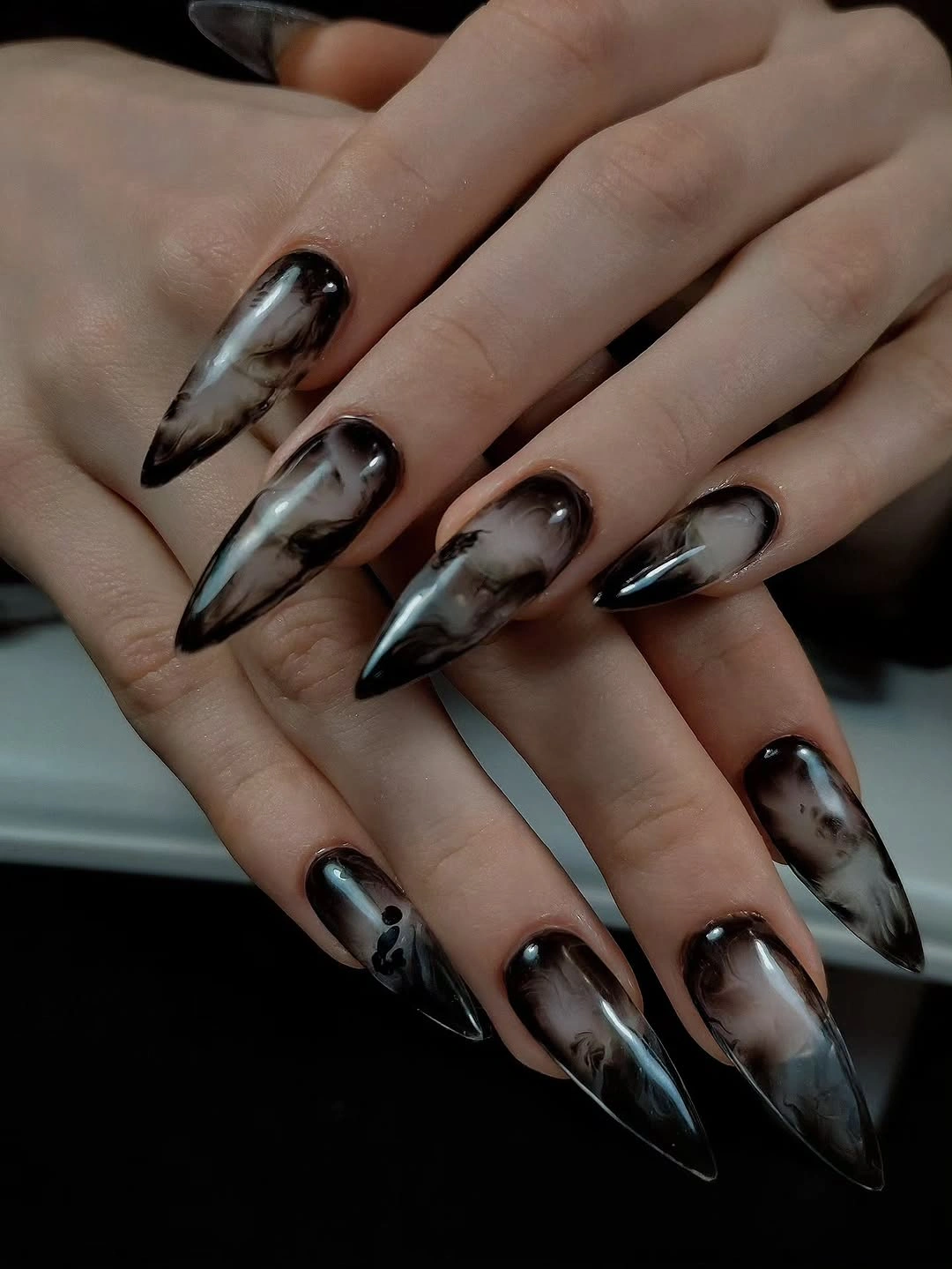
On a medium almond, keep the cloudy effect near the center and let the tip remain clearer so the length does not look swallowed by dark marks. A shorter version can use one smoky accent nail beside solid black or soft gray. The design already has strong movement, so plain clothing, silver jewelry, and a single dark color will support it better than another complex print.
Marbling is easiest to read when the light and dark areas remain separated enough to show their shapes. If the nail is small, simplify the number of swirls rather than trying to recreate every smoky transition. The visible appeal comes from the contrast between a clear-looking base and concentrated dark clouds, so preserving that pause is more important than increasing the amount of pigment.
Wine and black with rose details
Long pointed nails combine deep wine, black, and rose illustrations, making the smallest repeated detail the bridge between the solid fingers and the decorated accents. The flowers sit on selected nails, while the remaining surfaces provide dark blocks that keep the set from becoming a full floral field. The pointed silhouette adds drama, but the rose placement is what turns a dark color collection into a specific gothic-romantic direction.
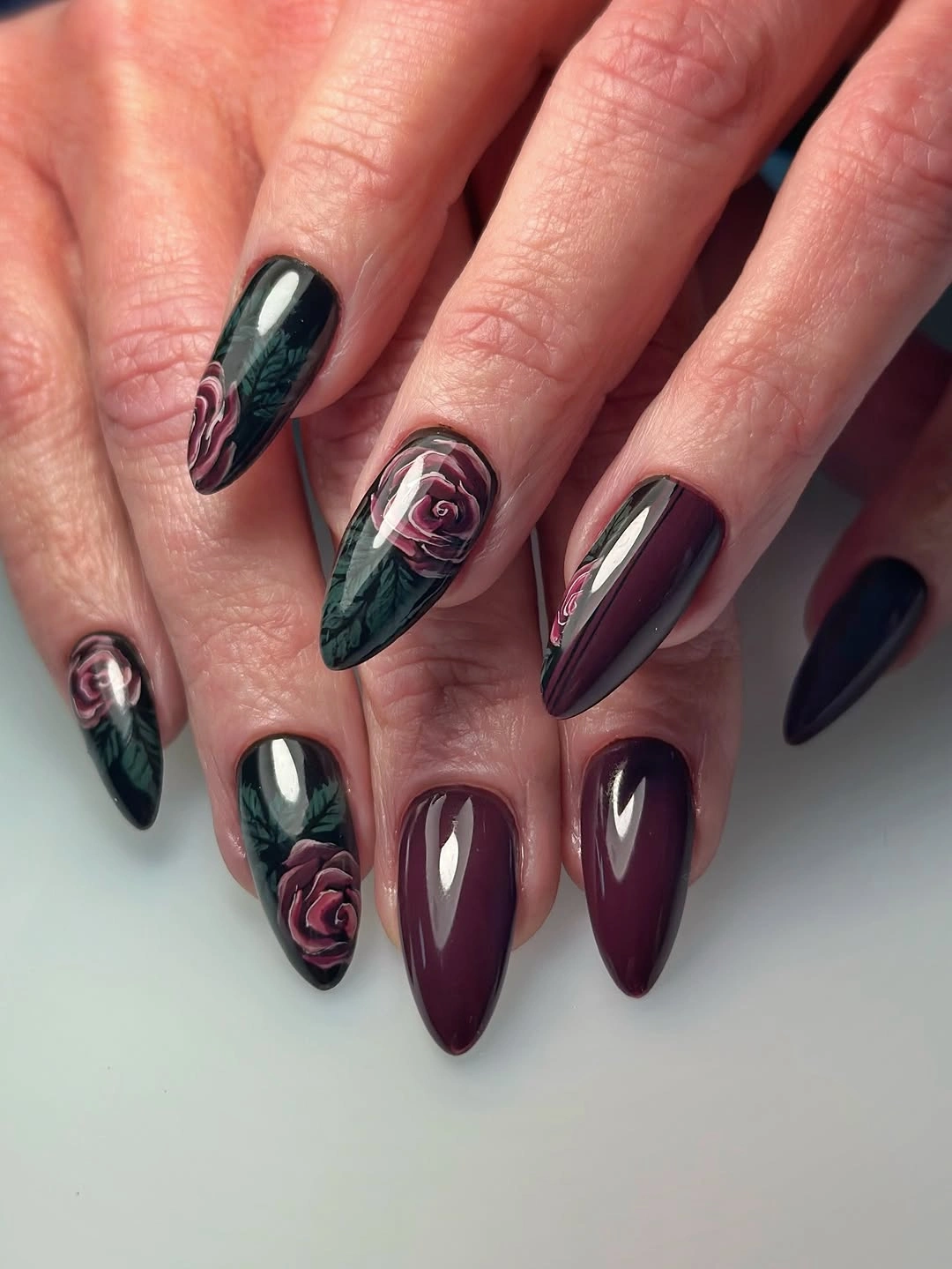
Reduce the design by keeping one rose accent and using the wine as the main color on a medium almond. A burgundy flower on a nude or smoky base would preserve the placement while lowering the overall contrast. Let the clothing stay simple – black, cream, gray, or a dark floral – because the manicure already contains both the solid anchor and the decorative focal point.
Floral detail becomes harder to distinguish when the pointed surface is narrow, so the rose should have a clear field around it. If the length is shortened, remove the black supporting lines before shrinking the flower into an indistinct mark. The set works through alternation: dark solids give the eye a pause, then the rose returns as a concentrated detail with more weight than its size suggests.
Emerald accents among black pointed nails
Long pointed nails alternate black and moss green with loose silver-lined strokes and bright oval green accents. The most consequential detail is the emerald-colored center on selected nails, which gives the nearly black set a jewel-like point of focus. Fine lines around it create movement, but the broad dark shapes remain dominant and prevent the decorative accents from spreading evenly across every finger.
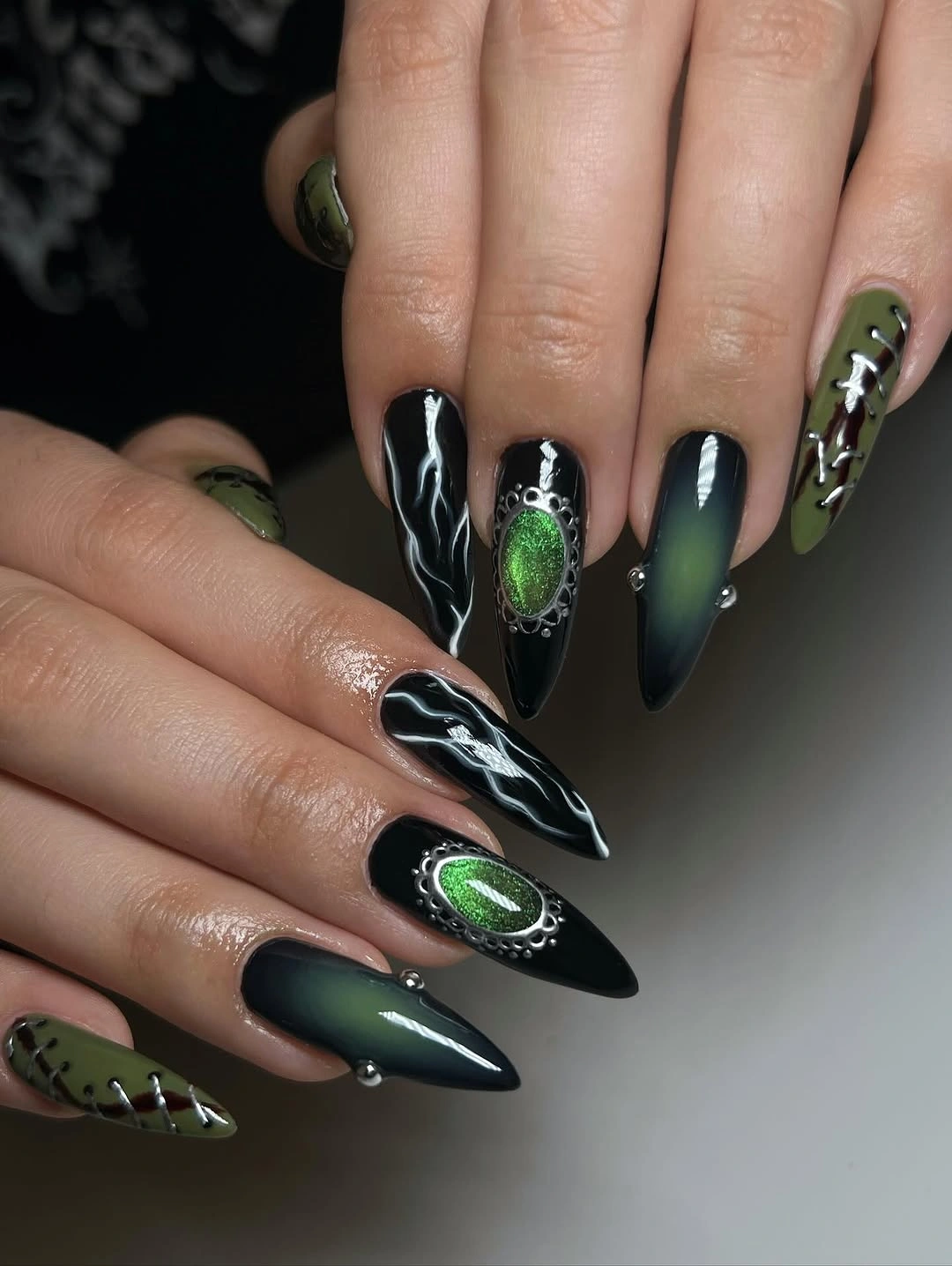
On a shorter almond, keep the green oval on one nail and repeat moss green as a small side stroke on another. A medium pointed shape can retain the black frame while reducing the amount of linework, which makes the design easier to read from normal distance. Pair it with black, olive, charcoal, or one green accessory instead of adding a second vivid color to the outfit.
The green detail needs space around it to remain the focal point, while the silver lines should guide the eye rather than form a second pattern. If the surface becomes crowded, remove the loose strokes first and keep the oval accent. That adjustment protects the hierarchy of the manicure: black establishes depth, green supplies the spark, and the thin metallic marks simply connect the two.
Reflective red patches on dark wine
Medium almond nails start with a dark wine base and add irregular red reflective patches that catch light across the surface. The red is not placed as a conventional tip or flower; it appears in broken, glossy areas, so the small change in value creates the movement. The almond outline remains simple, which lets the surface contrast carry the design instead of asking the shape to do all the work.
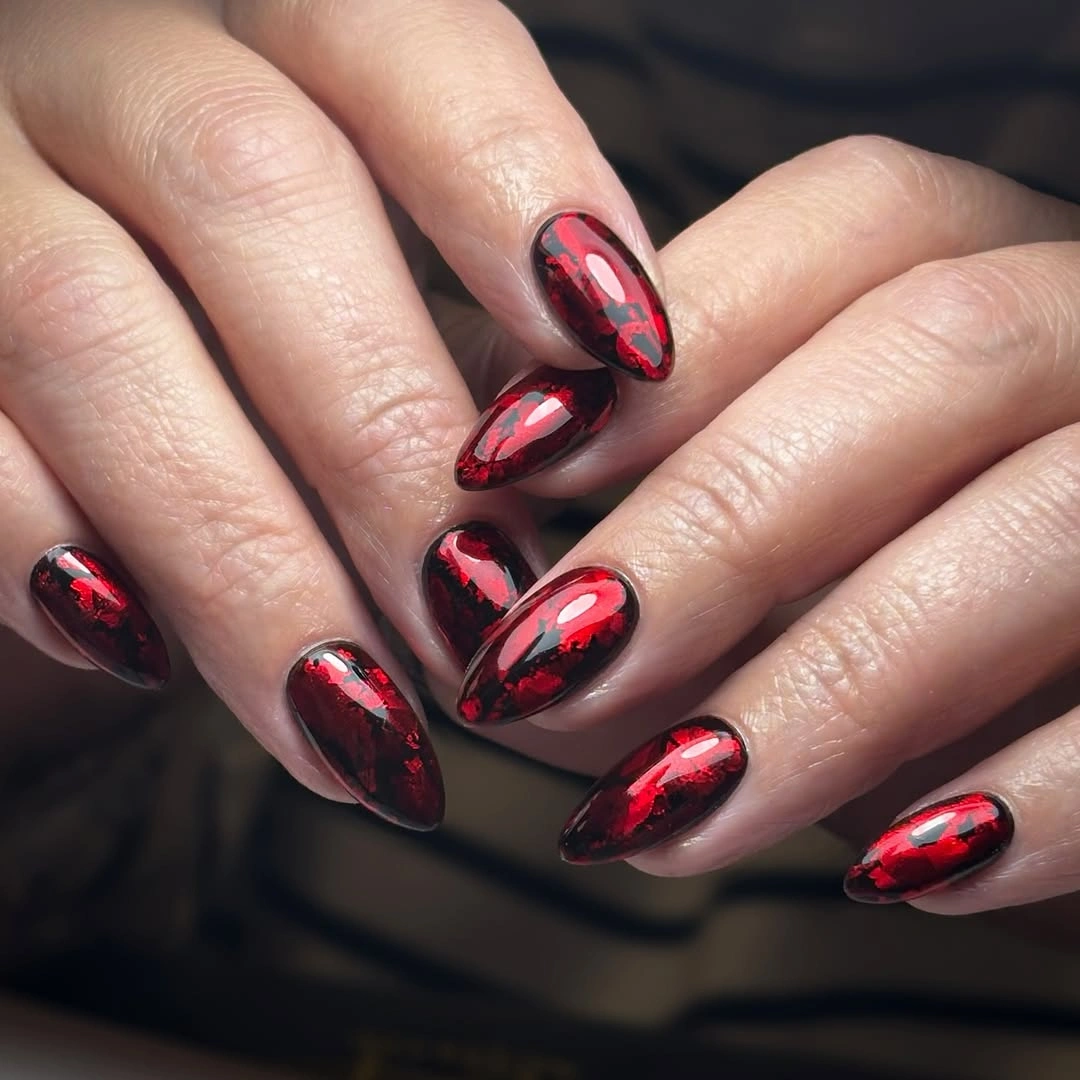
Keep the red reflection on two accent nails if you want a calmer interpretation, using plain wine on the rest. A short rounded square would make the patches feel more graphic, while a longer almond would exaggerate their directional shine. Black clothing, dark denim, silver jewelry, and a muted red lip can sit beside the manicure, but the rest of the look does not need additional gloss.
Irregular patches need enough separation to look intentional, especially when the base is already dark. Avoid turning every reflection into a similar stripe; variation in size is what keeps the finish from becoming a repeated sticker-like motif. If the surface begins to look busy, leave more wine showing and treat the red as a flash inside the color field rather than as a second full coat.
Berry magnetic-looking sheen on almond nails
Medium almond nails are a deep berry-plum with a fine pearly or magnetic-looking shift that gathers toward the center of each nail. The detail is subtle: the color stays dark at the edges and brightens through the reflected band, so the manicure changes as the hand moves. That controlled transition makes a single shade feel dimensional without introducing linework or a separate accent finger.
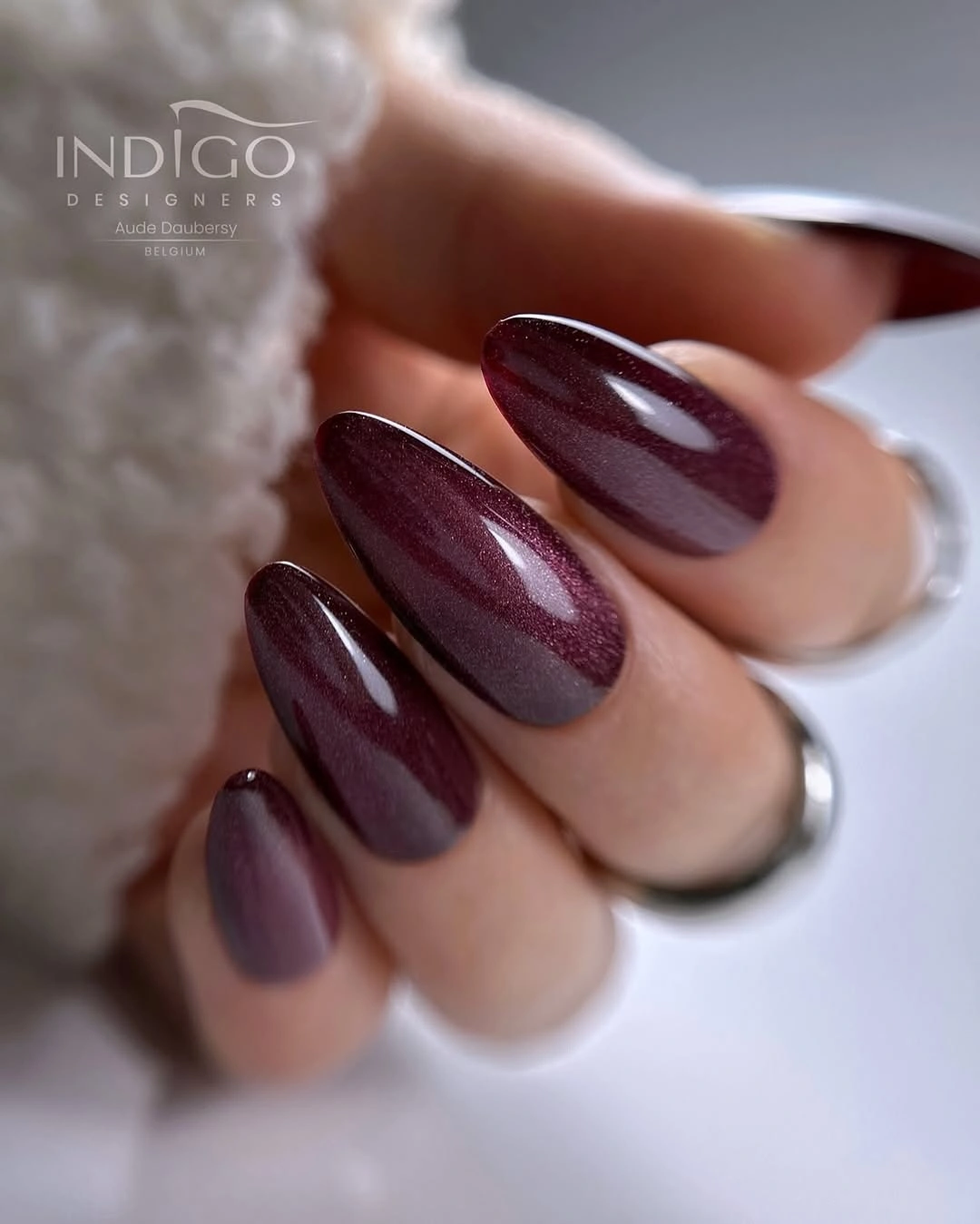
Use the shifting finish on two fingers and keep the others as smooth plum if you want the contrast to be easier to see. A shorter oval will make the central highlight feel softer, while a longer almond will pull it into a more directional streak. The palette works with cream, black, charcoal, burgundy, and silver, and the quiet variation can support a patterned sleeve without fighting it.
When the reflective band is delicate, heavy decoration would hide the feature that makes the set interesting. Keep the edges clean and let the light create the change; the design does not need a glitter layer to look dimensional. A shorter length may reduce the sweep of the reflection, but it will also make the dark berry easier to wear, so the tradeoff is mostly about motion rather than color.
Short burgundy with denim-friendly shine
Short rounded-square nails use a single glossy burgundy color, and the close crop makes the even surface and compact edge the main subjects. There is no motif competing with the depth of the wine shade, so the manicure feels direct and wearable rather than ornate. Denim in the setting creates a useful contrast: the dark red looks rich against blue without needing a second accent color.
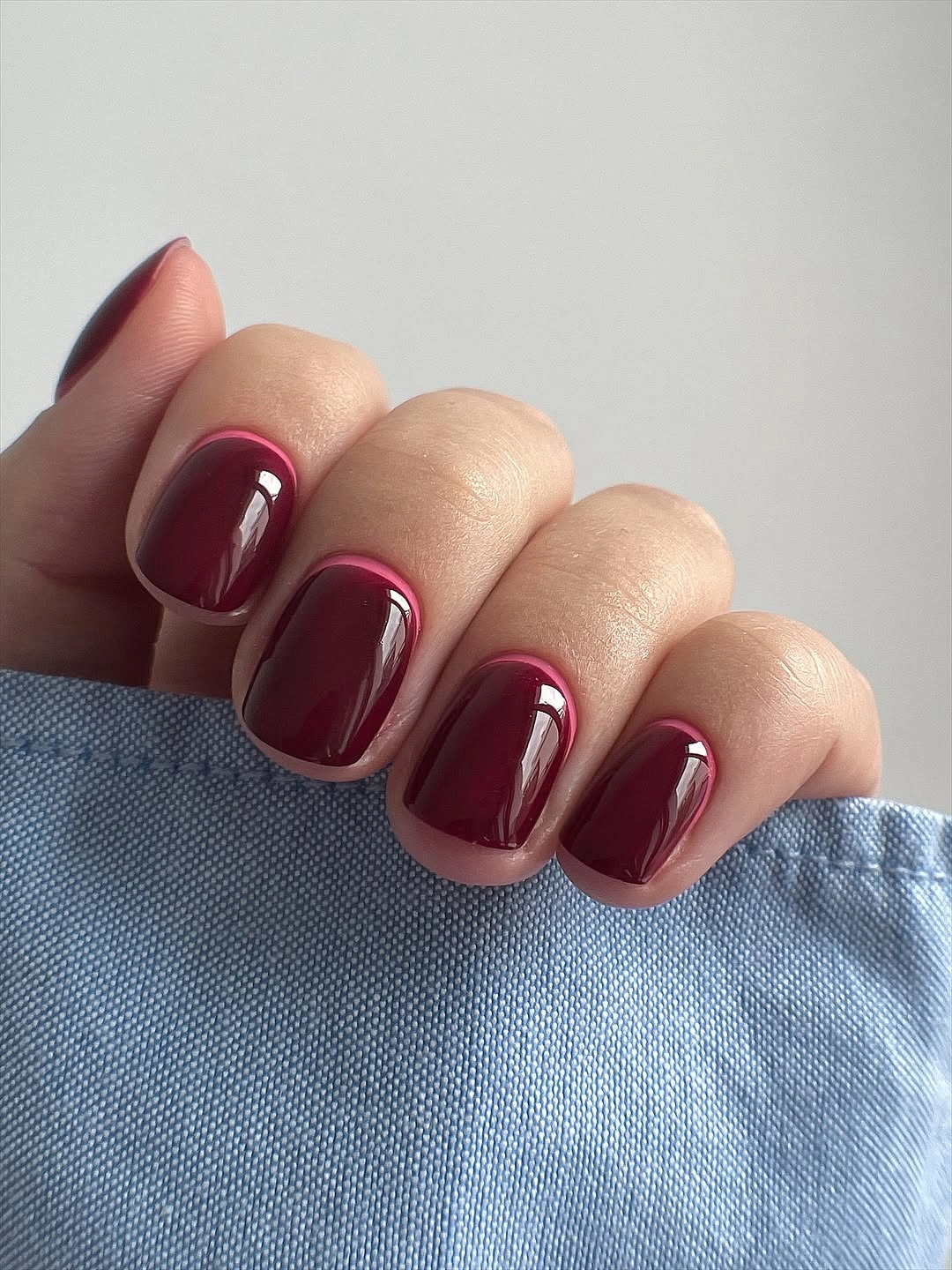
Keep the full burgundy set if you want the simplest dark fall option, or leave one nail sheer and use the wine as a narrow French edge. A rounded square is already compact, but a short oval would soften the color while a medium square would make it more graphic. The shade can move between casual denim, cream knitwear, black tailoring, and warm brown layers without losing its identity.
Single-color sets reward small corrections because the eye has nowhere else to go. Keep the length even, the corners similar, and the glossy edge free of extra marks. If the color feels too heavy, changing the shape or reducing the number of wine nails is more effective than adding glitter; the clean burgundy field is what makes this design easy to style.
Close-cut forest green in a pointed silhouette
This close view of dark forest-green almond nails emphasizes the pointed silhouette and the uninterrupted glossy surface rather than the wider hand composition. The useful detail is the way the highlight runs down the center, making each nail look elongated while the nearly black green keeps the finish restrained. The design is close to a single-color set, but the crop makes proportion more noticeable.
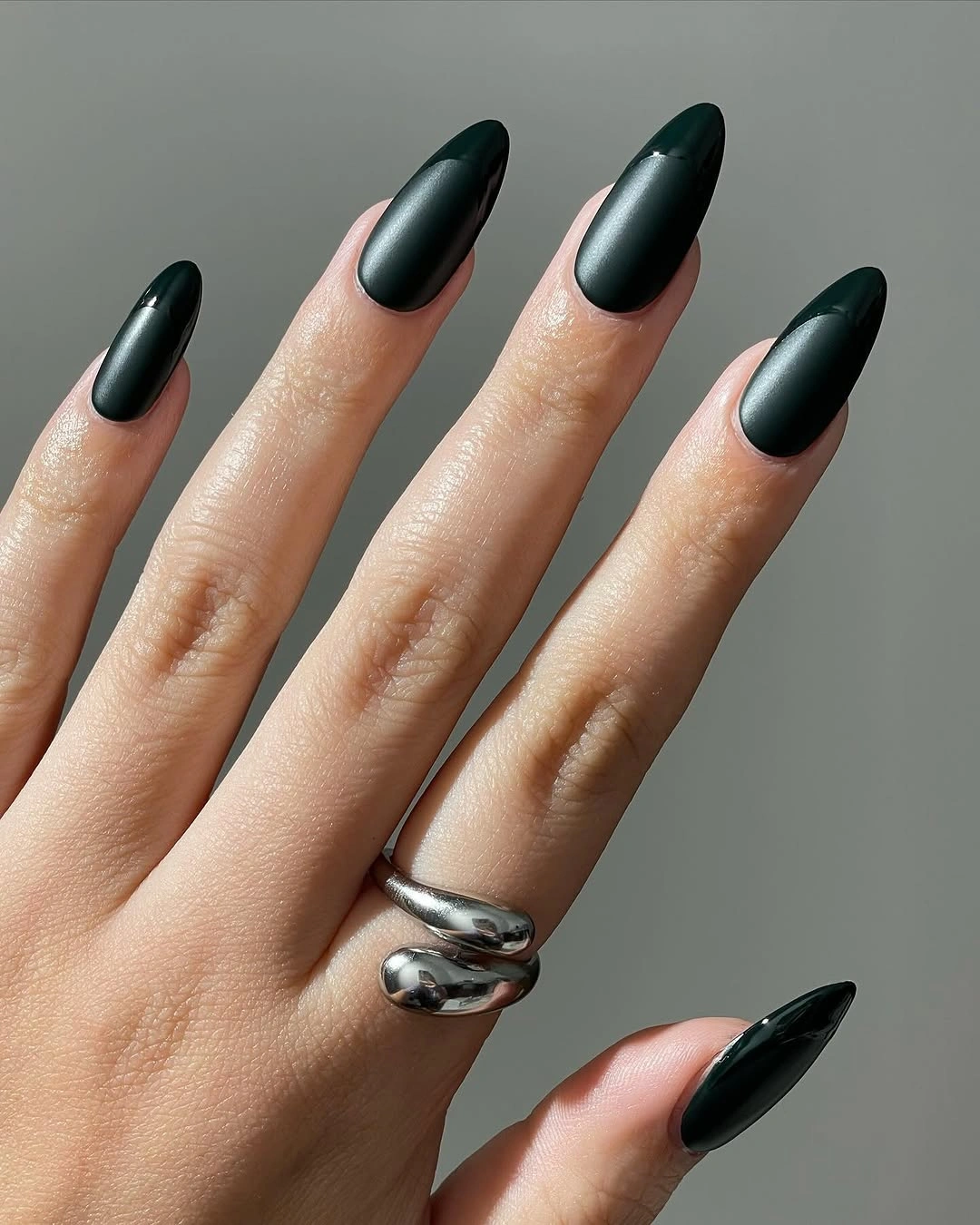
Use the shade on a medium almond if you want the same depth without the extended point, or place it on three fingers and pair it with sheer gray for more breathing room. A short rounded square will turn the color into a stronger block, so keep the finish glossy to retain movement. Silver metal, black, gray, and washed green clothing can echo the cool darkness without repeating the exact shade.
Because the surface is plain, the tip alignment and width carry more responsibility than any decorative feature would. A shorter version should keep the color unbroken and let the outline become the adjustment. The close, minimal approach works when the green remains the visual center; adding a motif would make the design less about its controlled dark shine.
Mixed dark details with a small silver star
Short nails combine glossy plum, silver-gray, black striping, and a small star-like accent, so the set is organized by contrast rather than by one repeated color. The silver finger provides a light interruption, the black stripe supplies direction, and the plum restores depth. This is a detail-first design because each small element has a different role inside a compact silhouette.
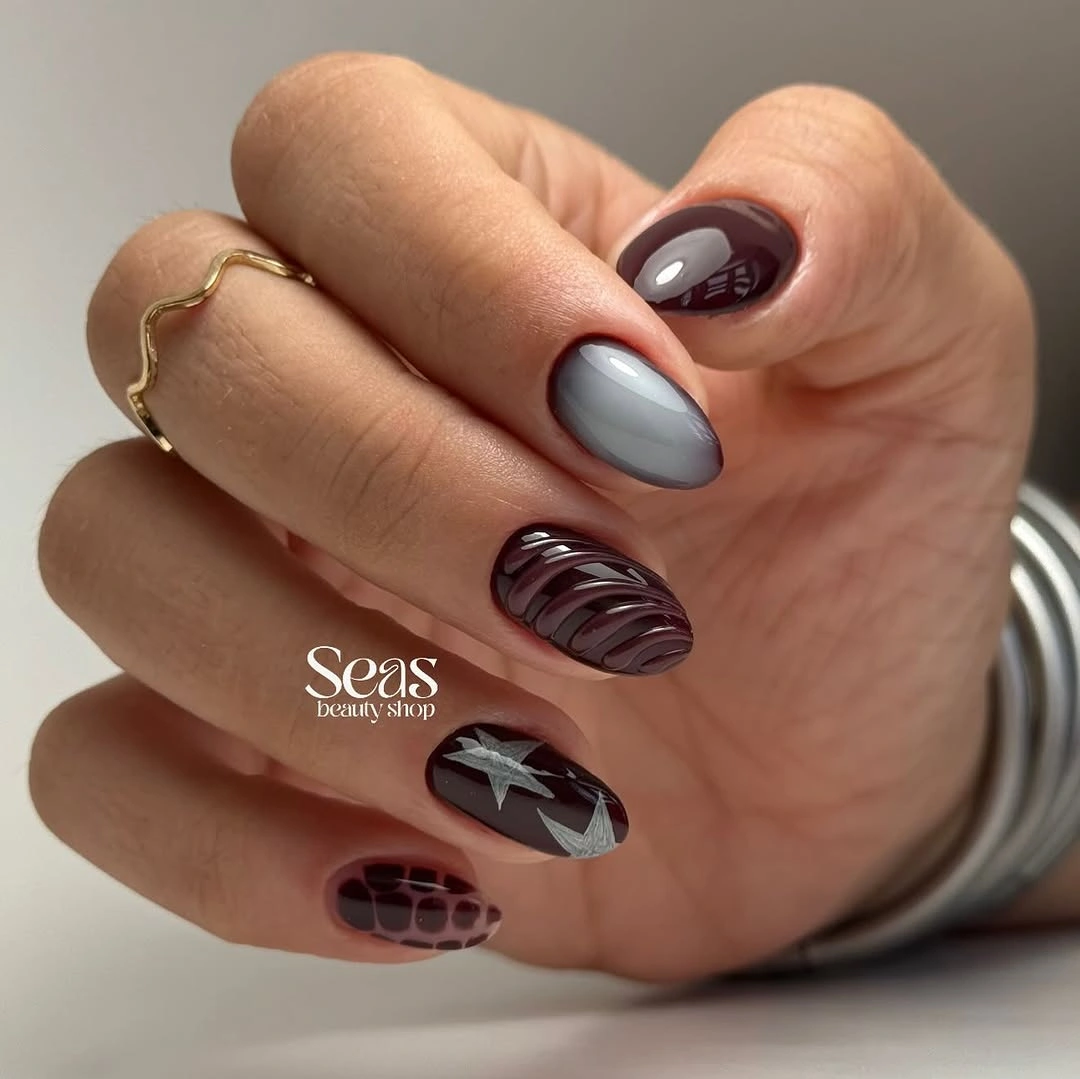
To keep the composition readable on a shorter nail, choose the silver accent and one black line, then let the plum repeat across the remaining fingers. A rounded square will give the mixed details more width, while a short almond will make the stripe feel more directional. The palette can support black, gray, plum, denim, and one metallic accessory without asking the clothing to repeat the star.
Small accents should not all demand the same attention, or the eye loses the order of the manicure. Keep the star tiny, allow the silver area to act as relief, and use the black stripe as a connector rather than a full pattern. If the design grows out, simplifying the striping first will preserve the contrast between deep plum and reflective gray, which is the more durable visual idea.
Reflective raspberry on short rounded squares
Short rounded-square nails use a raspberry wine color with a reflective metallic glow that brightens the center of each nail. The set stays uniform, but the surface is not flat: a bright central band appears against deeper edges and gives the compact shape a subtle movement. That small shift is enough to make the color feel richer while keeping the manicure free from overt decoration.
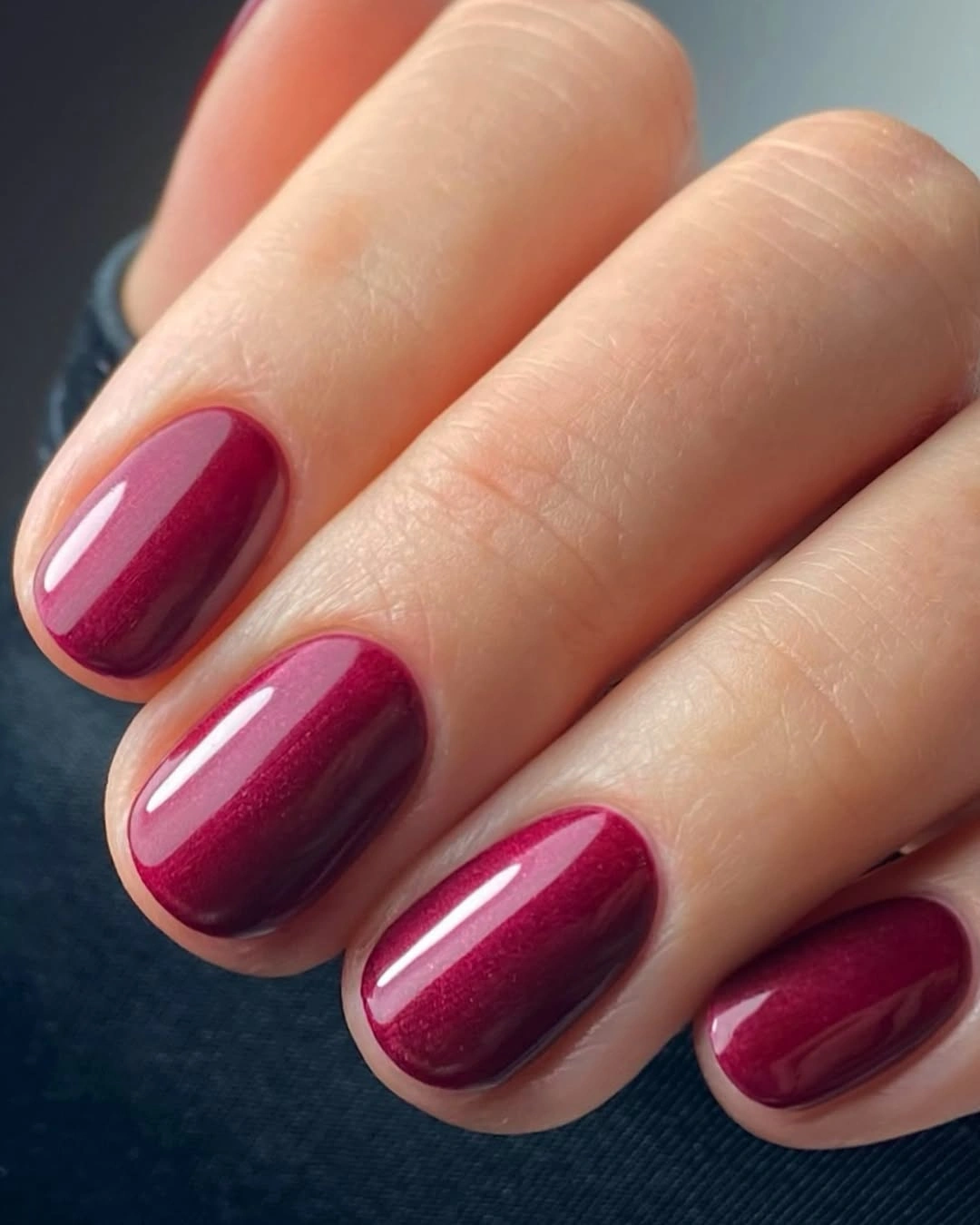
Keep the finish on every finger for a clean color statement, or place it on two nails and use a smooth burgundy beside it. A short oval would make the central glow softer, while a medium square would emphasize the reflected band. The color can sit with black, cream, gray, denim, or dusty rose, and the restrained shine is useful when clothing already has texture.
Metallic reflection is most convincing when the edges stay darker and the surface remains smooth, so extra glitter would reduce the contrast. If the nails are very short, keep the central highlight narrow enough to leave a visible border. The manicure gains its character from that small edge-to-center change, not from adding another shade or a decorative mark.
Deep blue-green glitter with a central flash
Short rounded-square nails combine a deep blue-green base with fine glitter and a bright blue stripe through the middle. The glitter is scattered across the dark field, while the central flash creates a clear directional feature that makes the set look more dimensional. Because the shape is short, the reflective line stays close and concentrated instead of spreading into a long sweep.
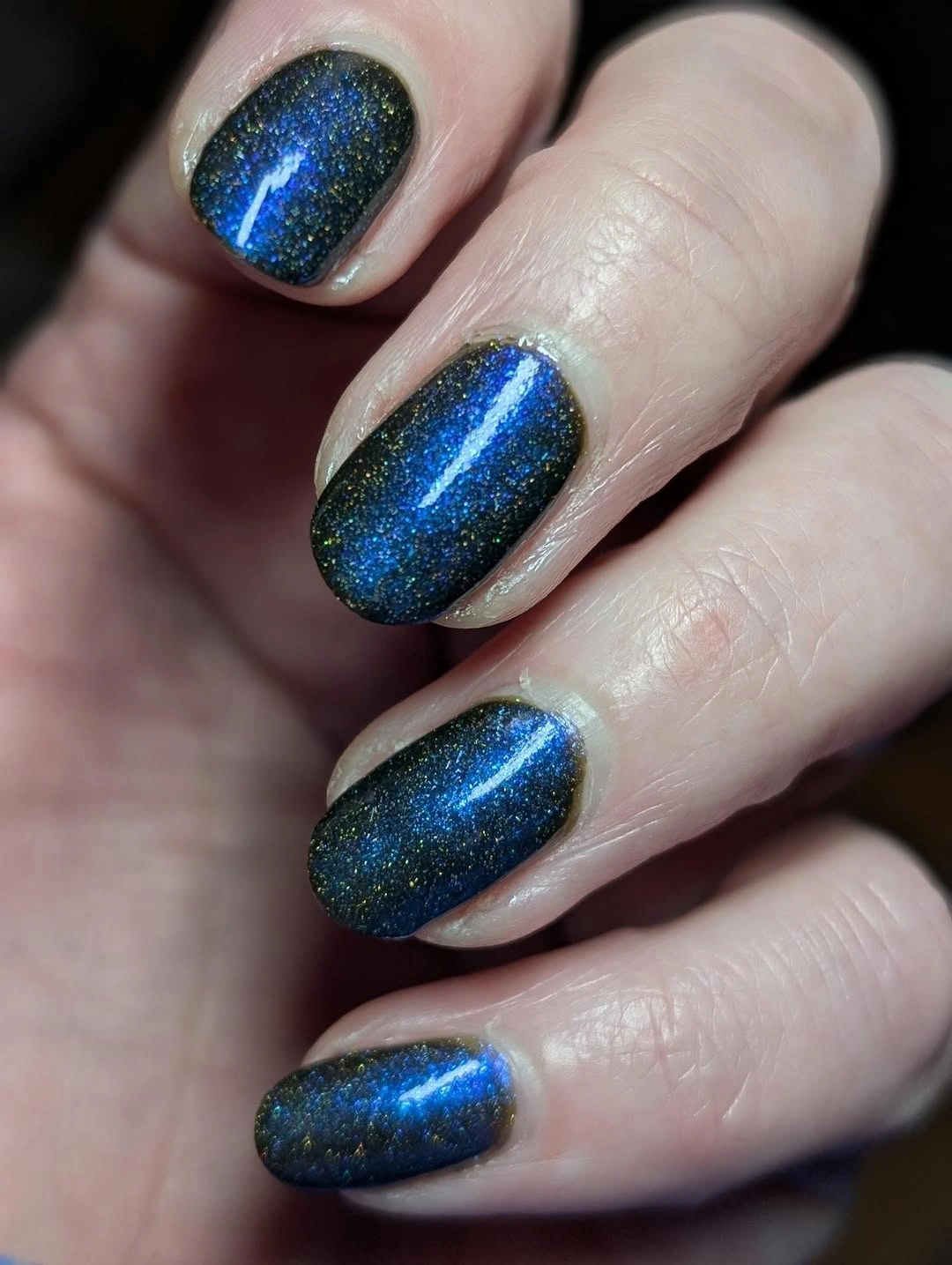
For less intensity, use the glittering blue-green on two nails and choose a plain deep teal on the rest, keeping the bright stripe as one accent. A short oval would soften the geometry, while a medium square could make the stripe more graphic. Silver, black, charcoal, and dark denim will support the cool palette; warm brown can work as a deliberate contrast without requiring another jewel tone.
The central stripe needs open space around it, especially when the base already contains fine sparkle. Do not add additional lines simply because the reflective feature is narrow; the surrounding glitter is already doing the supporting work. If the length changes, keep the flash aligned with the center so the eye still reads one controlled direction through the otherwise dark surface.
Navy French points with tiny gold flowers
Long almond nails place navy French points over a blush base and add small gold and pale floral details near the center. The dark tips are the first detail the eye notices, but the flower marks interrupt the straight color relationship and give selected nails a lighter focal point. The result is dark without becoming opaque because the blush base remains visible between the navy edge and the accent decoration.
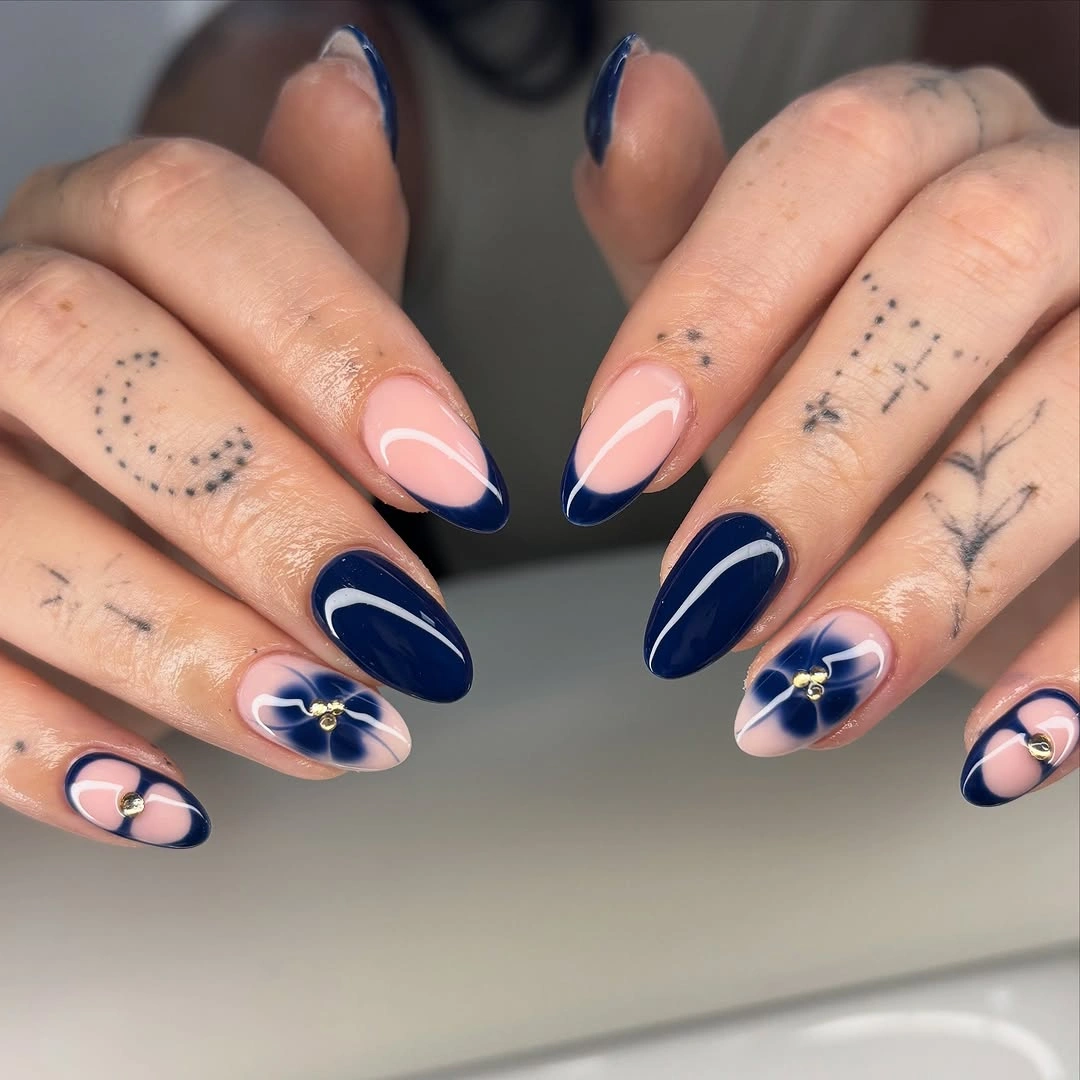
A shorter almond can keep the navy edge and move the flower to one nail, while a rounded almond would make the contrast feel more delicate. If the navy feels too severe, a deep blue-gray or plum can take its place without changing the placement. Cream, blush, gray, gold jewelry, and dark denim can all echo the palette while leaving the fine center details visible.
On a narrow tip, the French edge should remain even enough to read as a frame, and the gold detail needs a clear blush field around it. Reduce the number of petals before widening the navy band; otherwise the accent loses its role and the nail becomes visually heavy. The design is balanced by one strong edge and one small center, so both should stay distinct.
Almost-black plum with an uninterrupted shine
Long almond nails use an almost-black plum color with a clean glossy surface, making the dark tone and narrow silhouette inseparable. The most important detail is the reflective highlight along the center, which keeps the deep color from becoming visually flat. No motif is needed because the length, taper, and contrast between bright reflection and dark edge already create a complete composition.
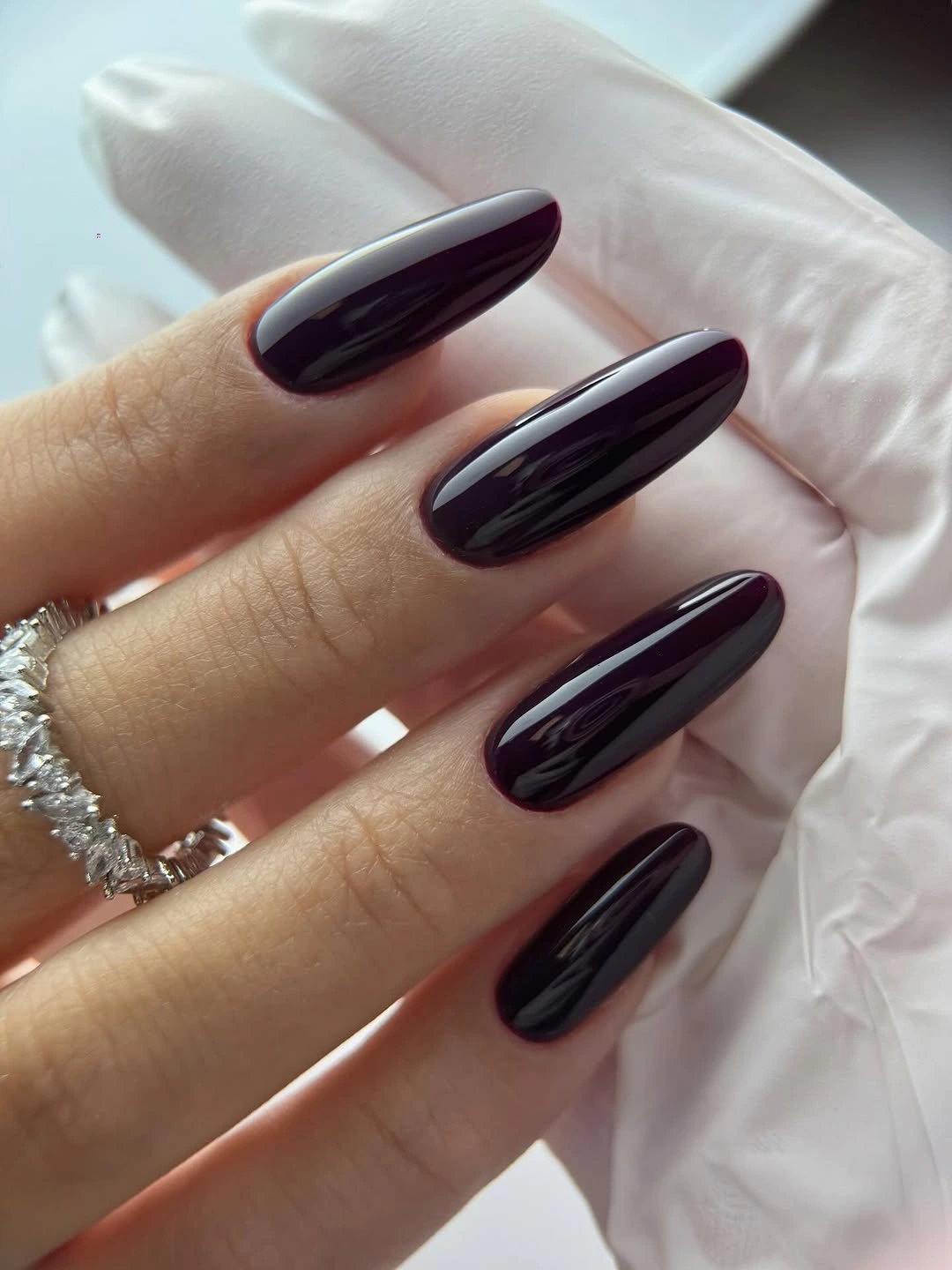
If the pointed length is not practical, keep the same color on a medium almond or a short rounded square, where it will read more compact and graphic. A sheer plum accent can soften a full set, while a narrow burgundy edge would add warmth without breaking the dark field. Black clothing, white knitwear, silver jewelry, and muted berry tones can all sit beside this shade.
Dark reflective nails reveal chips and uneven tips quickly, so a simple set benefits from a deliberate outline. Avoid covering the surface with extra embellishment; the polish needs clear room to show its plum undertone. Shortening the nail changes the drama, but it also makes the almost-black color easier to maintain, which is the honest tradeoff behind this otherwise minimal design.
Silver chrome on short rounded nails
Short rounded nails use a silver chrome finish with darker outlining, and the mirror angle makes reflection the defining detail. The shape is compact enough to keep the metallic surface from feeling costume-like, while the dark edge gives each nail a clear boundary against the soft background. The manicure is simple in color but not visually plain because the surface changes with every movement.
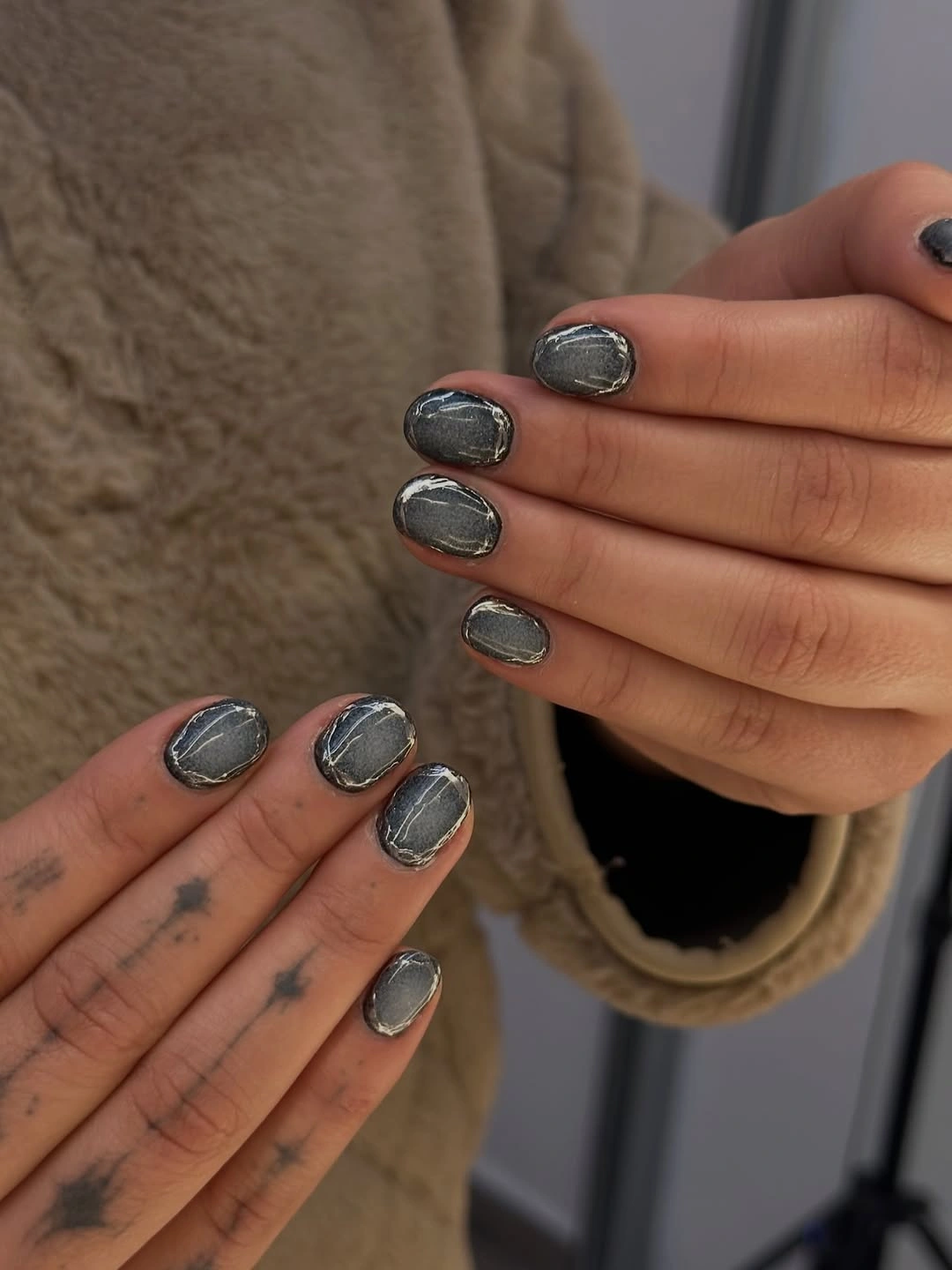
For a quieter version, use chrome on two accent fingers and a smooth gray or charcoal on the rest. A rounded square would make the dark outline more graphic, while a short oval would keep the reflected effect softer. Silver jewelry, black, cream, taupe, and denim all work with the finish, but a matte clothing texture can provide the best contrast against the reflective nails.
Chrome needs a clean border to look intentional, and a dark outline that becomes too wide will make the nail appear smaller. Keep the edge narrow and let the center remain reflective. If the compact shape makes the surface feel busy, remove the outline on one finger rather than adding more shine; the central reflection is the detail carrying the manicure.
Emerald reflections through smoky black
Long almond nails use smoky translucent black with emerald green reflective patches that appear across the centers. The green is concentrated rather than evenly painted, so each nail has a slightly different balance between dark transparency and jewel-like color. That variation keeps the repeated shape interesting, while the black field maintains a coherent dark fall mood.
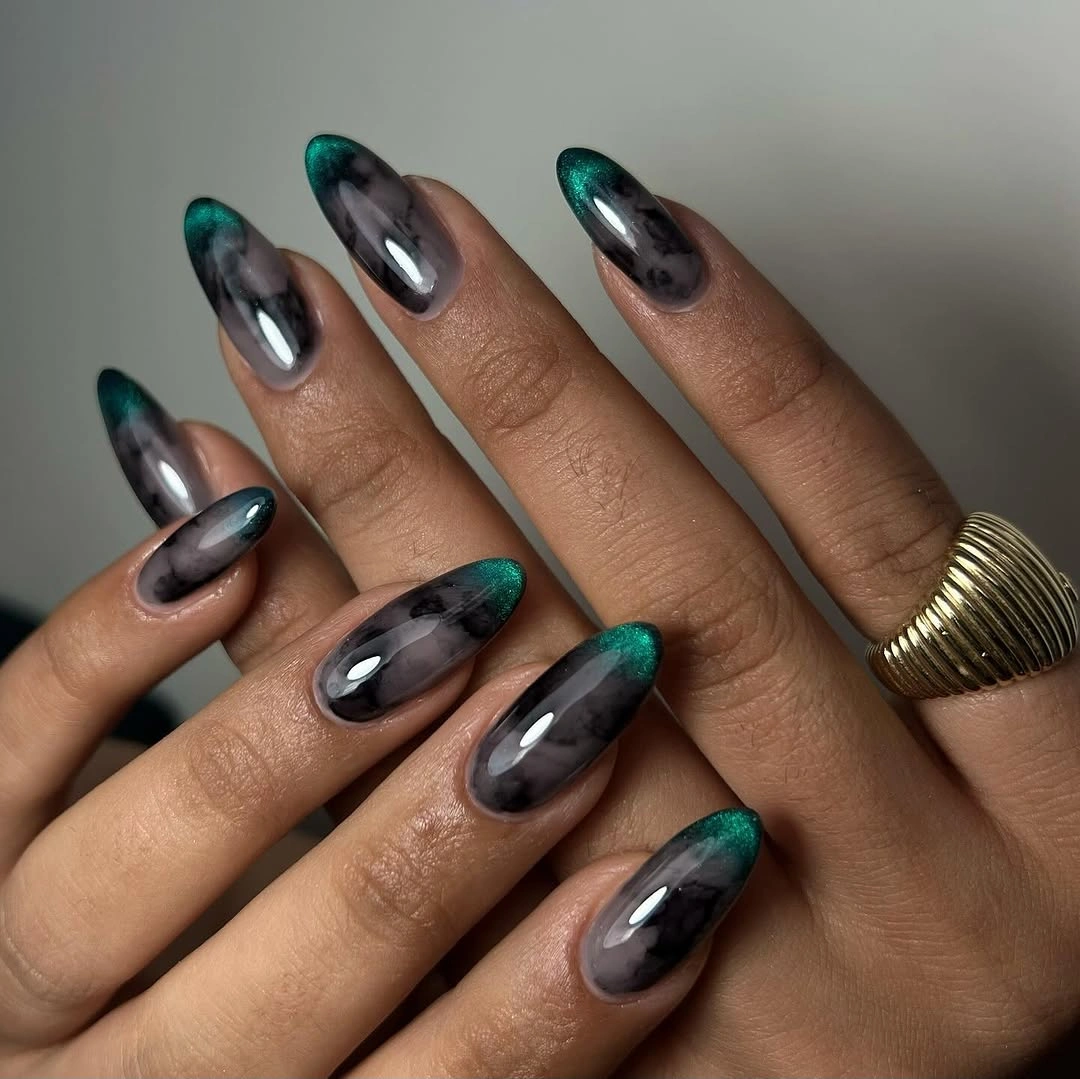
On a medium almond, keep the green reflection on two nails and use a sheer smoky base on the others. A shorter oval can soften the pointed effect, but a little length helps the green patch remain visible instead of collapsing into the dark edge. Pair the set with black, charcoal, forest green, bronze, or a single warm gold accessory to respect the contrast between cool shadow and bright reflection.
The reflective patch should stay irregular enough to look like a surface change rather than a repeated sticker, but it still needs open dark space around it. Avoid covering every nail with equal green; that removes the depth created by the smoky base. When maintenance or length becomes an issue, reduce the green area first and keep the translucent black relationship intact.
Navy-gray nails edged with silver
Medium almond nails use a deep navy-gray center with a thin silver chrome border tracing the outer edge. The small border changes the entire reading of the dark color: instead of disappearing into the background, it gets a precise outline that follows the almond shape. The silver is narrow enough to support the silhouette rather than becoming a second full-color band.
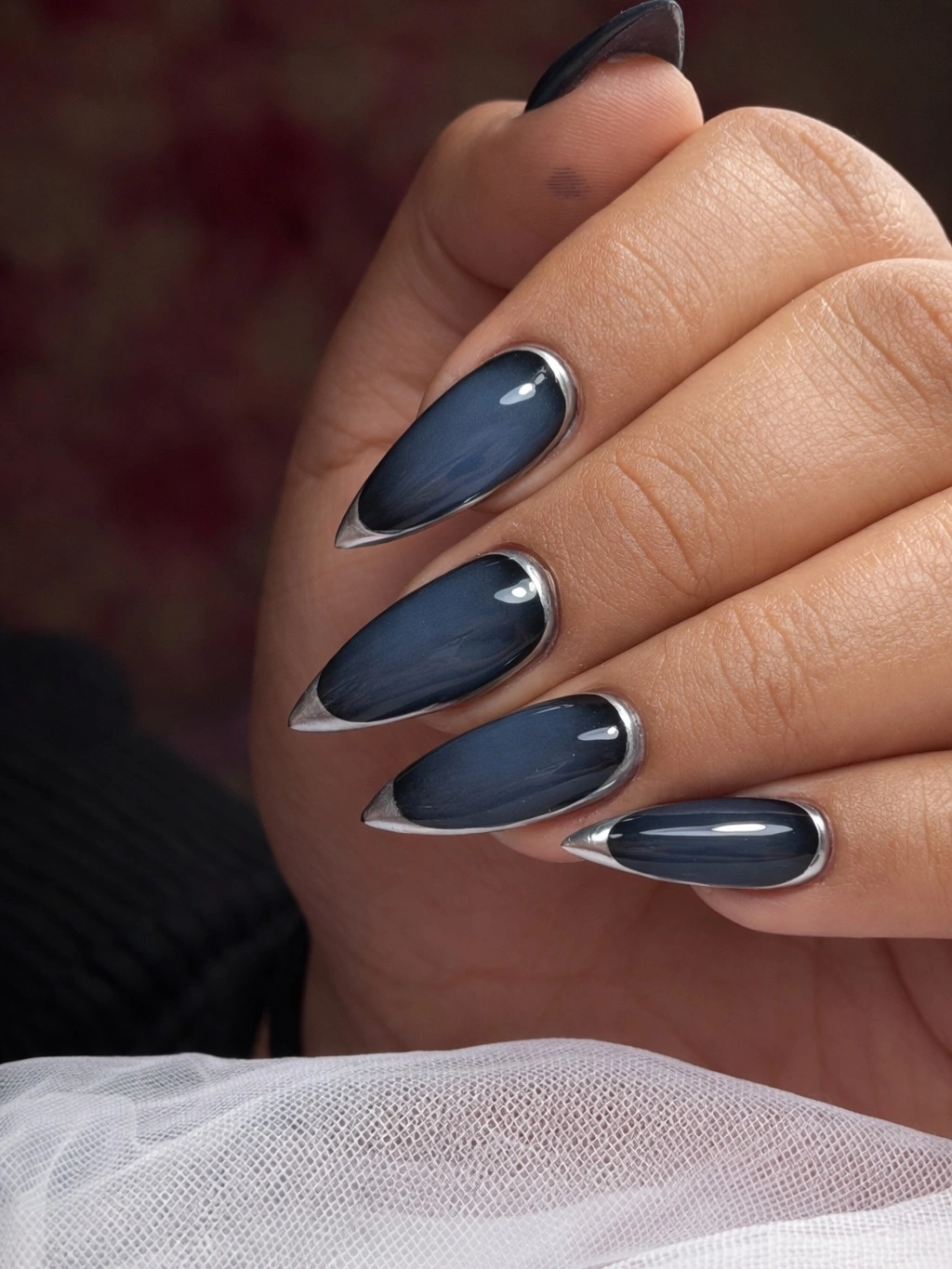
For a shorter shape, keep the silver only along the tip or use it on two fingers while leaving the rest navy-gray. A rounded almond will make the border feel softer, while a longer point will make the frame more directional. The palette works with black, white, gray, denim, silver jewelry, and soft pink because the chrome edge already supplies a controlled contrast.
Border details show uneven width immediately, especially around a tapered tip, so simplicity helps the manicure stay crisp. If a small nail cannot support a complete outline, stop the silver at the sidewalls and let the dark center remain broad. The visual idea survives because the cool border is a frame; it does not need to become a dominant stripe to be effective.
Plum solids with pale leaf accents
Long almond nails alternate dark brown-plum solids with pale pink accent nails decorated by black and rose-colored leaf shapes. The small leaf motif carries the lightest value in the set, so it immediately creates a focal point against the surrounding depth. The solids are not filler: they give the pattern a pause and keep the long silhouette from becoming a continuous illustrated surface.
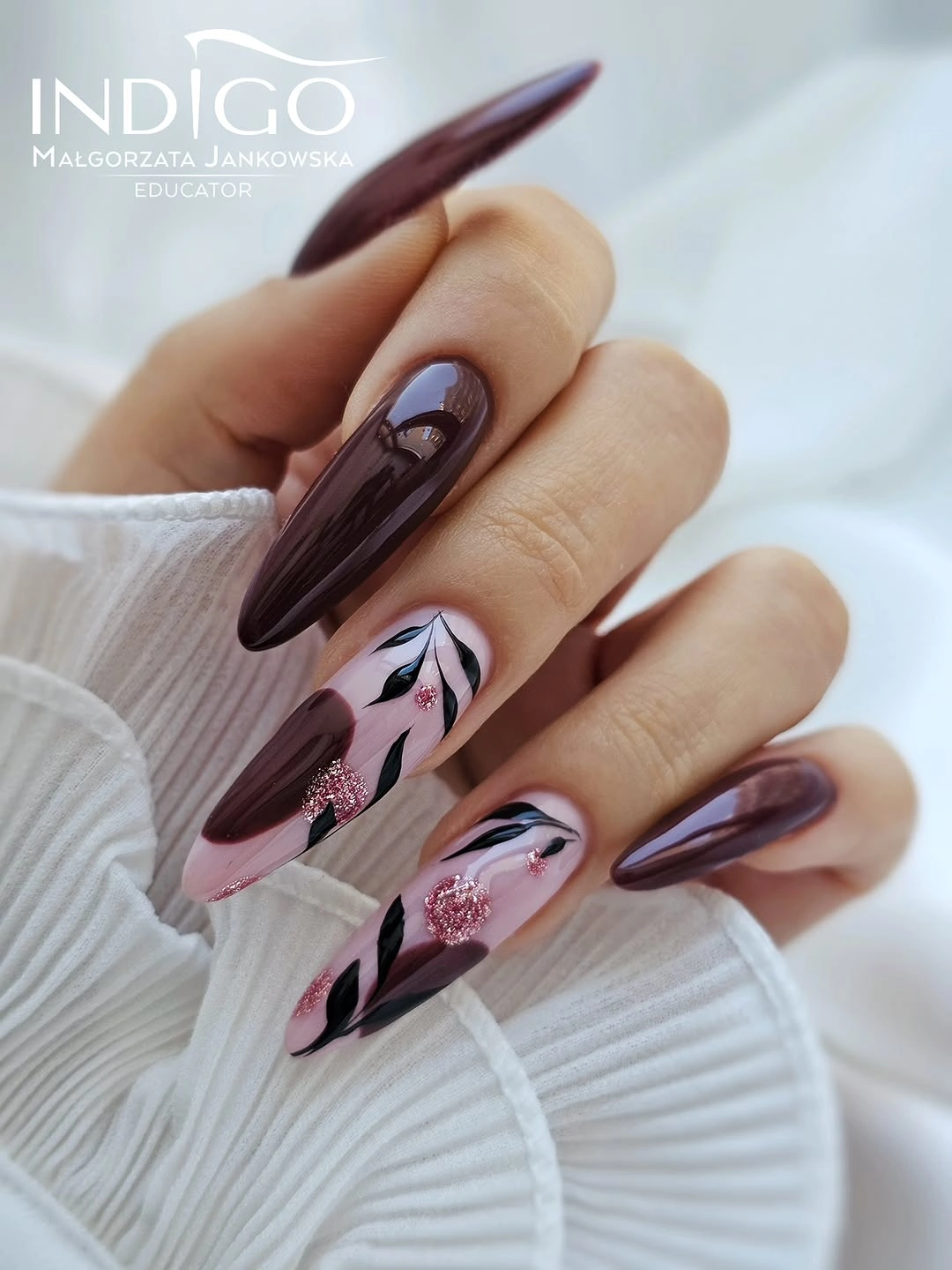
Use one pale accent nail beside several plum solids if you want the design to feel more wearable, or transfer the same contrast to a medium almond. A muted rose or warm nude can replace the pale pink without changing the role of the accent. Cream, black, chocolate, dusty rose, and white clothing will support the two-value structure without competing with the leaf shapes.
Leaf lines need a light field around them, especially when the nail is narrow and the surrounding solids are very dark. If the length is reduced, keep the motif toward the center and remove the smallest rose marks first. The set works because dark repetition makes the pale accent meaningful, so adding more light nails would lessen the visual consequence of that detail.
Brown-black gloss with copper reflection
Medium almond nails close the dark collection with a glossy brown-black surface and warm copper reflections that appear as narrow vertical bands. The undertone is the key detail: in shadow the nails look nearly black, but the warm highlight keeps them from reading as flat charcoal. The shape is long enough to show the reflection as a direction, yet compact enough to remain a practical reference for a dark solid.
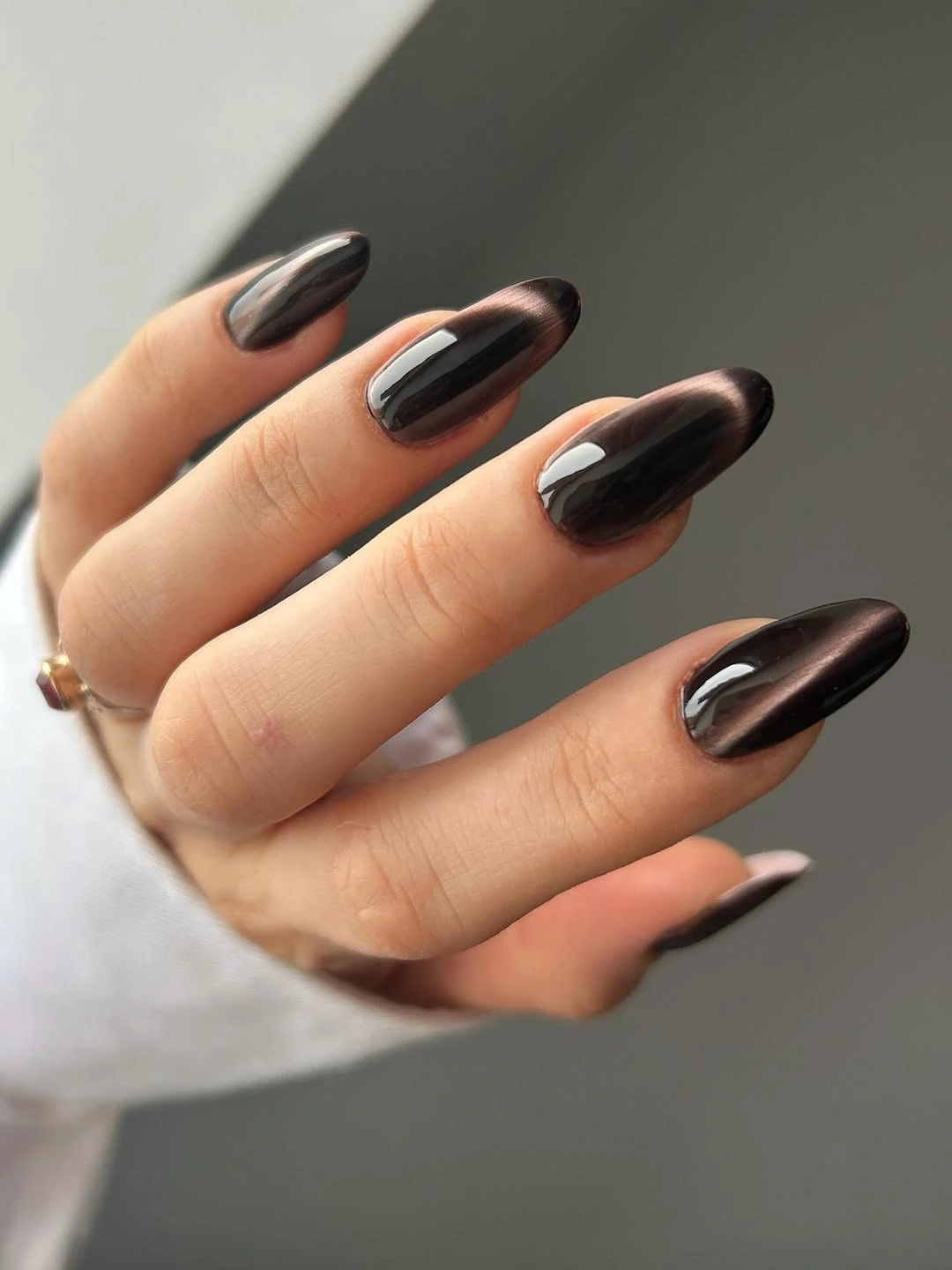
Keep the copper reflection on two nails and use a plain deep brown on the rest for a subtler adaptation, or move the color to a short oval. A rounded square would make the warm band more graphic, while a longer almond would pull it into a stronger sweep. The shade pairs with cream, camel, black, bronze, denim, and burgundy, giving the manicure several fall-friendly directions.
Warm reflection can disappear if the surface is covered with extra decoration, so leave the brown-black field uninterrupted. On a shorter nail, a small central band is enough to show the undertone; widening it will make the design look striped rather than reflective. The final balance depends on the quiet tension between an almost-black edge and a copper flash, and that relationship should remain visible.