The quickest way to make a manicure feel early-fall is not to reach for brown. It is to let one proportion change carry the season: a compact shape can hold a bright edge, a tapered nail can turn one saturated color into a deliberate line, and an open base can make a tiny botanical mark feel more considered than a full print. The effect comes from deciding where the eye should stop, not from adding every seasonal cue at once.
Think of each design as a question of visual weight. When color is solid, the outline has to do the balancing; when the motif is small, the empty base becomes part of the design; when the nail is longer, the taper can become the detail. A shorter point, a narrower tip, or one reserved accent can therefore change the whole reading while keeping the original idea intact and practical for real hands.
Lime and orange with tiny autumn botanicals
A compact rounded shape carries a surprisingly active palette here: one nail is a fresh lime green, another is vivid orange, and the remaining nails leave a pale base open for tiny leaf and pumpkin-like marks. That distribution gives the solid colors enough space to act as anchors instead of turning the manicure into an all-over print. The shorter length also keeps the sharp color changes readable without needing a long canvas.
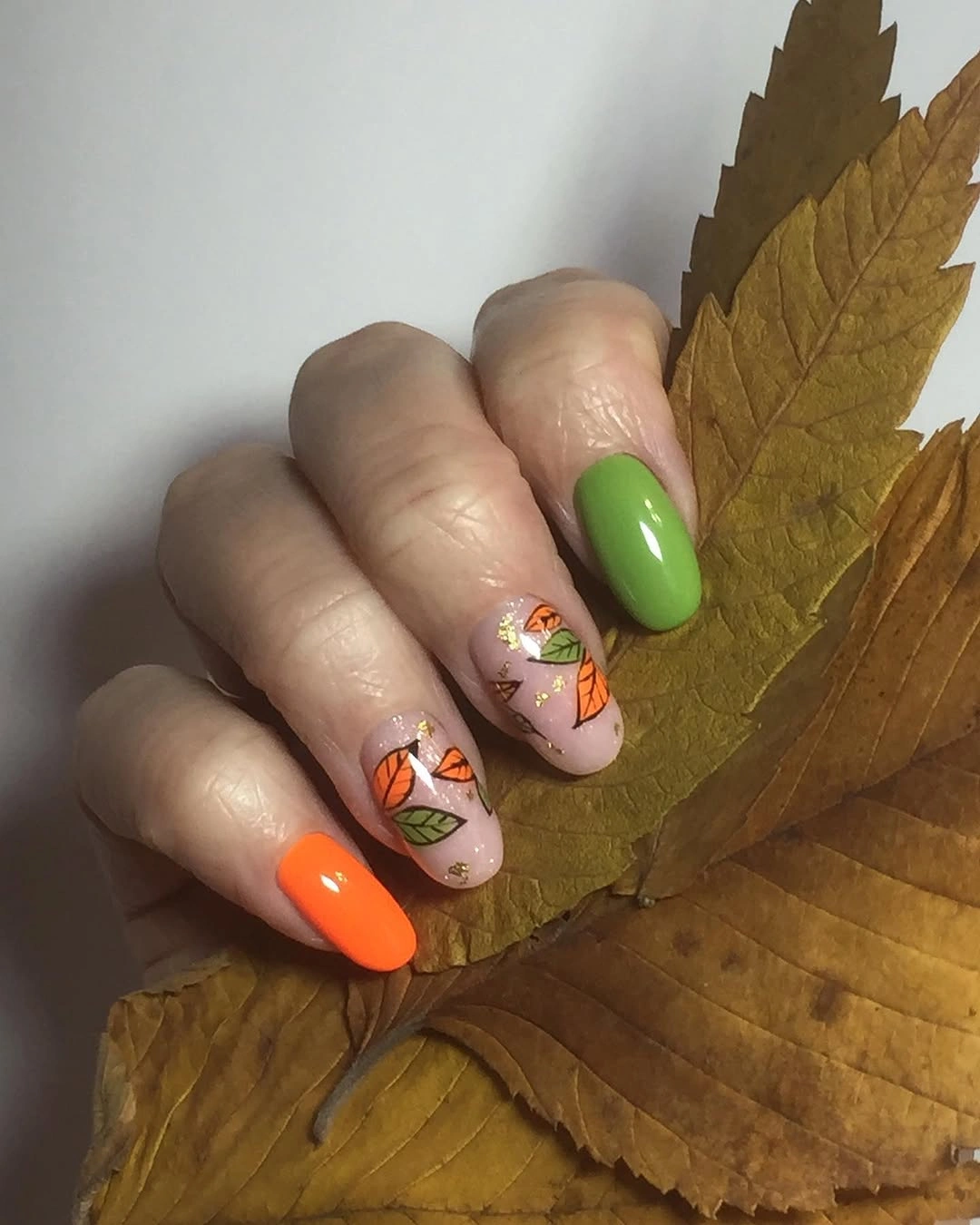
For a quieter version, keep the lime on one finger, repeat the orange only at the tip, and place the botanical drawing on a single accent nail. A rounded square can preserve the compact feeling, while a slightly longer oval would soften the contrast if the bright blocks feel too direct. The open pale nails will sit comfortably beside denim, cream knits, or a brown jacket without requiring an exact color match.
The small drawings are the part most likely to lose definition as the nail gets shorter or as several marks are placed together. Give each leaf room around it and let the two solid nails carry the color story. That keeps the design legible even if the seasonal motif is simplified, and it means the overall effect depends on proportion rather than on reproducing every tiny line.
Glossy cobalt on a long almond silhouette
Long almond nails in saturated cobalt blue make a single color feel directional because the tapered shape narrows the visual field toward each tip. The glossy surface creates broad reflected highlights, so the manicure reads as a smooth, uninterrupted color statement rather than a collection of separate details. The length is doing real work: it gives the intense blue room to look sleek instead of simply bright.
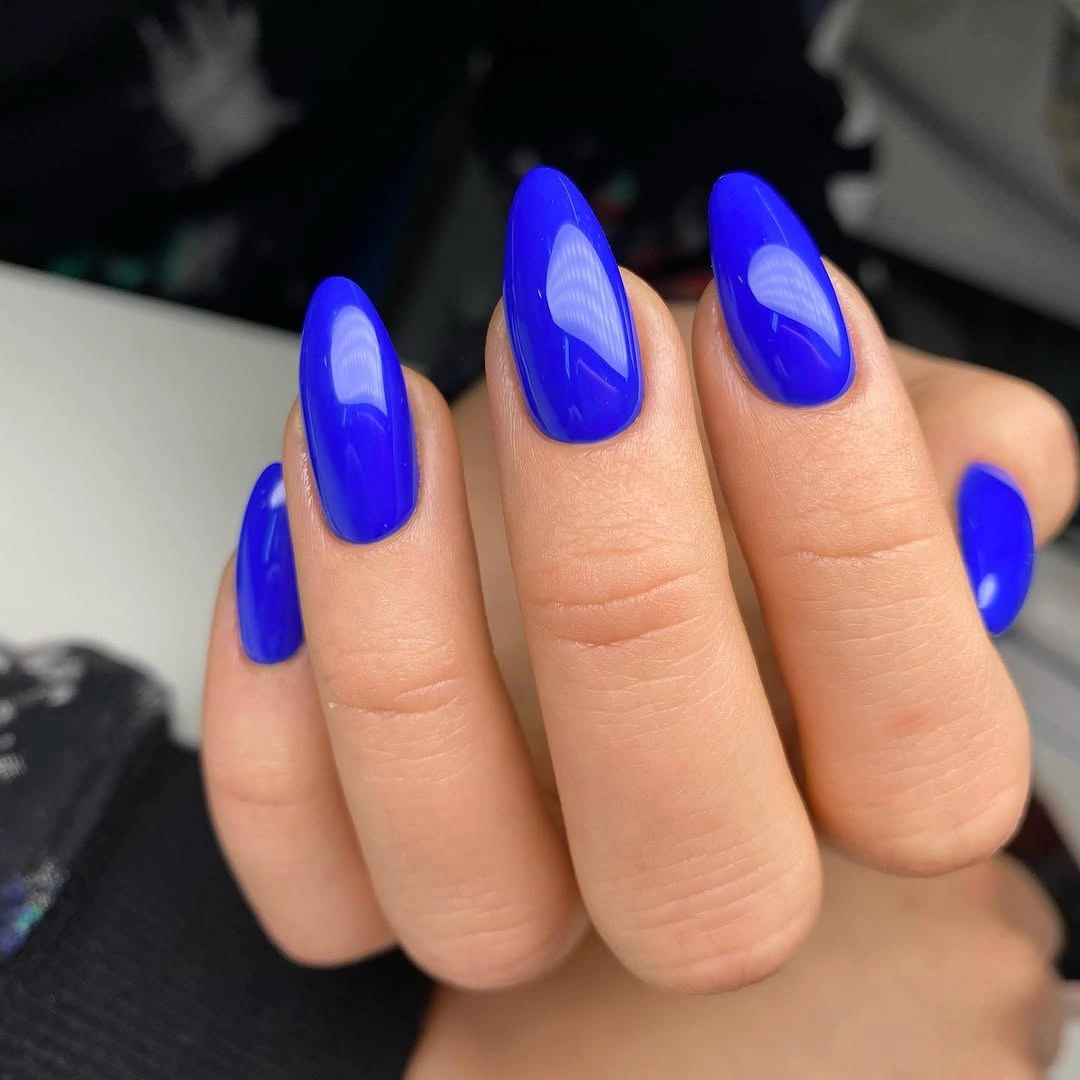
If the shade feels too dominant for daily wear, keep the cobalt on two or three fingers and use a sheer neutral on the rest, or move the same color onto a medium almond. A softer oval would reduce the directional point while keeping the saturated center of attention. Silver jewelry, gray clothing, black, and washed denim can support the cool blue without competing with it.
Long pointed edges make a one-color manicure visually elegant but less forgiving of snags and accidental contact, so the proportion should match your routine. A shorter almond will lose some of the dramatic taper but gain practicality, and the glossy finish will still provide enough movement through reflected light. The important choice is keeping the blue surface clean and the silhouette even.
Sheer pink with black micro French edges
Short natural-length nails use a sheer pink center and narrow black edges, with a few silver highlights and fine leaf-like strokes near the sides. Because the darkest value stays at the perimeter, the base remains open and the compact shape does not look crowded. The design is graphic, but its thin lines make it lighter than a full black manicure and allow the natural proportions of the nails to remain visible.
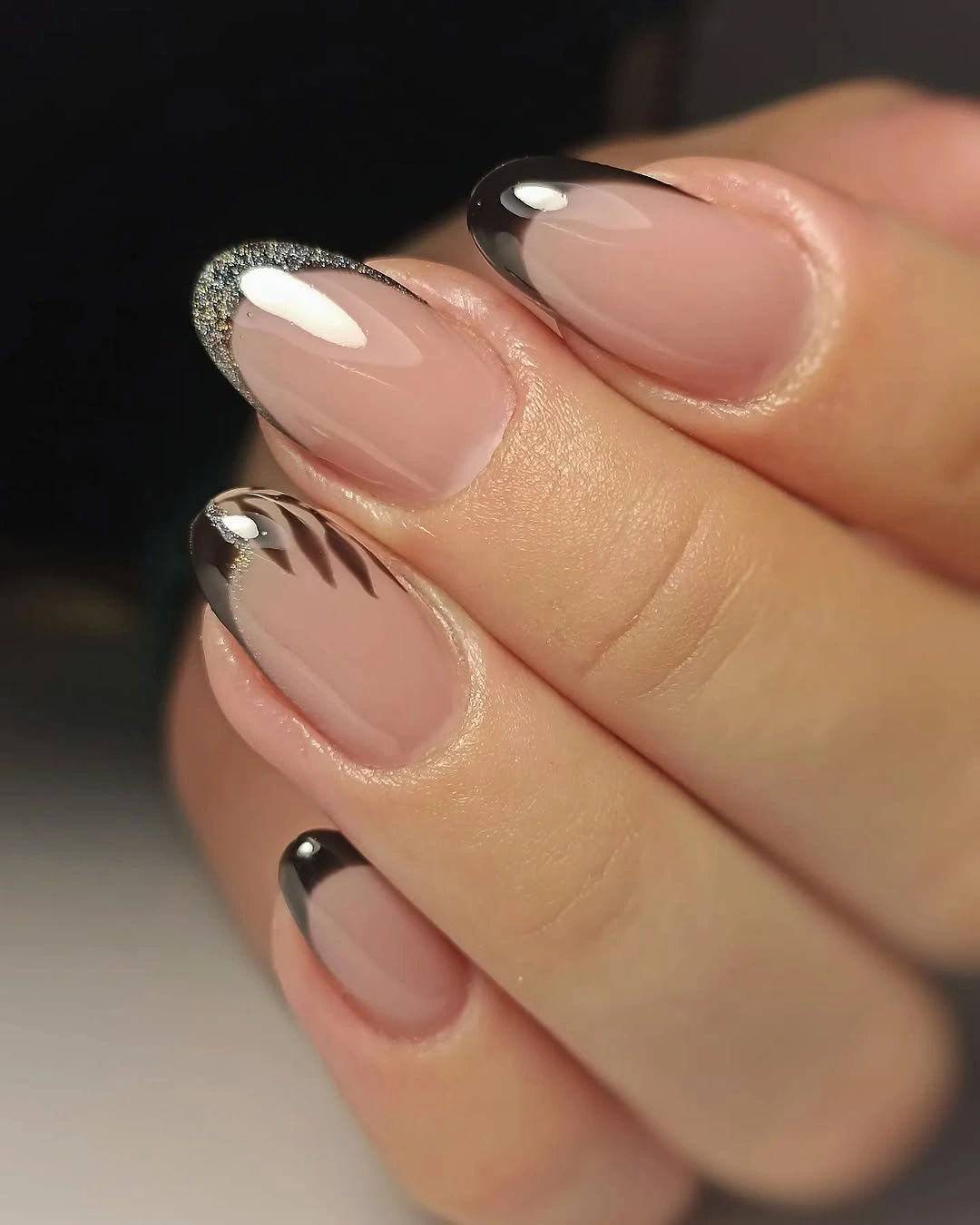
To adapt the idea to a very short square, make the edge thinner and use the botanical stroke on one or two nails rather than every finger. A soft oval would make the border feel gentler, while a crisp square would emphasize the geometry of the black line. The restrained palette works with silver jewelry, white shirts, charcoal layers, or a bright scarf because the dark detail acts as a small frame rather than a competing block.
Micro French lines depend on spacing more than on decoration, and uneven width will show quickly against a sheer base. Leave the center calm and avoid adding extra marks simply because the surface is available. If the edge begins to look heavy as the nail grows, narrowing the line or refreshing only the perimeter will preserve the original proportion better than covering the whole nail.
Lavender squares with a single floral accent
A medium rounded-square set makes pale lavender the main structural color and reserves the floral drawing for one light accent nail. The solid lavender fingers establish repetition, while the small pink and white flower breaks that repetition without changing the overall scale. The softened corners keep the color block approachable, and the accent remains legible because it is not competing with several other motifs.
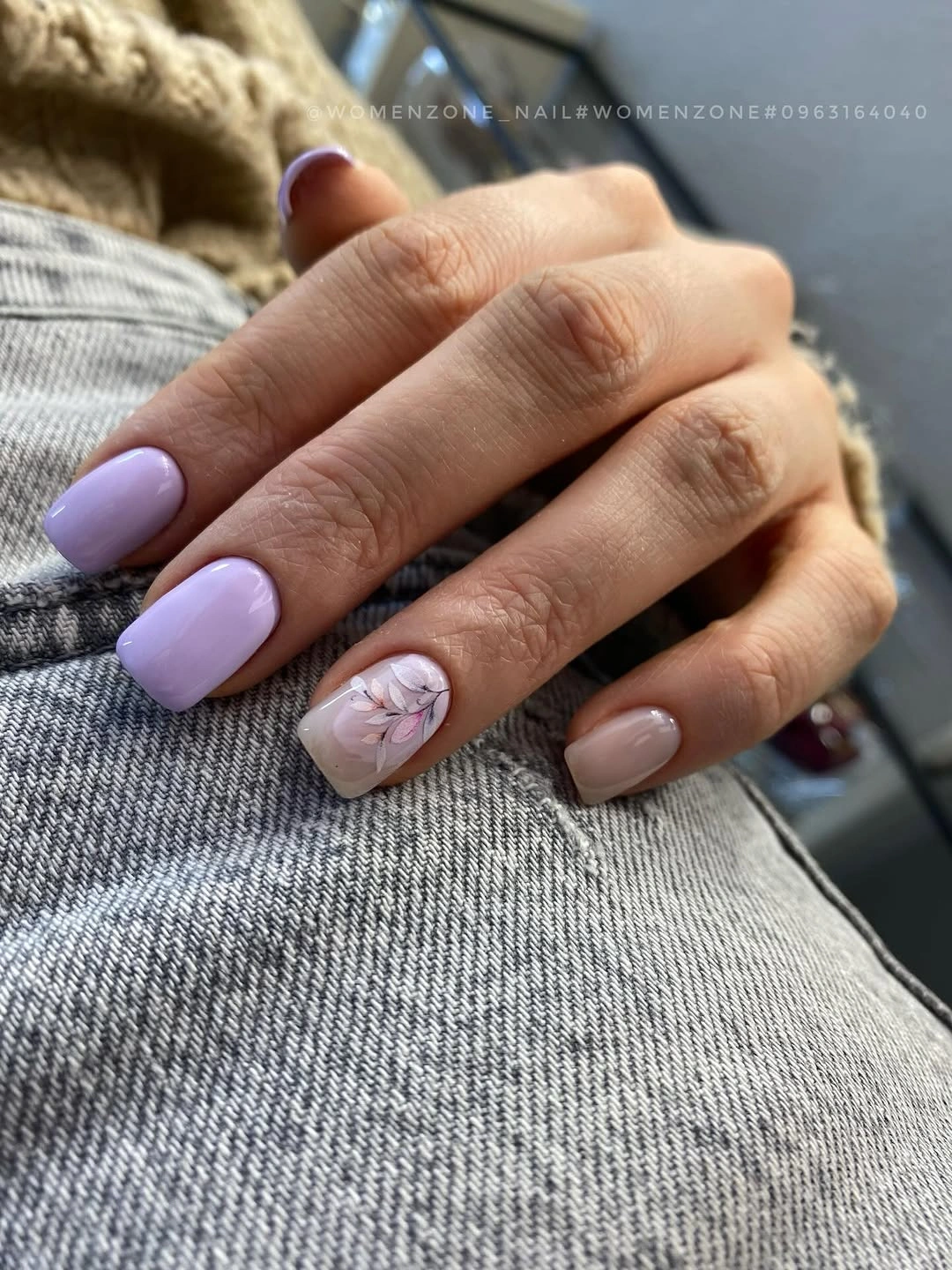
Keep the lavender on most fingers if you want the same calm rhythm, then move the flower to the ring finger or reduce it to two petals on a shorter square. A pale pink base can replace the accent nail without changing the proportion, while a darker plum flower would add contrast if the lavender looks too quiet. This palette pairs easily with gray knitwear, white, denim, and muted rose tones.
The advantage of concentrating the drawing is practical as well as visual: one detailed nail is easier to keep crisp than a full set of tiny petals. If the length is reduced, widen the open area around the motif instead of shrinking every line. The manicure works because the decorative finger has a clear role inside a repeated shape, so the accent should stay distinct rather than multiply.
Chocolate solids with warm curved accents
Medium almond nails balance glossy chocolate-brown solids with warm nude nails that carry small orange-brown curves near the tips. The dark fingers create a clear anchor, while the lighter ones interrupt the depth of the palette and make the set feel transitional rather than fully dramatic. Almond taper keeps the brown color elongated, so the manicure looks rich without relying on a large amount of surface decoration.
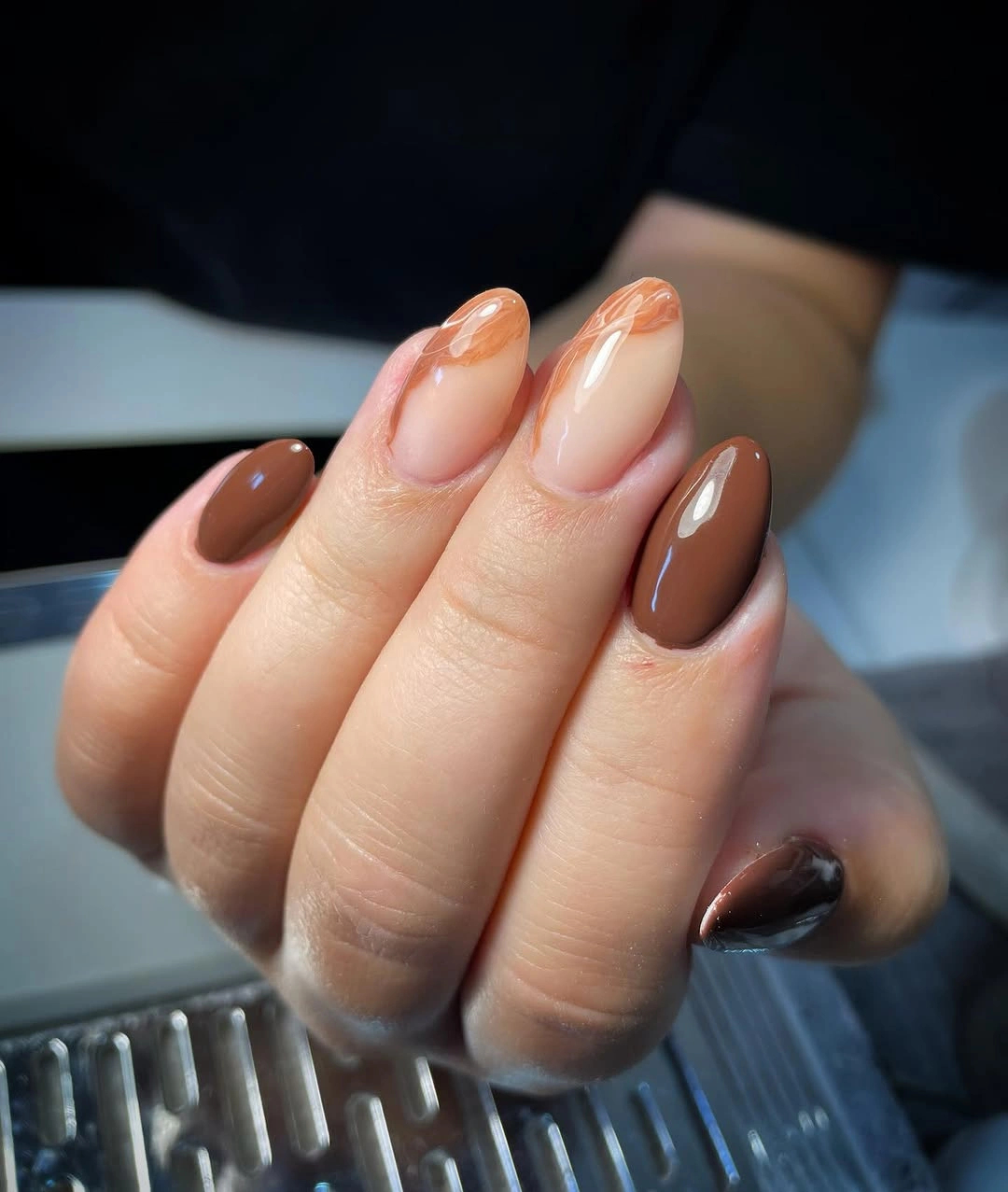
For a more compact interpretation, use the chocolate on the thumb and two central fingers, then place one curved accent on a nude square. A caramel or muted terracotta can replace the orange detail while keeping the warm relationship intact. The design sits naturally with cream, rust, olive, brown, and soft black, but the nude spaces also leave room for a lighter outfit to remain the focus.
Glossy dark color shows edge wear more clearly than a pale base, particularly on a tapered nail that catches the light along its sides. Keep the curved marks simple and let the brown fingers provide the contrast instead of adding more ornament. If maintenance time is limited, the tonal pairing still reads after the tiny accents are reduced, which is a useful quality for an early-season manicure.
Yellow French tips with small dark leaves
Short square nails turn a familiar French structure into an early-fall palette by placing sunny yellow across the tips and adding dark leaf-like marks over a sheer nude base. The color sits at the outer edge, so the square outline remains visible and the bright band feels intentional rather than bulky. A few darker lines supply direction and stop the yellow from reading as a simple summer-only block.
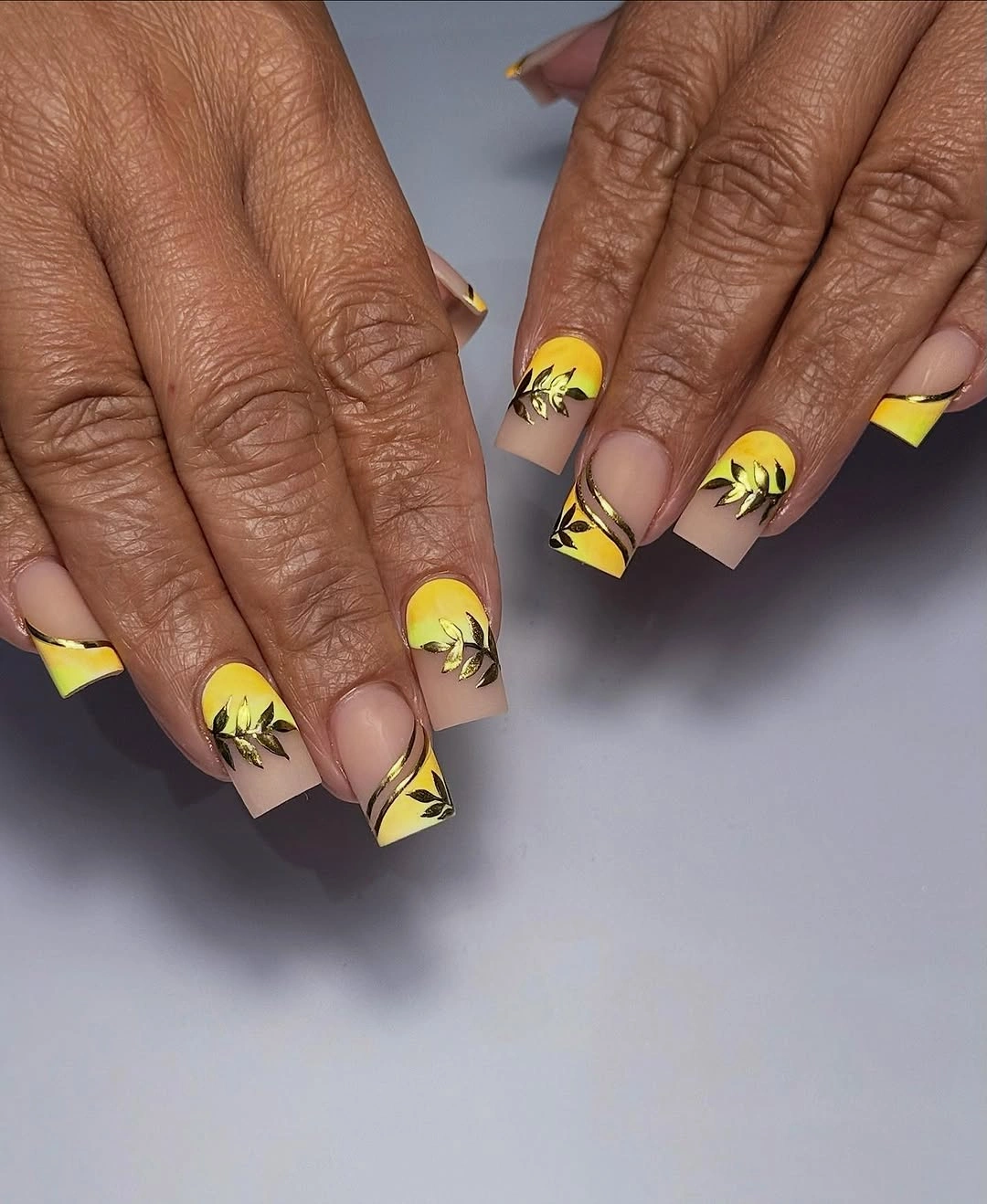
If a full yellow tip is too strong, narrow it to a slim band or use the color on alternate fingers while keeping the dark marks on one accent nail. A rounded square would soften the straight edge, whereas a slightly longer square would give the yellow more room to register. Pairing the set with camel, chocolate, cream, or washed olive lets the color bridge late summer and cooler layers.
The success of the design depends on the band staying even enough to make the tips look deliberate. Tiny leaves should not be placed so close to the edge that they disappear into the yellow, and they do not need to cover every finger. Leave the base open where possible; that negative space provides the visual pause that keeps the bright tips from overwhelming a short shape.
Burgundy, ivory, and leaf-lined accent fingers
A medium rounded-square manicure uses deep burgundy as the main weight, then opens two fingers into milky white and nude areas with burgundy and black leaf motifs. The repetition of the dark color gives the set a stable frame, while the accent nails introduce movement through curved stems rather than through a change in length. Because the motifs sit on lighter ground, their scale can stay small and still read clearly.
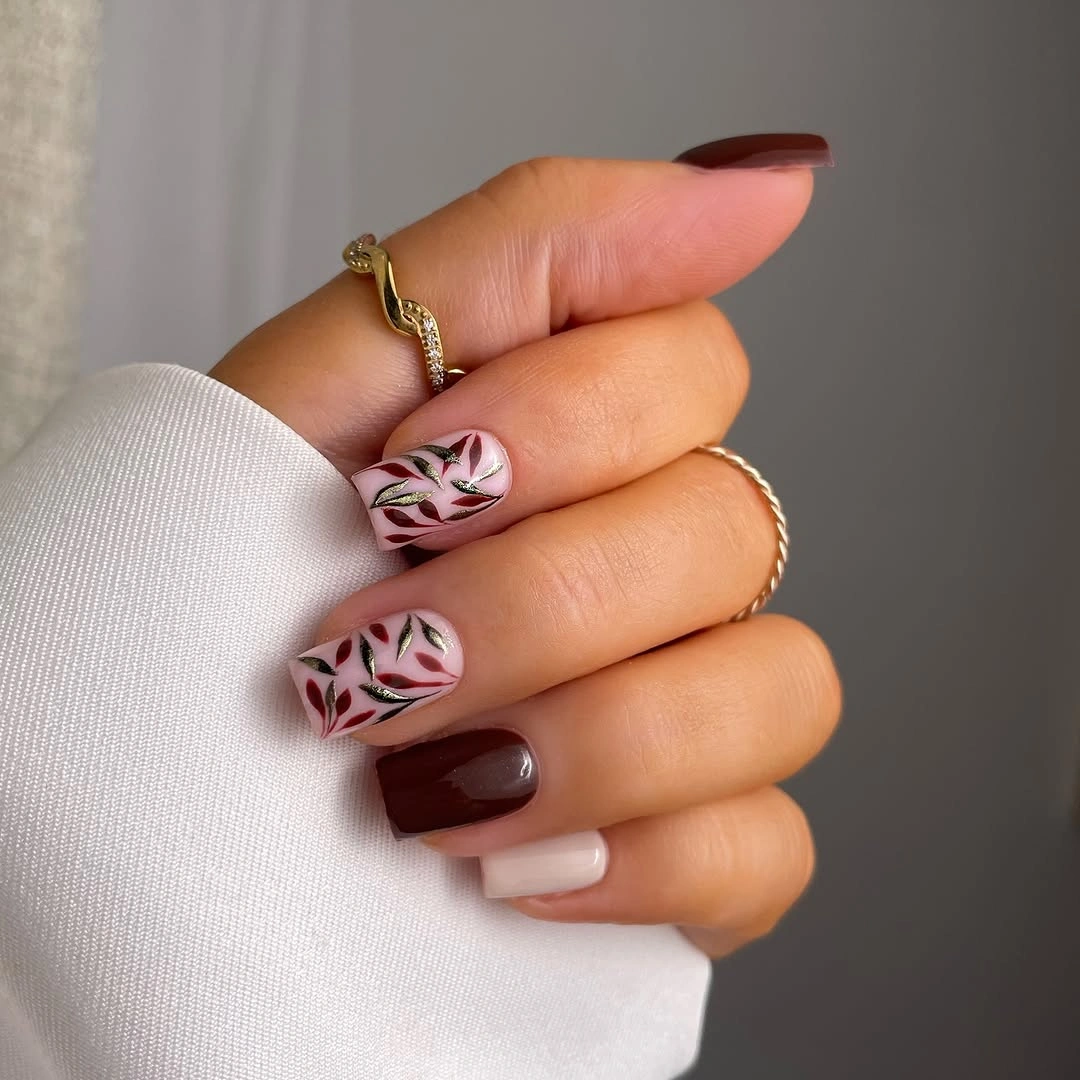
To make this practical on a shorter square, keep one burgundy solid and one leaf-lined accent, using a single stem instead of a full cluster. A warm beige base would preserve the contrast if milky white feels too bright, and a muted wine can soften the relationship between the solid and patterned fingers. The design works with black, cream, denim, and brown because the burgundy already acts as the connecting color.
Leaf motifs have more impact when the stems follow the nail rather than stopping abruptly at the sidewall. If the set begins to look dense, remove a few leaves before changing the whole palette. The structure is strongest when the solid burgundy fingers carry the visual weight and the lighter accents provide direction, so the pattern should support that hierarchy rather than compete with it.
Wine squares with botanical linework
Glossy wine red anchors this medium square manicure, while nude accent nails hold black botanical lines and a trace of metallic sparkle. The square tips give the deep shade a firm, horizontal finish, and the open accent fingers prevent the set from becoming a single dark wall. Fine linework supplies vertical movement across the nail, which balances the width of the square without needing a longer shape.
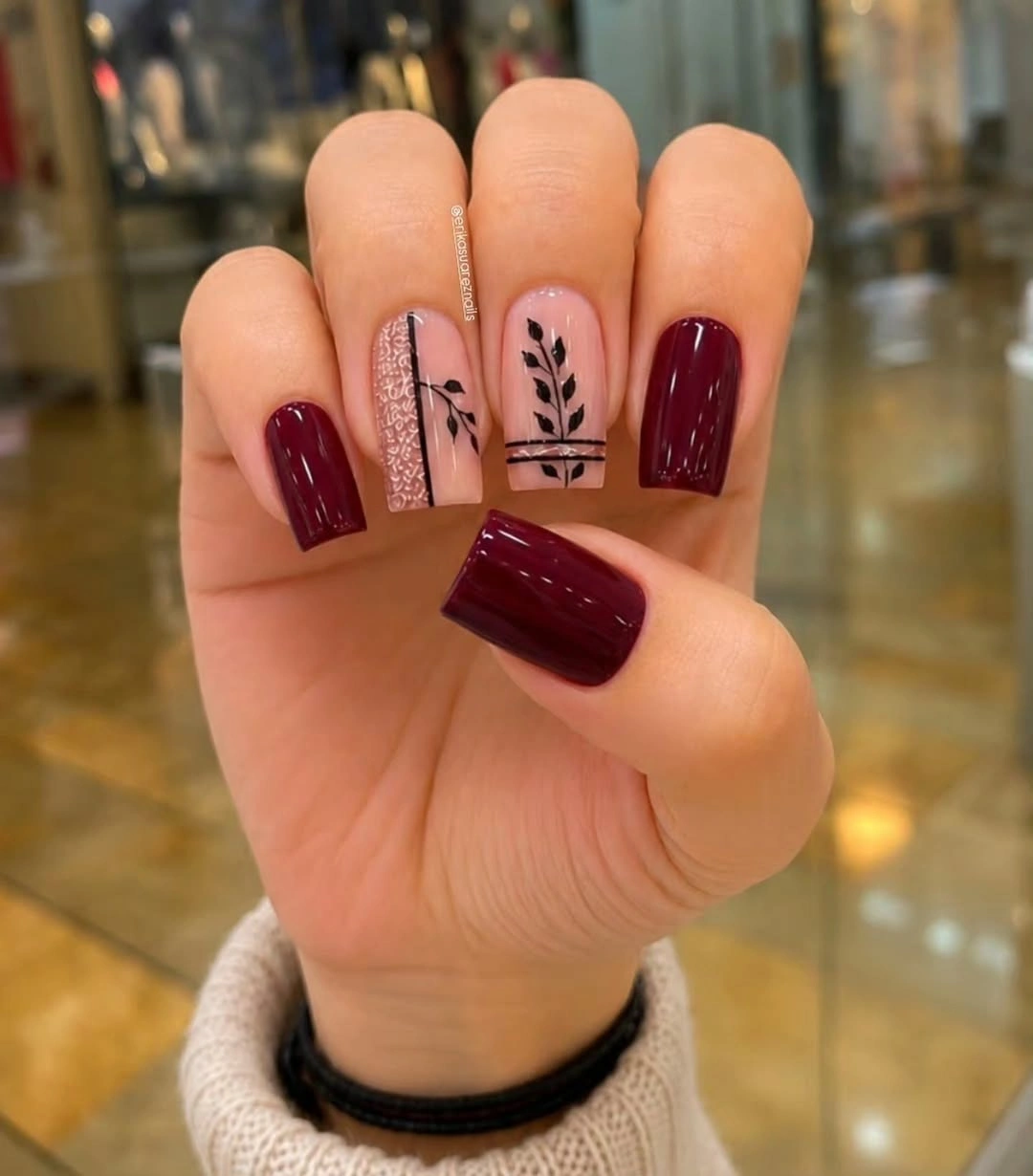
A shorter square can use the wine on three fingers and keep one nude accent with only a single branch. If you prefer a softer proportion, round the corners slightly and shift the linework toward the center so it does not crowd the edge. The color feels at home with cream knitwear, black, muted gray, and denim, while a small metallic detail can echo jewelry without turning the set into formal nail art.
Deep red polish makes the clean edge more noticeable, so the manicure benefits from consistent length and a simple accent layout. Metallic sparkle should remain a supporting note; too many reflective marks would erase the contrast between the solid and open nails. When the set grows out, a fresh nude base on the accent fingers can restore the visual spacing without changing the burgundy anchor.
Glitter-edged almond nails with soft flowers
Long almond nails pair a soft pink base with orange-gold glitter along the French edges and pale floral details across selected fingers. The glitter follows the taper, so it reinforces the length instead of sitting as a disconnected horizontal stripe. A mostly translucent center leaves the surface airy, while the warm edge gives the manicure a seasonal shift that is visible even when the floral marks stay delicate.
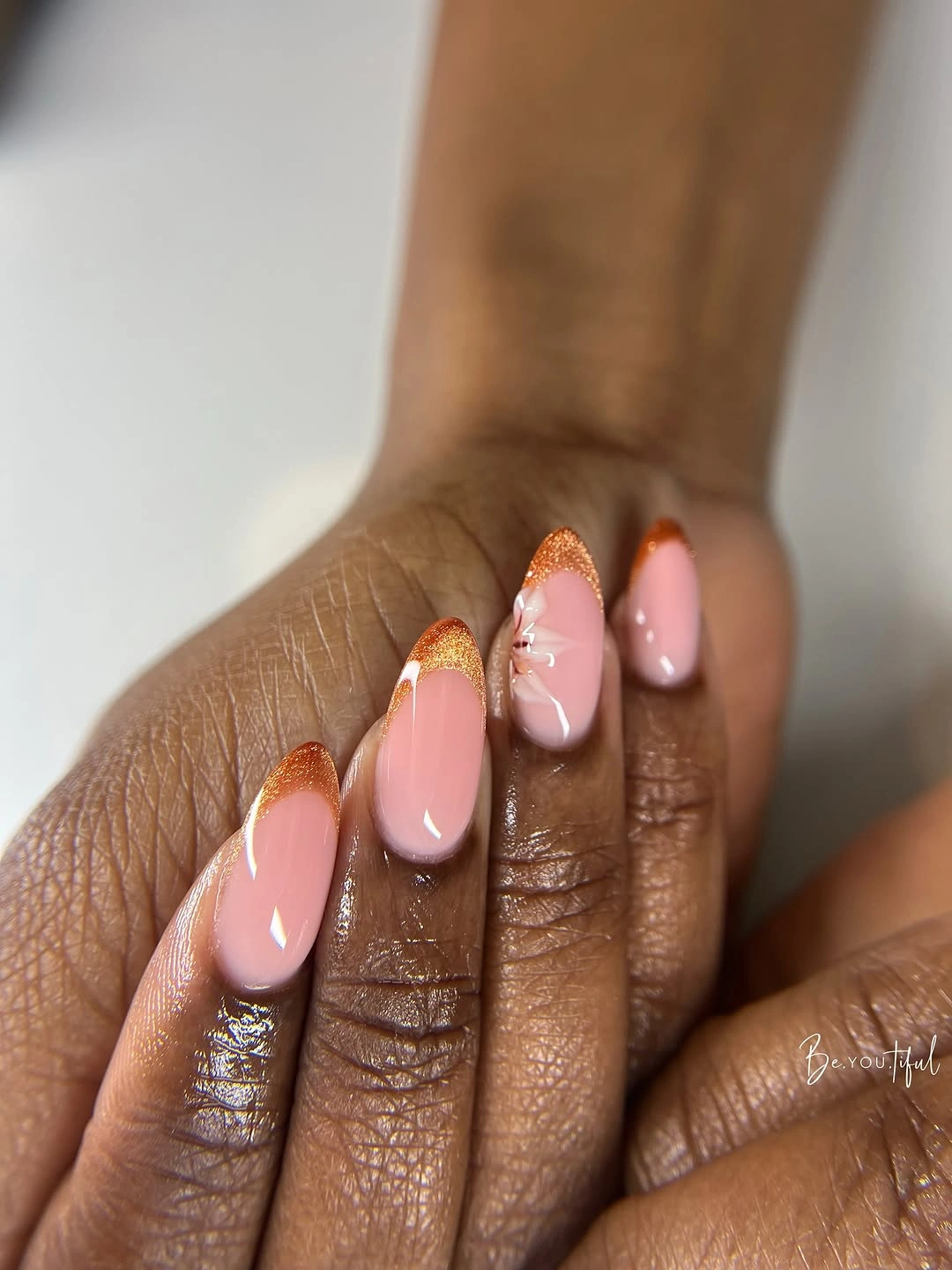
For a wearable version, keep the glitter edge on two nails and use a thin warm orange line on the rest, or transfer the same placement to a medium almond. A rounded tip would make the floral accents feel sweeter, while a sharper point would emphasize the directional edge. The pink, orange, and gold combination sits well beside cream, rust, brown, and soft gray without requiring a fully coordinated outfit.
Glitter and small flowers create two focal points, so spacing is important on a narrow almond surface. If the length is shorter, let the French edge remain slim and remove some petals rather than squeezing them into the center. The design is at its best when the glitter frames the shape and the flowers act as a quiet interruption, not when every available area is equally bright.
Playful mismatched color blocks and tiny motifs
This compact rounded set takes early-fall nails in a playful direction, mixing pink, coral, lilac, checkerboard blocks, flowers, and small cartoon-like marks across the fingers. The variety is held together by the short shape and by repeating bright values, so the manicure feels intentional even though no two nails carry the same exact design. The result is energetic rather than polished into uniformity, which is part of its appeal.
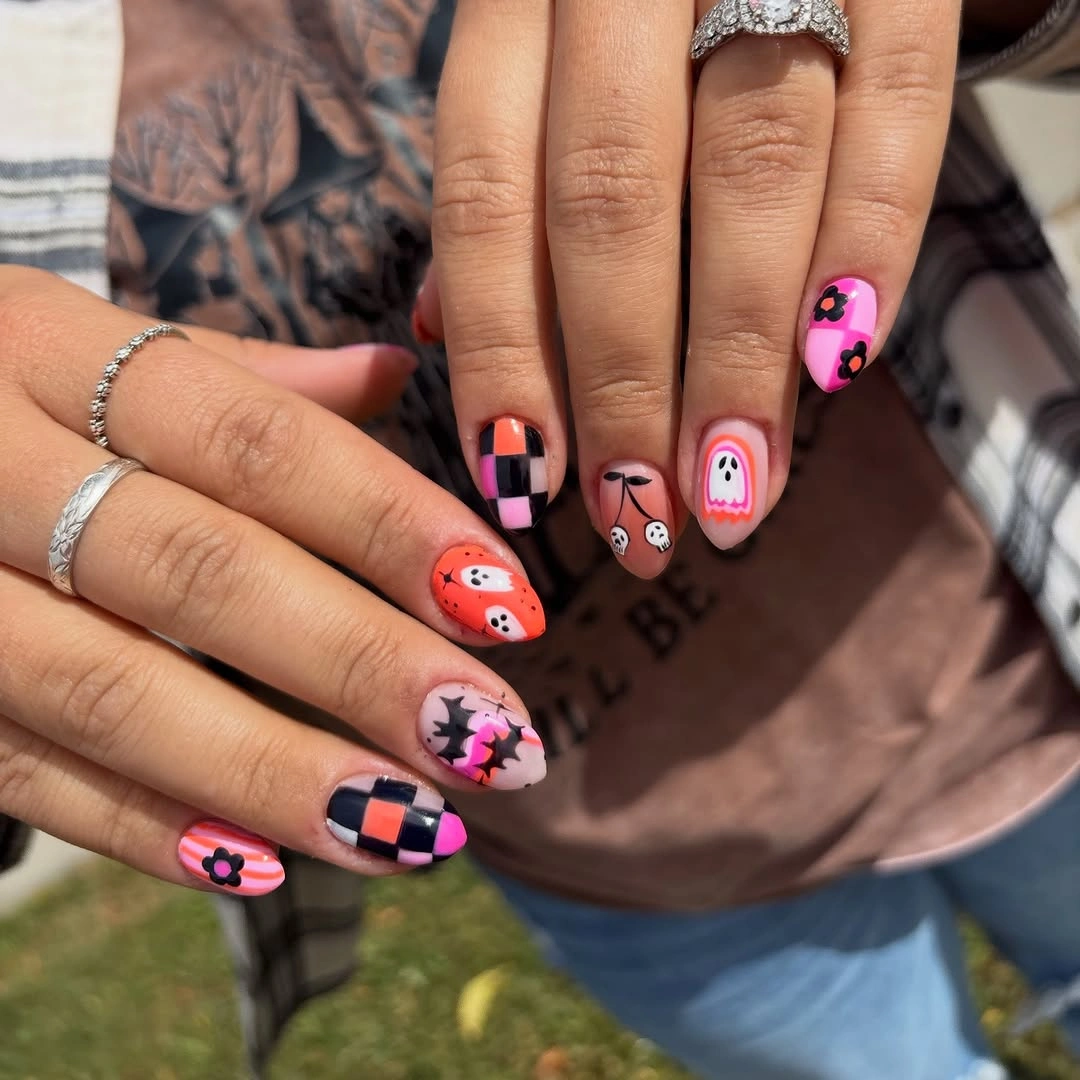
To reduce the visual noise, keep the checkerboard on one accent nail and repeat the coral on two solid fingers, leaving the remaining nails sheer. A short square will give the blocks more structure, while a rounded oval would soften the cartoon details. This direction works best with simple clothing colors – black, white, denim, or one matching bright – so the manicure can remain the focal point.
Many small motifs need a clear hierarchy or they begin to merge when the nail is viewed from a normal distance. Choose one graphic idea, such as the checkerboard or the flower, and let the other marks become supporting dots or lines. The short length is a practical advantage here because it keeps the mixed set contained; adding more length would require more deliberate spacing, not simply more decoration.
Orange edging with one raised red flower
Short rounded-square nails use a sheer nude base with orange edging and one prominent red flower accent, photographed against a warm knit texture. The design feels seasonal because of the color placement rather than because every nail is covered in a fall symbol. The raised-looking flower supplies a single point of physical and visual emphasis, while the compact outline keeps the rest of the set quiet.
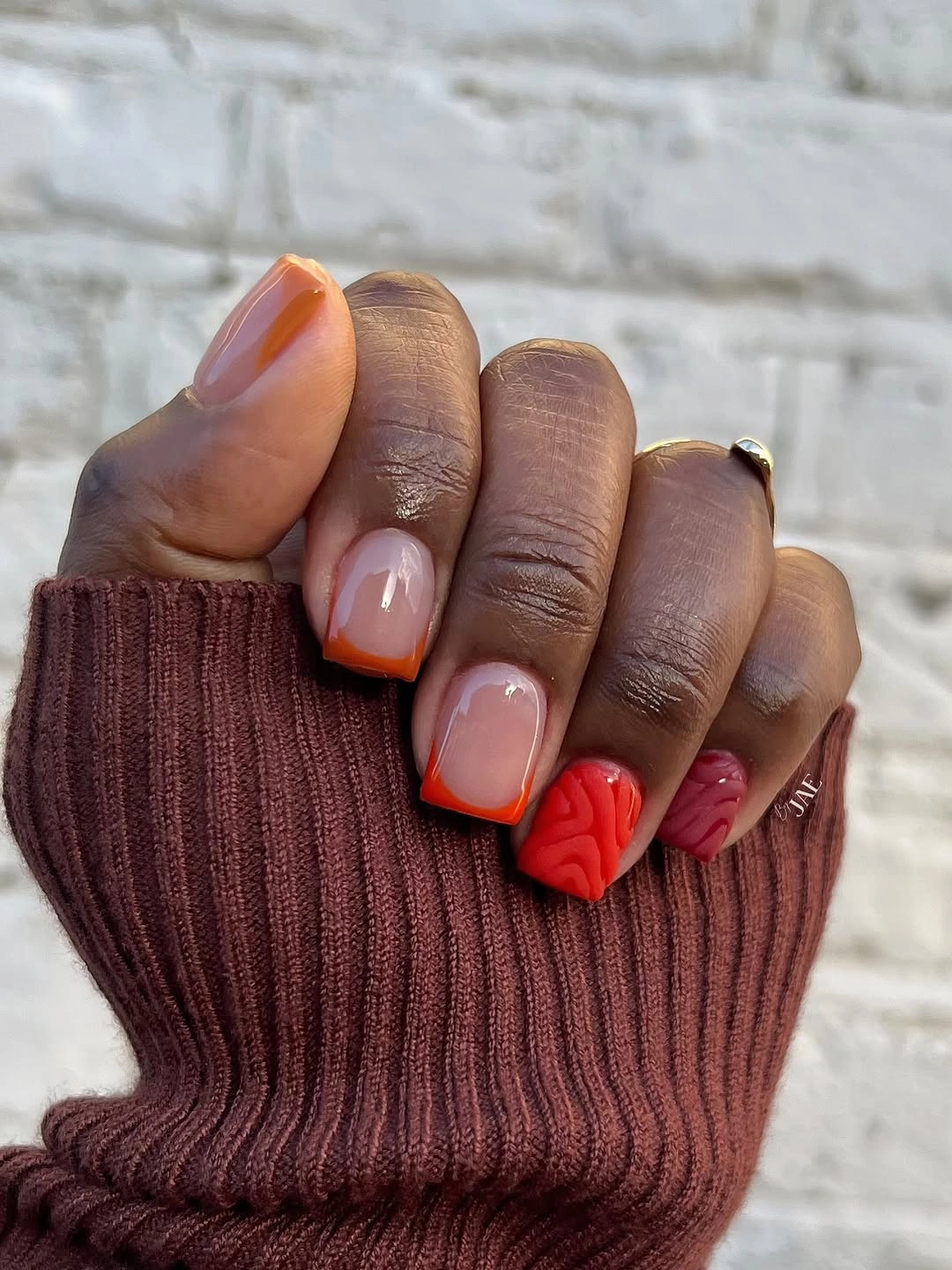
For a simpler adaptation, keep the orange at the tip on two or three nails and use a flat red flower on one accent finger. A short square will preserve the graphic border, while a small oval may make the flower feel less angular. Pairing the manicure with brown, cream, rust, or soft gray repeats the warmth of the knit background without requiring the clothing to mirror every accent.
A raised detail can catch on fabric or lose its crisp outline sooner than a flat mark, so its placement matters more than adding additional texture. Keep the flower away from the busiest edge and allow the nude base to remain visible around it. That empty space is what makes the single accent feel deliberate, and it also gives the manicure room to grow out without becoming visually crowded.
Teal almonds with floral and jeweled accents
Long almond nails divide the color story between solid teal and pale nude accents with small flowers, blue-green stones, and a slim glitter edge. The saturated teal fingers act as broad anchors, while the decorated nails carry more information in a lighter value. This contrast makes the length feel organized: the solid fingers establish the silhouette, and the accents add detail without spreading it evenly across the entire set.
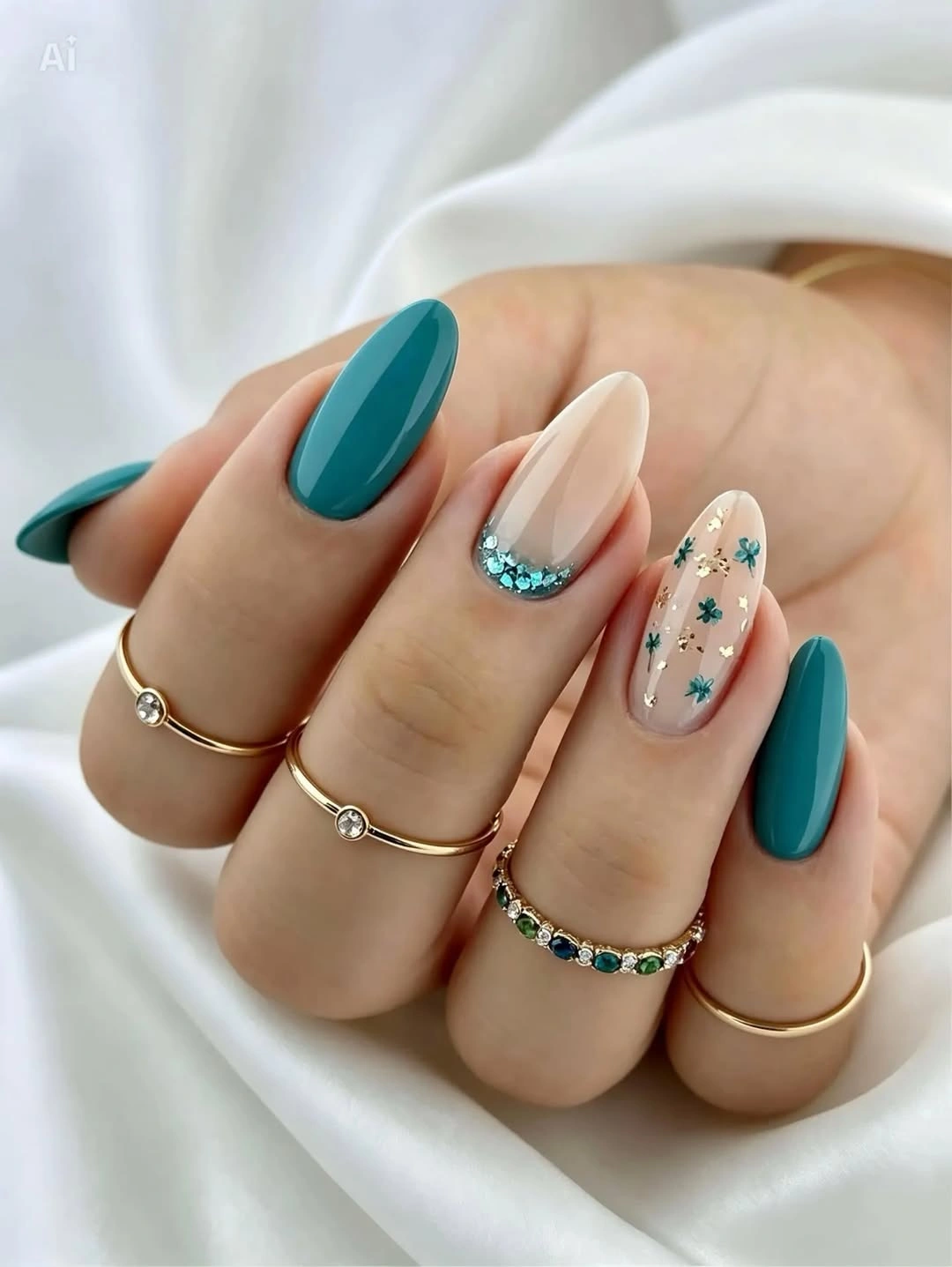
A medium almond can carry the same relationship if the teal remains on two nails and the jeweled detail is reduced to a small cluster on one. For less contrast, replace the pale base with a muted blue-gray or use a plain nude without the flowers. The combination pairs naturally with white, denim, charcoal, silver jewelry, and cool green layers because the teal already provides a clear focal color.
Long pointed lengths give stones and fine flowers more room, but they also make the contrast between the solid and decorated nails more visible as the set grows. Keep the embellishment concentrated and check that each accent still has open space around it. The manicure does not need extra sparkle everywhere; its proportion works because the teal blocks remain the first thing the eye reads.
Autumn botanical sprigs on translucent almond nails
Long almond nails use a translucent nude ground so red, orange, and gold botanical sprigs can remain the main feature. The motifs travel along the length of each nail rather than forming a single heavy band, which keeps the pointed silhouette visible. Warm colors repeat across the set, but the open base prevents the design from becoming opaque or overly dense.
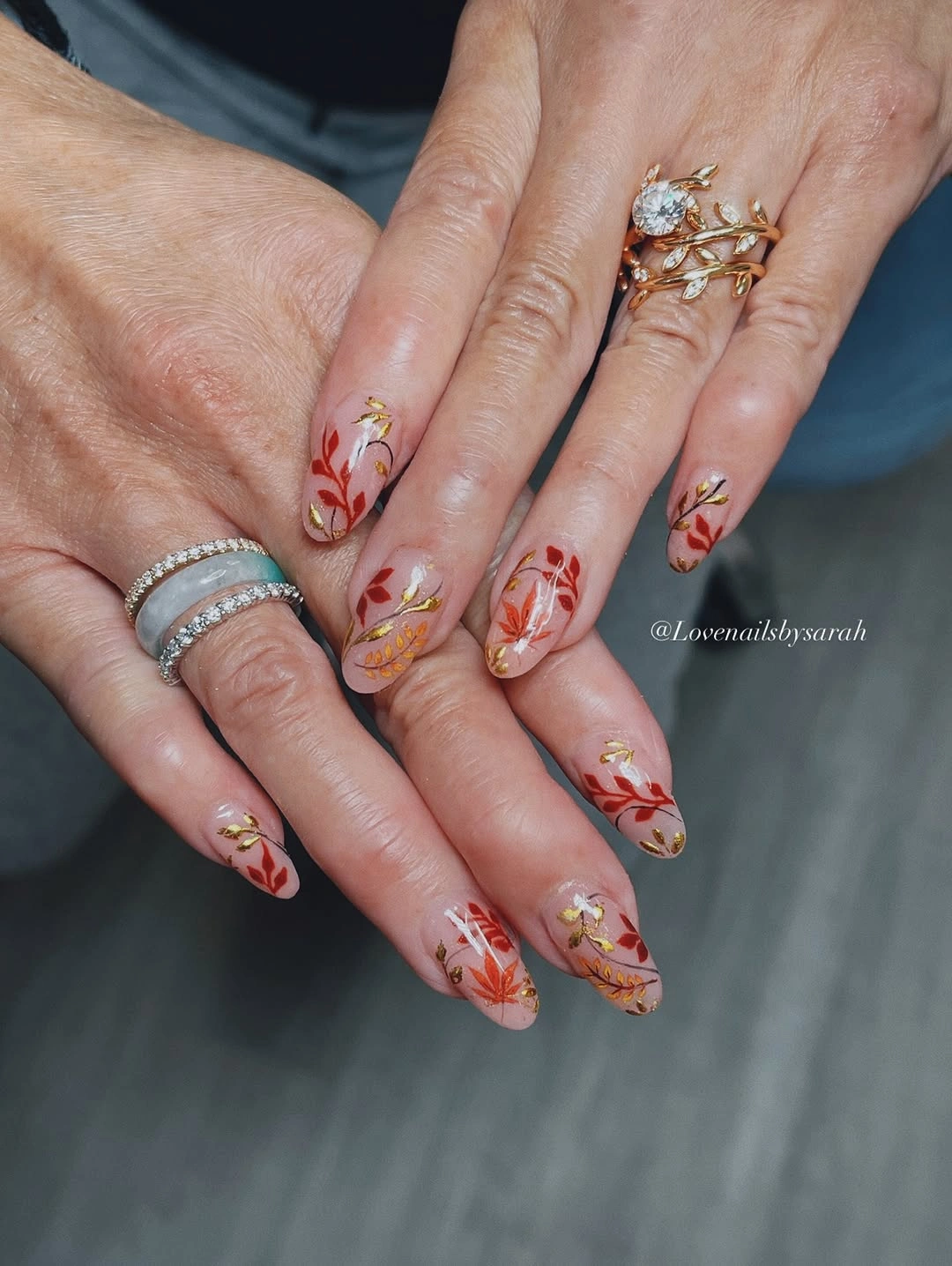
On a shorter almond, use one sprig near the tip and leave the remaining nails as a warm nude or a single muted red. A rounded almond would make the foliage feel softer, while a longer point would emphasize the vertical movement. The palette can sit beside cream, camel, rust, olive, and burgundy, and the translucent background helps it work with both light and dark clothing.
Fine stems need breathing room, especially when several warm colors are layered on one nail. If the leaves begin to crowd one another, remove a mark or shorten the branch rather than filling the open base. The seasonal impression comes from the relationship between the warm motif and the clear space around it, so preserving that ratio matters more than copying every visible sprig.
Black and white graphic points on nude
Long almond nails turn a nude base into a sharp graphic design by placing black and white shapes at the tips and along selected side edges. The dark points create direction, while the pale center keeps the manicure from becoming a full black statement. Because the motif follows the taper, it lengthens the eye line and makes the almond silhouette feel especially deliberate.
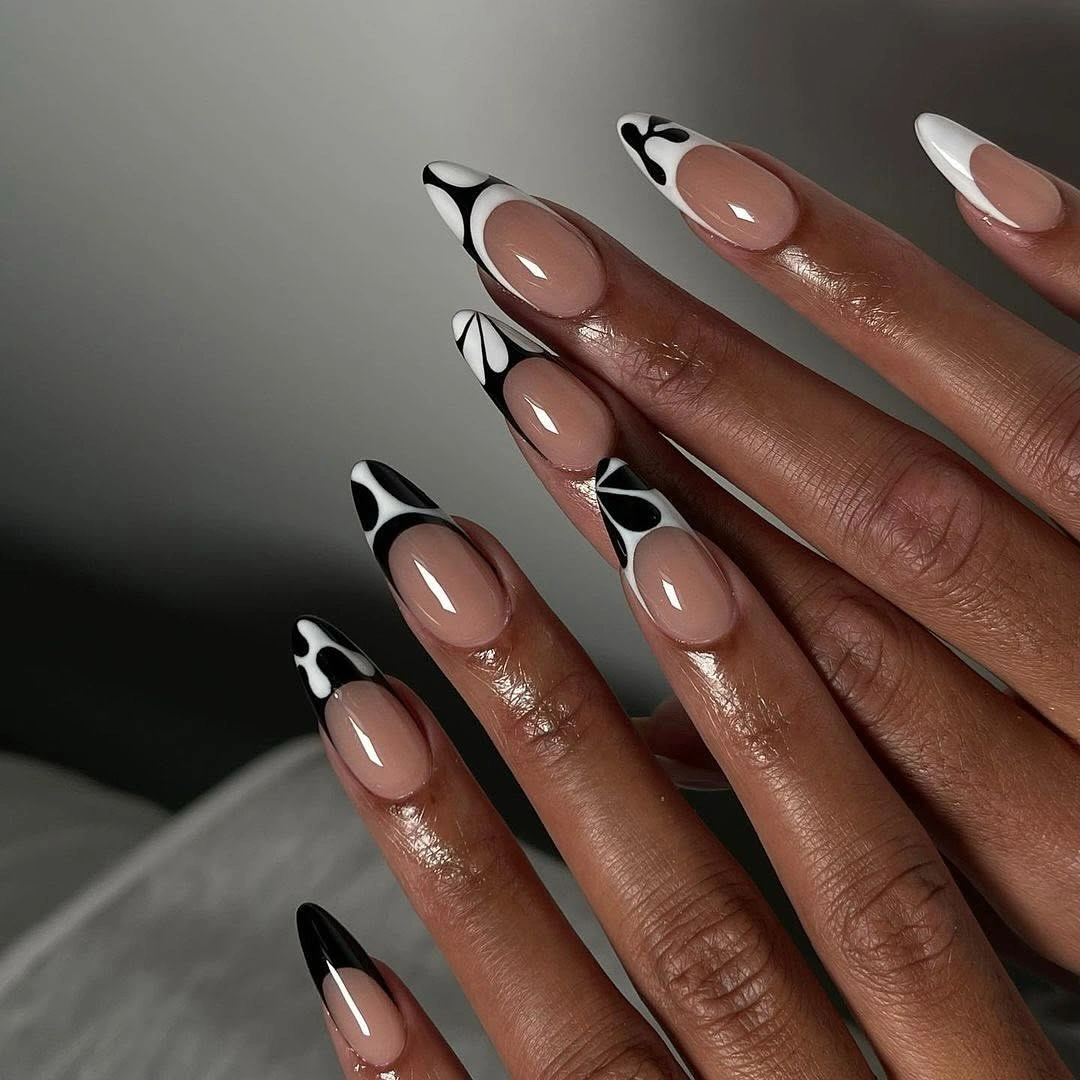
For a medium almond or shorter square, keep the black at the tip and replace the side accents with one white line on two nails. A softer brown-black would lower the contrast without losing the structure, while a sheer pink base would preserve the open center. This design pairs well with monochrome clothing, tailored layers, denim, or a single red accessory because the nail already carries a clear graphic rhythm.
High contrast makes small placement errors easy to notice, particularly when the black point changes direction from nail to nail. Use fewer shapes on a shorter surface and let the nude area do more of the work. The cleanest result comes from treating the black and white as a frame for the almond outline, not as a reason to cover every part of it.
Burgundy tips with tiny autumn flower marks
Long almond nails combine burgundy tips, one solid wine finger, and pale bases carrying small orange and brown botanical marks. The deep edge gives the set a clear focal boundary, while the flowers add seasonal information without taking over the whole nail. The pointed length makes the tips feel elongated, but the lighter center keeps the manicure balanced instead of visually bottom-heavy.
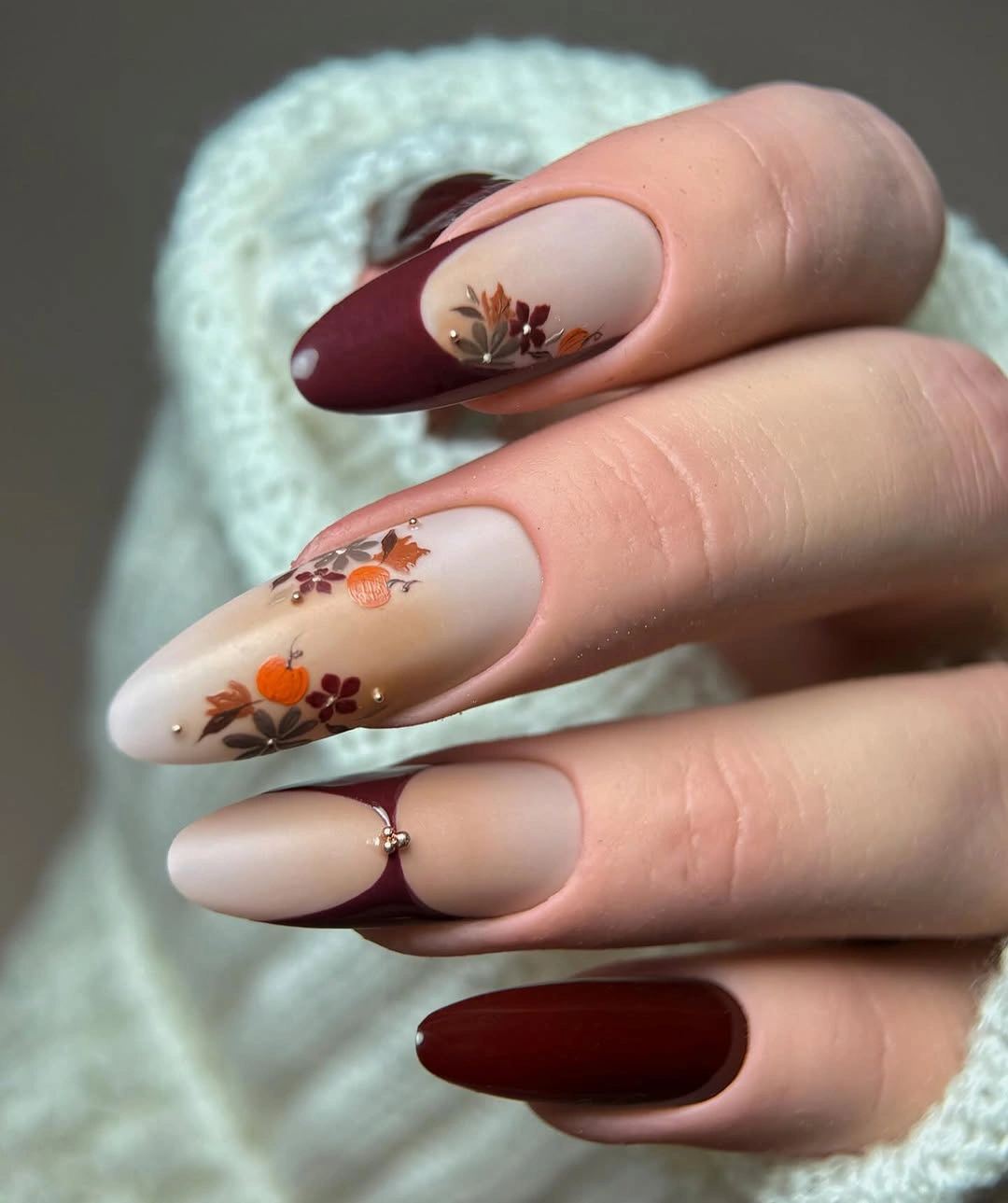
Use the burgundy as a narrow French edge on a medium almond, then limit the flowers to one or two nails for a more wearable version. A rounded shape would make the design less directional, while a square could turn the burgundy into a stronger horizontal block. Pairing the palette with cream, chocolate, muted orange, or pale pink will repeat the warmth without making the whole look dark.
Decorative marks near the tip should remain distinct from the burgundy border, otherwise the two details flatten into one busy band. Keep some pale base visible between the flowers and the edge, especially if the nail is short. The set works because solid wine, framed tips, and tiny motifs have separate jobs; keeping those jobs separate preserves the visual hierarchy.
Fresh lime green on compact square nails
Short square nails use a glossy pale lime green across the entire set, letting color and proportion carry the design without any motif at all. The compact square gives the bright shade a neat boundary, while the reflective surface keeps the single-color manicure from looking flat. A black heart-print layer behind the hand makes the green appear even fresher, but the manicure itself remains clean and self-contained.
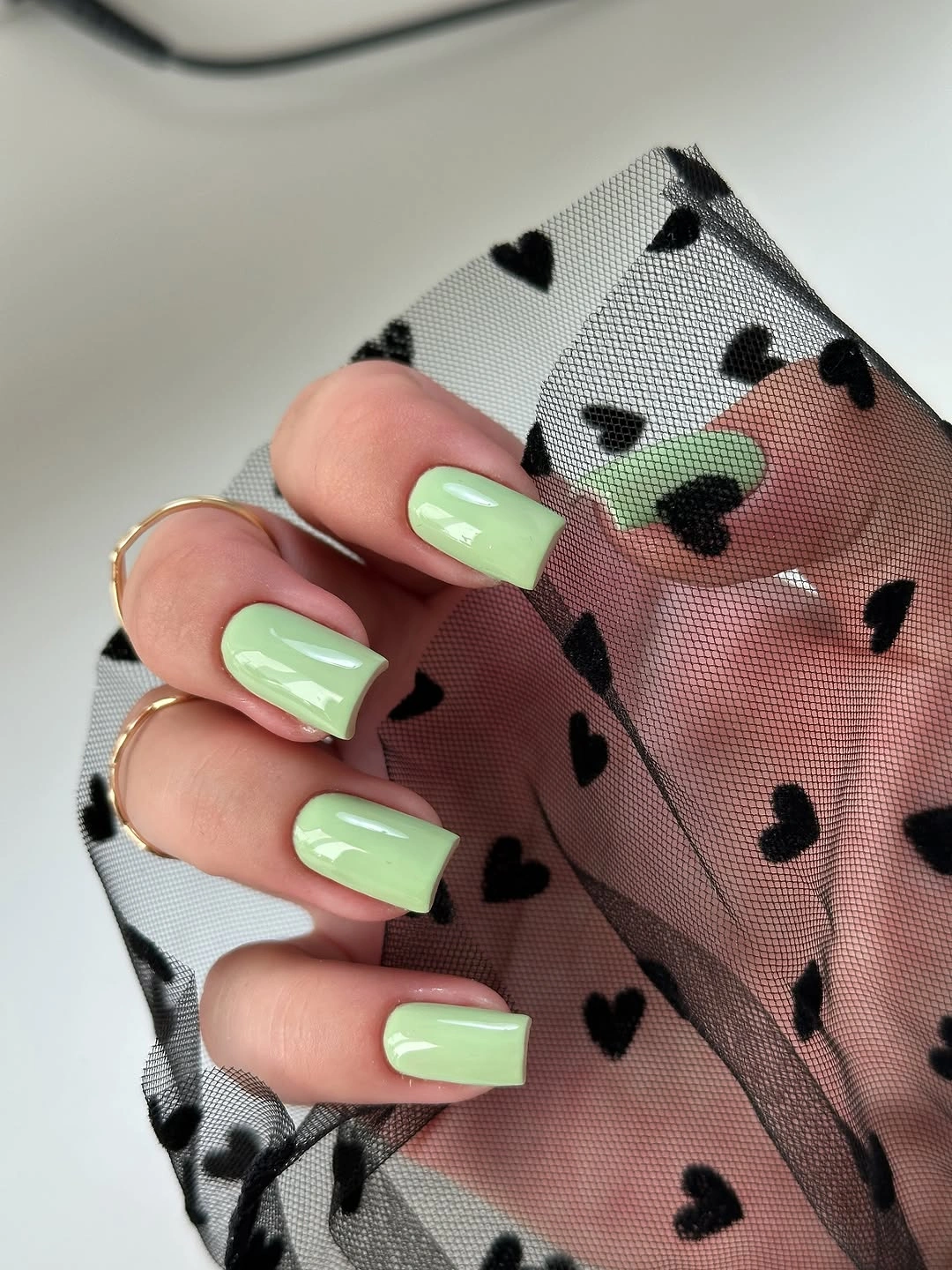
If a full lime set feels too vivid, use it on two or three fingers and repeat the shade as a thin French edge on a sheer base. A short rounded square will soften the corners, while a medium square will make the block more graphic. The color can sit beside black, white, denim, brown, or a muted floral print; the simpler the clothing, the more intentional the green reads.
Bright solid color benefits from an even shape because there are no accents to distract from uneven width or length. Keep the corners consistent and resist adding extra decoration merely to make the set more seasonal. The strongest adaptation is often a controlled reduction – fewer lime nails, a narrower band, or a shorter length – because the visual identity comes from the color block itself.
Neutral squares with colorful autumn accents
Medium square nails begin with a neutral base and add small orange, green, and blue accents, including floral details and bright tips on selected fingers. The underlying shape remains broad and stable, while the color appears in compact areas that give the set a collected, late-summer-to-fall feeling. Because the accents are scattered rather than repeated as one uniform band, the manicure has movement without losing its square structure.
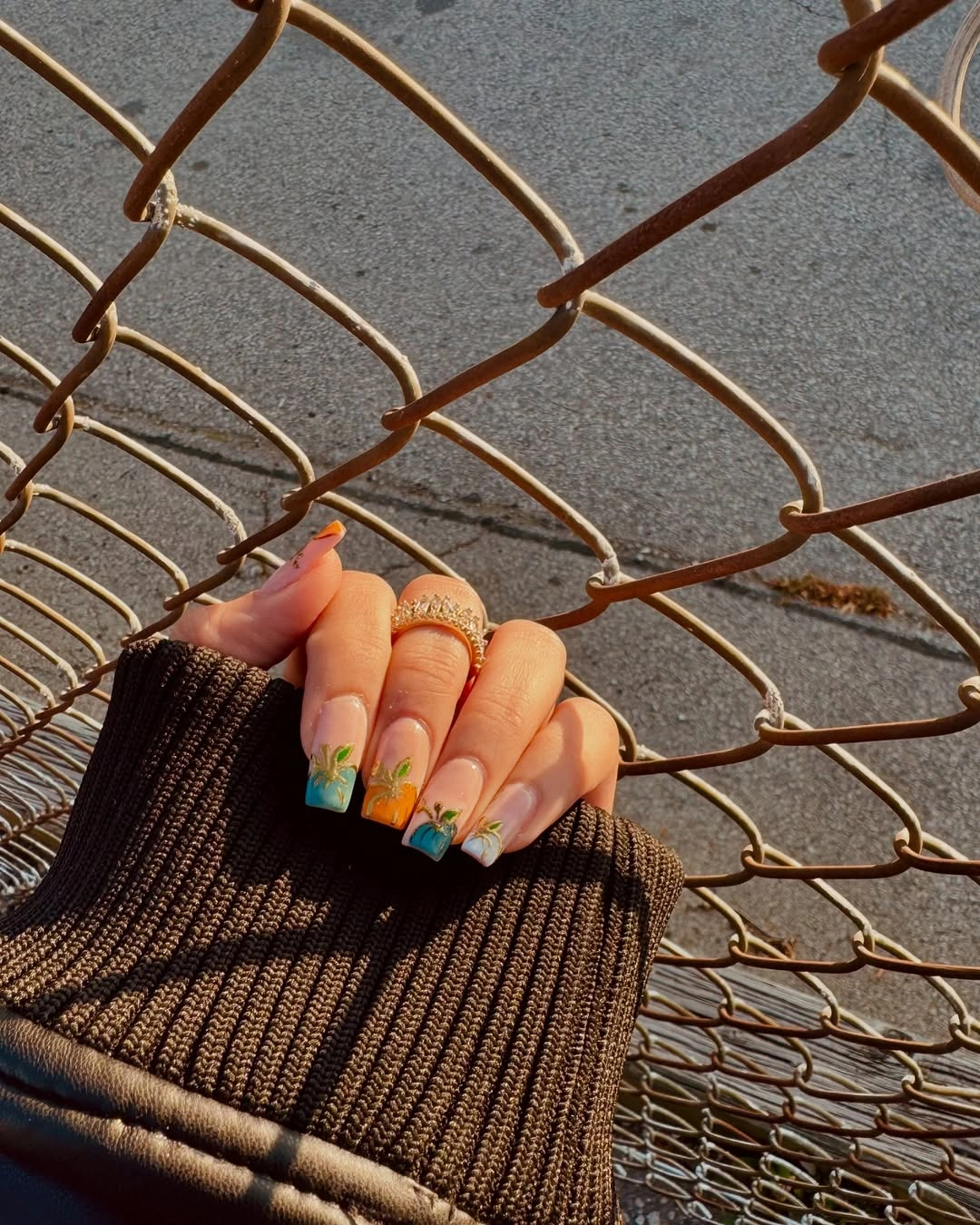
For a shorter version, keep the neutral on most fingers and choose one orange accent plus one green or blue detail. A rounded square will make the small floral marks softer, whereas a longer square can support more deliberate color blocking. Cream, brown, denim, teal, and rust clothing can all connect to the palette, but a neutral outfit will let the small accents remain visible.
Mixed colors need enough repetition to feel related, so echo one accent hue at least twice and allow the remaining shades to stay secondary. If the pattern becomes too busy on a small nail, remove one mark instead of shrinking every element. The design is controlled by the neutral base and the spacing between accents; those structural pauses are more important than adding another color.
Stained-glass panels inside black pointed frames
Long pointed nails use black triangular framing to hold multicolor panels that shift through pink, green, yellow, and blue. The dark borders create a strong directional silhouette, while the bright inner sections behave like small windows rather than full-coverage color blocks. This is one of the most architectural designs in the collection because the placement of each panel matters as much as its palette.
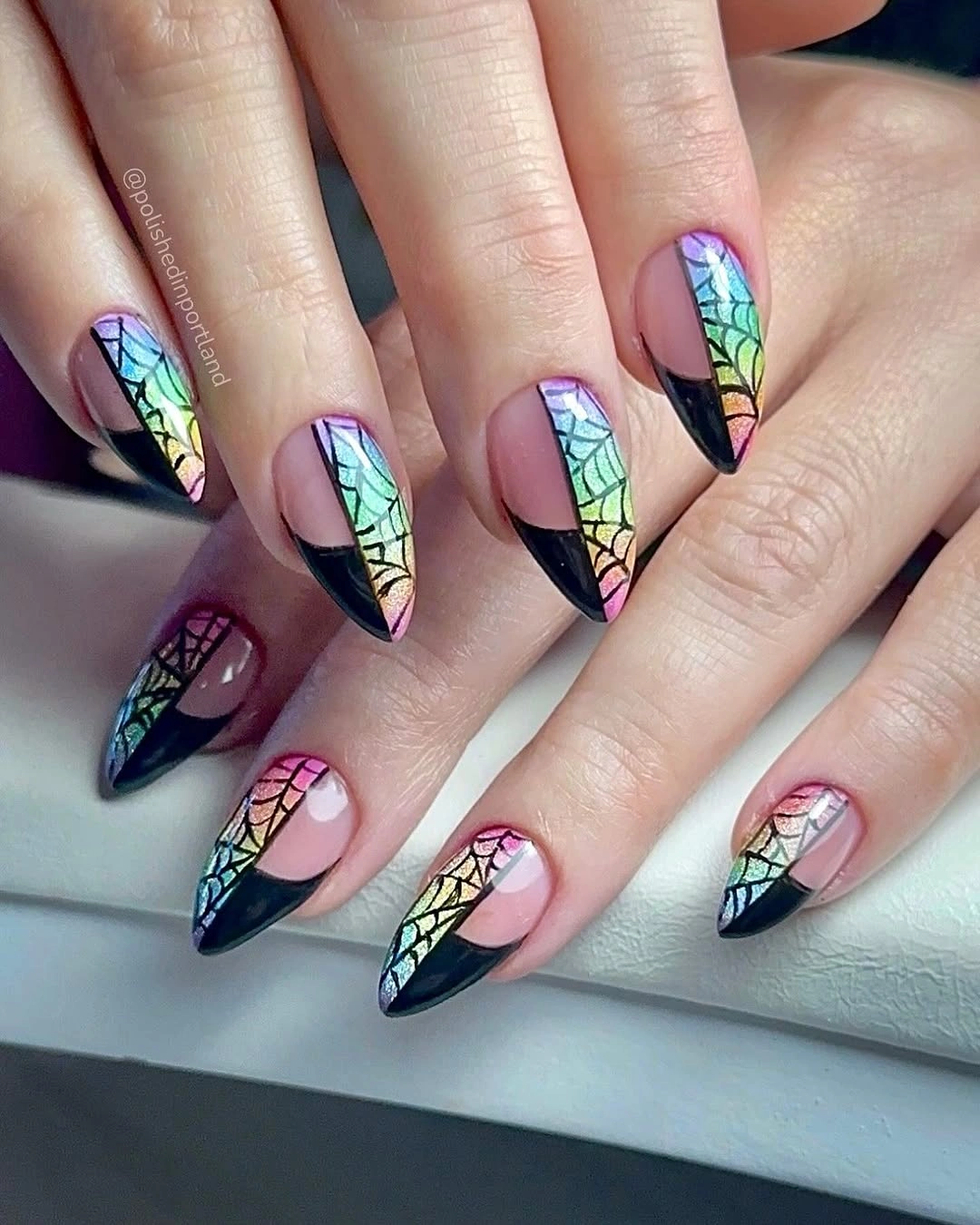
To adapt the idea to a medium almond, keep the black point and use only two contrasting panel colors, perhaps pink with green or blue with yellow. A shorter pointed shape will make the frame broader in relation to the nail, so leaving a small nude area can prevent the design from looking packed. Keep clothing simple – black, gray, denim, or one bright accessory – so the panel colors can hold the attention.
Geometric details are less forgiving when the nail surface is small because each border becomes part of the silhouette. The practical choice is to preserve the frame and reduce the number of internal sections, not to compress every color into a tiny space. The manicure succeeds when the black outline remains visually continuous and the colored panels stay separated enough to read as deliberate insets.
Blush squares with gold wavy lines
Short square nails use a blush-lilac base, slim gold wavy lines, and a small bead-like cluster on one finger. The decoration stays close to the edges and one accent area, leaving most of the surface calm. That spacing gives a compact shape a refined sense of direction without making the manicure depend on length, and the gold adds a warm counterpoint to the cool pink base.
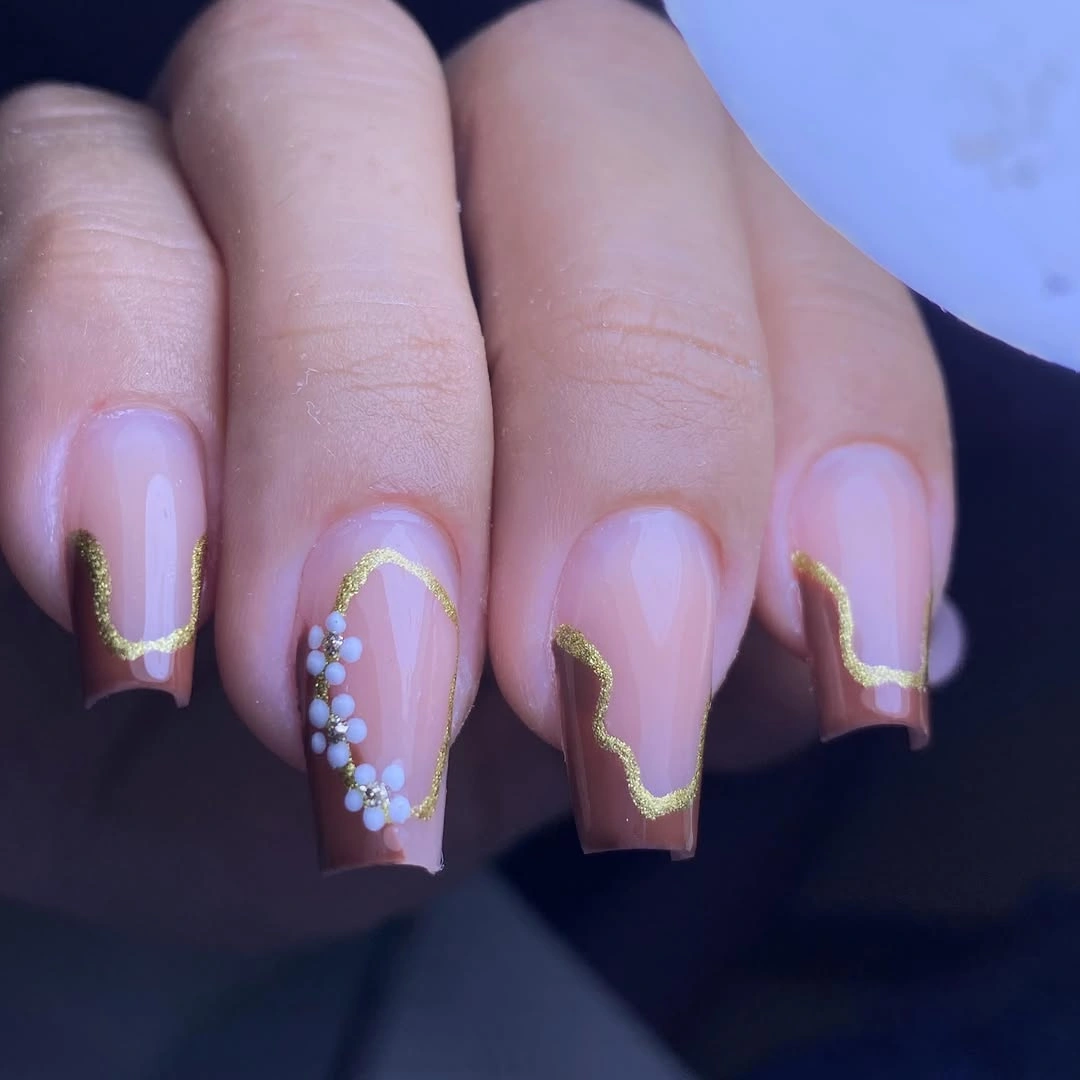
Keep the lines on two nails and replace the bead cluster with a single gold dot if you want a lower-profile version. A soft oval would make the waves feel more organic, while a square with sharper corners would emphasize their geometry. The palette works beside cream, gray, burgundy, lavender, and gold jewelry, especially when the clothing has one quiet texture rather than a competing print.
Raised details need a little more room around them, so do not crowd the cluster with additional glitter or linework. As the nail grows, the gold waves can look disconnected if their spacing changes too much; a small refresh of the line is usually cleaner than layering another motif. The controlled amount of shine is the point here, and it should remain a supporting line inside the blush field.
Sheer pink with a fine wine micro tip
Short square nails finish with a sheer pink base and an extremely thin dark burgundy edge. The design is restrained enough to show the compact shape clearly, yet the wine line gives each tip a defined boundary and a small seasonal shift. A soft taupe sleeve in the setting reinforces the quiet palette, but the manicure remains useful because it does not depend on a decorative background or a large amount of contrast.
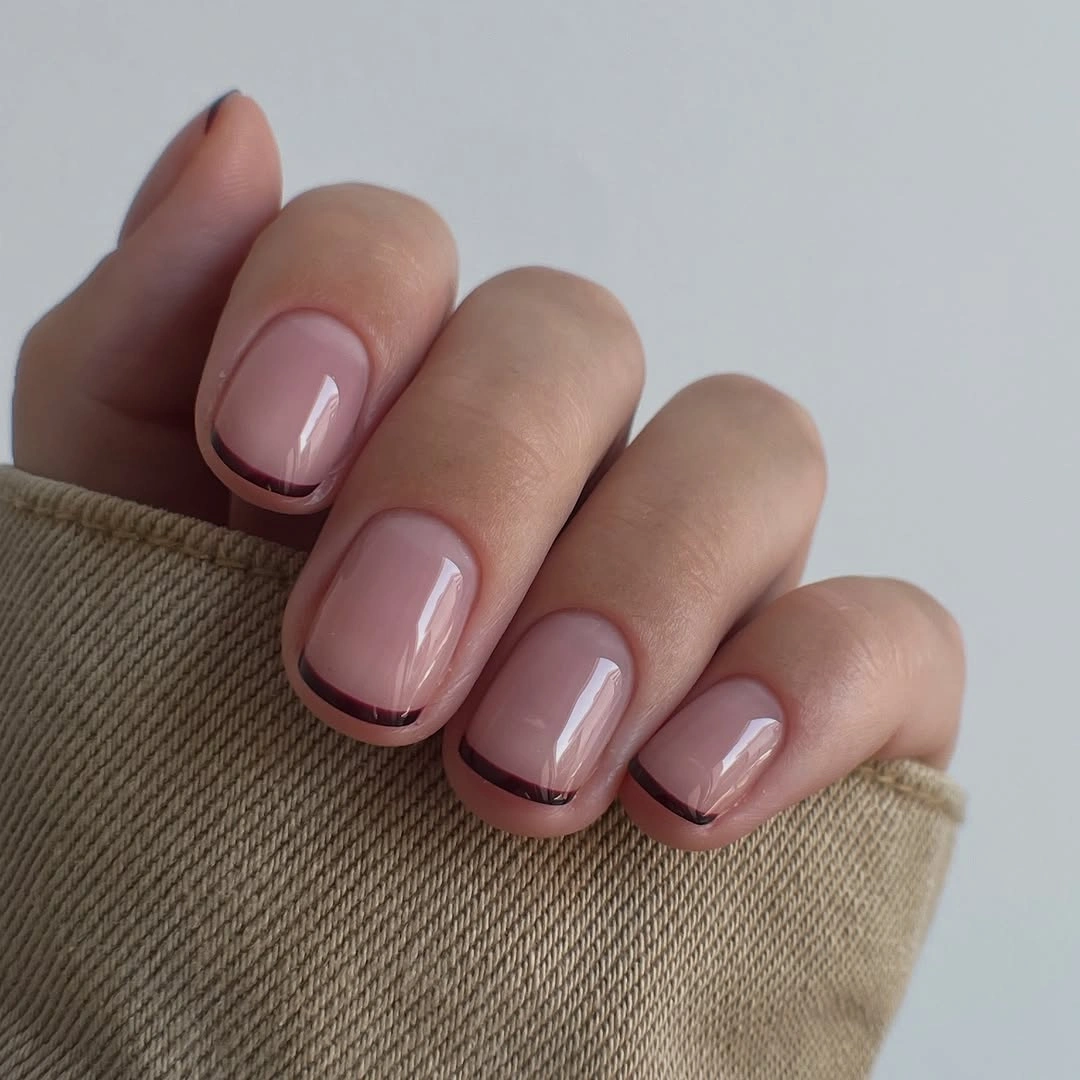
If the edge is hard to keep narrow, use a slightly wider burgundy French band on two nails and leave the rest translucent. Rounding the corners will make the line feel softer, while a medium square will make the tip more graphic. This is an easy palette to wear with camel, cream, black, burgundy, denim, and rose gold because the dark line behaves almost like a small accessory.
The appeal comes from restraint, so added marks would work against the proportion. Keep the pink surface even and let the wine border remain the only strong detail; this also makes grow-out less conspicuous than it would be on a full dark manicure. When maintenance is due, refreshing the thin tip preserves the structure without needing to rebuild an elaborate design.
Tonal berry blocks across medium squares
Medium square nails alternate glossy berry, magenta, mauve, and one pale neutral, creating a tonal color-blocked set without any painted motif. The colors are close enough to feel related, but their different values give the fingers a measured rhythm from deep to light. The square shape supplies structure, so even the brighter magenta stays composed rather than becoming a scattered collection of unrelated colors.
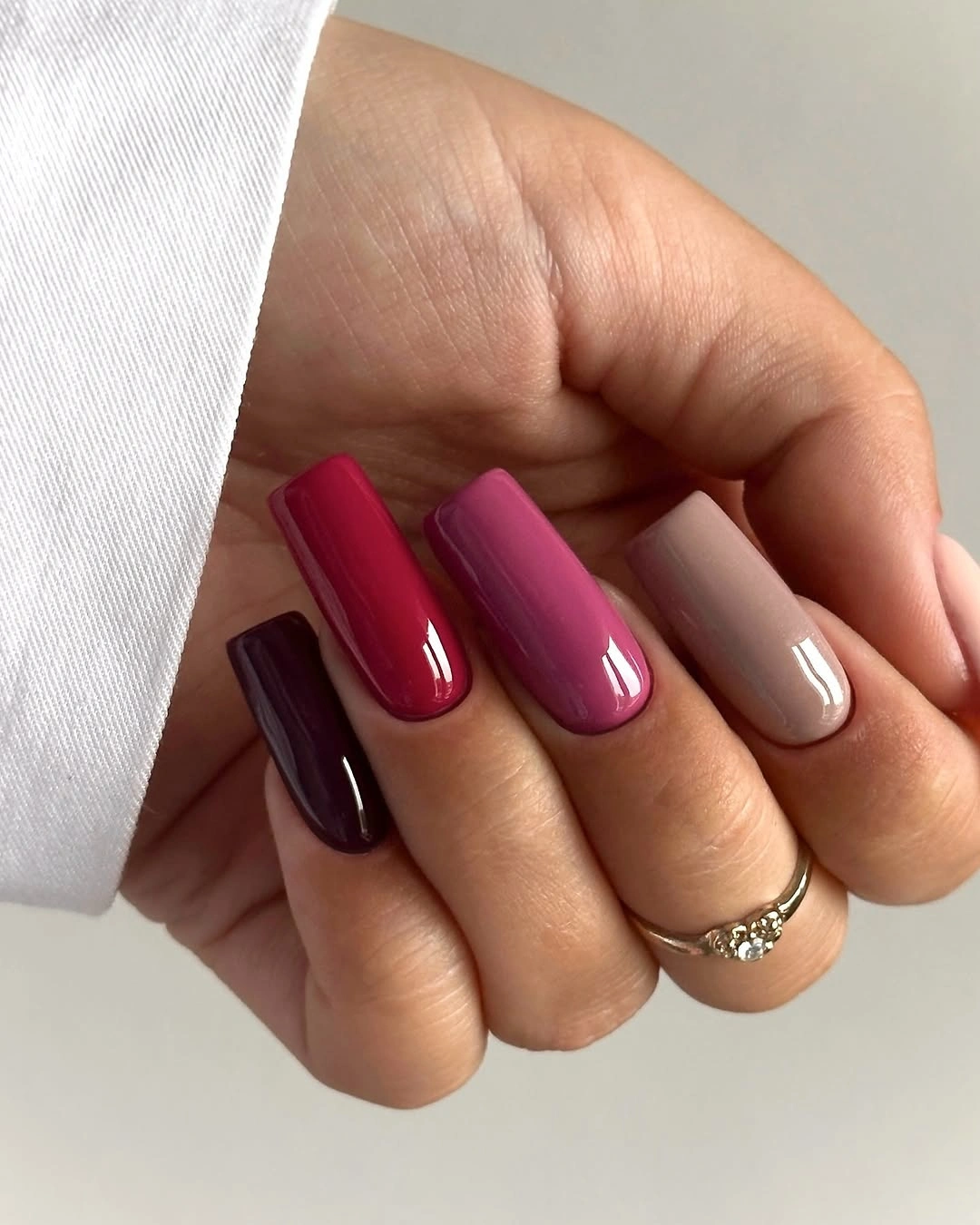
For a shorter square, choose two berry shades and repeat the pale neutral on one accent finger. A rounded edge will make the color changes gentler, while a longer square can emphasize the alternating blocks. The palette pairs with gray, cream, chocolate, black, and pale pink, and it does not require a matching berry garment because the repeated undertone already creates cohesion.
When several full-coverage colors sit beside one another, consistent length and finish become the quiet organizing elements. Keep the tones in a deliberate order rather than mixing them randomly, and let one pale nail provide relief from the saturated blocks. The set is strongest when the color relationship stays visible from a distance, so extra decals or glitter would only blur the useful contrast.
Reflective berry-magenta on pointed almond nails
Long pointed almond nails close the collection with a vivid berry-magenta solid color and a glossy, reflective surface. The shade is saturated enough to carry the full manicure alone, while the tapered silhouette gives it a sleek directional finish. Unlike the botanical and graphic ideas, this design relies on uninterrupted color, so the proportion of length to width becomes the central visual decision.
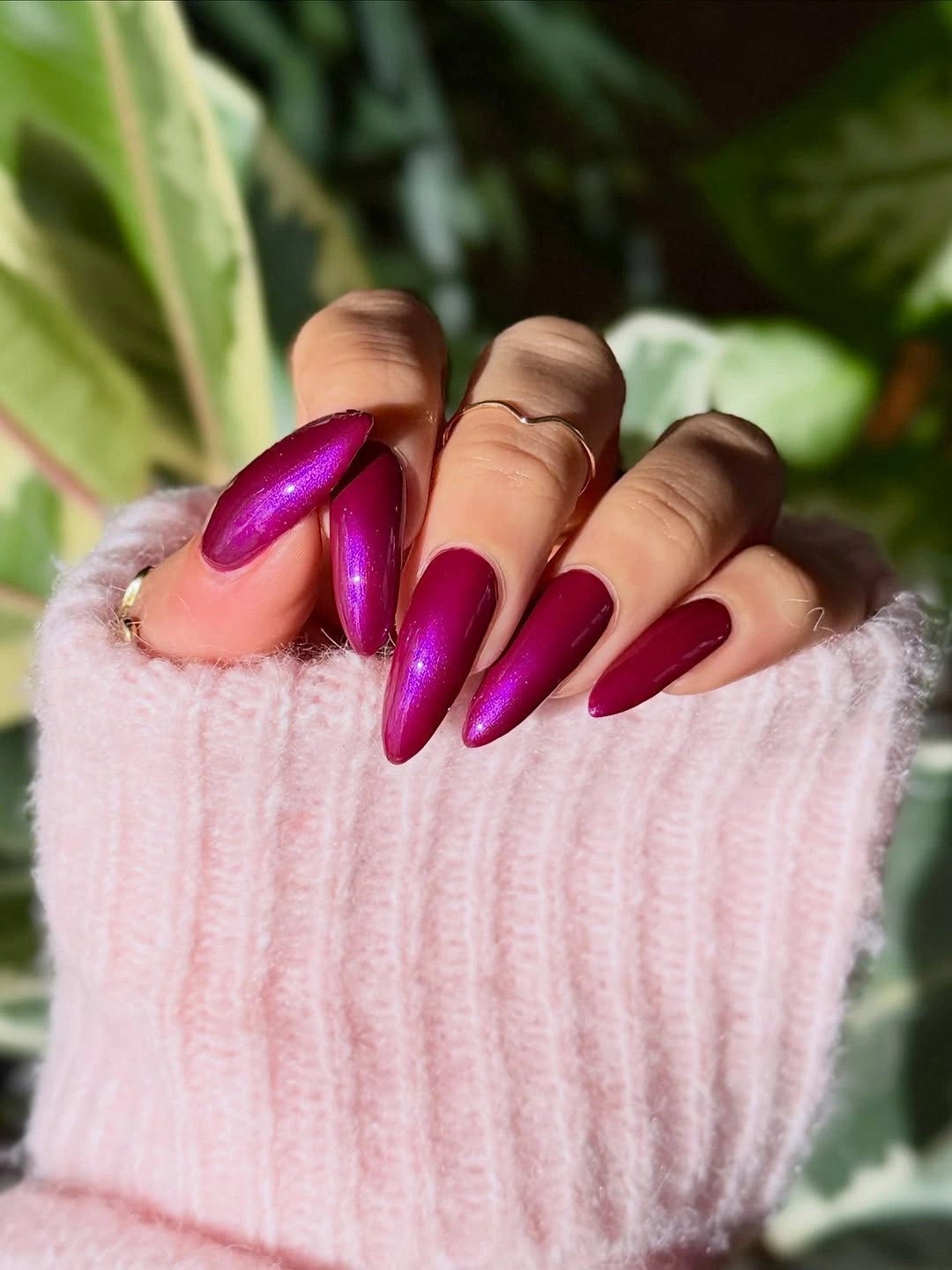
To make the idea more practical, move the same color to a medium almond or keep it on three nails with a sheer pink on the rest. A softer oval will reduce the point without losing the reflective color, and a shorter length will make the saturated shade feel more everyday. Cream, gray, black, denim, and soft pink all give the berry room to stand out without competing with its shine.
Long pointed nails make a full solid shade look polished, but the length also makes the silhouette more noticeable as it grows out or catches on clothing. Keep the surface simple and let the glossy highlight provide the movement; additional decoration would weaken the clean proportion. The final effect depends on preserving the relationship between a narrow tip, a saturated field, and enough length for the color to read as intentional.