When the light starts turning softer and my sweaters come back into rotation, I always notice the same little dilemma: do I want a quiet manicure that works with everything, or one detail that makes getting dressed feel more fun? These fall manicure ideas 2026 move between mushroom neutrals and deep color, but the most convincing thread is the way curved lines, glossy surfaces, and small accents keep the hands from feeling flat.
I would use the set as a decision board rather than a menu to copy exactly. Pick the silhouette that fits your usual length, then borrow one color relationship or one placement idea from a more dramatic example. A sheer base can soften a dark tip, and a single patterned nail can carry the mood when a full mixed set would feel like too much.
Mushroom Tones with Curved White Arcs
The first manicure balances muted mushroom taupe, a soft olive note, and sheer pink instead of committing to one solid autumn shade. The nails have a medium almond outline, while white curved arcs follow the tips and brown line details echo that movement. The result feels collected because the colors stay quiet even though the surfaces do not all match.
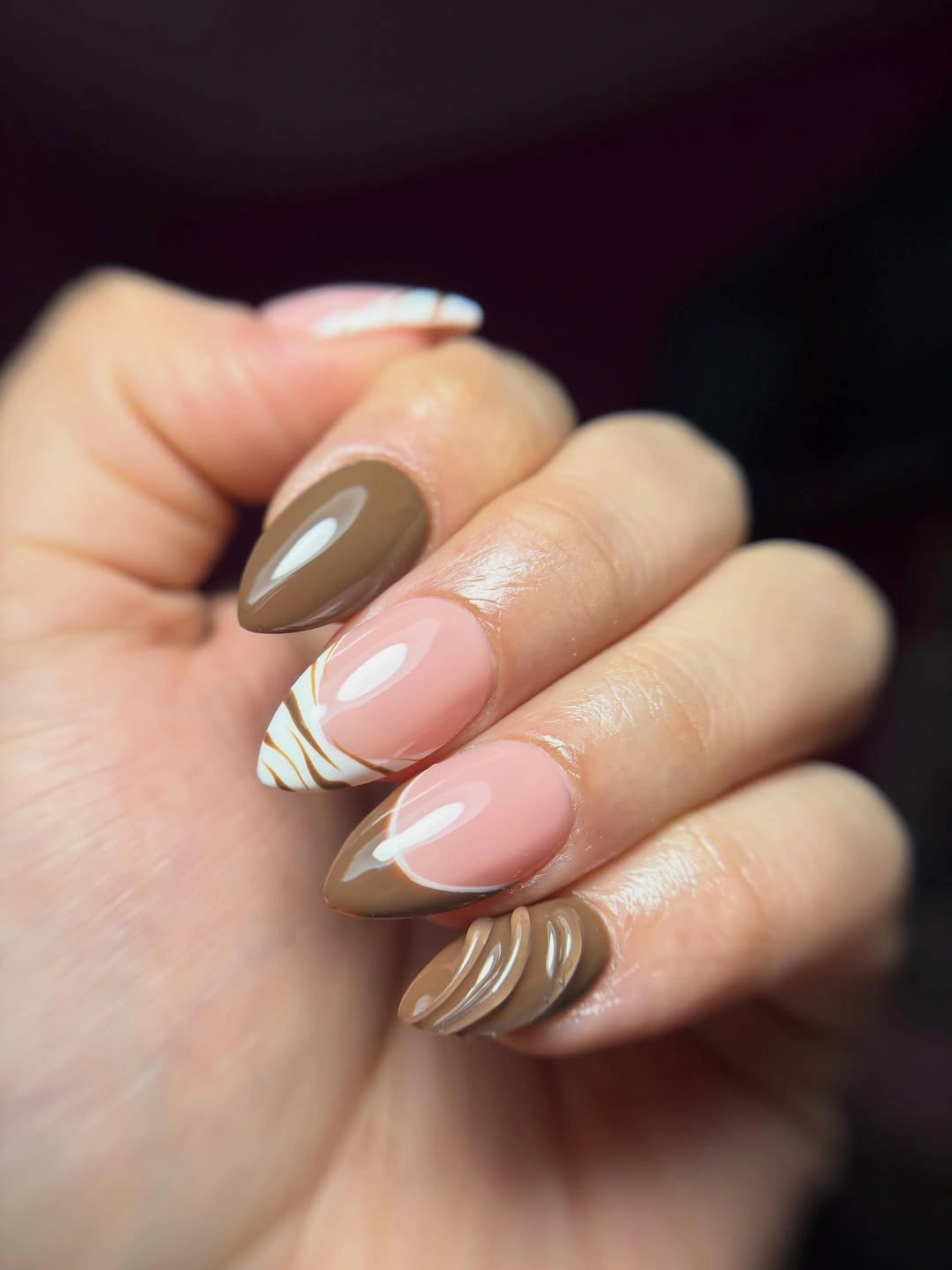
What makes this combination useful is the open space between the lines and the base color. A white arc keeps the olive and taupe from looking heavy, while the repeated curves gently reinforce the almond shape. For a shorter version, keep the pink field and place one clean white sweep near the tip, then repeat the olive on only one or two nails.
The delicate lines are also the honest limitation. They are doing more visual work than the colors, so uneven spacing or visible grow-out will show sooner than it would on a plain brown manicure. I would save the full arrangement for a moment when you want detail, and use the simpler two-color adaptation when daily upkeep needs to stay easy.
Cocoa Pink with One Spotted Accent
Here the long almond shape gives a sheer pink center and cocoa-brown sides enough room to read as intentional blocks rather than tiny fragments. One nail switches to a dense tan-and-black spotted pattern, so the print feels like a deliberate interruption instead of a second competing theme. The repeated brown keeps the hand warm even when the accent becomes the first thing you notice.
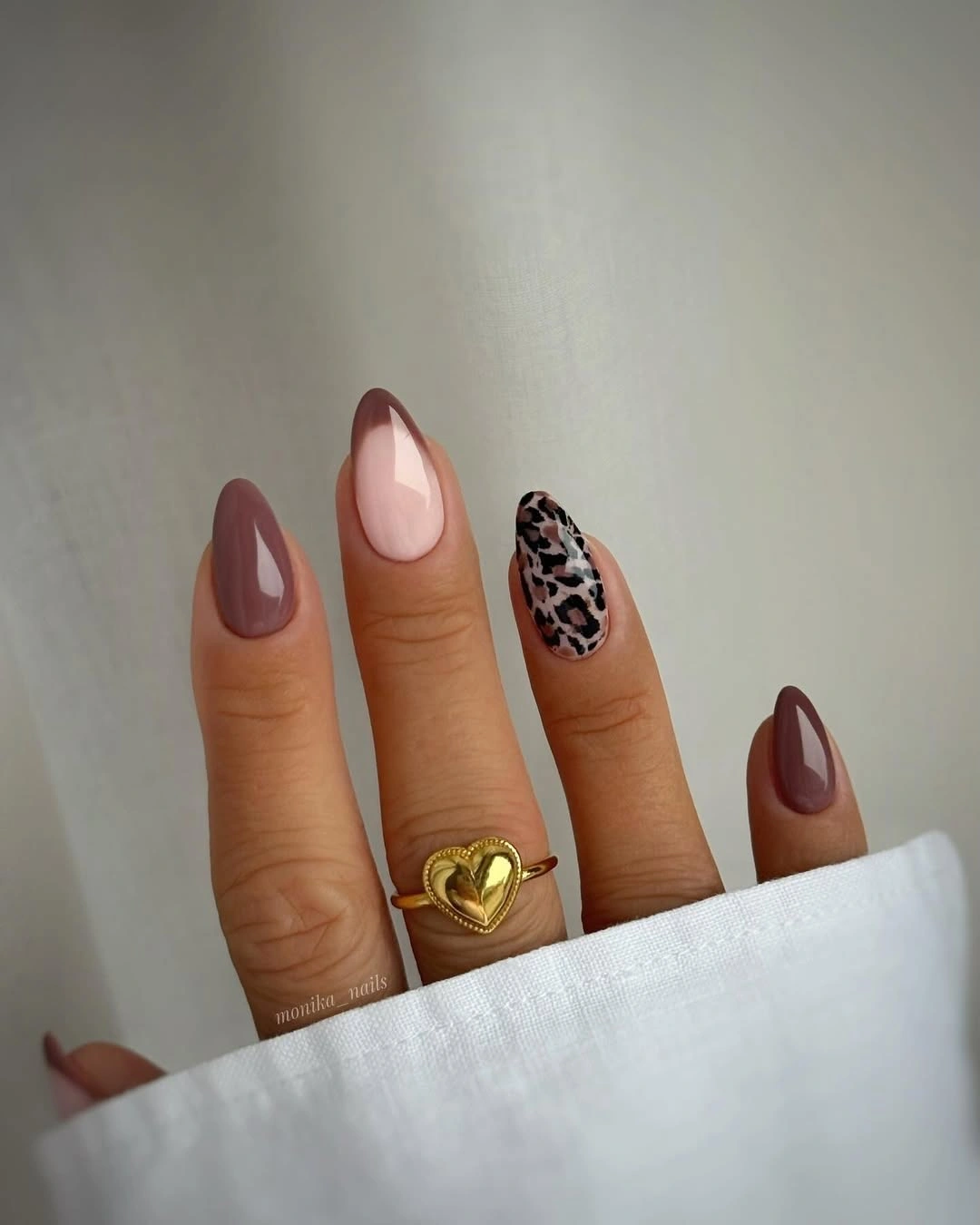
The balance comes from letting the patterned nail stand alone. Solid brown repeats the darkest value, while the pink sections create breathing room around it and keep the set from becoming visually dense. If your nails are shorter, use a half-tip of cocoa on two fingers and put the spotted detail on one rounded nail where the pattern can remain broad and legible.
Long almond length is part of the attitude here, not a minor background choice. The diagonal sides make the color blocks look sharper, and a shorter edge will make the same brown-and-pink split feel calmer. That is a worthwhile trade if you love the palette but need a manicure that fits typing, errands, and a less statement-driven week.
Blush, Burgundy, and Concentrated Sparkle
A blush base gives this medium almond manicure a soft center, then burgundy curves, chocolate details, and small reflective-looking accents build the fall depth around it. The strongest decoration stays close to a few tips and side areas rather than spreading evenly over every nail. That uneven rhythm makes the set feel hand-designed, with a clear focal point and quieter fingers supporting it.
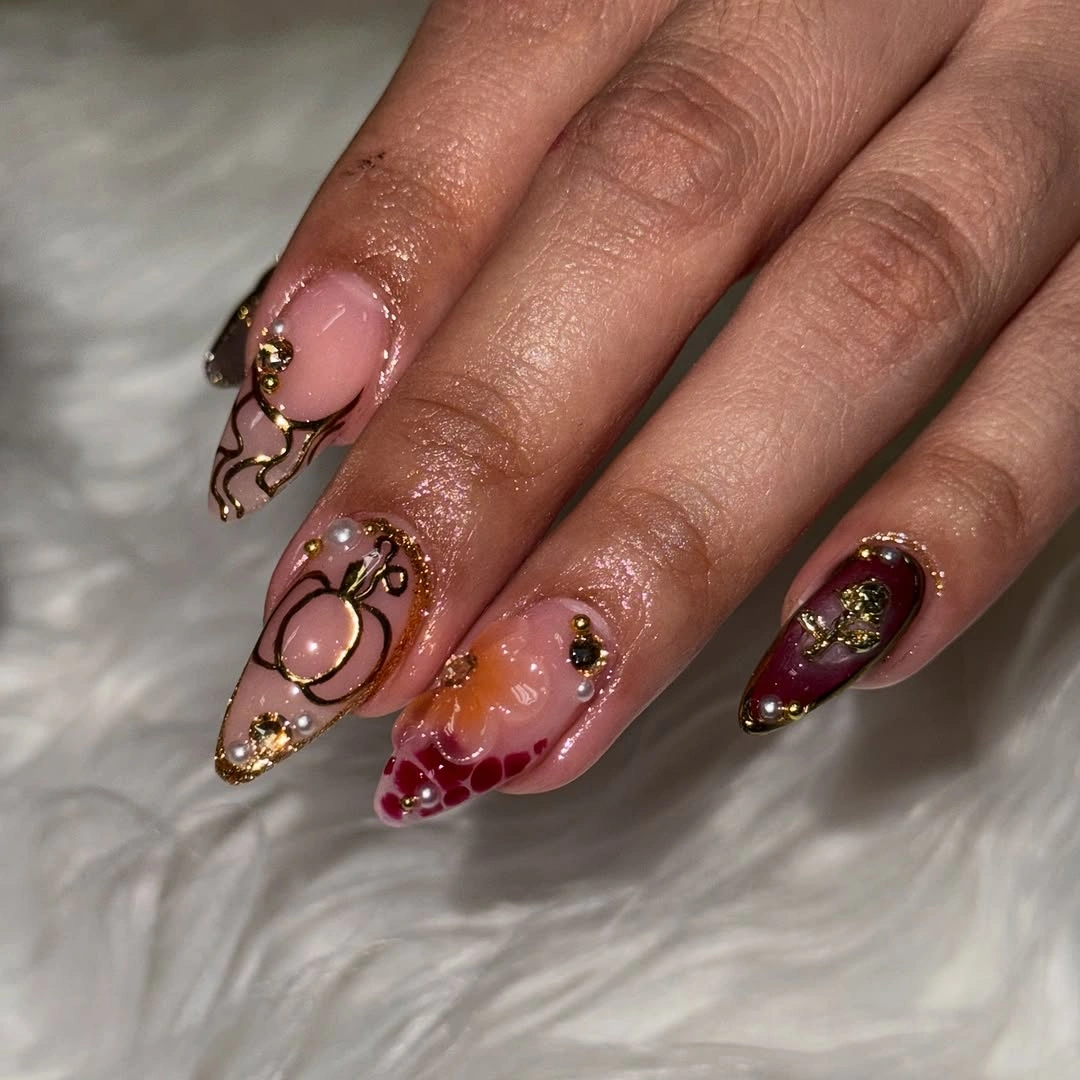
The practical idea is to treat the sheer pink as the organizing space. Burgundy can act as the dark anchor, while one glitter-like or jewel-like cluster supplies the change in texture. You could keep the line work on two nails, repeat a plain wine tip on the rest, and still preserve the comparison between soft color and concentrated sparkle that makes this manicure interesting.
Small accents ask for a little patience because their scale is part of the look. If several details merge as the nails grow, the set can lose the open-and-detailed contrast that gives it shape. A shorter appointment-friendly version should use fewer pieces with slightly wider spacing, even if that means giving up one of the tiny decorative marks.
Brown French Lines with White Contours
These long almond nails start with a milky pink field and use espresso-brown tips or side curves as the main fall statement. Thin white contours and a few warm amber dots sit over the dark edges, so the manicure has a layered look without covering the whole nail. The contrast is graphic, but the translucent base prevents it from becoming severe.
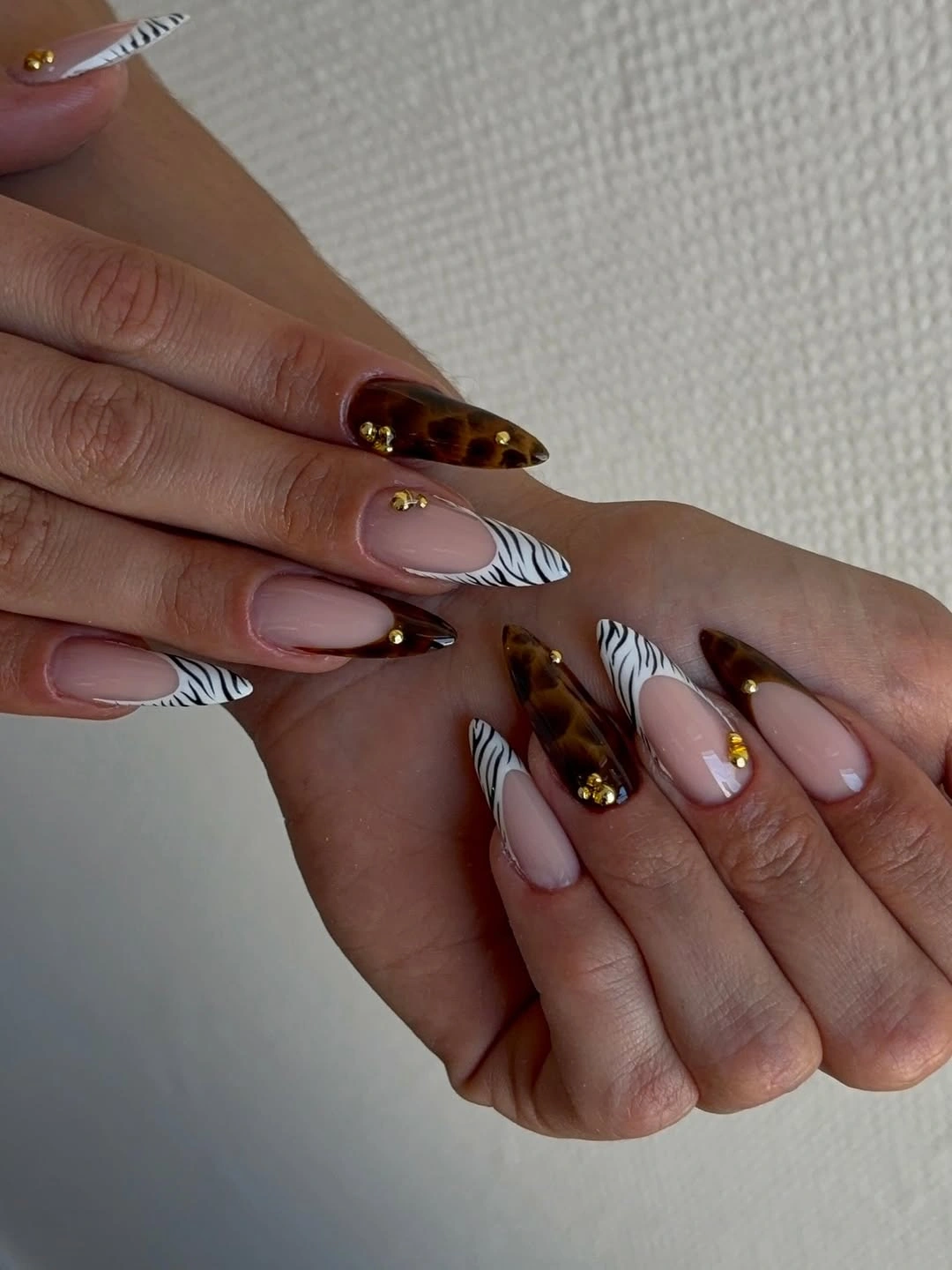
White works here as a visual pause between the brown and the hand. It sharpens the curve, keeps the tip from looking like a solid block, and makes the almond outline easier to follow. To adapt the idea, retain the brown French edge on two or three fingers and use one white line on a sheer nail rather than reproducing every narrow detail.
That narrowness is the tradeoff. The design depends on clean curves that stay parallel enough to look purposeful, and the longer shape gives the lines room to breathe. On a shorter nail, a single wider brown sweep will be more forgiving than several thin borders, while still delivering the same warm contrast and softly editorial feeling.
Deep Chocolate on a Rounded Square
Sometimes the strongest fall manicure ideas for short nails are the ones that stop trying to decorate every surface. This medium rounded-square set is a deep chocolate brown from edge to edge, with glossy reflections doing the styling work. The clean shape gives the color a modern, slightly graphic presence, especially against the soft knit sleeve nearby.
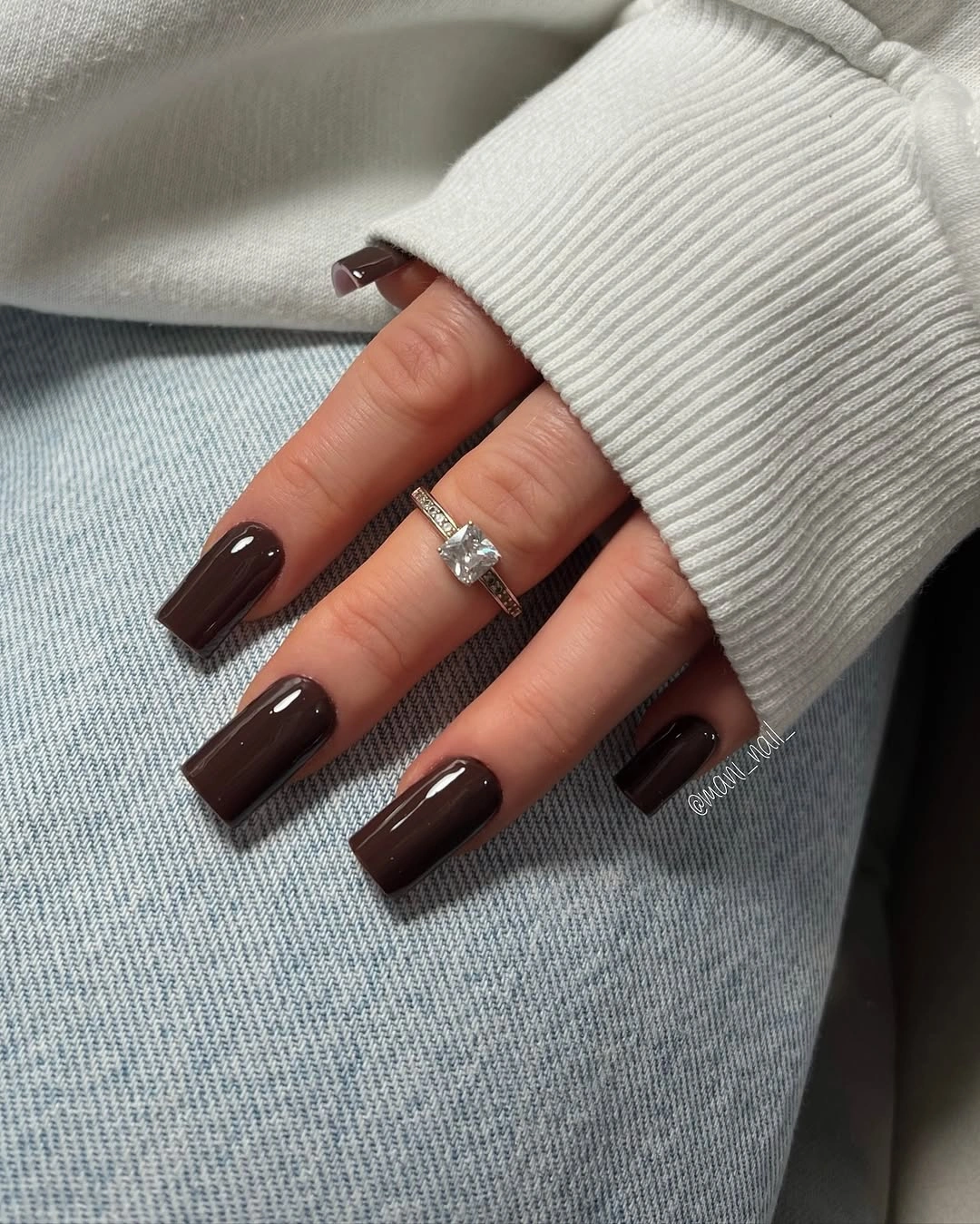
A single dark shade is useful when you want seasonal color without a pattern, a ring of accents, or a conversation about matching several details. The high-shine surface keeps the brown from looking dull, while the square outline makes the manicure feel crisp rather than romantic. If you prefer an almond edge, the same color will look a little softer and less architectural.
The simplicity also makes upkeep visible. Glossy dark polish shows a rough tip quickly, and the squared edge can feel more prominent as it grows forward. I would choose this version when you enjoy checking the outline and refreshing shine, or soften the demand by moving to a medium taupe-brown that is less contrast-heavy between appointments.
Plum, Nude, and a Speckled Detail
Dark plum nails alternate with nude pink ones here, while a single speckled accent adds a small change in surface and pattern. The medium almond outline keeps the hand elongated, but the repeated nude fingers stop the burgundy from becoming one uninterrupted dark mass. That alternation is what makes the design feel fall-ready without relying on a bright color.
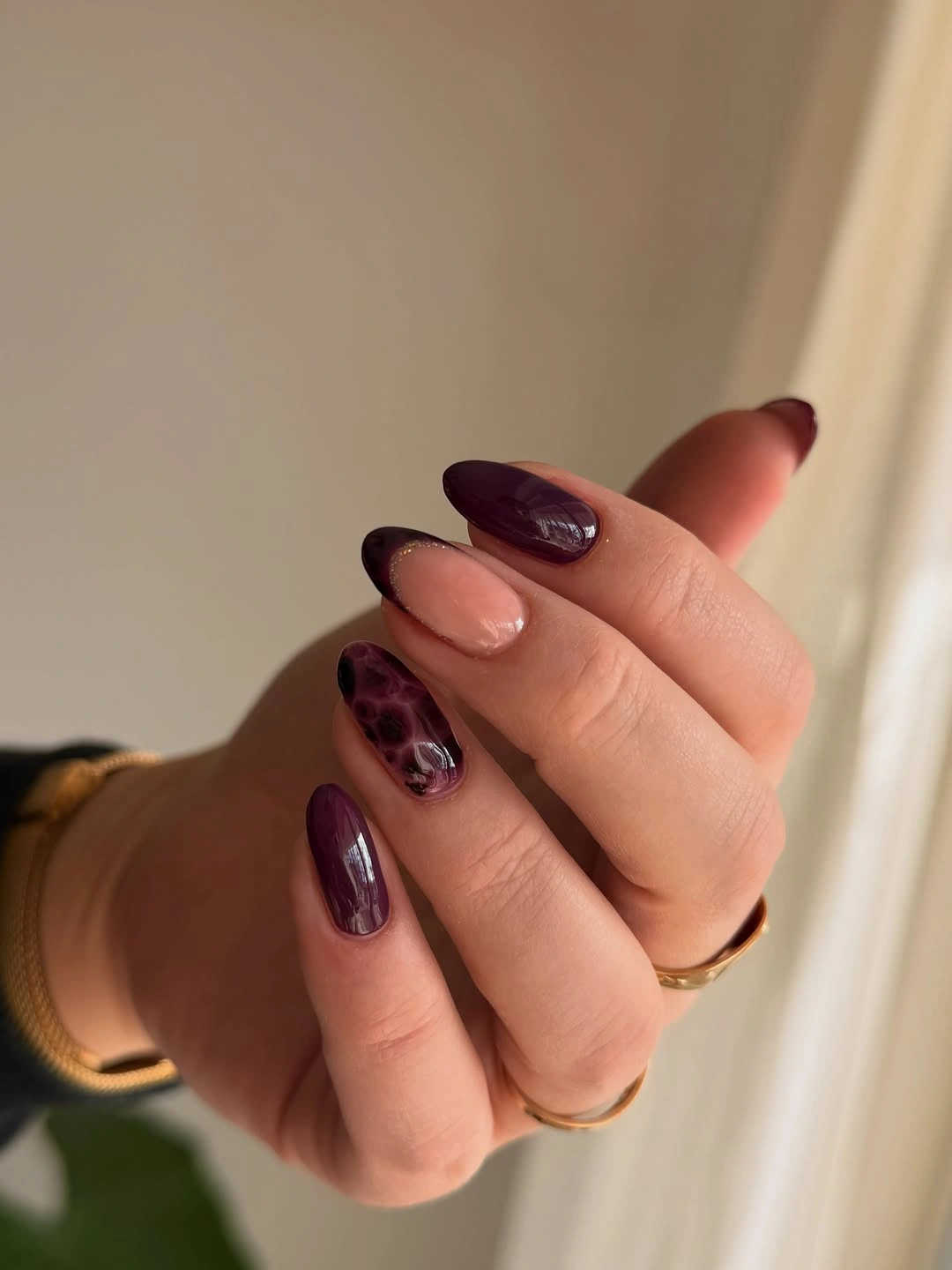
The easiest way to borrow it is to decide which value should repeat more often. More nude creates a softer, lighter impression; more plum makes the manicure feel moodier. Keep the speckled pattern on one finger, and choose a rounded spot scale if your nails are shorter so the print reads as a clear texture instead of a crowded blur.
Deep plum can look nearly black when the light is low, which changes the relationship between the colors. The nude repeats become important because they protect the contrast and give the eye a place to rest. If your wardrobe already leans dark, a muted berry or warm brown substitute may preserve the idea while keeping the hand easier to read.
One Autumn Palette, Many Tiny Motifs
This mixed manicure moves through burnt orange, olive green, cream, cinnamon, and pale pink, giving nearly every nail its own small decision. There are plaid panels, light line work, leaf-like marks, and a pale fan detail, yet the warm colors repeat often enough to hold the set together. The medium almond length gives each motif a little room without making the hand feel overloaded.
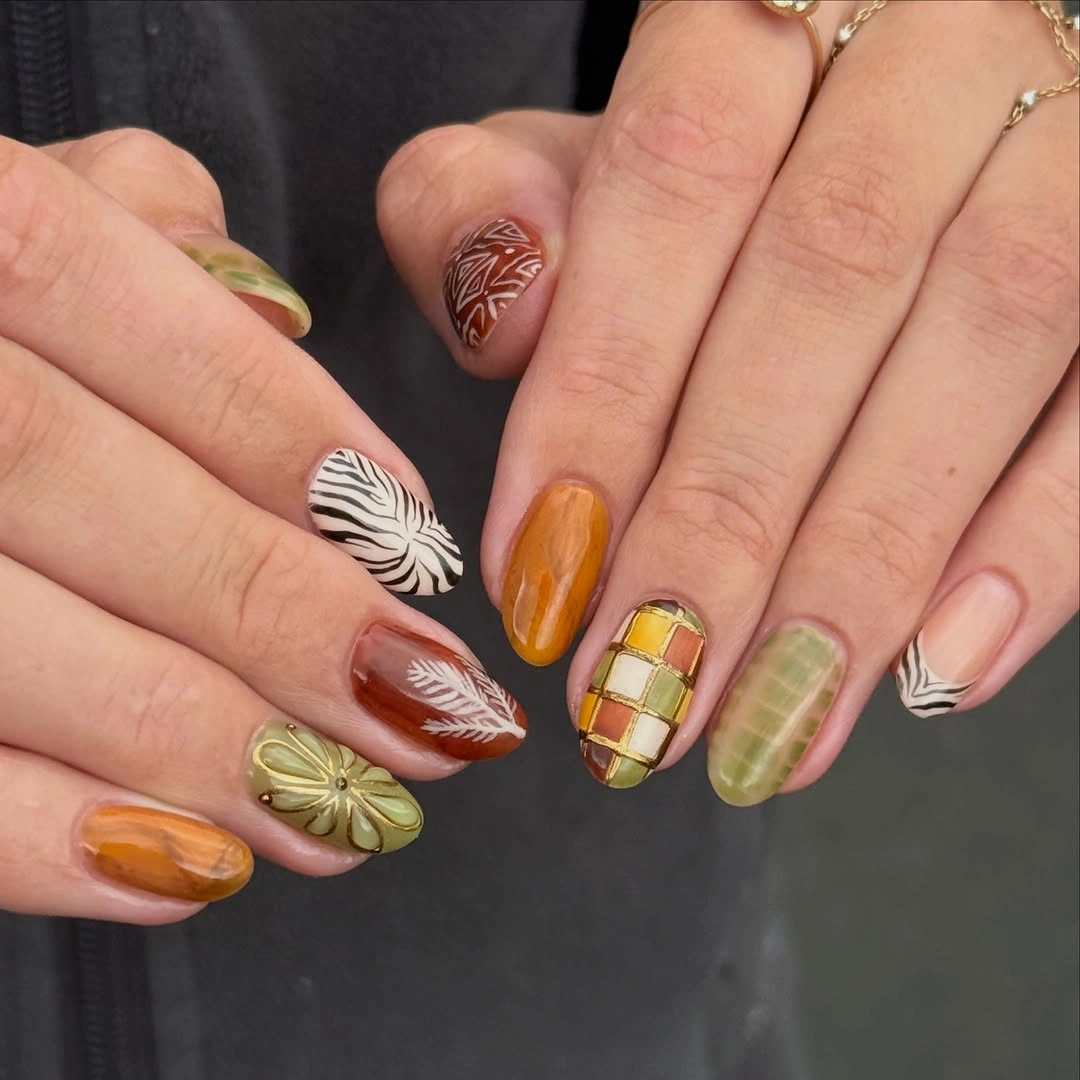
Its best lesson is about editing, not copying every finger. Choose a base color, one geometric detail, and one organic detail, then repeat only those across the hand. A two-color version with one plaid nail and one leaf-like accent will feel calmer, while keeping the same fall manicure ideas short nails can support through scale and spacing.
Visual variety has a real limit: the more motifs you add, the less quiet space remains. On a shorter nail, tiny checks and line art can merge before the color does, so fewer larger shapes will usually look more deliberate. I would keep the full mix for a playful occasion and take one or two details into an everyday set without losing the palette’s warmth.
Textured Color Blocks for Short Nails
Rust orange, blush pink, cream, and charcoal share this short square manicure, but the color blocks are only part of the effect. Rounded tone-on-tone lines create a raised-looking wave pattern on several nails, giving the compact shape movement without tiny pictures. The palette feels seasonal, while the short edge keeps the overall statement grounded.
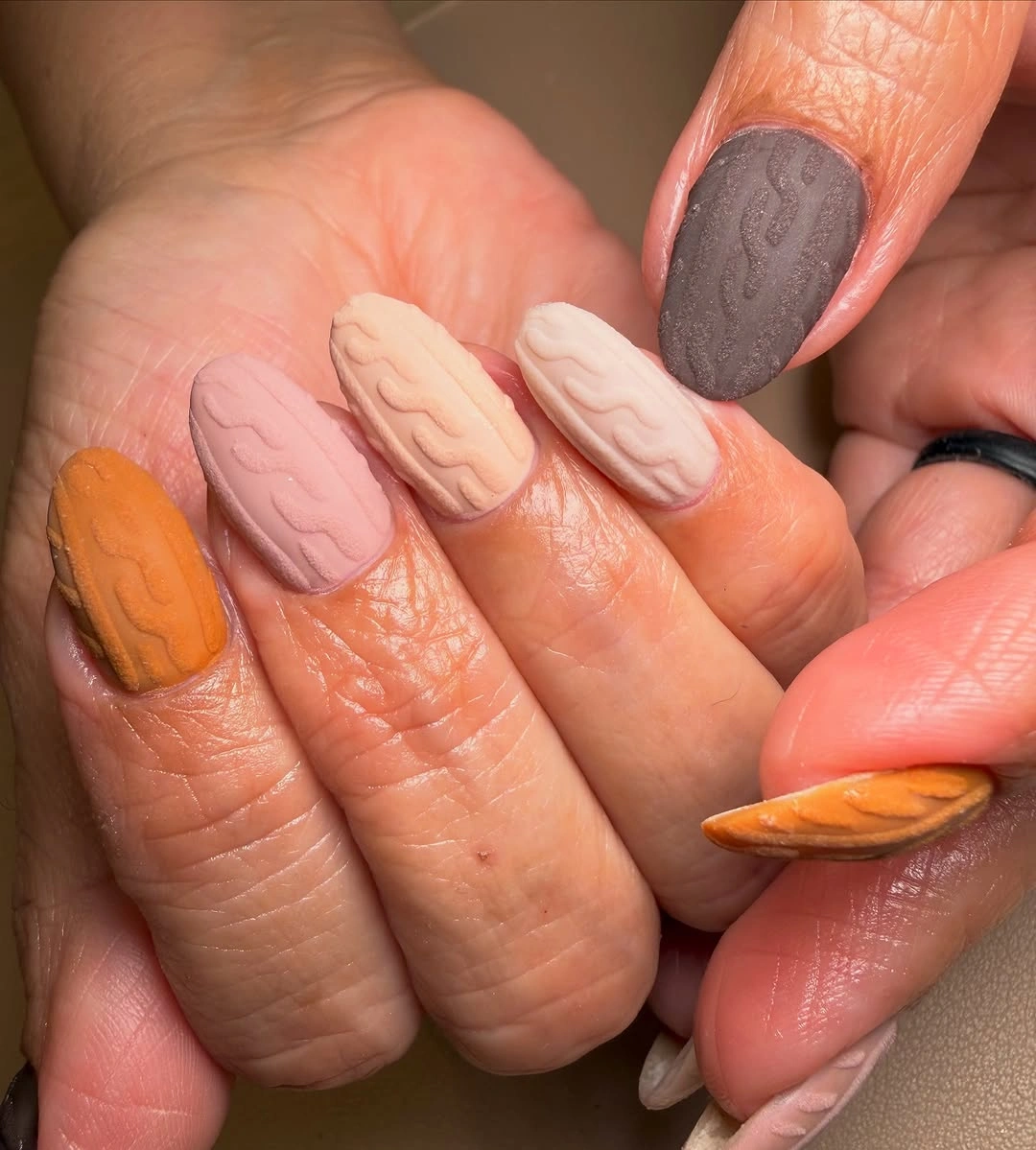
That texture is a smart alternative to intricate art when the nail surface is limited. Repeated waves can follow the length of a square nail, and solid blocks make the color easy to understand at a glance. If you want a quieter version, use the charcoal on one nail, cream on two, and keep the wavy detail only where there is enough room to see it clearly.
The dimensional-looking lines may catch wear on the tips, and a short square can make any roughness more obvious. This is less about avoiding the idea and more about choosing its best scale. A smooth glossy base with two painted waves can deliver the same tactile impression while being easier to live with than texture on every finger.
Neutral Mauve with a Printed Tip
Soft mauve-taupe and sheer nude keep this medium square manicure calm, then one animal-like printed tip changes the temperature. The pattern stays at the edge rather than covering a whole nail, so the hand reads polished before it reads playful. The squared silhouette adds a little structure to the soft colors and gives the print a clear boundary.
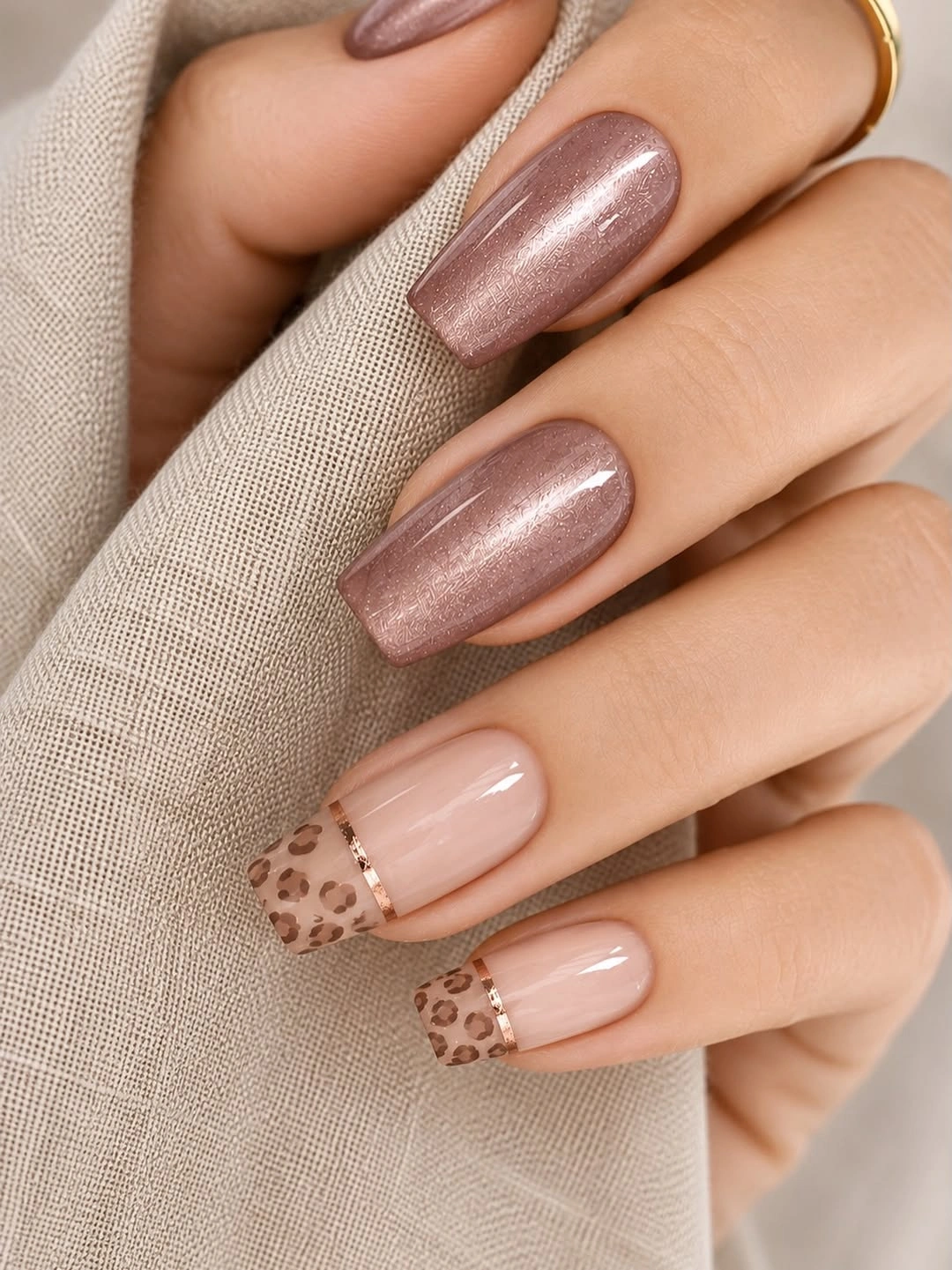
For fall manicure ideas square nails can carry, this is a useful proportion: let the neutral field take most of the surface and use the print as punctuation. Larger, simpler spots will translate better to a shorter nail than many tiny marks. You can also replace the tan and brown with olive and cream if you want the same idea to feel less traditional.
Animal print needs enough tip width to remain recognizable. If the nail is very short, compressing the pattern into a narrow strip can make it look accidental rather than intentional. I would keep the printed finger slightly broader in shape and let the remaining nails stay plain, because the contrast is what gives the set its quiet confidence.
Reflective Teal for a Darker Mood
These long almond nails shift toward deep teal and blue-green, with reflective highlights that move across the surface against a dark background. There is little visible illustration, so the finish carries the drama and the warm edge-like glints add a small contrast. The result is darker than classic brown, but still tied to the season through jewel-like depth.
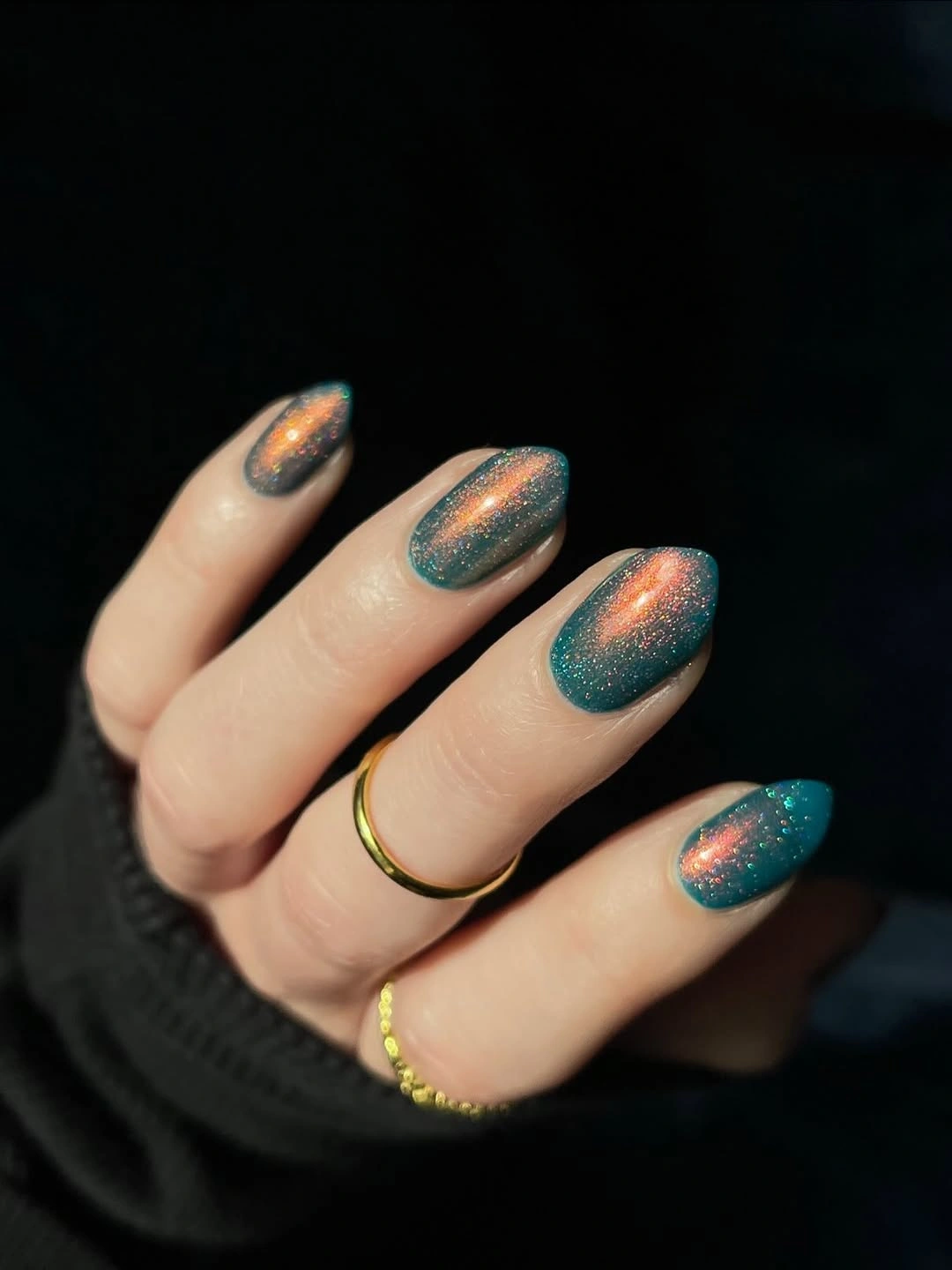
If you are comparing fall manicure ideas green, this is the version to study for finish and lighting rather than motif. A deep blue-green on every nail can feel rich without becoming flat, while one warm metallic-looking line keeps the color from blending into black. On a shorter shape, choose a slightly brighter teal so the reflective shift remains visible.
Reflective surfaces are honest about texture and edges. Dents, uneven tips, or a dull patch will catch the light more strongly than they would under a cream polish. The payoff is movement, though, so I would choose this design when you want the manicure to change as your hands move rather than stay visually quiet from every angle.
Vivid Orange Tips on Sheer Pink
The bright orange tips are the immediate focus, but the sheer pink base is what keeps this long tapered-square manicure from feeling heavy. One nail carries a small warm clustered accent with orange and gold-like sparkle, while the rest repeat the saturated edge. The contrast is clear, cheerful, and more autumnal than a full neon surface would be.
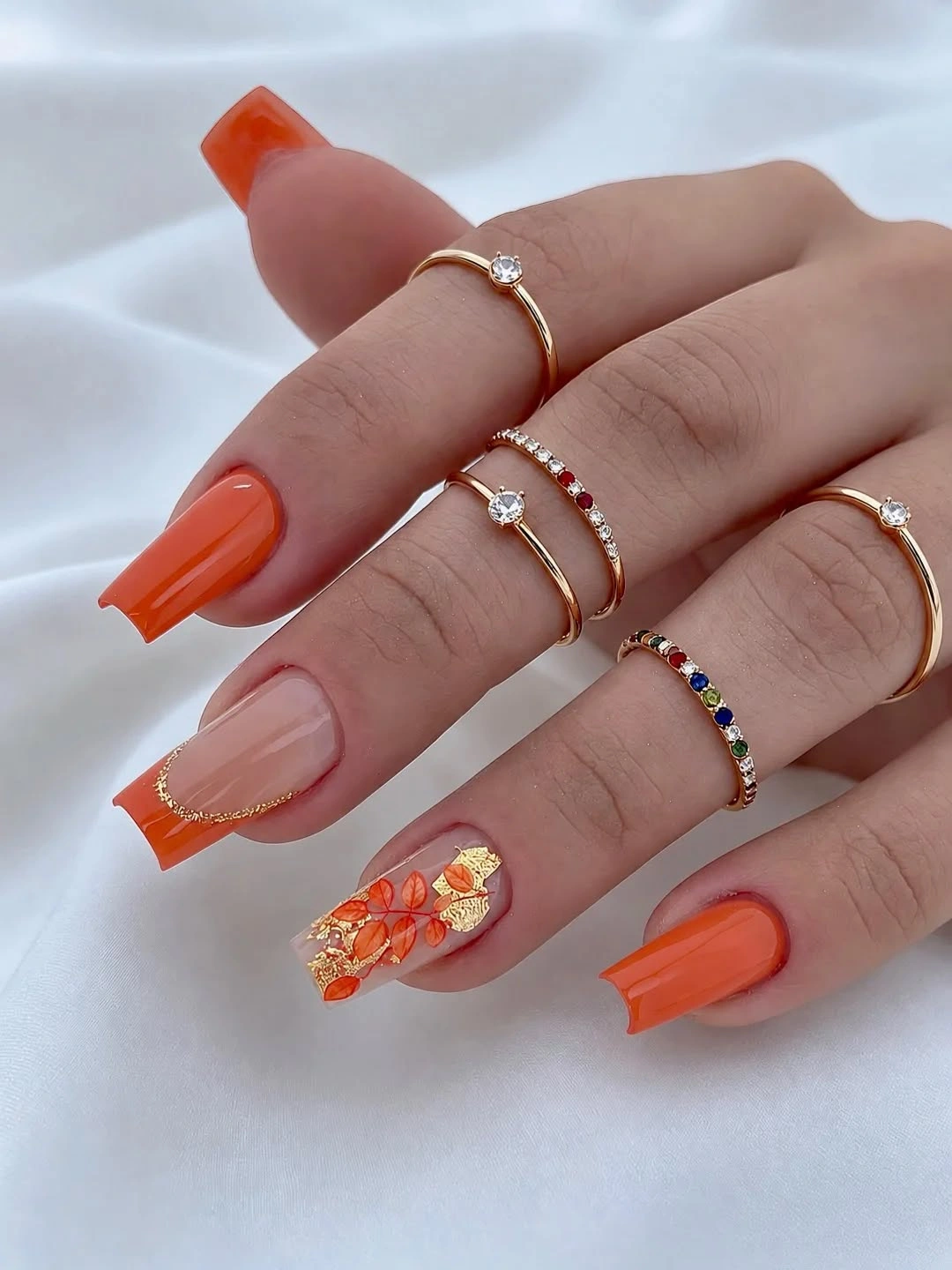
Orange works best here as a border. It gives the eye a strong line to follow, and the pale center leaves enough space for rings, sleeves, or a quieter outfit to remain part of the overall balance. For short nails, narrow the tip and keep the accent on one finger; the color will still read, but the hand will feel more practical.
The concentrated accent is also a useful warning about scale. On a long nail it can sit beside the bright edge without crowding it, while on a smaller nail the two details may compete. If you want daily ease, keep the orange tip and replace the clustered nail with a plain sheer pink one that lets the silhouette do more of the work.
Wine Tips with a Soft Branch-Like Line
Translucent pink keeps this medium almond manicure light, while dark wine tips make the shape feel unmistakably fall. One nail adds thin pale red lines that curve like small branches, introducing a delicate organic note without turning the hand into a literal themed set. The repeated tip gives structure, and the single line-art finger gives the eye somewhere to pause.
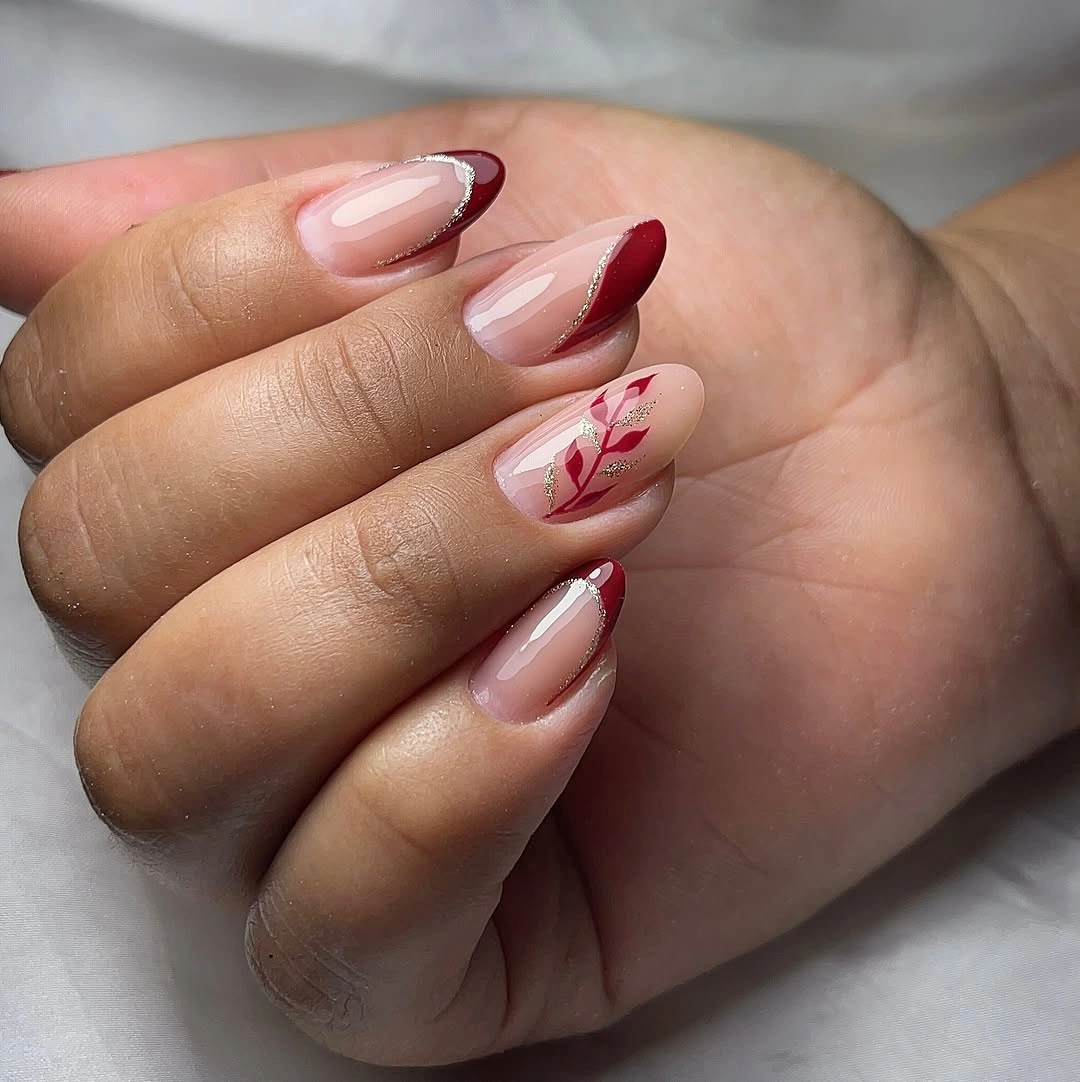
The design is easy to adapt because the dark color stays at the edge. You can repeat the wine tip on every nail, then use one curved line on the ring finger, or swap the wine for brown when you want a softer contrast. A narrow tip will preserve more pink space and make the look closer to natural nails short styling than to a full statement manicure.
Sheer bases can be beautiful and demanding at the same time. They keep the hand open, but any unevenness or visible grow-out remains part of the composition. I would choose this layout when you like a clean appointment finish and can keep the line work sparse, because crowding the delicate marks would erase the calm that makes the design work.
Oxblood Curves on Blush Nude
Blush nude provides a pale center for deep burgundy and brown curved tips, while one irregular spotted nail repeats the darker colors. The medium almond edge makes the arcs look elongated, and the dark sections stay near the perimeter instead of filling the whole surface. It is a graphic fall manicure, but the open base keeps the hand from reading as too dense.
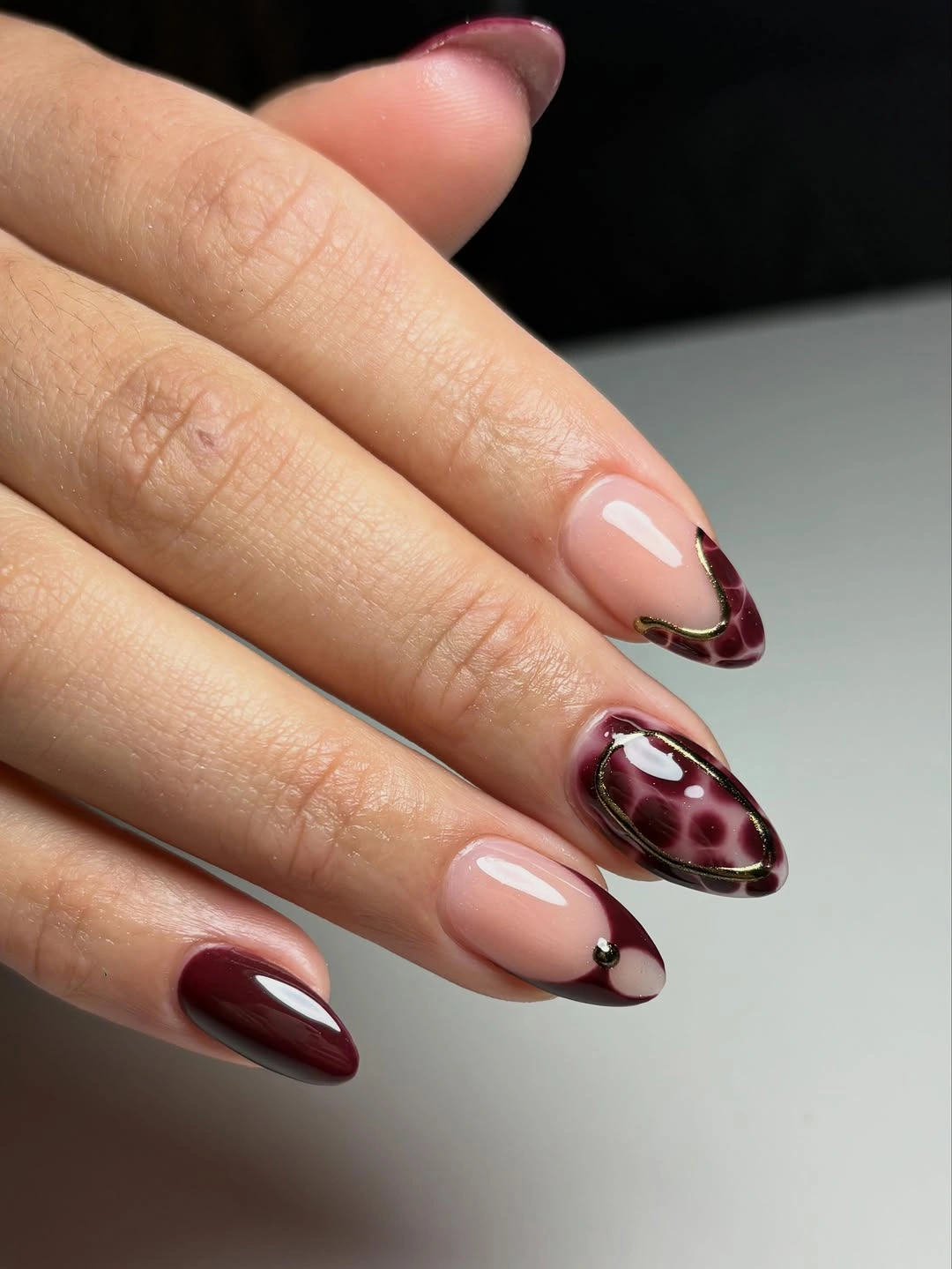
Curved tips are especially useful when you want a little more shape definition. They draw the eye along the almond outline and create movement without needing glitter or extra objects. For an easier version, keep the burgundy curve on three nails, use a plain nude on one, and reserve the spotted detail for a single finger where it can remain spacious.
The tradeoff is precision. A straight French line can hide a small variation, while an irregular curve advertises its spacing and angle. That is not a reason to avoid it, but it is a reason to make the design simpler on a shorter nail. A broad arc will look more intentional than a thin, crowded attempt to recreate every contour.
Graphic Tips with Small Autumn Plaid
Warm nude beige anchors this long almond set, then black and espresso tips, thin lines, and a small plaid detail introduce sharper contrast. Each accent has room around it, so the pattern does not compete with the pointed silhouette. The pale base matters as much as the dark details because it separates the graphics and keeps the hand visually breathable.
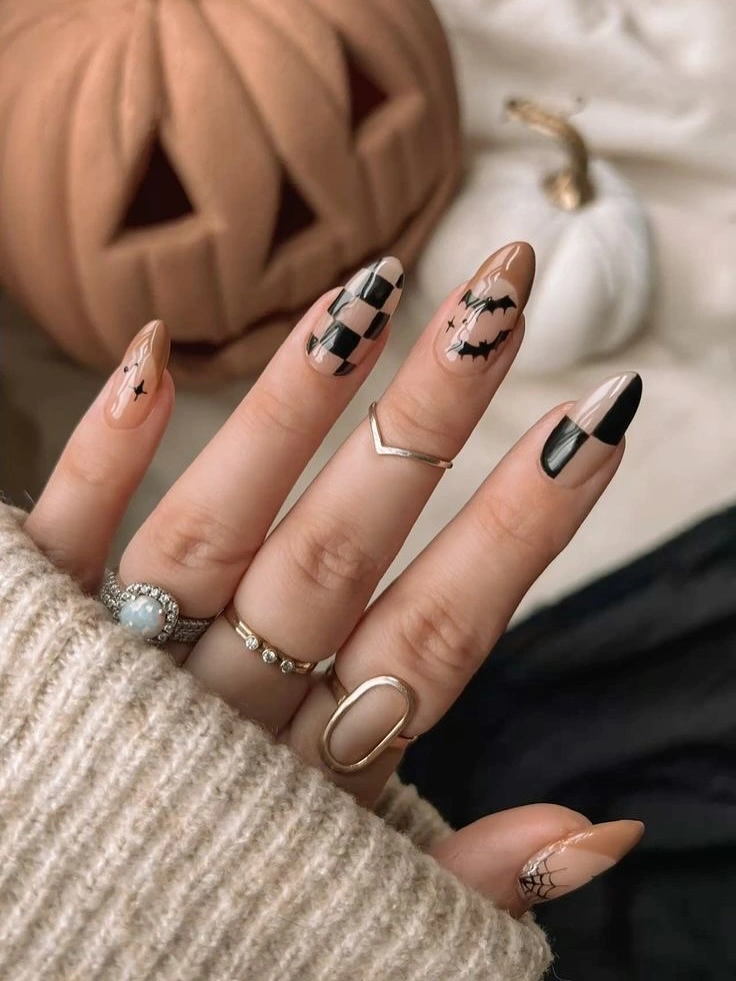
You can borrow the look in layers. Start with one dark pointed tip on each hand, add a thin line to one finger, and use the plaid only if the surface still feels open. That approach makes the fall manicure ideas almond shape feel adaptable rather than locked to a long, highly decorated version, with enough empty space to keep the pattern readable.
Length changes the practical judgment here. Pointed ends and small graphic corners are striking, but they are also more visible when they snag, chip, or grow forward. A shorter almond can keep the same nude-and-brown contrast if the tip becomes rounder and the plaid is enlarged into one simple block.
Sheer Base with Dramatic V Tips
The very long stiletto-almond shape is the main event, even though the color plan is restrained. A sheer pink base leaves most of the surface open, then dark brown or black V tips create sharp diagonals that emphasize the point. The manicure looks graphic because of the geometry and length, not because it uses a lot of separate decoration.
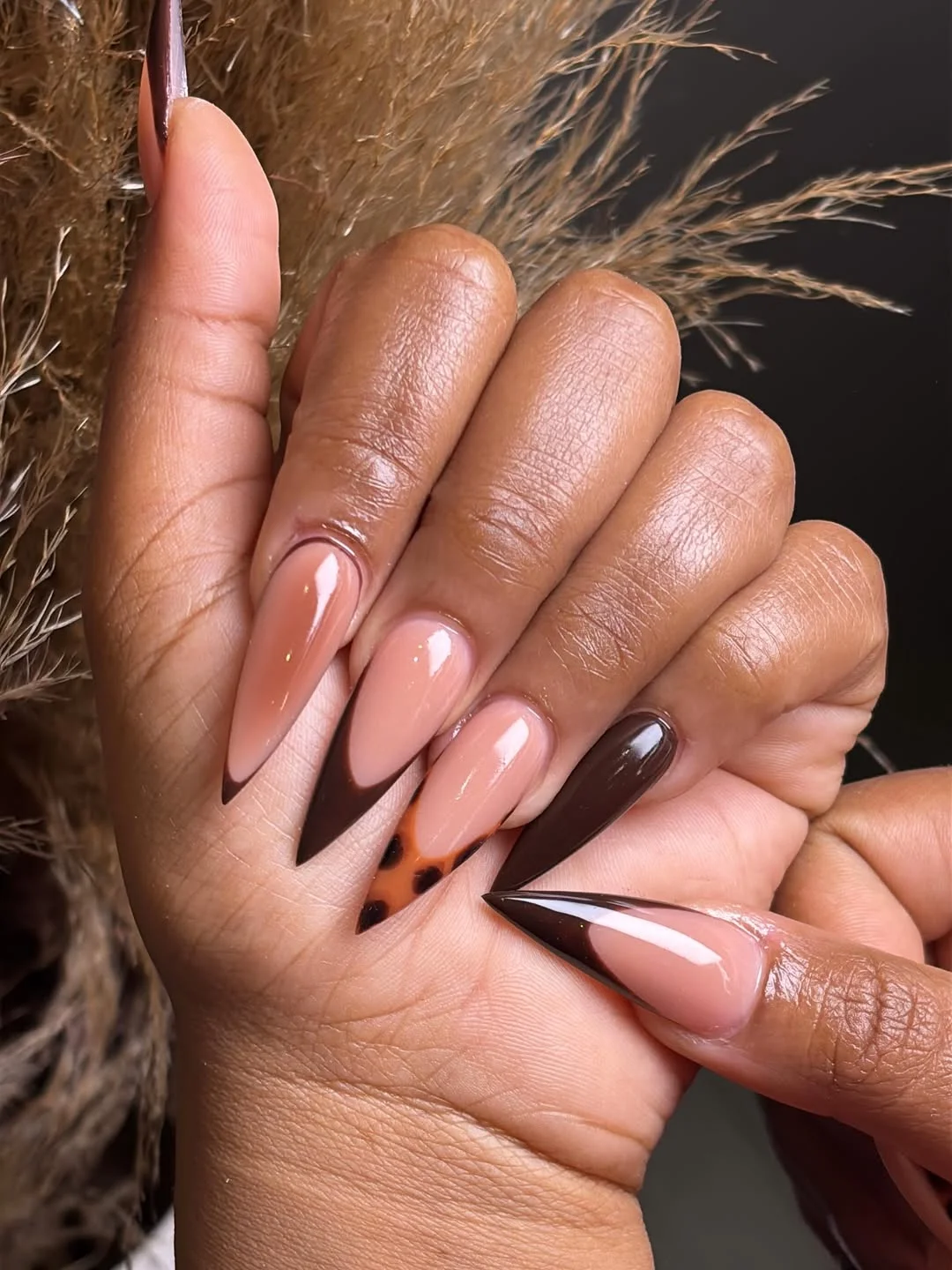
For a wearable translation, shorten the nail and let the V become wider and softer. The eye will still follow the dark diagonal, while more of the pink base remains visible and the overall impression becomes less theatrical. This is a good example of adapting a shape idea rather than treating the original length as mandatory.
Extreme length changes how the manicure behaves in daily life, so color alone cannot make it low-maintenance. The pointed outline is visually powerful but demands more attention than a rounded almond. I would save the full version for a statement moment and use dark half-tips on a shorter shape when comfort needs to share the decision.
Butter Yellow with Brown Curved Stripes
Pale butter yellow, mauve-taupe, cream, and dark brown make this long almond set feel unexpected without losing its autumn connection. Some nails use tiny dark dots, while others repeat curved stripes that echo the almond sides. The colors change from finger to finger, but the line movement creates a visual system that keeps the mix from becoming random.
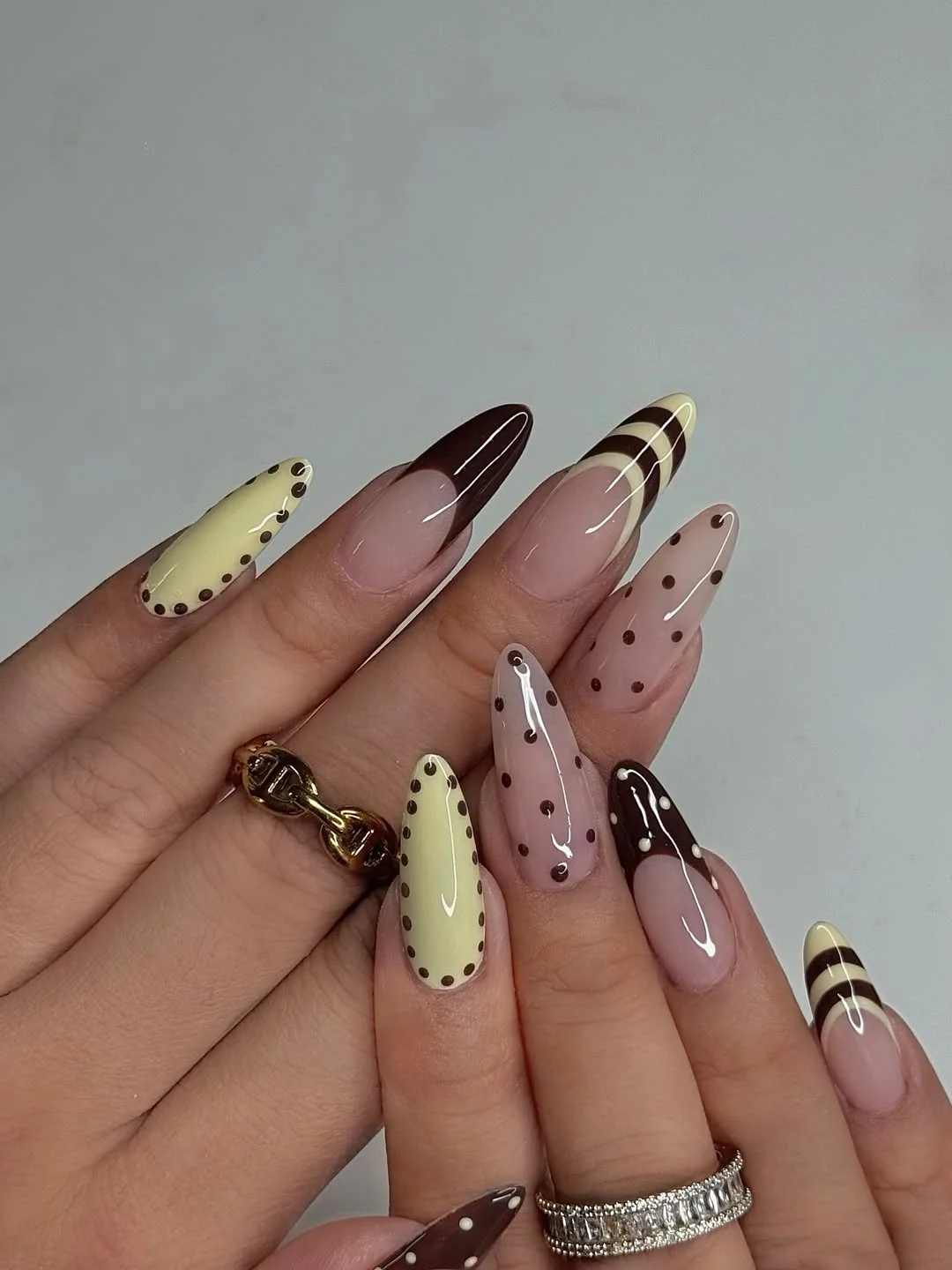
Yellow is easiest to wear here as a light accent rather than the only base. Let brown or taupe repeat more often, then use the pale yellow where you want the hand to feel brighter. The curves can stay on two nails, and a simple dotted detail can replace the smaller marks if you are adapting the idea to a shorter length.
The pale shade has a real personality of its own. It may look stronger against some skin tones and can show staining or surface change more than a medium brown would. If that contrast feels too sharp, a muted cream or soft olive can keep the same brown-line logic while making the set more neutral for everyday wear.
Navy Plaid with Blush Contrast
Deep navy anchors these medium almond nails, while blush, pale bases, rust, and gray appear in small plaid panels crossed by narrow light lines. The design feels a little like fall fabric translated into nail scale, but the colors remain clean enough to avoid looking costume-like. Repeating navy gives the mixed details a reliable place to land.
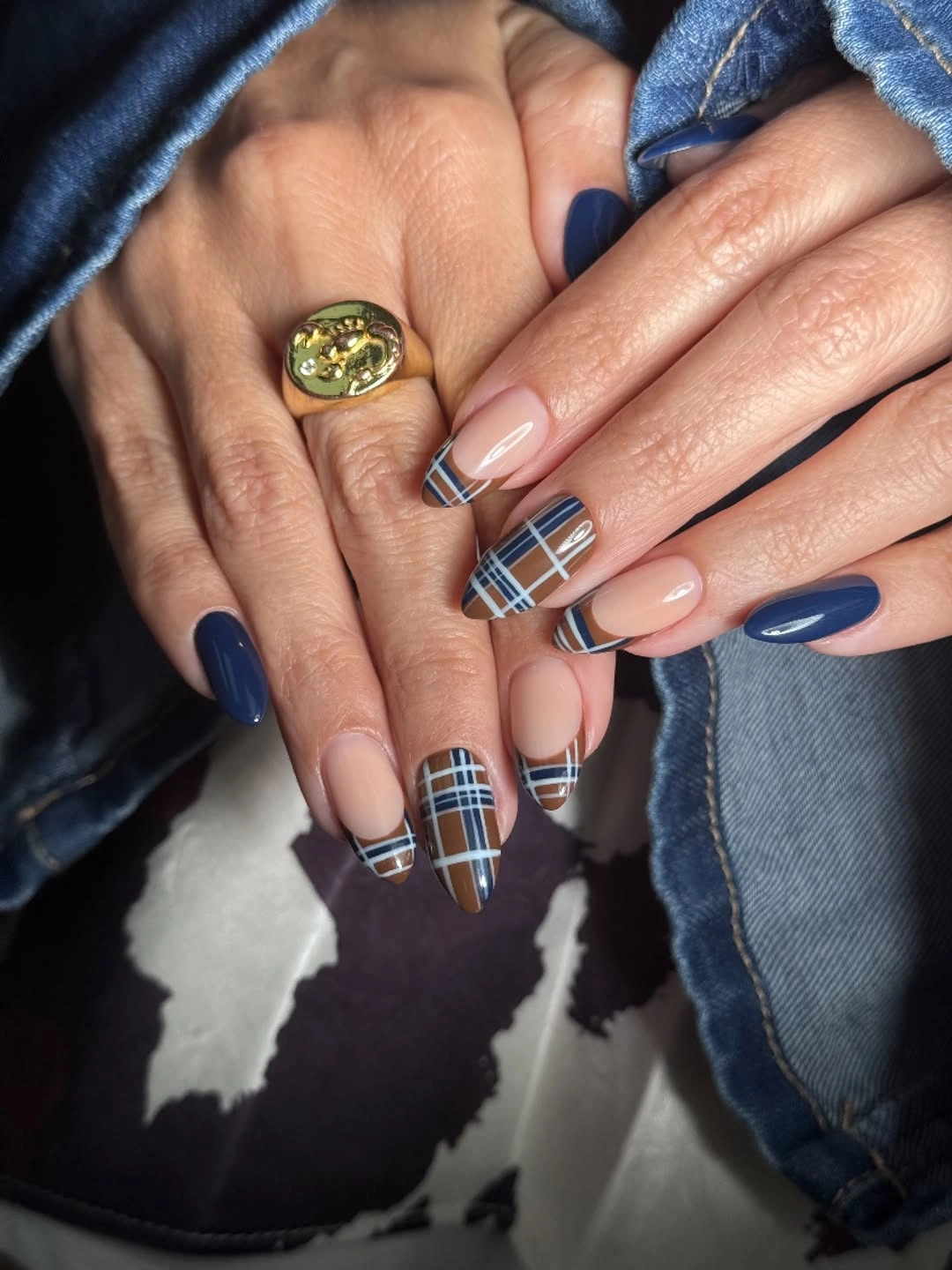
The most useful move is to choose one anchor before choosing the pattern. Keep navy on two or three nails, then use a single plaid panel and one blush surface to create contrast. On shorter nails, enlarge the grid and reduce the number of crossing lines; the fabric reference will still be present, but the pattern will remain readable.
Tiny checks are less forgiving than solid color. When the surface shrinks, too many narrow lines can become visual noise, especially beside a ring or textured sleeve. I would treat the plaid as a focal detail and let the remaining nails stay plain, because the open fingers make the small grid look more considered.
Deep Tonal Color Instead of Busy Art
Espresso, burgundy, and black create the entire mood of this long almond manicure. The colors shift subtly across the hand, and glossy reflections reveal the difference between wine and near-black brown without relying on visible illustrations. The effect is rich and dimensional, yet the surface stays clean enough for someone who prefers color to decoration.
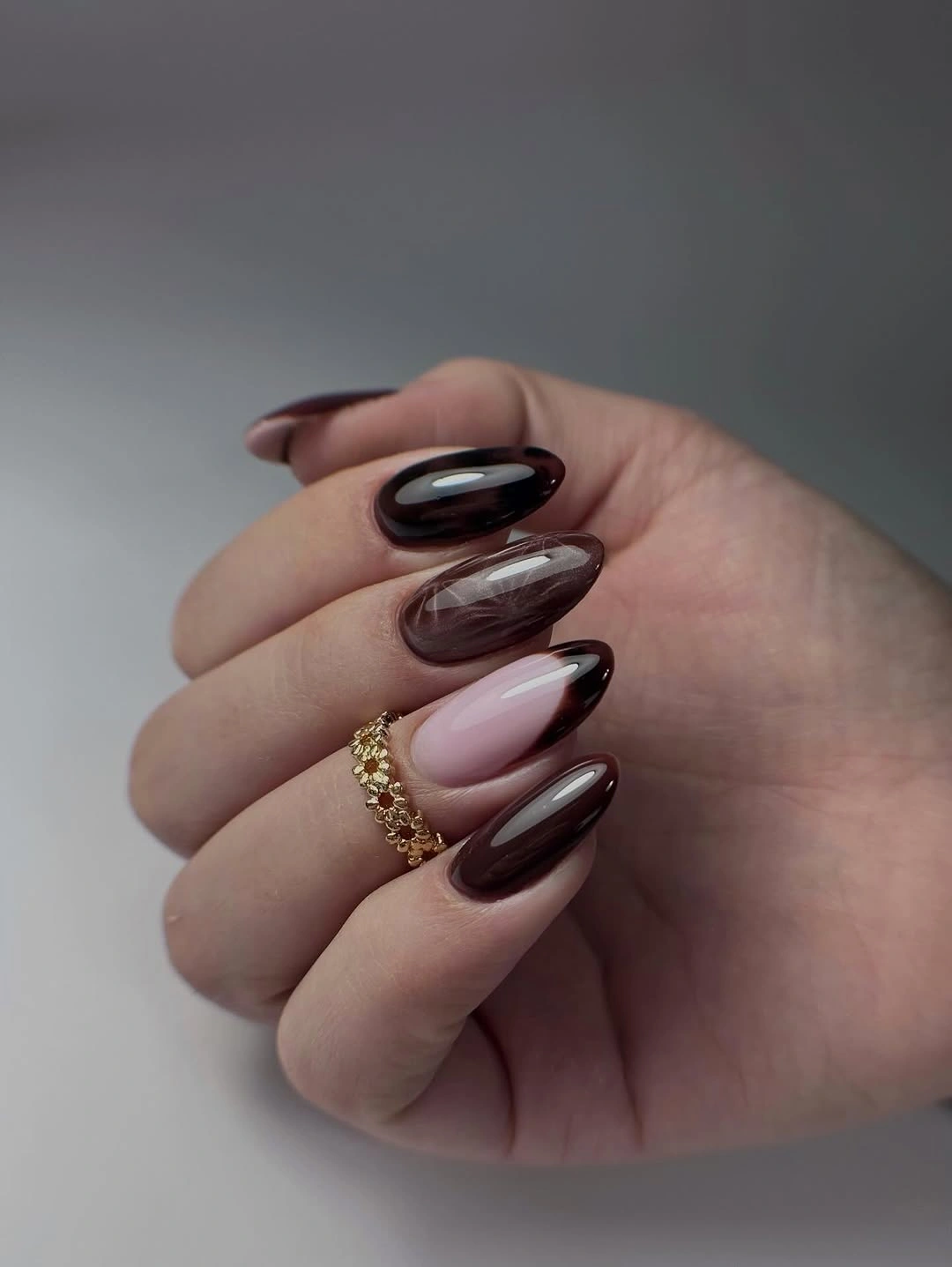
Think of tone as the detail. A slightly lighter burgundy on one or two nails will keep the dark palette from collapsing into one block, while the curved tips can guide the eye along the shape. If the nails are shorter, choose one middle-value berry or brown so the color change remains visible rather than disappearing into black.
Low contrast is both the charm and the limitation. The manicure may look nearly uniform in dim light, and a dull surface can remove the distinctions that make it feel layered. I would choose a high-shine finish and keep one lighter nail available when you want the tonal story to read clearly in everyday settings.
Thin Copper Lines on Clear Nude
These medium square nails use a transparent nude field and trace each tip with a narrow orange-copper line. There is no extra motif competing with the edge, so the design reads airy, precise, and quietly seasonal. The warm outline gives the hand color without covering the surface, which makes the simple structure feel more considered than a plain nude.
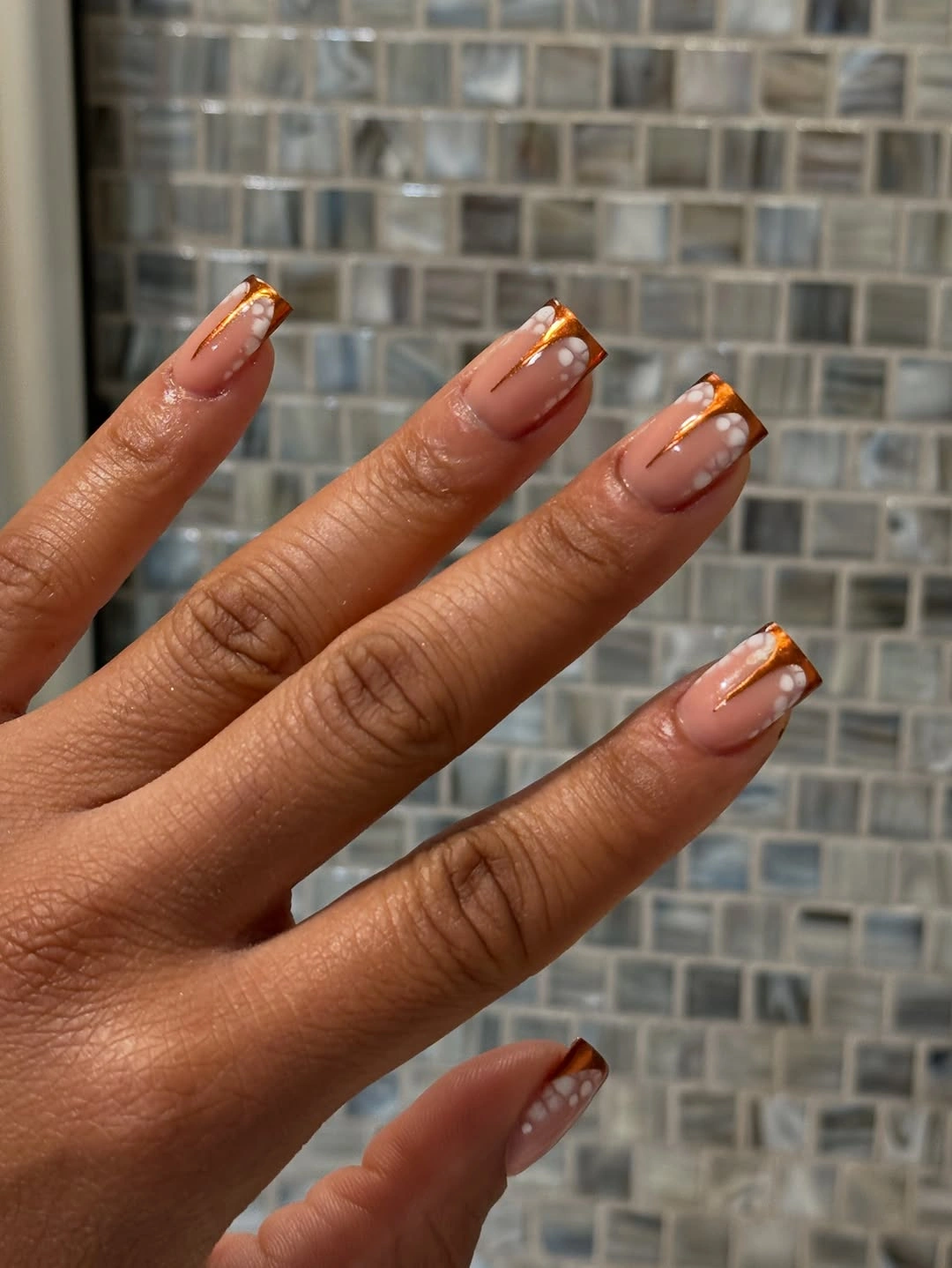
A fine line is a practical way to test fall manicure ideas square nails without committing to a dark full set. Keep the line copper for warmth, or change it to brown, olive, or burgundy while preserving the same placement. The short-friendly shape also means you can ask for a slightly thicker border if the delicate version would disappear on your nail bed.
The thinner the outline, the more it depends on clean spacing. A small break or uneven curve can stand out because the rest of the manicure is so open. If you want a lower-maintenance result, make the tip a little wider and let the color carry more of the visual weight than the precision of the border.
Espresso, Blush, and a Long Almond Line
Deep espresso alternates with blush nude and soft taupe across this long tapered almond set. There are no printed accents, so the contrast between solid color blocks and pointed ends creates the style. The dark nails add weight, the blush nails lighten the hand, and the repeated order gives the manicure a deliberate rhythm.
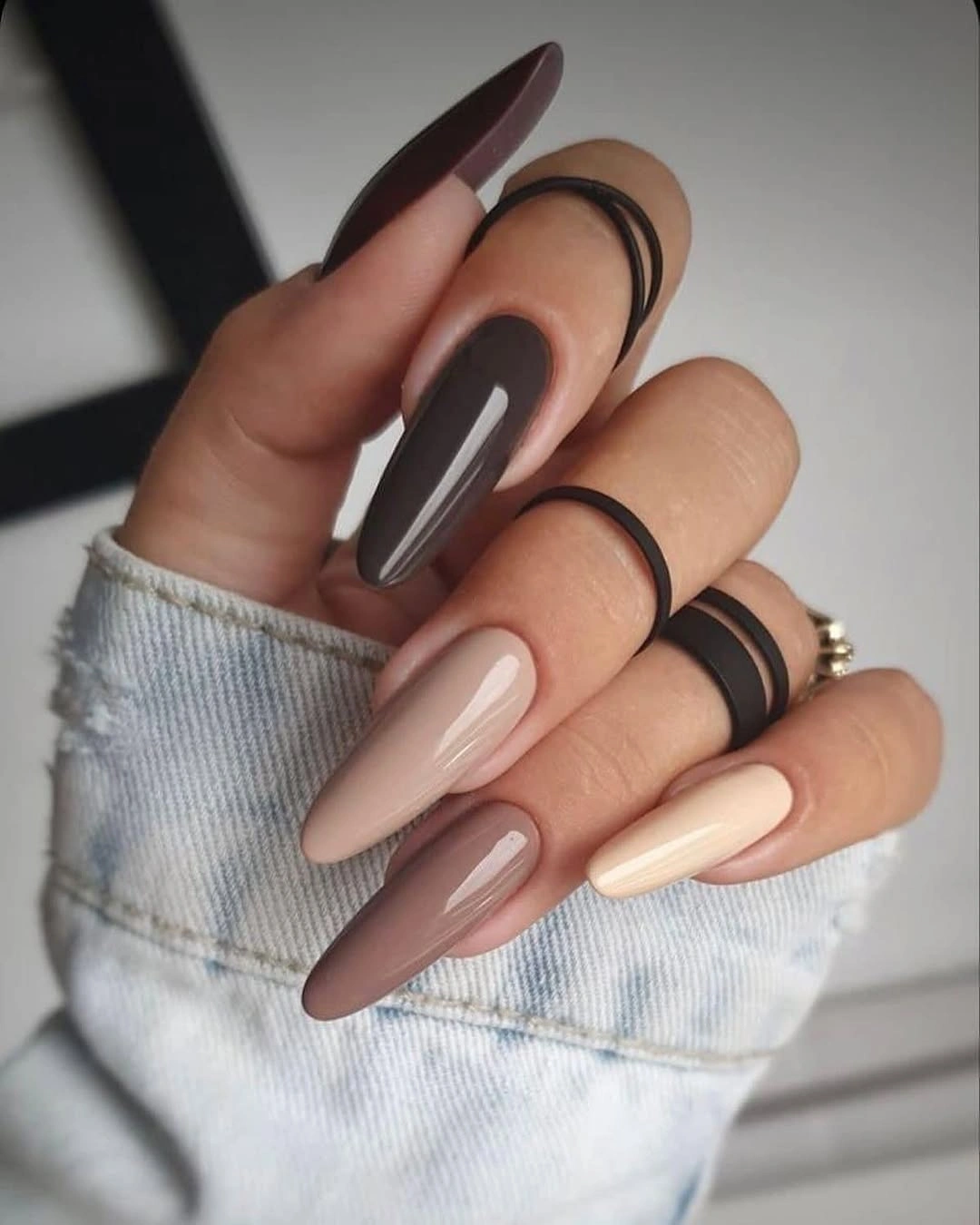
Changing the ratio is the easiest adaptation. More blush makes the set gentler, while more espresso gives it a stronger evening mood. You can also keep the long almond outline but shorten the free edge, because the color relationship remains clear even when the points become less dramatic and more comfortable for everyday use.
Long pointed ends are not a neutral backdrop. They add visual drama and can affect how practical the manicure feels, especially when the hand is busy with sleeves, bags, or keyboard work. I would use the alternating colors on a medium almond when you want the same fall contrast with fewer concessions to length.
Translucent Tortoiseshell Tips
Each long almond nail keeps a sheer nude base and finishes with a translucent amber-and-brown tip whose darker spots vary slightly from finger to finger. Because the color remains see-through, the manicure feels lighter than a full amber surface while still bringing the warm, mottled character associated with tortoiseshell. The repeated tip keeps the set cohesive.
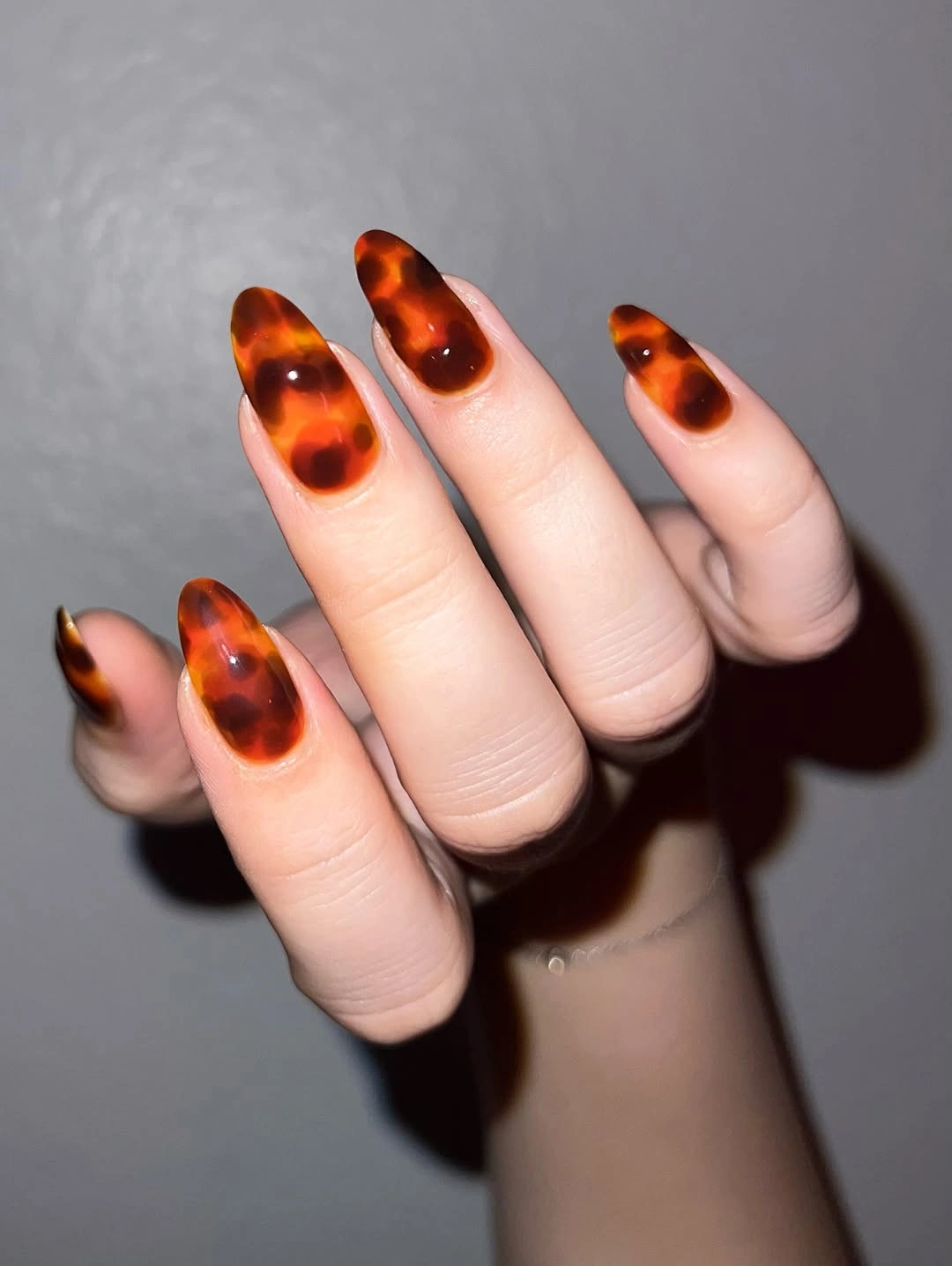
This is one of the easiest fall manicure ideas simple enough to adapt. Keep the tip broad on long nails, or reduce it to a small rounded crescent on a shorter almond so the pattern does not crowd the nail. The varied spots are helpful because they remove the pressure to make every finger perfectly identical while the silhouette does the organizing.
Transparency needs enough width and contrast to stay visible. If the tip becomes too narrow, the amber may read as a vague shadow rather than a deliberate pattern. I would keep the base pale and the tip slightly fuller than a micro-French, especially if the goal is for the warm detail to show in ordinary daylight.
Rounded Brown Loops on Sheer Pink
The final set uses a medium almond outline and a sheer pink base, then adds irregular chocolate-brown loops, tiny pale highlights, and bronze-like borders around selected tips and sides. The shapes are organic rather than perfectly repeated, so the manicure feels softly graphic and personal. Open pink areas keep the dark lines from taking over the hand.
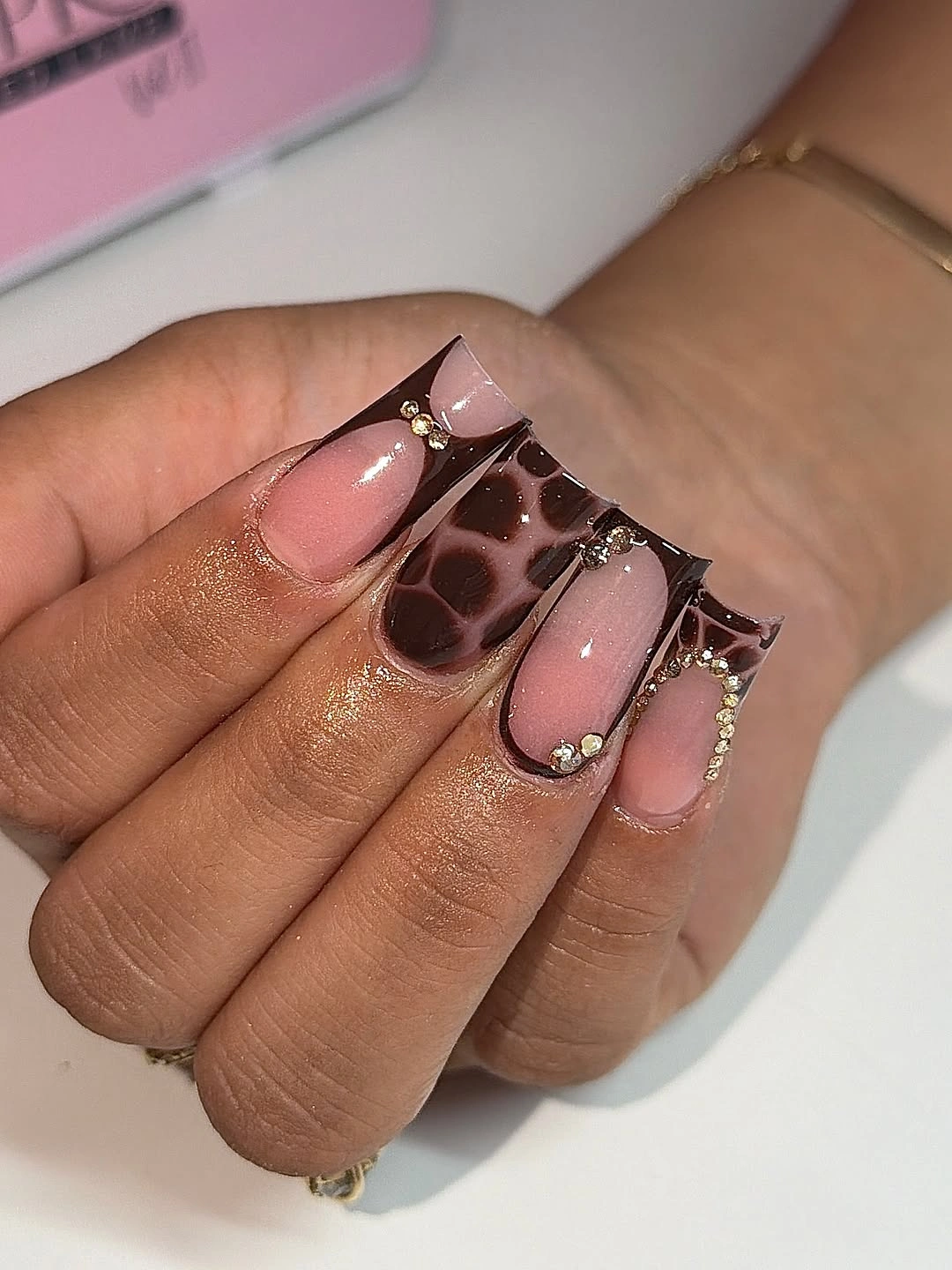
The best adaptation is to borrow the outline language and edit the number of loops. Two accent nails can carry the full brown curves, while the remaining fingers use one small border or a plain sheer finish. That keeps the contrast between negative space and dark detail, which is the visual reason the set feels layered without becoming dense.
Irregular art still needs balanced spacing. If every loop grows in a different direction, the design may look crowded rather than relaxed, especially on a smaller nail. I would choose a few confident curves and leave more pink visible when wearability matters, because the restraint makes the brown details look intentional.