A shade can look completely different once it meets the hand, which is why choosing fall nails for fair skin tones is often more about proportion than about following a color rule. Contrast can be soft, sharp, or nearly invisible, and the most satisfying choice is usually the one that feels balanced at a glance. What matters is giving the color enough definition to feel purposeful without asking it to carry an entire look alone.
Before settling on a design, decide whether you want the shape, the surface, or the color to be noticed first. Once one of those choices is clear, leave the others quieter so the finished manicure has room to breathe. The site’s spring nail color guide is a helpful related reference for seeing how a clean outline changes the effect of a shade.
Milky Cream with Delicate Brown Speckles
The milky off-white base gives these long almond nails a soft, open look, while small cocoa spots add a controlled amount of contrast. Because the marks vary in size and do not cover the whole surface, the pale color remains the main field rather than becoming a background for a dense print. This approach is especially appealing when you want fair skin tone nail colors that feel noticeable but still light in overall value.
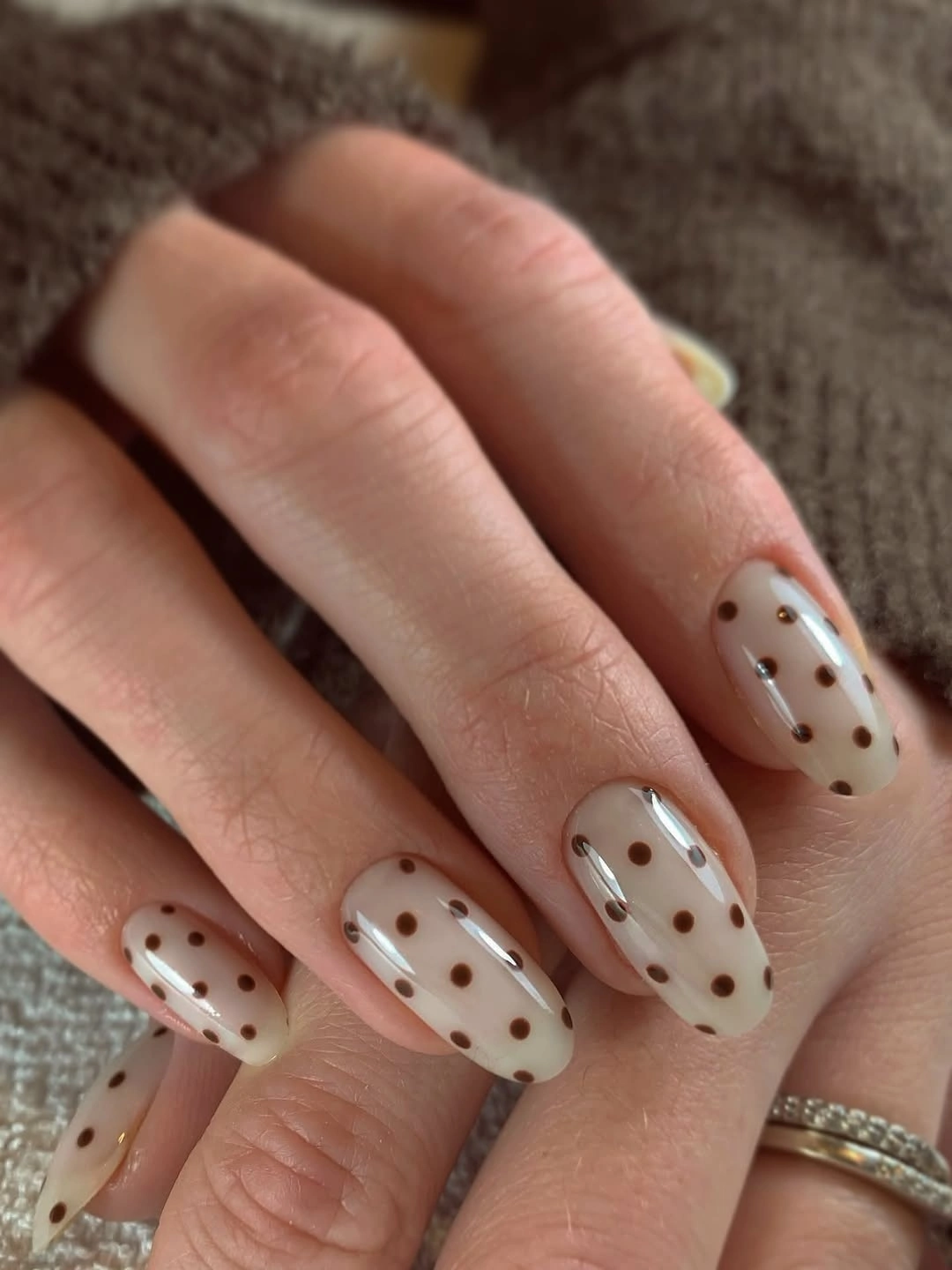
The design feels balanced because the almond length offers plenty of room around each small mark. A shorter oval version could use fewer spots and retain the same idea, while a longer shape lets the irregular placement look more relaxed. Keep the brown close to one tone instead of introducing several colors, since the restrained palette is what stops the spots from reading as a busy all-over pattern.
There is a practical upside to leaving so much cream space: the manicure still looks calm from a distance and gains interest only when someone notices the details. Light bases may show surface wear earlier than dark ones, so smooth edges matter. That small maintenance tradeoff is worth it for a look that pairs easily with denim, knitwear, warm jewelry, and almost any neutral clothing color.
Nude Almond Nails with Open Floral Lines
Soft pink nude almond nails make an ideal ground for the fine brown flowers and dotted centers scattered across this set. The flowers are outlined rather than filled, which keeps their scale gentle and lets the nude base remain visible between every petal. This is a thoughtful option for fall nails for fair skin tones when you like ornament but prefer a design that does not cover the hand in dark color.
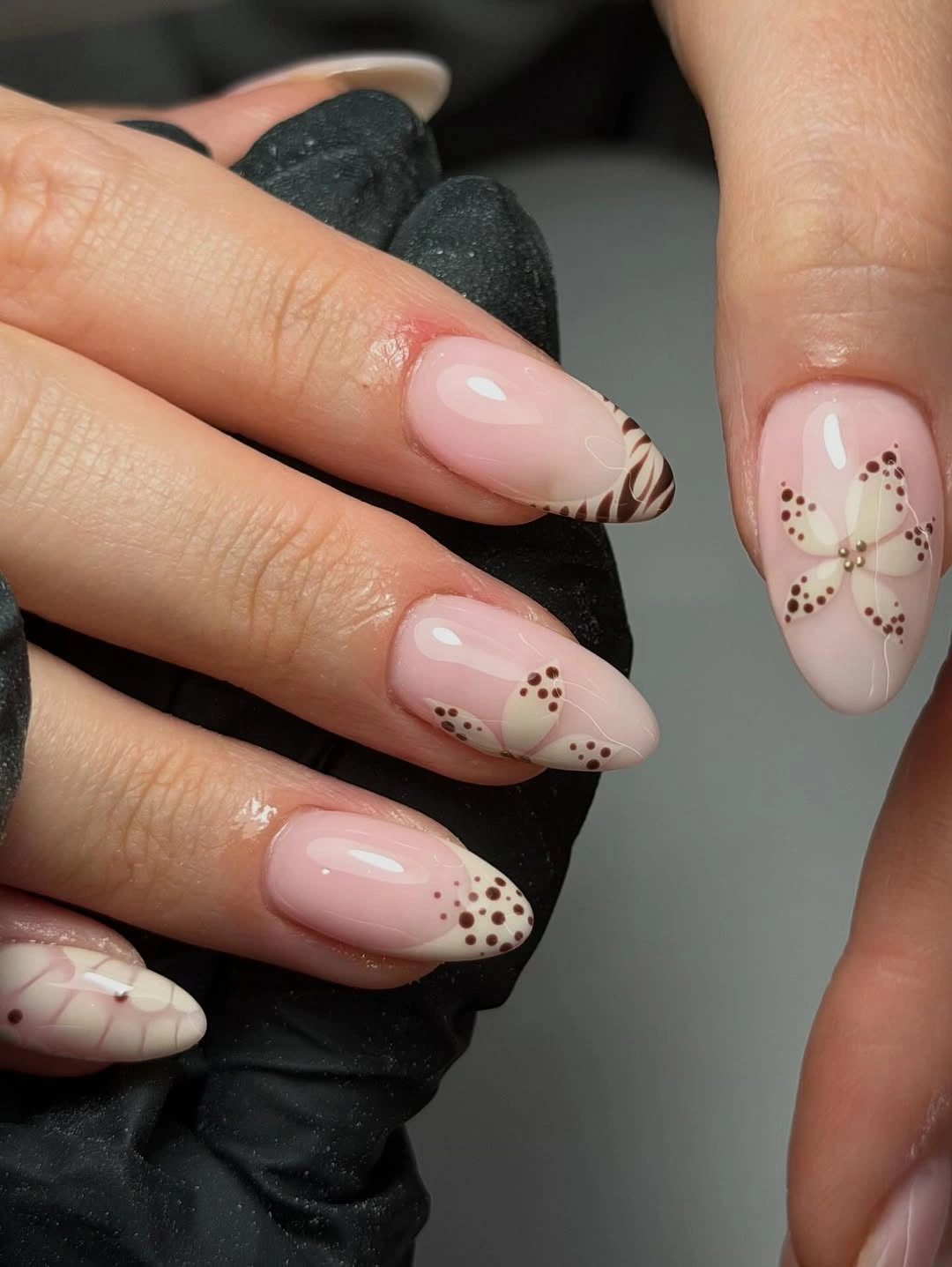
What gives the florals their clarity is the generous negative space around them. The tiny blossoms are allowed to sit separately, so the eye can follow each curved line without losing the overall silhouette. To make the idea more minimal, choose one flower on two accent nails and keep the remaining nails plain nude; the line work will still feel intentional without demanding the same precision across every finger.
Fine outlines ask for a clean surface and will look best when the brown stays crisp, so this is not the most forgiving choice for anyone who wants a very low-effort finish. Still, it has a quiet flexibility. The nude color makes the flowers easy to style with both warm and cool accessories, while the visible spacing ensures the manicure remains more refined than decorative in its overall mood.
Dark Botanical Marks at Bare Nude Tips
Small black and dark brown leaf-like marks placed near the tips give these pale nude almond nails direction without changing their light character. The lower part of every nail stays almost bare, which makes the dark detail feel like a finishing gesture rather than a full illustration. For readers considering nail colors for fair skin, the gentle base and compact dark marks show how contrast can be present without making the entire set feel heavy.
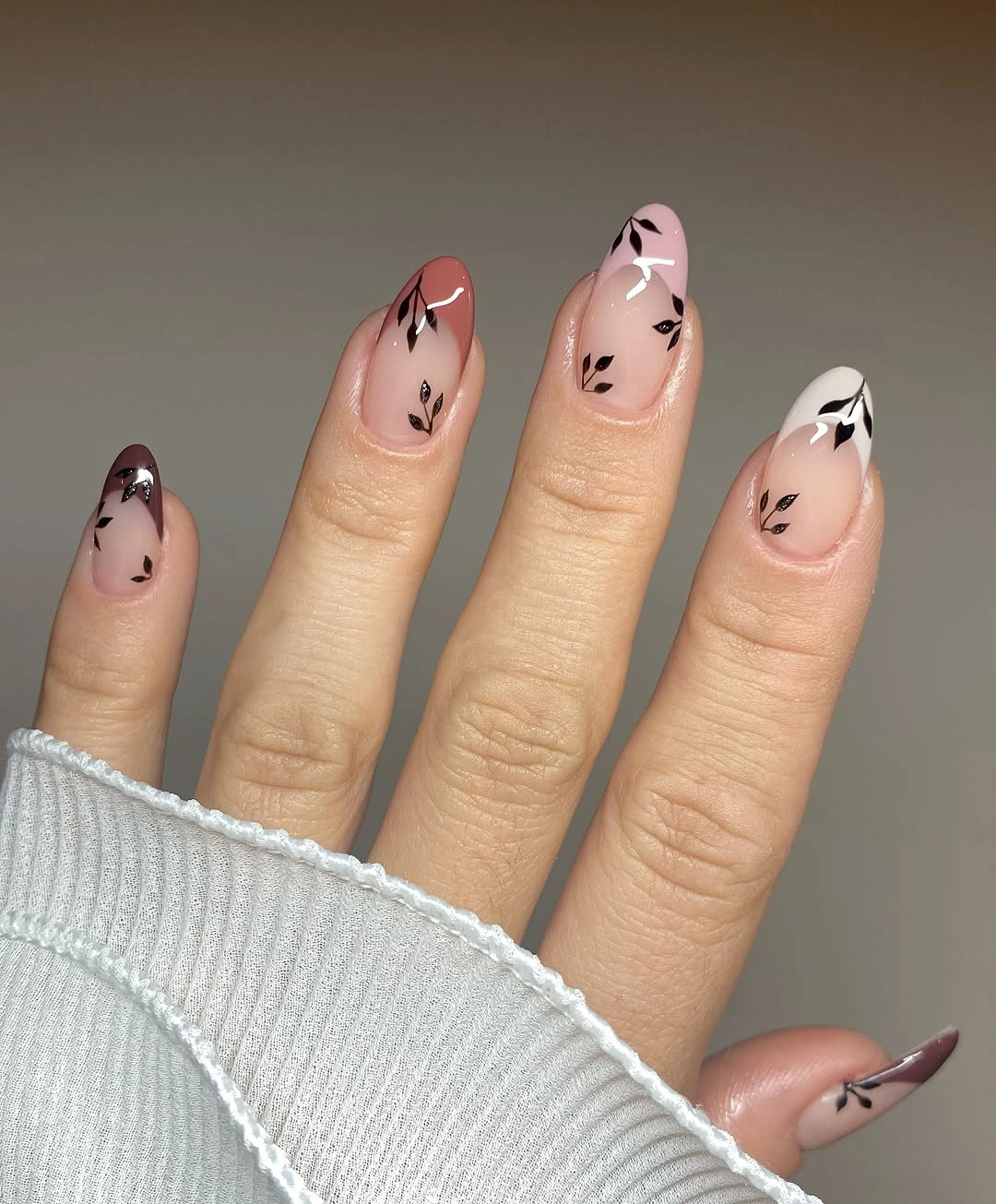
Tip placement is the key choice here. It follows the length of the almond shape and naturally draws the eye outward, while the uncovered base keeps the design airy. If the dark marks feel too strong for your taste, swap black for a muted cocoa line or reserve the motif for only two nails. The visual logic will stay the same because the open space, not the pigment amount, creates the lightness.
This kind of subtle art is less about a dramatic first impression and more about a detail that rewards a closer look. It works well with rings or textured sleeves because it leaves enough visual room for other accessories. The main limitation is that very thin lines can lose their precision sooner than a solid color, so keeping the design small and intentional is also the most practical way to maintain it.
Dusty Lilac with Fine White Flowers
Muted lilac gives this almond manicure a soft but distinct color base, while the narrow white flowers and green stems bring a delicate linear contrast. The floral details are placed vertically, following the nail shape instead of sitting like separate stickers on the surface. That decision makes the whole set feel more continuous and helps the cool lavender tone remain the visual anchor rather than disappearing behind the botanical work.
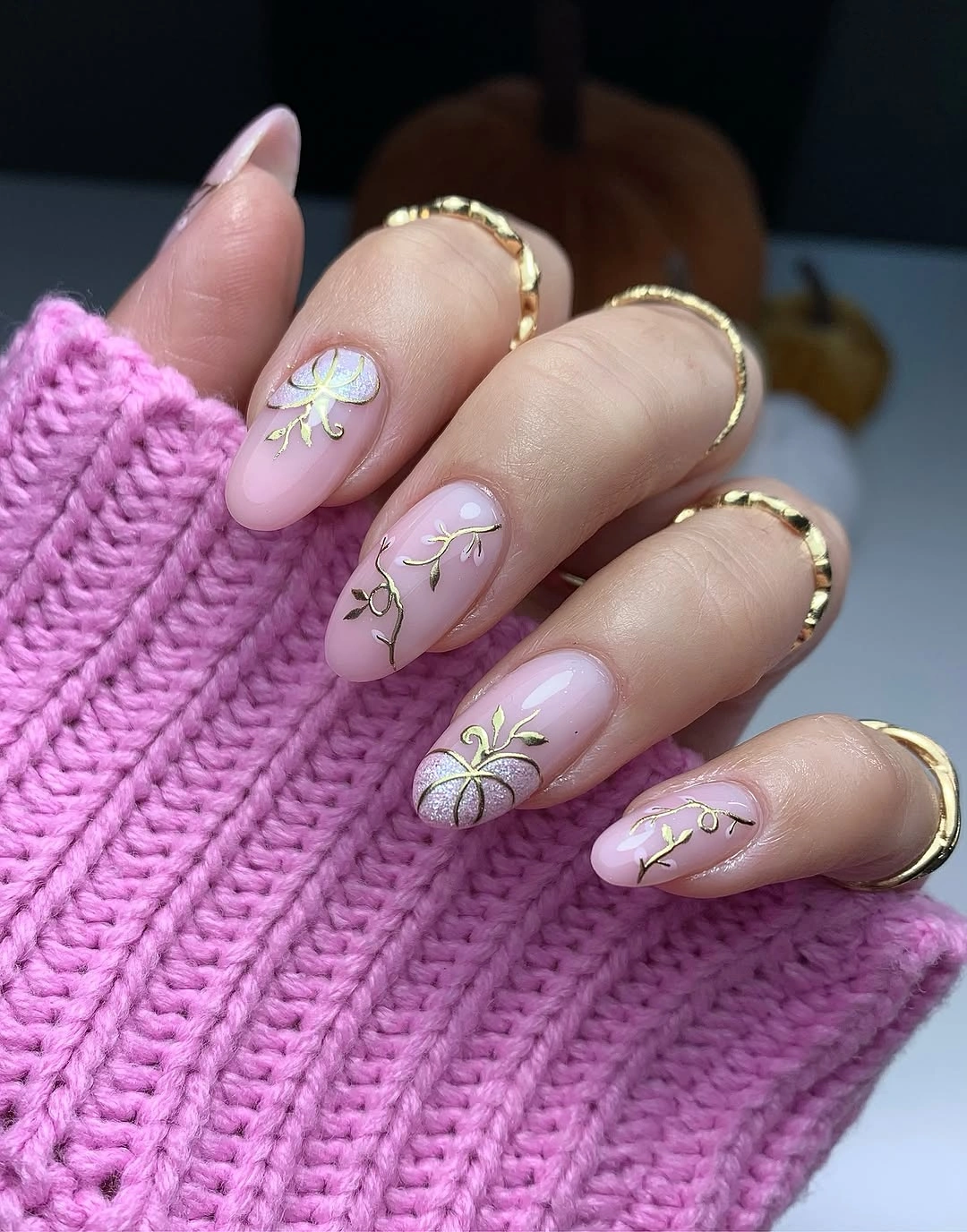
The color is gentle, yet the white line work keeps it clear against fair skin without needing a darker full nail. For a more pared-back variation, use the flowers on one or two nails and leave the others in solid lilac. You will keep the same clean contrast while reducing the amount of intricate detail, which can be useful if you prefer an artful look that still feels simple in everyday settings.
Because the stems and petals are narrow, this manicure benefits from an even glossy finish that helps the small marks remain distinct. A very matte surface could make the delicate lines feel less crisp. The combination is best for someone who enjoys muted color with a little structure: not a plain pastel, not a dense pattern, but a balanced middle ground where the light base and focused detailing support each other.
Mustard and Mauve with Zebra Accents
Mustard yellow and dusty mauve solids give this medium almond set warmth, while the pale nails with black zebra stripes add a sharper graphic interruption. The pattern is kept to selected nails, which is exactly why it works alongside two different solid colors. Instead of competing, the warm shades create a color-blocked frame for the black-and-cream detail and make the print feel chosen rather than randomly added.
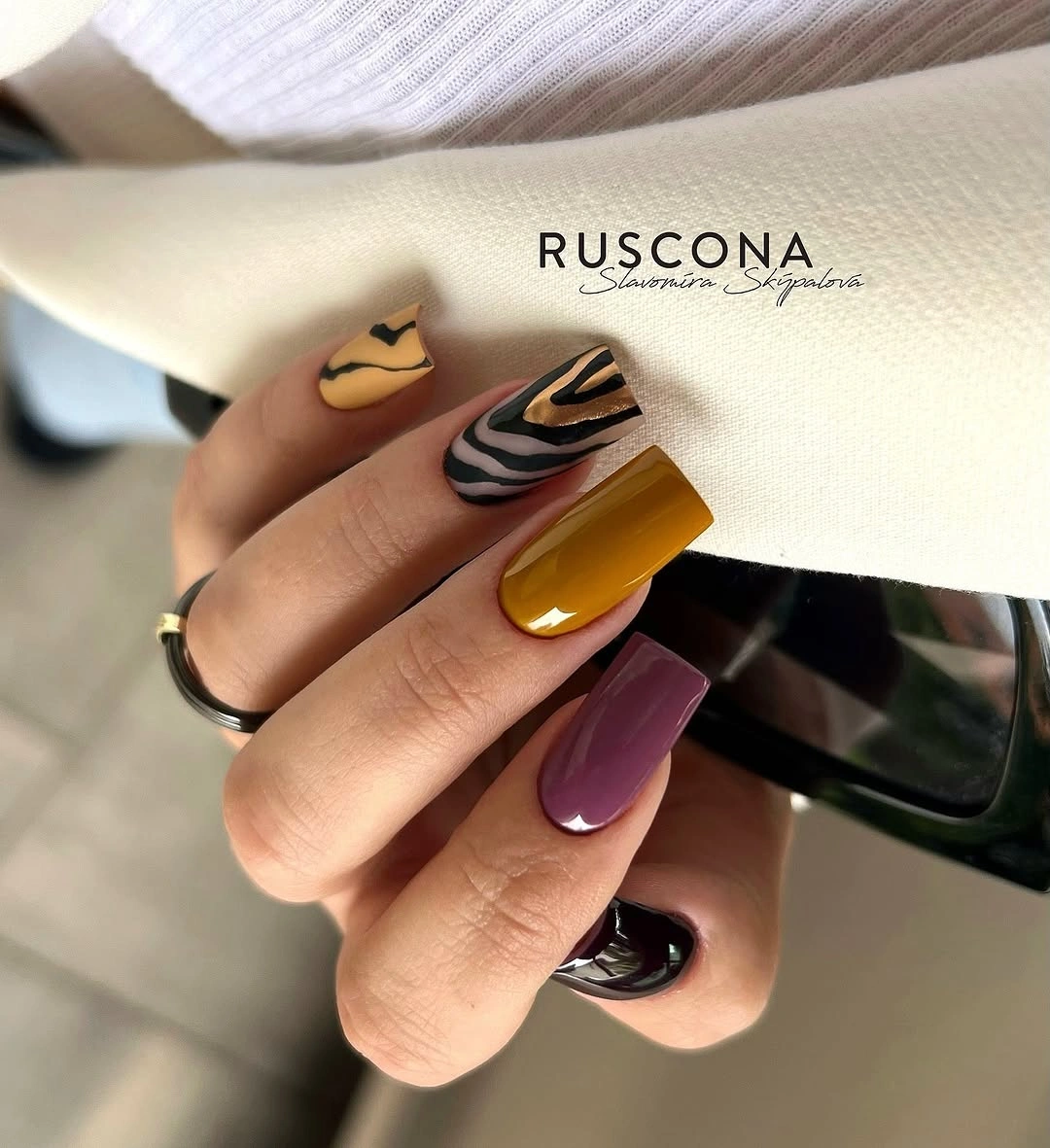
A palette with several elements needs a clear hierarchy, and here the zebra work gets its authority from the pale base and dark line contrast. If you want a softer version, retain the mauve and use only one striped accent with a cream background. The mustard can be omitted or used as a tiny tip, depending on how much warmth you want to bring into the finished balance.
Animal-inspired stripes are naturally high energy, so they are most wearable when the surrounding nails are solid and the finishes remain consistent. This is not a design that needs glitter or rhinestones to make its point. Let the graphic black marks do the work, and keep the almond length medium enough that the pattern has room without turning the hand into an uninterrupted field of movement.
Deep Green on a Clean Almond Outline
Near-black green gives these medium almond nails depth, but the glossy highlights reveal enough color to prevent the result from reading as ordinary black. The uniform finish makes the shape the central visual decision, which is why the set feels composed rather than plain. It is a strong fall nail color for fair skin when you want contrast with a slightly cooler undertone and no decorative application to manage.
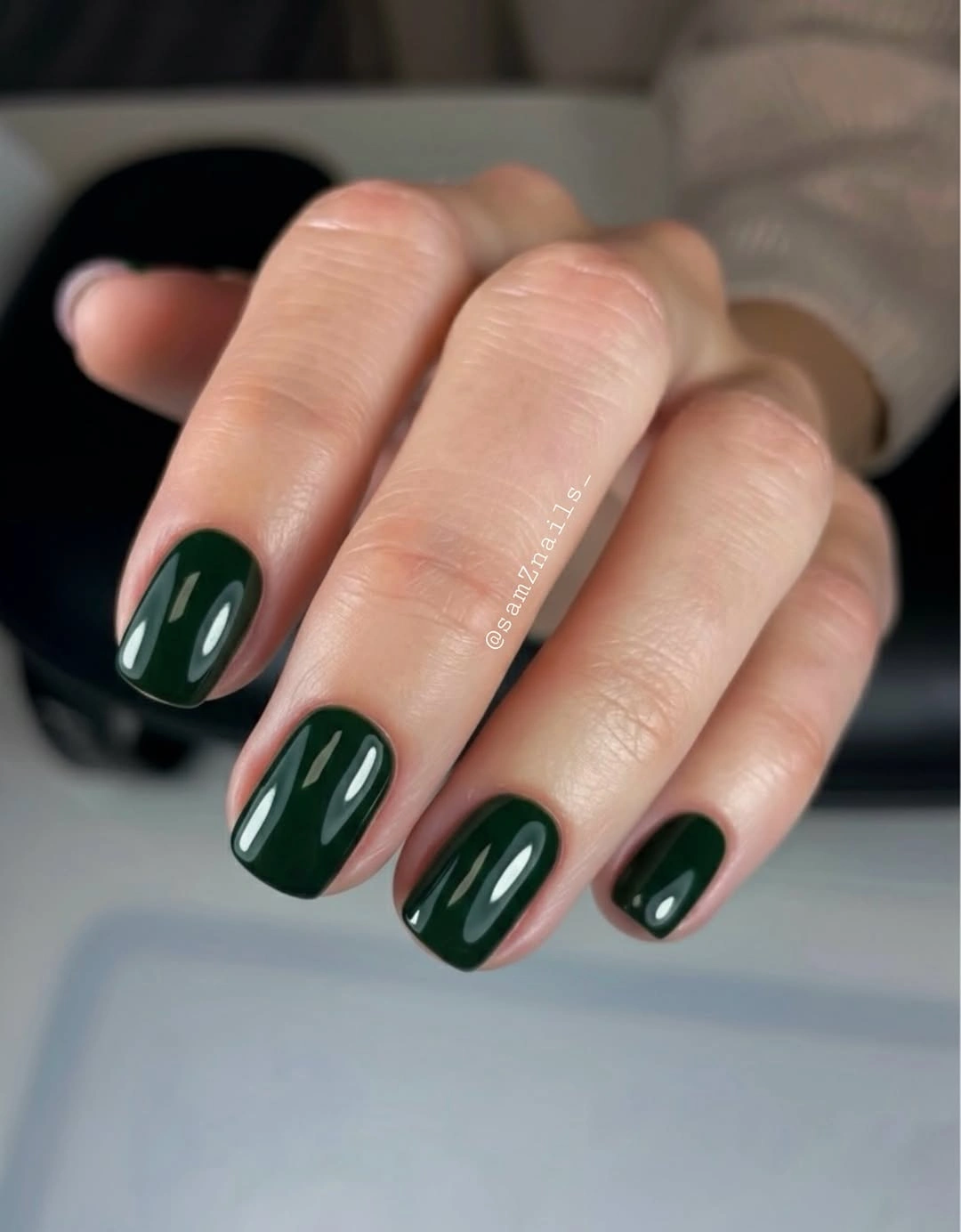
The almond silhouette softens the density of the green and makes the color appear more fluid as light moves across it. A shorter rounded version would look quieter, while the medium length here gives the shade a little more presence. Since every nail carries the same pigment, even coverage is the important detail; the clean surface is what turns a dark single color into a polished choice rather than a default.
Dark colors can show chips near the edge, especially when the gloss is high, so this works best for someone ready to keep the tips neat. In exchange, it is remarkably easy to style. Deep green sits comfortably next to black, cream, denim, brown leather, and gold jewelry, giving you an alternative to wine red that still carries the depth people often want from an autumn manicure.
Orange Animal Print with Dark Pointed Tips
Warm orange, black spots, and deep red tip accents cover most of these long almond nails, making the animal-print idea intentionally expressive rather than understated. The palette stays coherent because the orange ground repeats across the hand, even when the black marks shift in shape. This is a full-detail look, and its strongest feature is that it commits to one energetic pattern language instead of mixing unrelated motifs together.
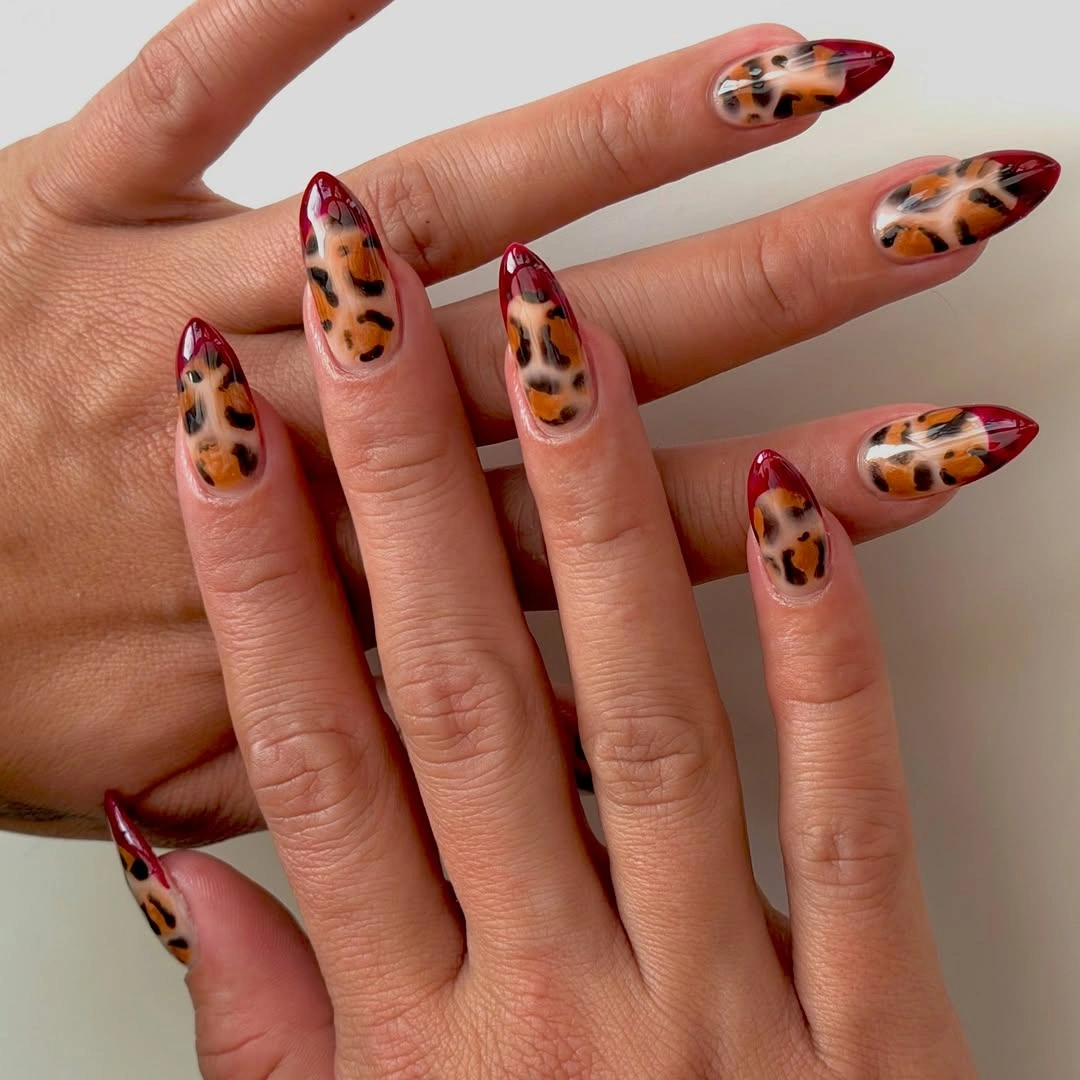
When a print occupies so much surface, color repetition is what prevents it from looking chaotic. The black markings have a consistent job, the orange supplies warmth, and the darker tips give the elongated nails an edge. To adapt the concept for a less dramatic version, use the print on two nails only and let the rest remain a solid deep orange or red; the palette will still carry the same personality.
The tradeoff is visible: long nails and all-over pattern demand attention, so this may not be the choice for someone who wants a quiet beauty detail. That does not make it impractical, just expressive. Keeping jewelry simple and avoiding another bold pattern in your outfit will let the orange-and-black contrast feel edited, while the glossy finish ensures the irregular spots look deliberate rather than muddy.
Short Raspberry Red with a Glossy Finish
A medium-deep raspberry red gives these short oval nails a finished, confident color without relying on an accent, tip, or sparkle. The rounded edges soften the saturation and keep the set approachable, which is useful if bright polish often feels too formal or too youthful on your hands. Among fall nails for fair skin tones, this is the kind of one-color choice that gets its strength from depth and an even glossy surface.
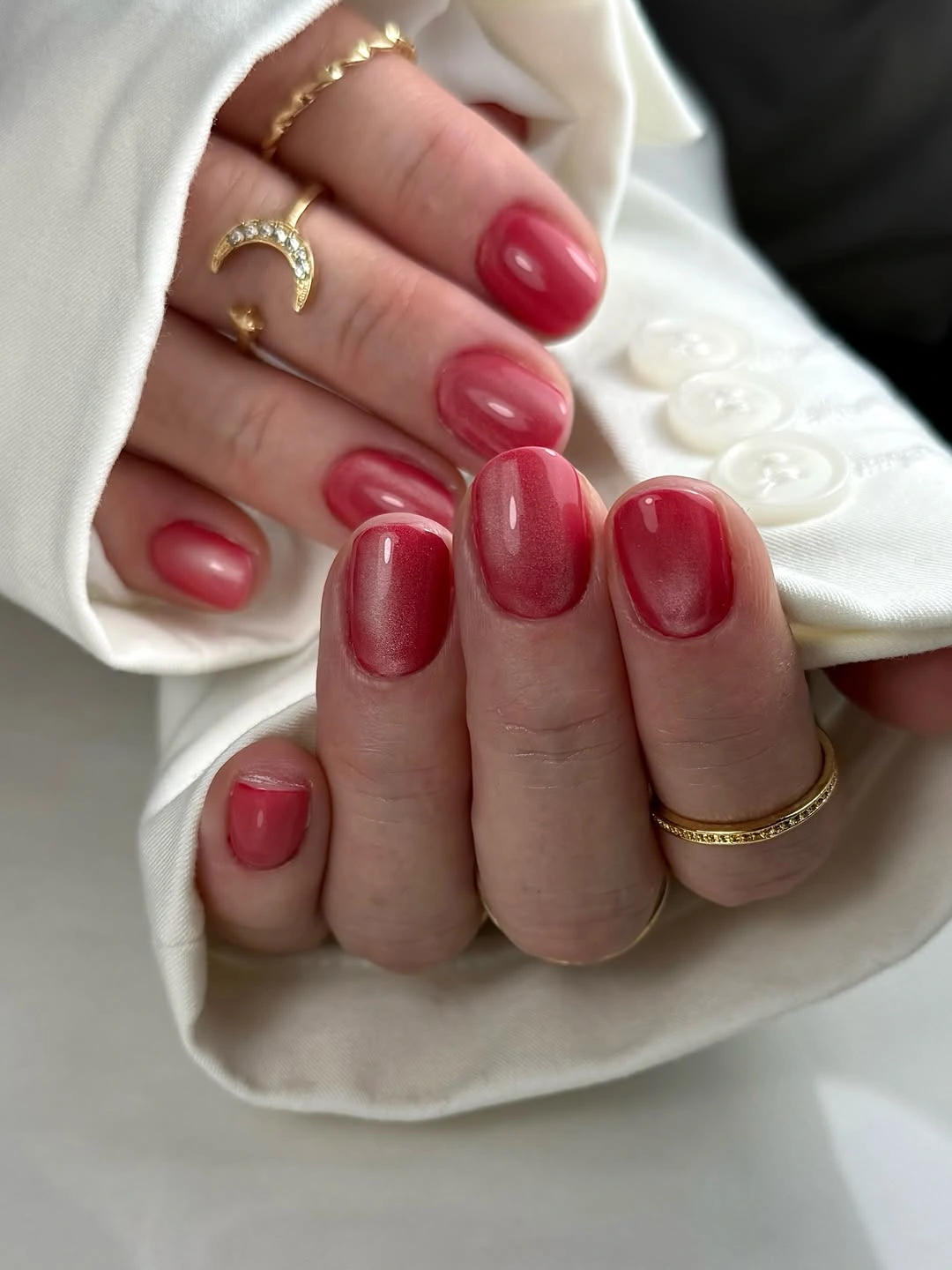
The compact length changes how the red reads. Instead of becoming a dramatic statement, the color feels contained and clear, with the nail shape doing the work of keeping it relaxed. If you prefer a little extra interest, a single slightly darker nail could create a subtle tonal shift, but there is no need for additional art. The uncomplicated color is precisely what makes this look easy to repeat.
Raspberry is more flexible than a very bright primary red because it has a muted depth that can sit beside cream, charcoal, brown, or denim without forcing the rest of your styling to match it. It will show edge wear eventually, as all glossy dark shades do, but the short shape keeps maintenance manageable. A tidy outline and a color you genuinely enjoy on all ten nails are enough here.
Berry Fuchsia on Long Almond Nails
Long almond nails covered in a clear berry-fuchsia shade make color the entire focal point, with no visual distraction from accent nails or pattern. The gloss intensifies the saturation and gives the elongated shape a smooth, continuous line. This is for the person who wants their manicure to be seen immediately, yet prefers that impact to come from one precise decision rather than from several competing embellishments.
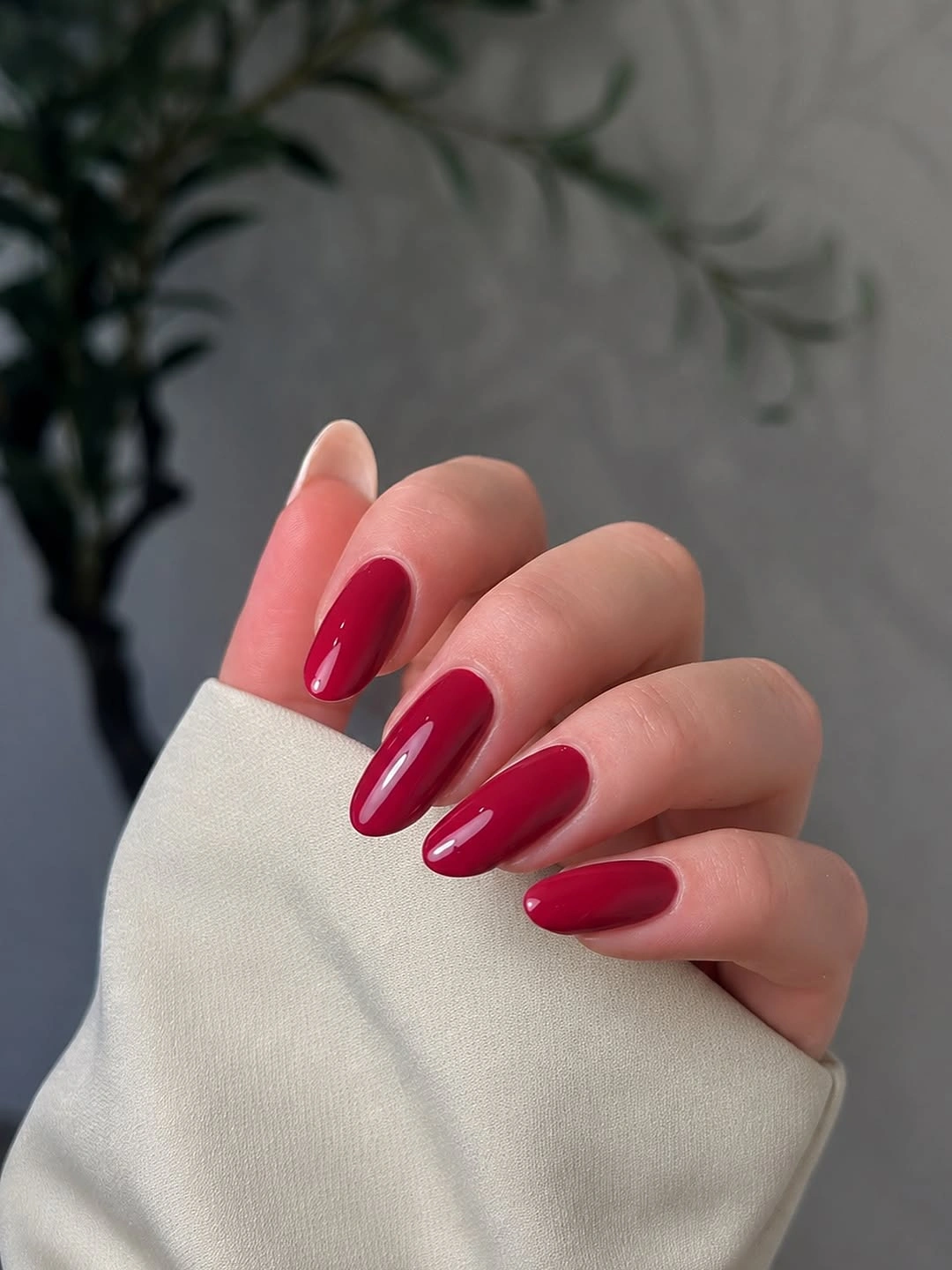
The clean design benefits from the consistency of its length and color. On a shorter shape, the same fuchsia would feel more casual; on these longer almonds, it becomes a brighter style statement. If you are unsure about wearing the shade on every nail, test it on a medium length first. The color has enough depth to feel rich, but it will not recede the way a muted plum or brown might.
Strong full-coverage color creates a simple styling rule: let the nails be the most saturated detail, then keep other accessories relatively restrained. A neutral sleeve, minimal ring, or plain bag will give the berry shade room to work. The maintenance requirement is mostly about keeping the glossy surface and free edges clean, because without a pattern there is nowhere for unevenness to hide.
Gray-Blue and Pink in a Compact Mix
Short square nails alternate gray-blue, pale pink, and a dark patterned accent, creating contrast that is cool and composed rather than stark. The color blocks are small enough to stay tidy, while the square outline gives each shade a clear little panel. This is a useful way to mix fair skin tone nail colors when you want a design with variety but do not want a long shape or a fully illustrated manicure.
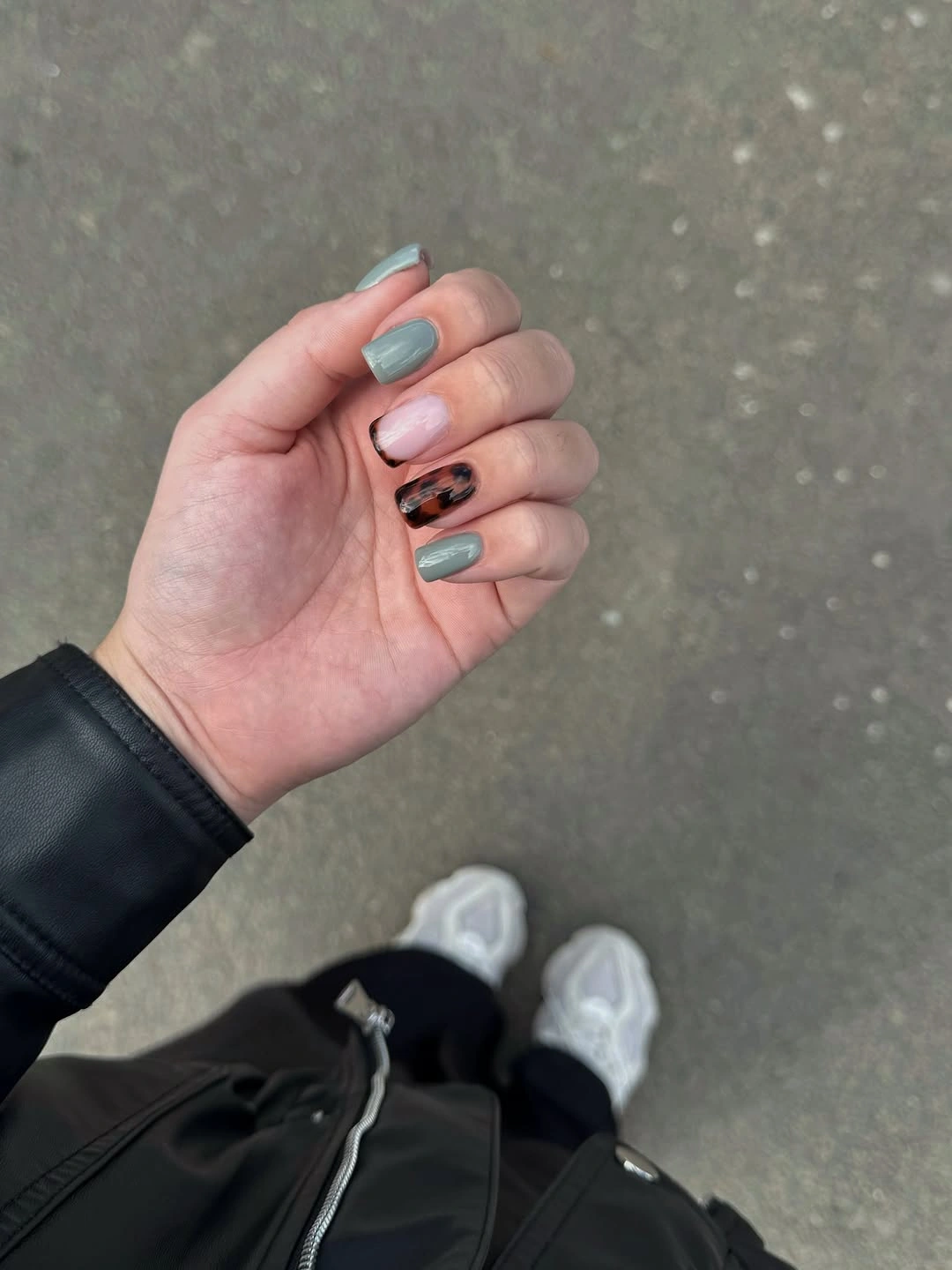
The cool gray-blue provides depth, the pale pink keeps the value light, and the darker accent supplies a concentrated point of interest. You can make the same formula feel calmer by removing the patterned nail and repeating the blue once more. What matters is the balance between a soft light tone and a cooler deeper one, not the exact number of colors placed across the hand.
Short square nails suit mixed shades because the compact surfaces keep the arrangement from looking scattered. They also make the look easier to wear for someone who prefers a practical length. Avoid adding extra metallic details here; the color relationship is already doing enough. The crisp edge and limited palette are what make this design feel modern, clean, and more polished than a random assortment of seasonal shades.
Mixed Animal Patterns in One Tight Palette
Zebra stripes, tortoiseshell-like patches, spotted marks, and a pale green scaled accent appear together in this medium-length mixed manicure, yet the brown, black, cream, and pale green palette holds them in the same visual family. It is not a minimal set, but it has a logic: every pattern is built from a similarly earthy range, so the different marks feel collected rather than unrelated.
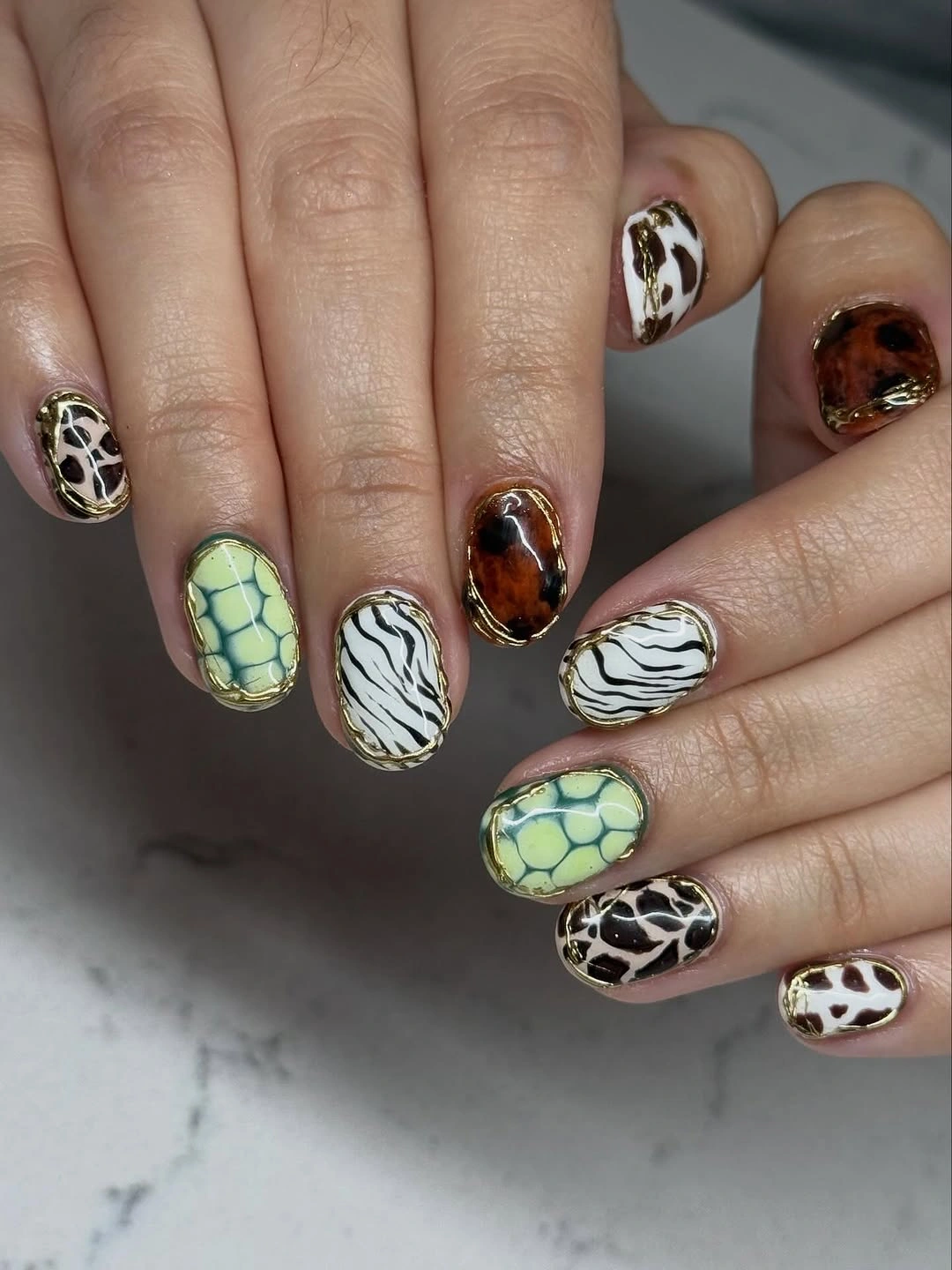
With several prints in one set, editing becomes more important than adding. Leave at least one nail quieter, let the cream base show around the darker patterns, and avoid introducing another bright color. If this many motifs feel like too much for your personal style, choose one animal pattern and repeat it on two accents, borrowing the shared brown-and-cream palette without copying the full mix.
This design has a clear tradeoff: it gives maximum visual interest but asks for a simpler outfit and careful detail work. The medium length helps by providing space for the individual marks without making them too tiny to read. It is a good choice when nails are meant to be a playful styling element, not merely a background detail, and when you enjoy patterns with deliberately uneven character.
Muted Neutrals in Soft Color Blocks
Cream, peach nude, dusty pink, and muted purple appear as separate solid colors on these medium almond nails, creating a low-contrast color-block effect. None of the shades is especially loud, but together they add more movement than a one-color neutral manicure. The shared dusty depth is what makes the different colors feel connected, even though each nail takes a slightly different place in the soft progression.
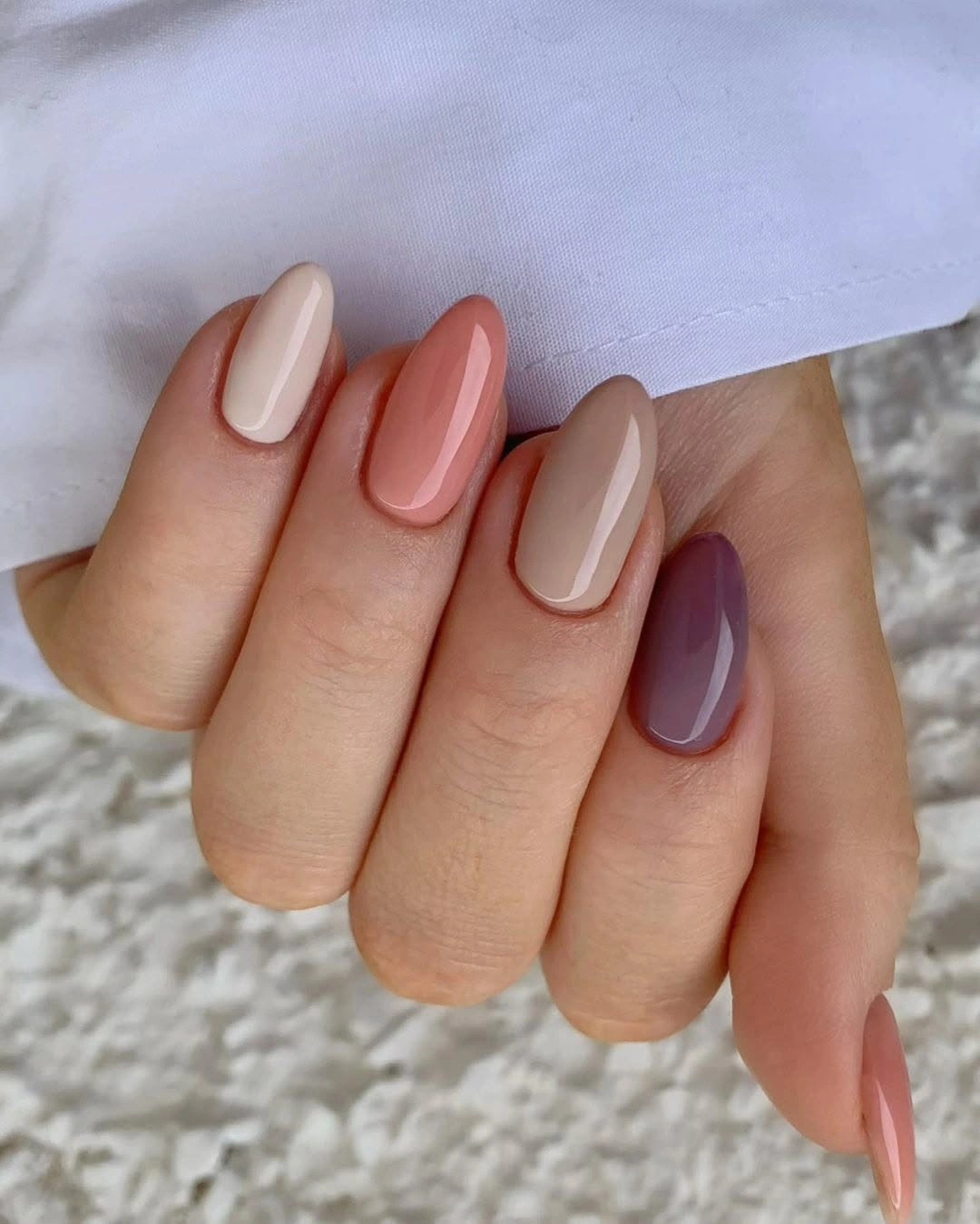
This is an approachable way to experiment with multiple colors when you do not want patterns, tips, or line work. Select shades with a similar softness and let the almond shape remain consistent, then the variety will feel intentional rather than random. You could limit the formula to three colors for a quieter result, or repeat the cream on two nails to create a little more symmetry without losing the relaxed color shift.
Because the colors are close in intensity, the set has a calm presence that works well with both silver and gold jewelry. It will not deliver the same instant contrast as a dark green or berry shade, but that is its advantage for someone who likes a more open, light feel. Smooth application matters, since each solid color is exposed on its own without an accent pattern to distract from uneven coverage.
Sheer Iridescent Fragments over a Light Base
A translucent light base scattered with pale blue, pink, and lavender reflective pieces gives these medium almond nails a dimensional surface without becoming a dense glitter manicure. The fragments overlap irregularly, so the effect changes as the hand moves and catches different light. This is a good fit for someone who wants a lighter fall detail but still wants their nails to have visible texture and a little unexpected color play.
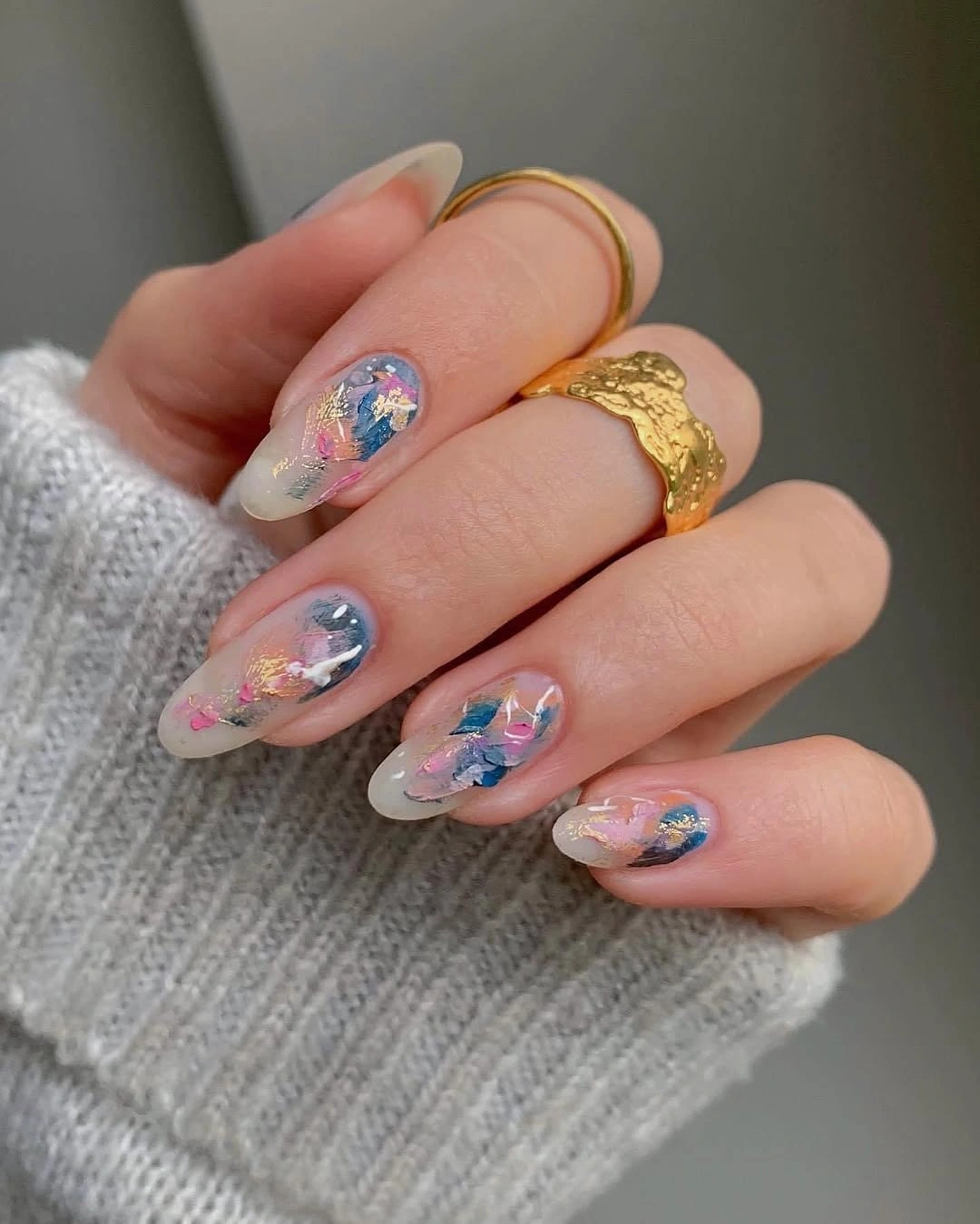
The sheer ground is important because it keeps the reflective pieces from feeling heavy. On an opaque dark base, the same fragments would read more dramatic; here, they create a softer, almost floating effect. A simpler adaptation would use the iridescent detail on only two nails and leave the others in a milky nude, which keeps the finish special while reducing the amount of sparkle across the hand.
Reflective surfaces are naturally attention-catching, so avoid adding another illustrated motif or highly contrasting tip. The irregular pieces have enough movement on their own. This finish also rewards smooth maintenance, because uneven edges can stand out against a light translucent base. When kept tidy, it offers a fresh alternative to solid color: light, textural, and deliberately less predictable from one angle to the next.
True Red on a Long Clean Almond Shape
A clear bright red on long almond nails is a direct design choice, and the absence of accents lets that color and silhouette carry all of the impact. The glossy finish gives the red a continuous polished surface, while the long taper keeps it from feeling casual. This version is useful when you want a classic shade to look intentional through precision rather than through extra artwork, glitter, or a complicated color combination.
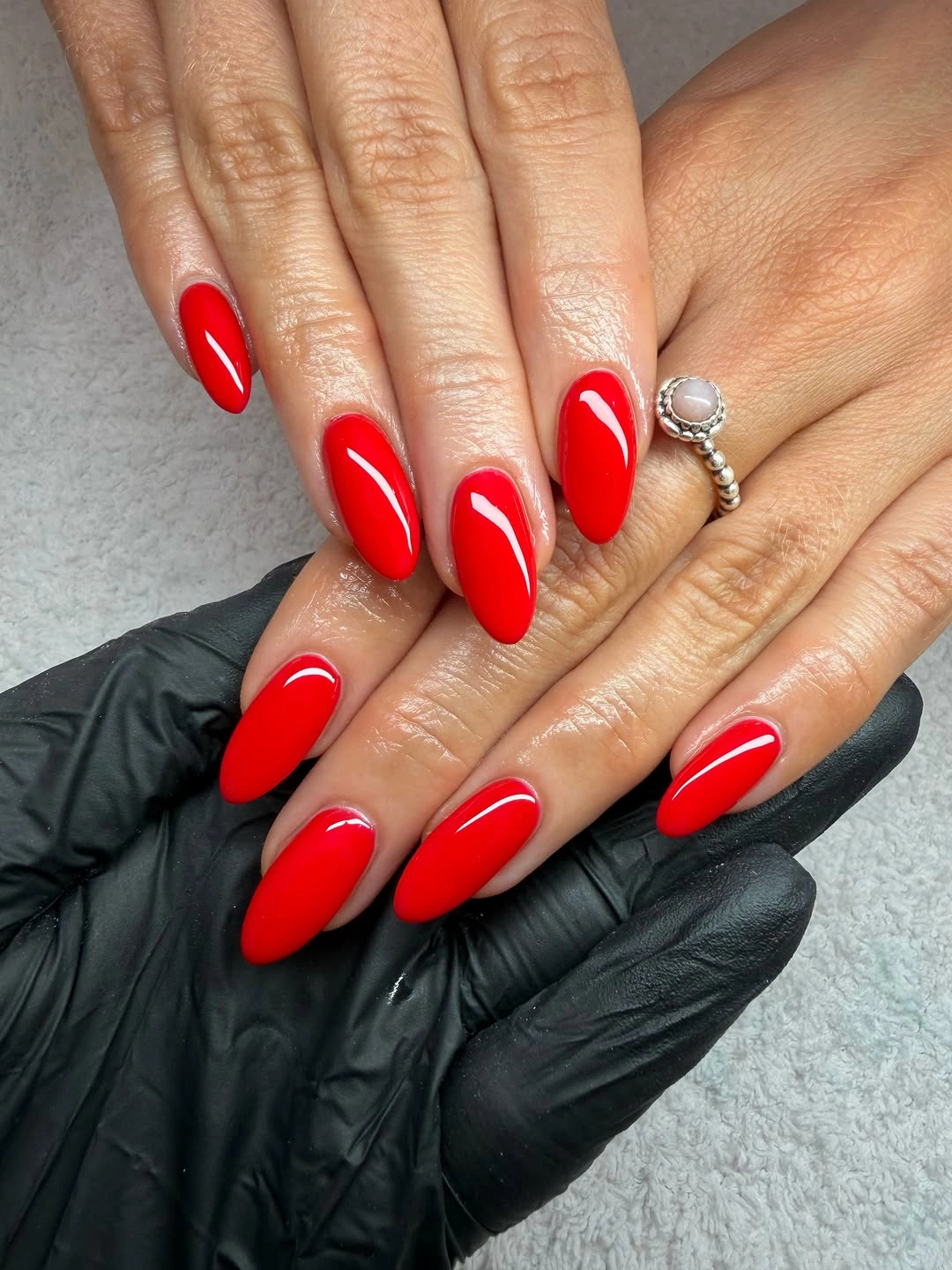
The strength of a true red is also its limitation: it does not quietly blend into the rest of your look. If you want the same color story with less intensity, take the length down to medium or choose a deeper berry red. Keeping the outline clean is more important than adding a feature nail, because any additional detail would compete with the simplicity that makes this particular red feel so decisive.
It pairs naturally with black, cream, denim, and warm metallic jewelry, but it can also be the one vivid element beside an otherwise neutral outfit. That versatility comes from its clarity, not from trying to be subtle. Choose it when you enjoy a manicure that has immediate presence, and remember that the even surface and neatly shaped tips are the details doing the most work.
Mauve Nails with Dark Metallic Center Panels
Soft mauve-purple nails are transformed by elongated dark brown metallic panels that run through their centers and catch gold-toned highlights. The mauve base remains visible around each reflective section, creating a frame that keeps the metallic detail from becoming too solid or heavy. The repeated central placement is what makes the design feel ordered, even though the reflective surface shifts as it catches the light.
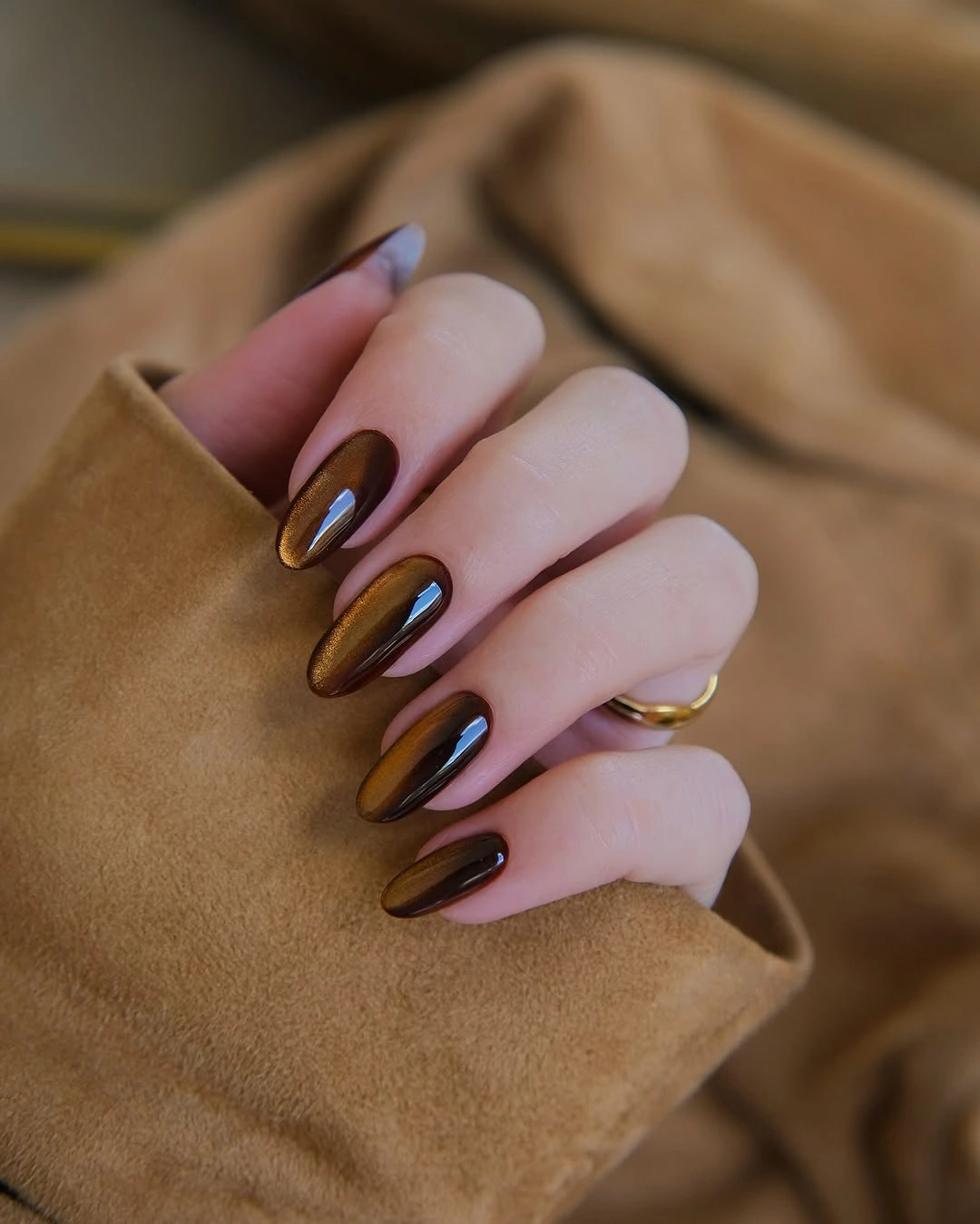
A centered stripe is an efficient way to add lengthwise movement to an almond shape. It pulls the eye along the nail without needing a full pattern, and it gives the quieter mauve a stronger visual point of contrast. For a more restrained version, use the metallic panel on two nails and leave the others solid mauve; the relationship between soft base and dark reflection will still be easy to see.
The finish will be the attention point, so it is better to keep the rest of the palette simple and skip extra sparkle or decals. Metallic surfaces also tend to reveal uneven placement, which makes careful symmetry worthwhile. When the panels stay centered and the mauve border remains even, the manicure feels more like a controlled light effect than a dark stripe placed on top of a pastel base.
Leopard-Style Marks on Bare Nude Tips
These medium nude nails keep their lower halves clear and place small brown-and-black spotted marks only along the tips. That placement gives the animal-inspired motif a much lighter feel than a full spotted nail, while the nude base keeps the overall value soft. It is a practical route for someone who enjoys a patterned detail but wants the result to stay closer to a clean French-style structure than a full print.
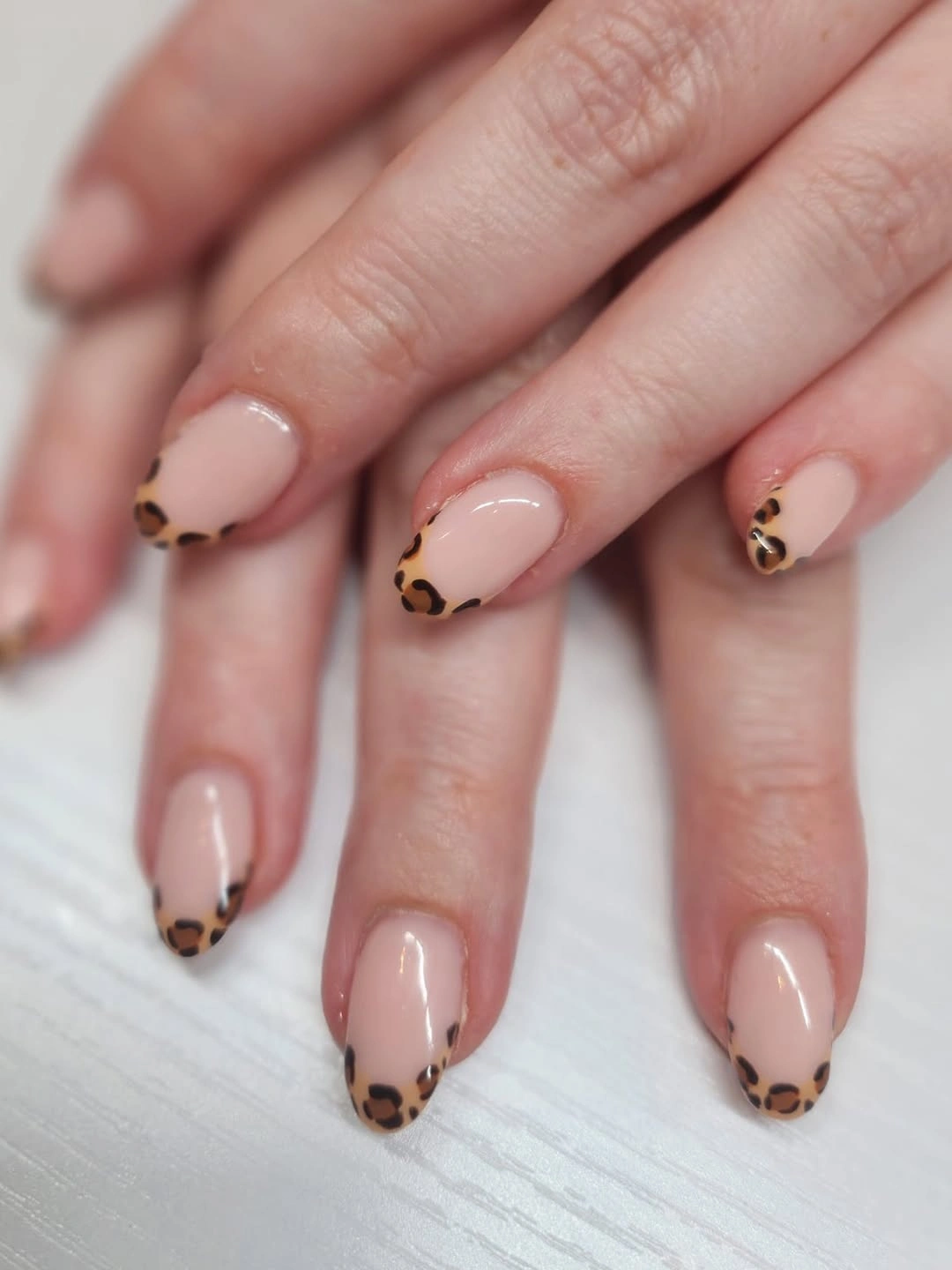
The tip-only approach makes the pattern easier to scale for different nail lengths. On a short oval, use fewer, slightly larger spots; on a longer almond, the smaller irregular marks can follow the curve of the edge. You do not need every tip to match exactly. A little variation is part of what makes the pattern feel natural, as long as the brown, black, and nude relationship stays consistent.
Leaving the base mostly bare can make regrowth less abrupt in appearance, which is a welcome benefit for anyone who does not want a solid color line at the cuticle. The spotted edges will still need occasional attention because their contrast is sharp, but there is less overall surface to maintain than in a full animal-print manicure. The result stays playful, controlled, and easier to integrate into daily styling.
White Stilettos with Tiny Pumpkin Details
Long pointed white nails create a bright field for the small orange pumpkins, green leaves, and fine botanical lines placed across this illustrated set. The white base is doing a lot of practical work: it keeps the motifs legible and gives each little detail a clean outline. This is a more expressive option for fall nails for fair skin tones, especially when you want a seasonal reference that is clearly visible rather than suggested only through color.
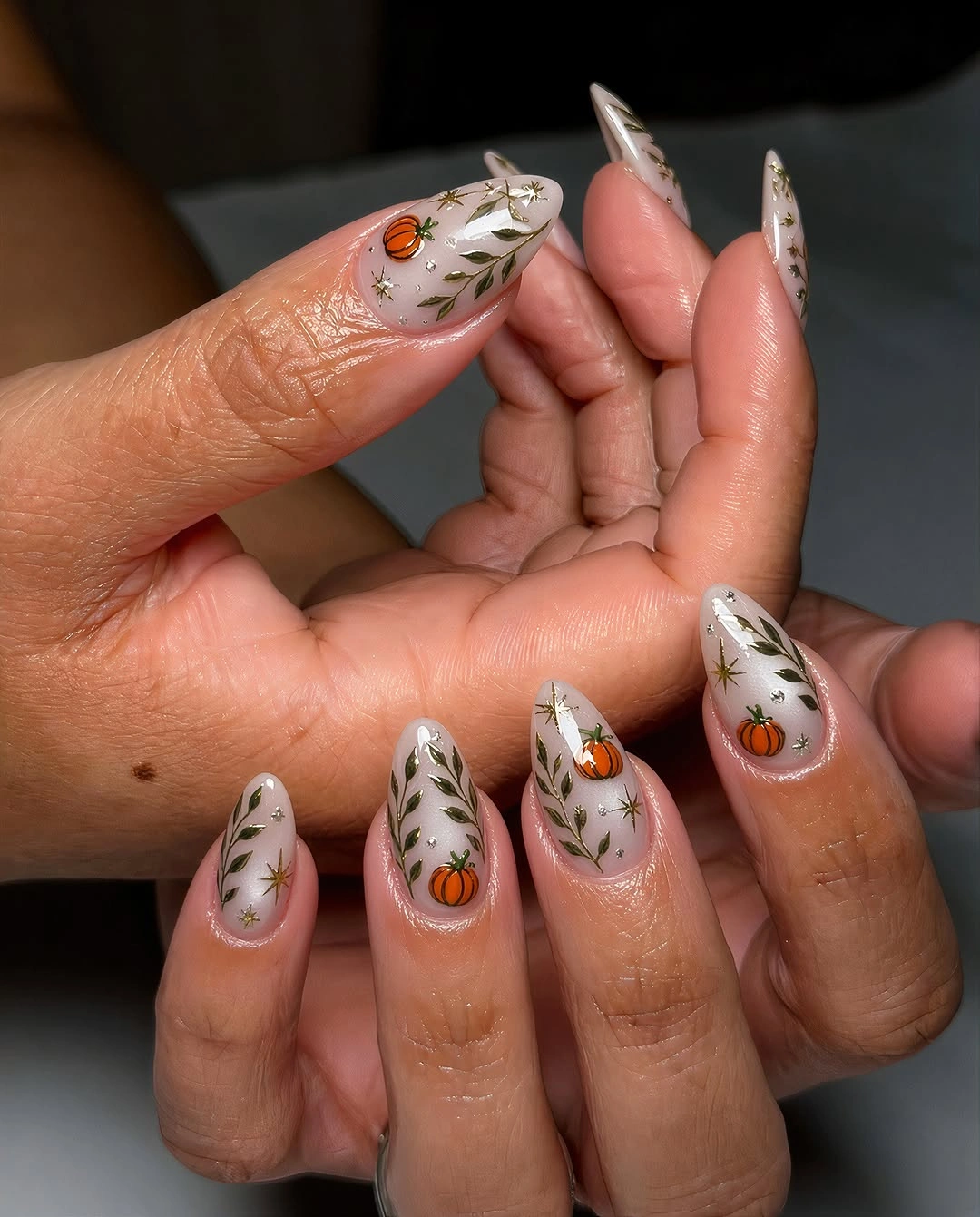
The pointed shape provides extra room for the illustrations, so the pumpkins and leaves do not need to be squeezed into a tiny surface. A medium almond version could keep one pumpkin accent and a few green strokes for a less dramatic interpretation. What matters is retaining the white base and limiting the palette, because the orange and green details are strongest when they are not competing with additional colors or glitter.
Illustrated motifs carry more visual information than a simple color block, so they are best paired with uncomplicated jewelry and clothing. Fine lines can also show their wear sooner, which makes this a look for someone who enjoys keeping detailed nails fresh. Its charm comes from the clear composition: a pale ground, small warm motifs, and enough empty space for the details to stay readable instead of becoming cluttered.
Nude Nails Linked by Olive Green Accents
Nude nails with green curved tips, a patterned brown accent, a white outlined detail, and small gold dots could easily feel disconnected, yet the repeating olive green gives the set a shared visual thread. The nude base remains the largest color area, which prevents the individual details from becoming too dominant. This is a good lesson in how one repeated accent shade can organize a manicure that uses several different small ideas.
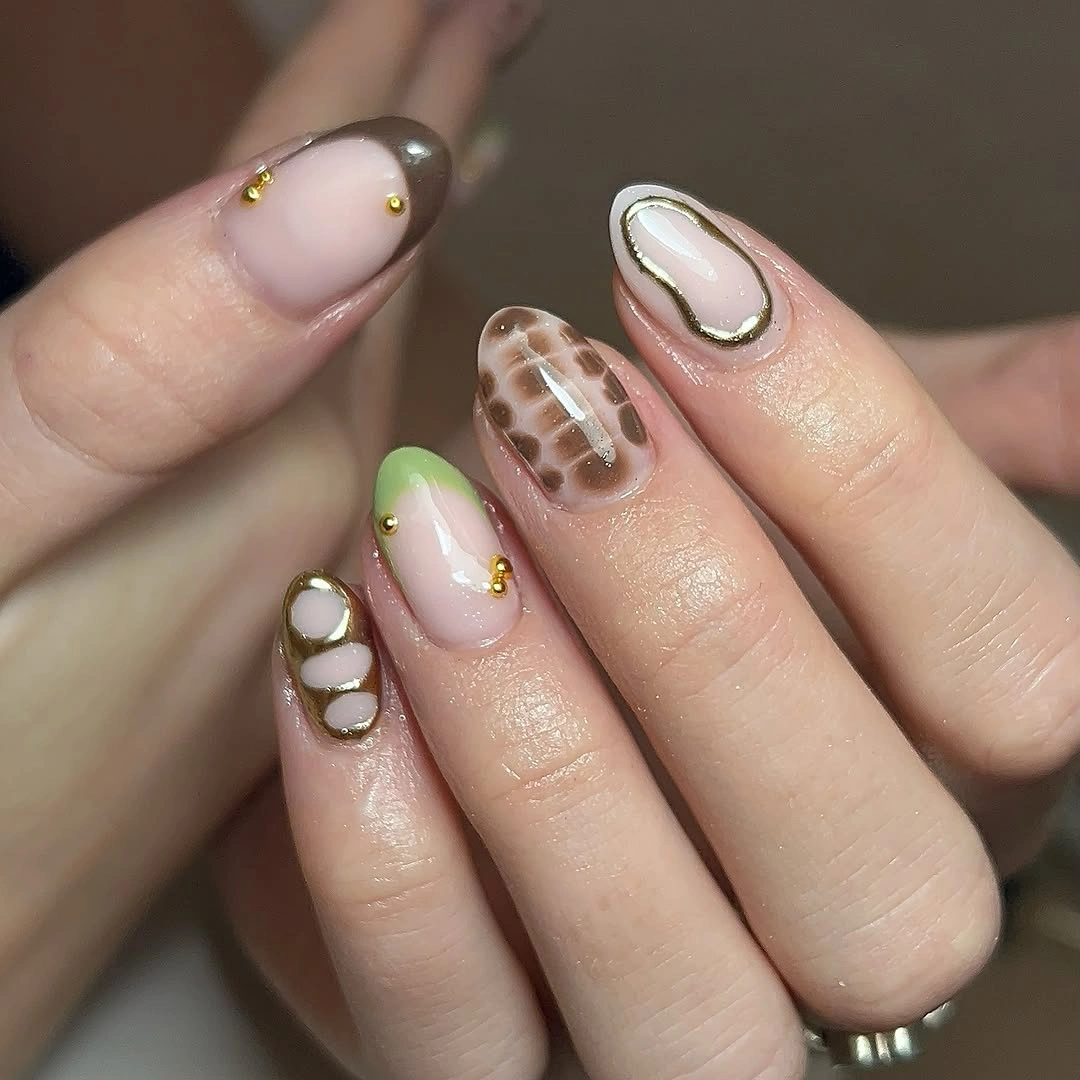
The green appears in more than one placement, so it reads as part of the plan rather than a random contrast. If you want to simplify the design, keep only the olive tip and one small gold accent on a nude nail. You will preserve the warm-cool balance while making the result easier to maintain and more suitable for someone who prefers a calm manicure with just one recognizable twist.
Mixed details need boundaries, and the nude ground provides them here. Adding another saturated color would make the set harder to read, while keeping the palette to nude, olive, brown, white, and gold lets each small choice remain visible. The reward is a design that feels collected instead of uniform, with enough spacing to keep the individual accents clear on the medium almond shape.
Glossy Amber and Brown Tortoiseshell Squares
Irregular amber, deep brown, and black patches give these short square nails a layered tortoiseshell-style effect, with the glossy surface adding visual depth around each uneven shape. No two nails carry the same patch arrangement, which is exactly why the pattern feels organic rather than stamped. The compact square length makes the rich colors look contained and wearable, even though the surface has a lot more movement than a plain brown manicure.
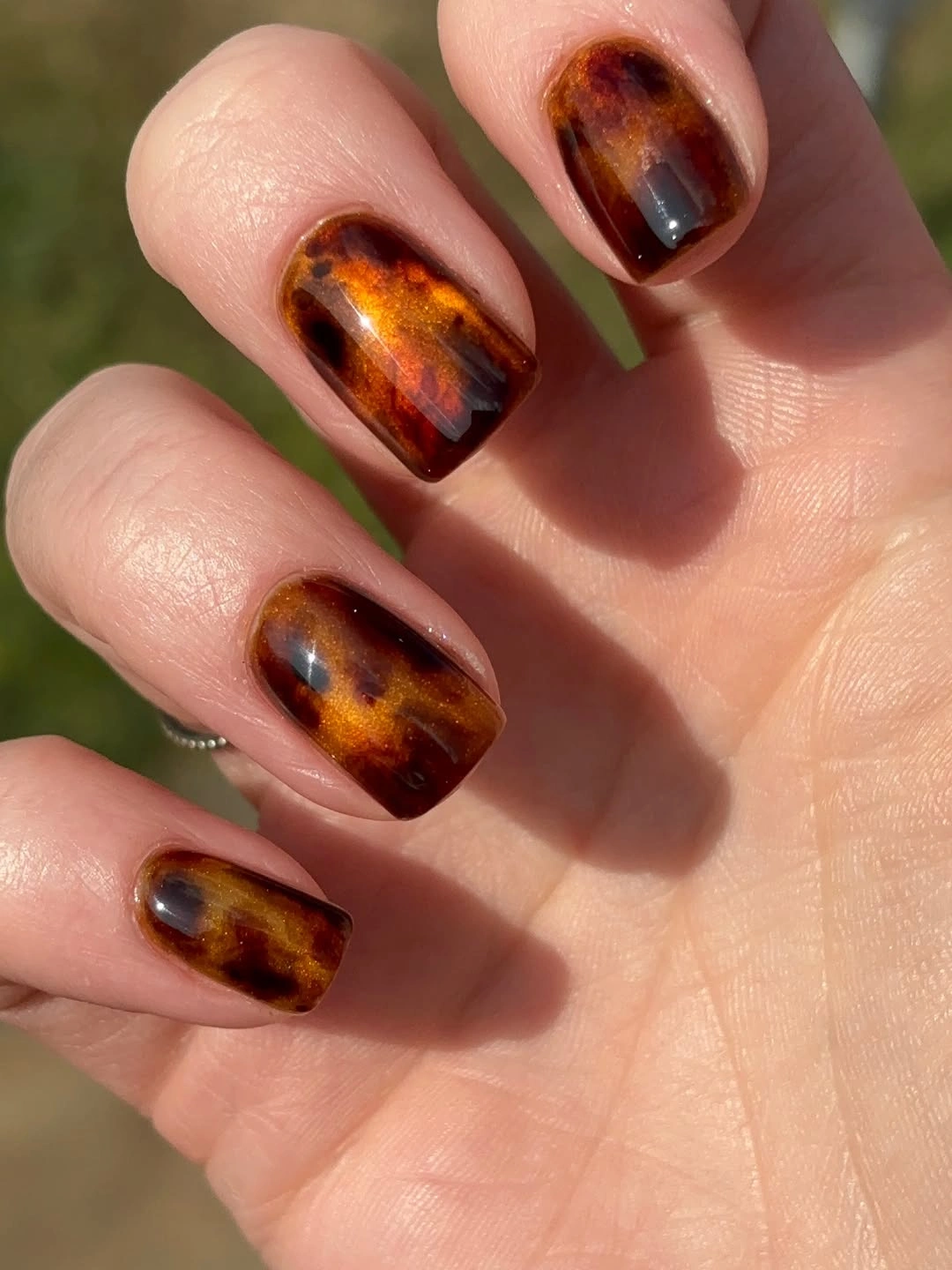
The appeal comes from variation within a stable palette. The amber areas provide light, the brown deepens the pattern, and the black adds definition where the colors meet. If you are trying the look for the first time, use tortoiseshell on two accent nails and choose a deep brown solid for the others. That gives you the same warm layered feeling without covering the whole hand in a high-detail finish.
Because the patches are intentionally irregular, you do not need perfect symmetry for the design to look convincing. What does matter is keeping the colors translucent-looking enough to retain that sense of depth rather than turning them into flat blocks. The short square silhouette is a useful practical counterweight, making a busy pattern feel more everyday than it might on very long pointed tips.
Fox Illustrations on Long Nude Points
Long pointed nude nails provide enough canvas for white tips, orange fox faces, black outlines, and small leaf-like elements to sit without overlapping. The nude ground is an important editing choice because it lets the illustrated accents remain separate and keeps the orange details from overwhelming the full length of the nails. This is a distinctly decorative manicure, but its palette stays focused enough that the drawings are still easy to follow.
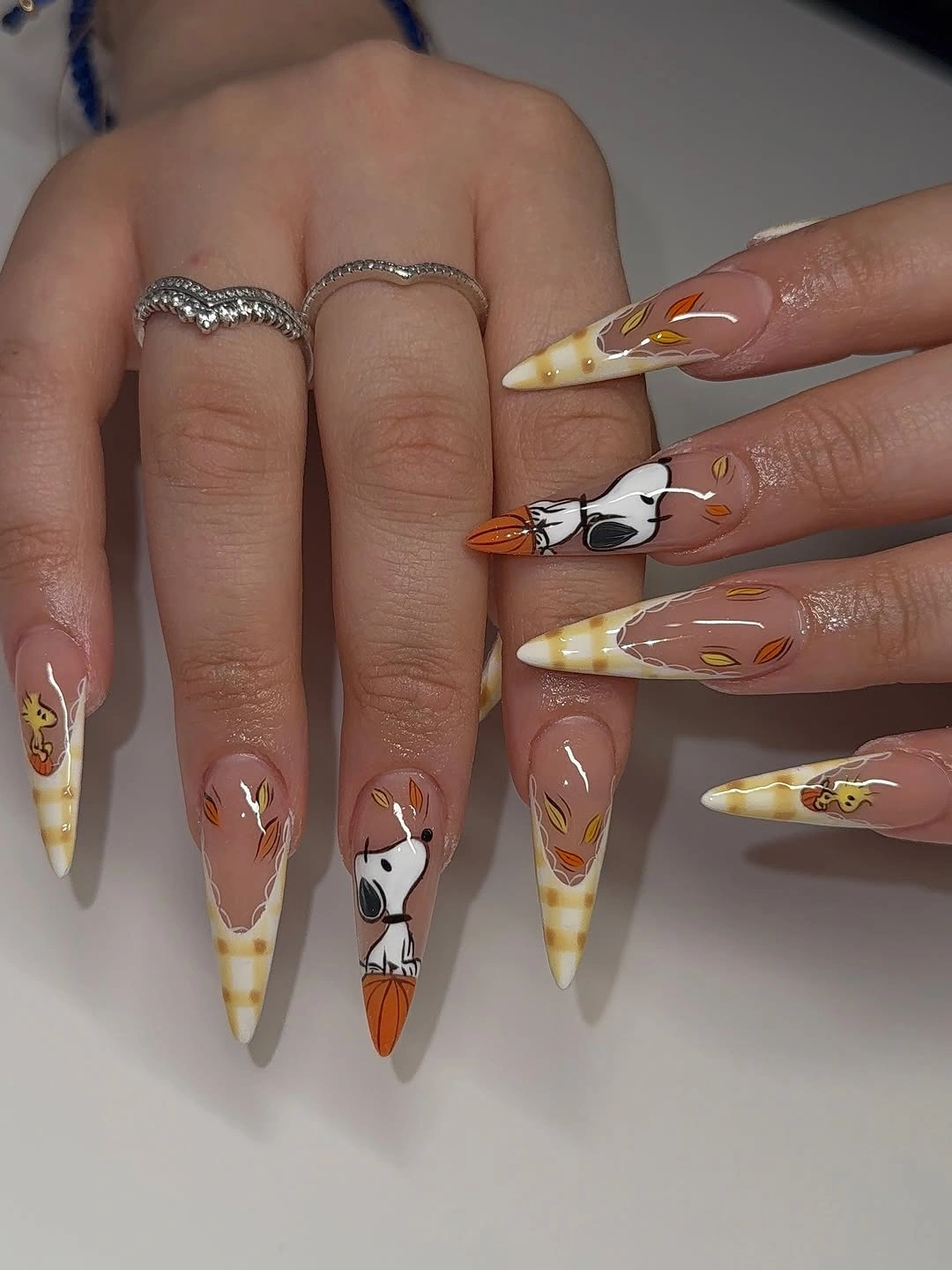
Scale is what makes this design work. The length permits recognizable fox details, while the pale base leaves space around them and prevents the tips from feeling crowded. If you prefer less illustration, place one fox on an accent nail and use white tips with tiny black leaf marks on the others. You will retain the character of the original without needing every nail to become a full storytelling surface.
The expressive art and pointed shape make this better suited to a moment when you want nails to be part of the outfit, not a subtle finish. It also calls for a steady approach to maintenance, since the fine dark outlines are important to the clarity of each motif. Keep the supporting colors restrained, and the fox details will remain playful rather than competing with a busy mix of extra patterns.
Smoky Translucent Color Clouds Across Each Nail
Muted olive gray, brown, soft red, and smoky dark areas blend across these medium nails with no sharply outlined boundary between them. The cloudy transitions create movement without forming a literal figure or repeated print, which gives the set a more abstract kind of interest. This is a compelling alternative when solid fall nail colors feel too simple but a detailed illustration feels like more than you want to wear.
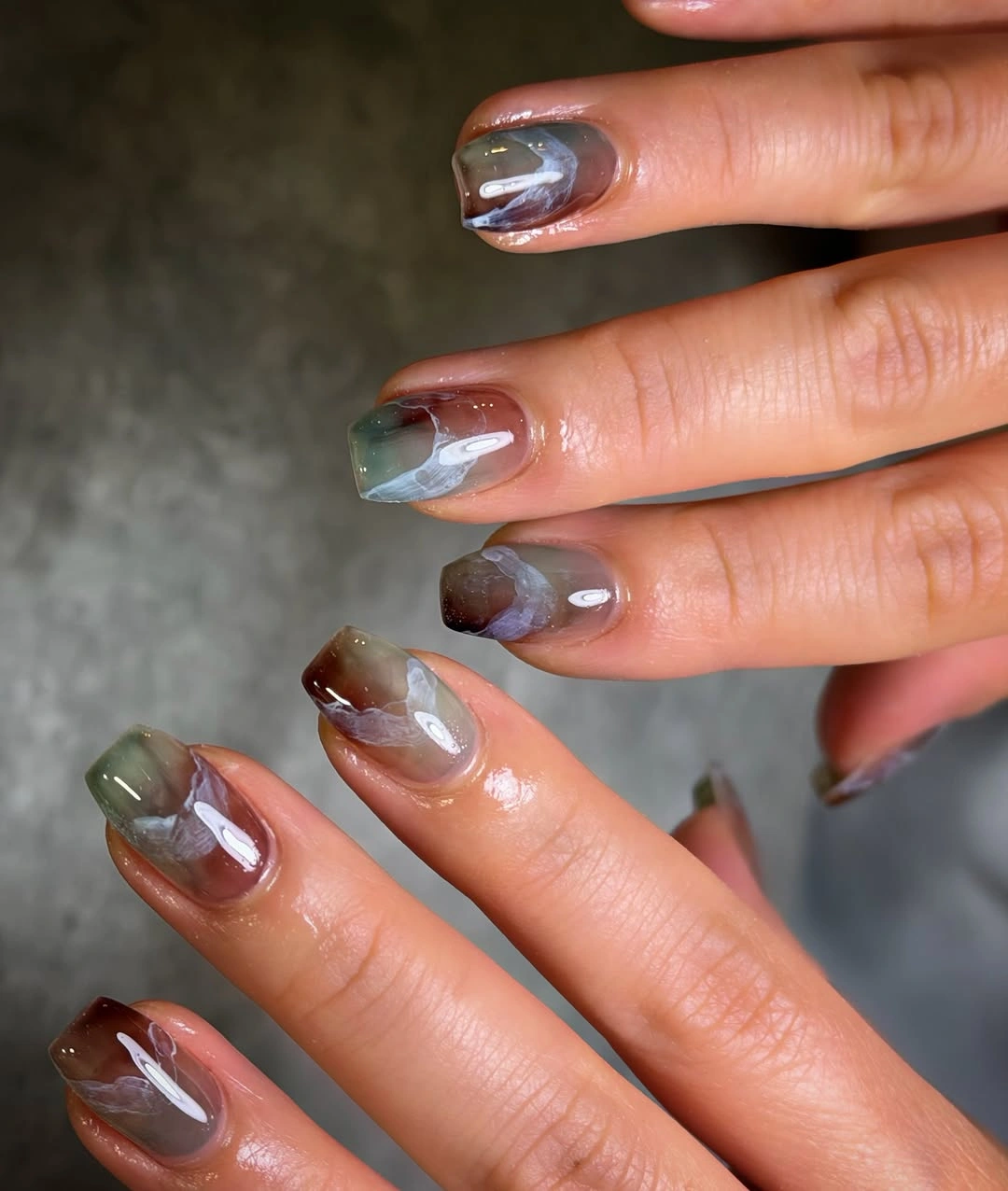
The subdued palette is what keeps the blended effect from becoming loud. Each color appears as a soft wash rather than a firm block, so the manicure changes from nail to nail while still holding together as one atmospheric idea. A shorter length could use fewer tones and larger soft areas, while this medium shape has room for the overlapping colors to look gradual rather than compressed.
Irregular blends will never be identical, and that is part of their appeal. Anyone who prefers perfect symmetry may find a solid or centered panel more satisfying, but someone drawn to movement will appreciate the small variations. Keep accessories simple and let the translucent effect remain the main texture, since adding glitter or line art would interrupt the soft, cloudy quality that gives this set its distinct character.
Deep Plum Squares with Bright Gloss
Very dark plum on medium square nails offers the grounding effect of black with a quieter undertone that becomes visible in the reflected shine. The color is uniform across every nail, so the square outline and high gloss become the defining features. It is a strong choice for fair skin tone nail colors when you want depth and contrast but prefer a shade with more complexity than a plain jet-black manicure; these purple nail ideas make a useful related comparison.
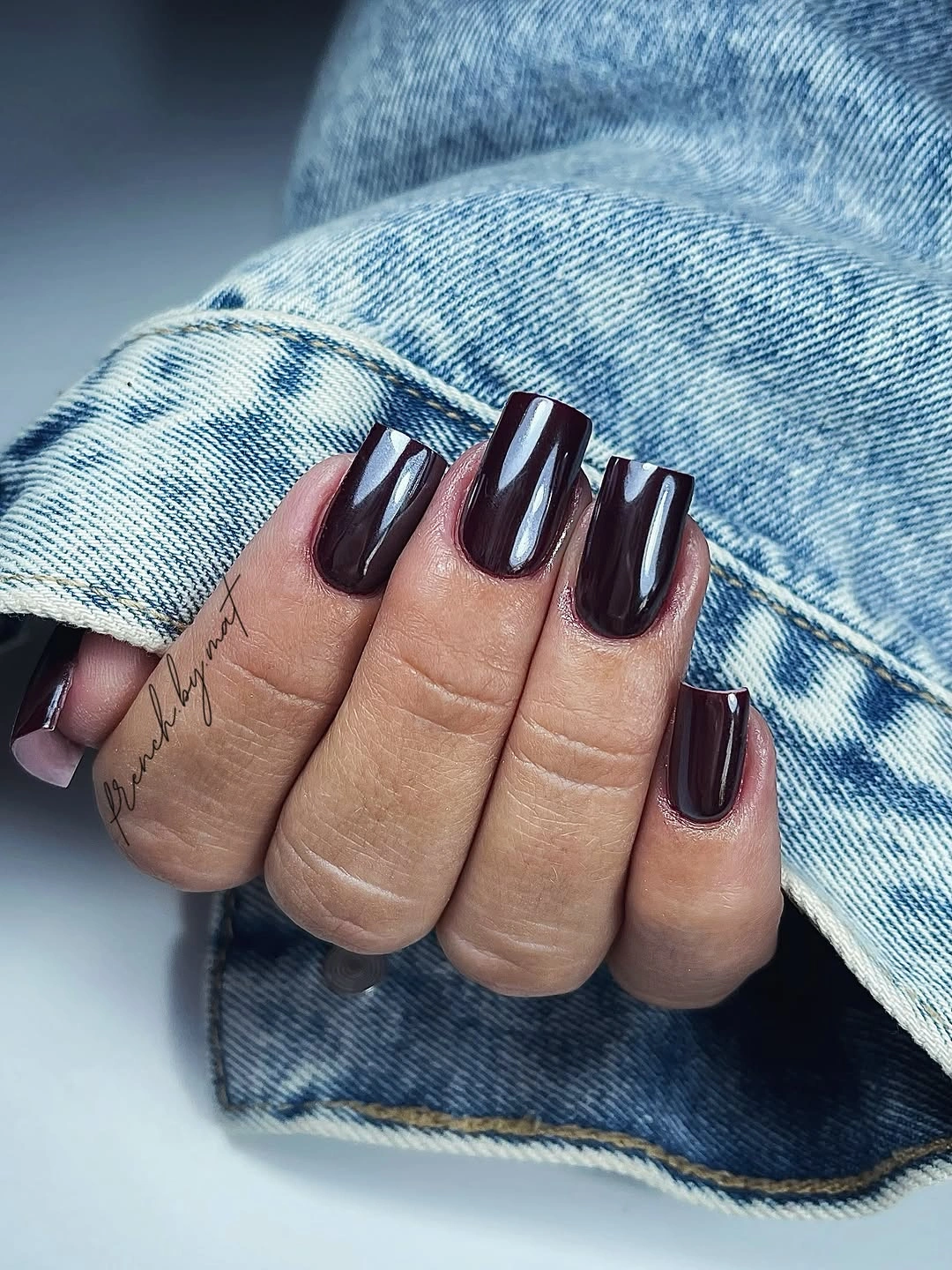
The squared shape gives the dark plum a clean, graphic character, especially when each nail is kept at a similar length. A rounded oval would soften the shade, while this outline lets it feel more deliberate and structured. There is no need for a feature nail here; the subtle purple cast and reflective surface already provide enough visual change as the hand moves through different light.
Like other dark glossy colors, plum will ask for tidy free edges if you want it to keep that polished appearance. In return, it is easier to pair than a saturated bright shade and has enough richness to stand alone beside simple clothes. It closes the article’s ideas with a useful reminder: a manicure can feel fresh through a nuanced color and precise shape, even when every nail is painted the same way.