Skin tone is not a single color problem, because the same manicure can change character when its value, temperature, and reflective detail move around the hand. The useful question is not whether a shade is universally flattering; it is where the contrast sits and whether the base leaves enough space for the fingers to remain visually present. A warm brown can ground a pale accent, while a cool green or navy can create a cleaner separation. Look for the small placement decision that makes the palette feel intentional.
The most adaptable fall nails for medium skin tone usually balance one clear color family with one controlled interruption. That interruption might be a translucent panel, a fine gold border, a single floral nail, or a darker edge around a lighter center. Shape matters as much as pigment: long almond lines stretch the contrast, while short rounded nails keep it compact. Choose the relationship you want to preserve, then simplify the detail around it rather than changing everything at once.
Ornate Gold Detail over Pale Pink
Long nude-pink nails use a pale base as a quiet field for fine gold lines, bright embellishments, and glossy peach accents. The detail is concentrated along the length and around selected fingers, so the lighter base remains visible against the deeper surrounding skin. That contrast gives the ornate elements room to register instead of blending into one mass. Shape also contributes: the elongated almond silhouette creates a narrow route for the eye to follow from cuticle to tip.
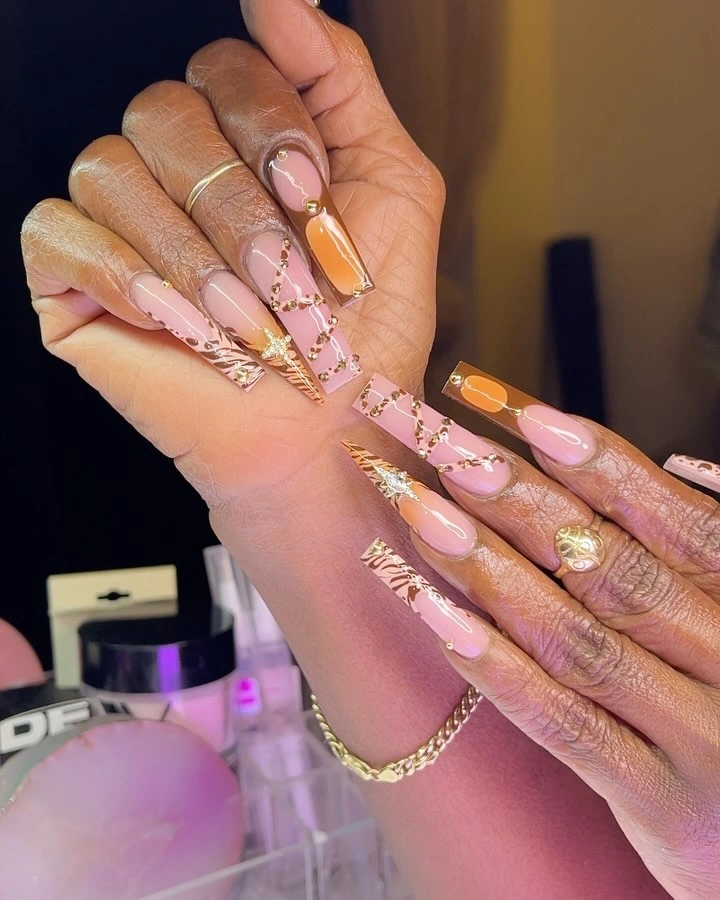
To make the arrangement easier to wear, keep the pale base on every nail but reserve the most concentrated gold detail for two fingers; a shorter almond or soft square shape will reduce the jewelry-like effect without losing the contrast, while a warmer nude will make the gold feel quieter. The limitation is density: many small accents can compete at close range, so leave a plain section visible on each decorated nail to maintain separation, giving the eye a quiet area before it returns to the gold lines.
Gold jewelry will echo the bright accents, but the manicure can also sit beside denim, cream, or warm brown because its main field is still neutral. If you are comparing fall nail designs for all skin tones, notice how the pale base does not try to match the hand; it creates a deliberate light-dark relationship. Keep that relationship, and reduce ornament only where the shape or occasion demands it.
Mixed Neutrals with a White Flower
Short oval nails combine several quiet neutrals with one white flower, a brown tortoiseshell-like accent, and a black outlined graphic nail. The small white flower is the softest detail, while the dark outline creates the sharpest contrast, so the set has a built-in sequence from delicate to graphic. Tiny gold dots add a warm point of light without taking over. The important choice is variation inside a restrained palette, not a single repeated motif on every finger.
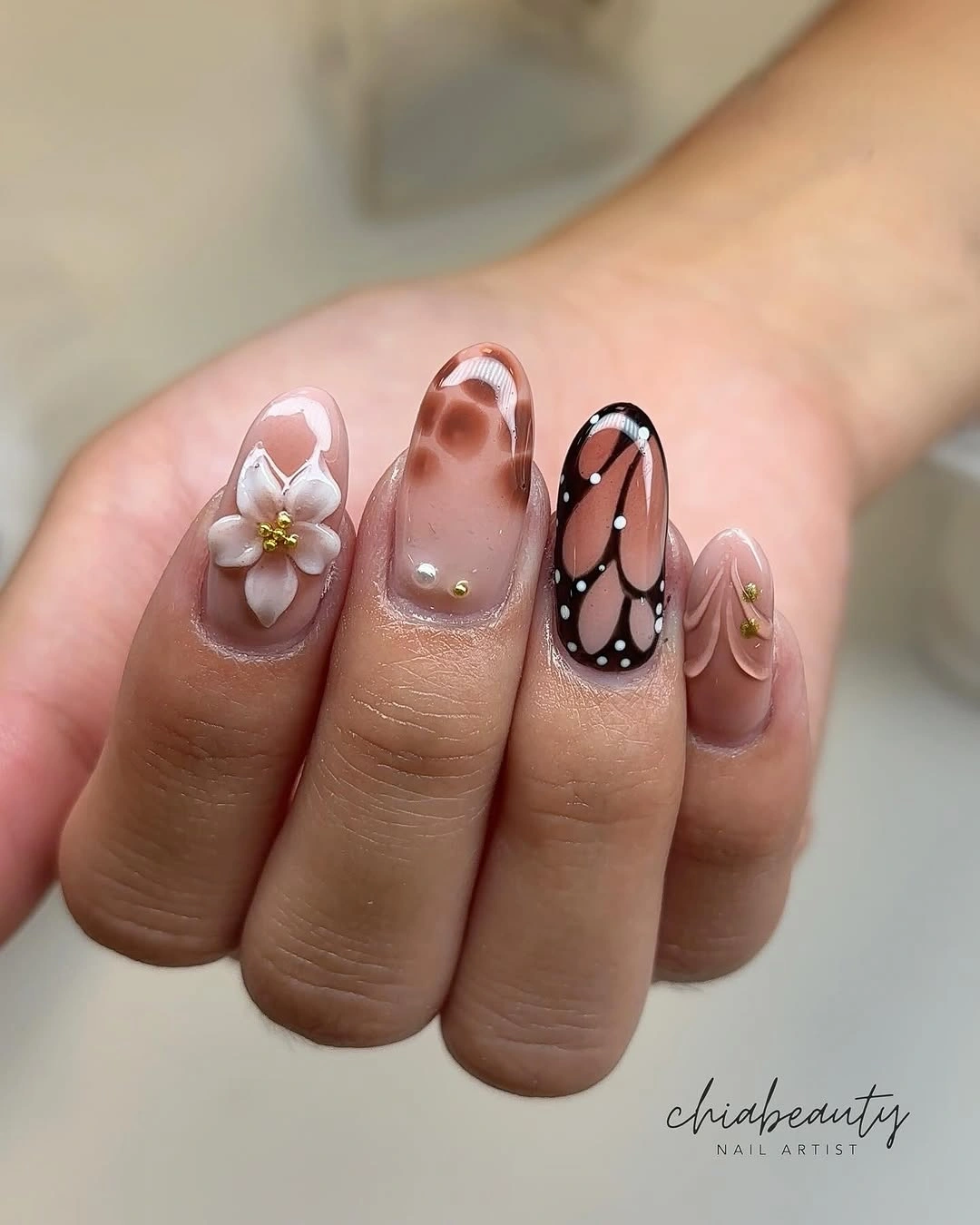
Use the floral nail as the anchor and repeat only one dark outline if you want the manicure to look less busy. A warm beige base will blend more gently with medium skin, while a cooler pink will make the white flower stand out. The realistic limitation is scale: a small oval nail cannot carry several high-contrast accents comfortably, so leave at least one or two fingers plain. That visual rest makes the decorative fingers look more deliberate.
The set works with everyday clothing because the neutrals absorb styling changes, while the white and black accents give the hand definition. A small gold ring can connect to the dots, but the manicure does not require matching jewelry. What matters most is the order of attention: soft base first, flower second, dark outline last. Changing that order by adding more black would make the design feel heavier than its compact shape suggests.
Translucent Pink with Amber Swirls
Medium almond nails use translucent pink space as the background for warm amber-brown curves and tiny gold accents. The clear-looking areas keep the hand visible, while the orange-brown marks create warmth near the center and sides of the nail. Because the lines bend rather than fill the whole surface, the manicure has movement without losing its pale base. The small gold details matter because they repeat the warm direction in a more concentrated point.
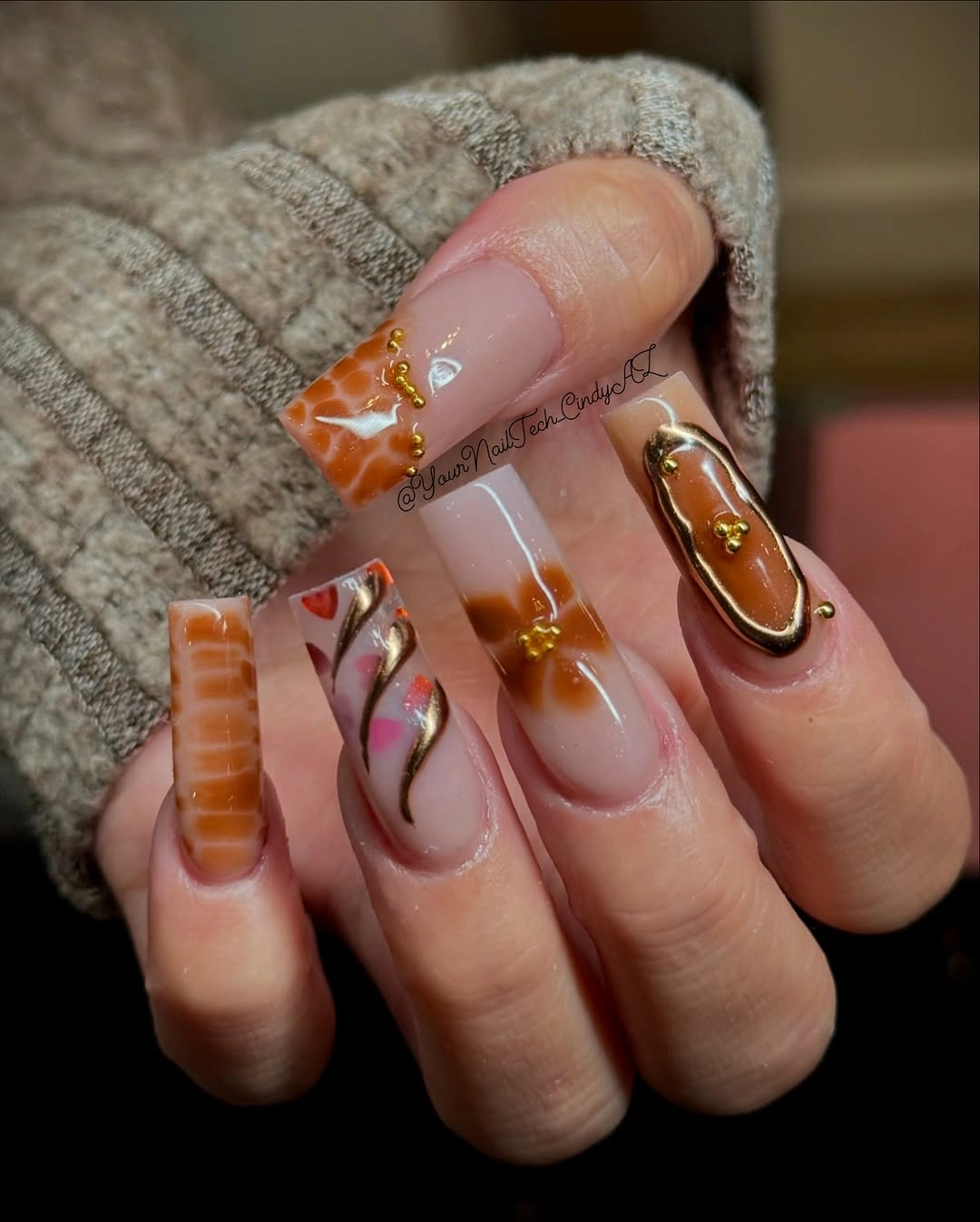
For a lighter adaptation, keep the middle of the nail pale and concentrate the amber close to one edge. A softer caramel tone will blend with the pink, while a deeper brown will make the curves more graphic. The limitation is that translucent space needs a clean border to read as intentional; if too many warm marks overlap, the negative space disappears. Keep the curves separate enough that each one has a visible beginning and end.
This palette can work with warm gray, denim, cream, or muted olive because the amber supplies a grounded autumn note without becoming the entire manicure. If you like cat eye nails, the useful comparison is placement: reflective color spreads across a surface, while these swirls leave the base open. Preserve the open center if you want the set to stay airy, even when you change the shape.
Ribbed Sage Green on Long Almonds
Long almond nails use one muted sage-green family and create variation through visible ribbed texture, with a raised-looking leaf accent on one finger. The color is not doing all the work; the fine grooves catch light in narrow lines and make the monochrome set more dimensional. The elongated shape lets the texture travel along the nail, while the accent gives the repeated surface a clear point of difference. It is a detail-led look where finish changes value more than hue.
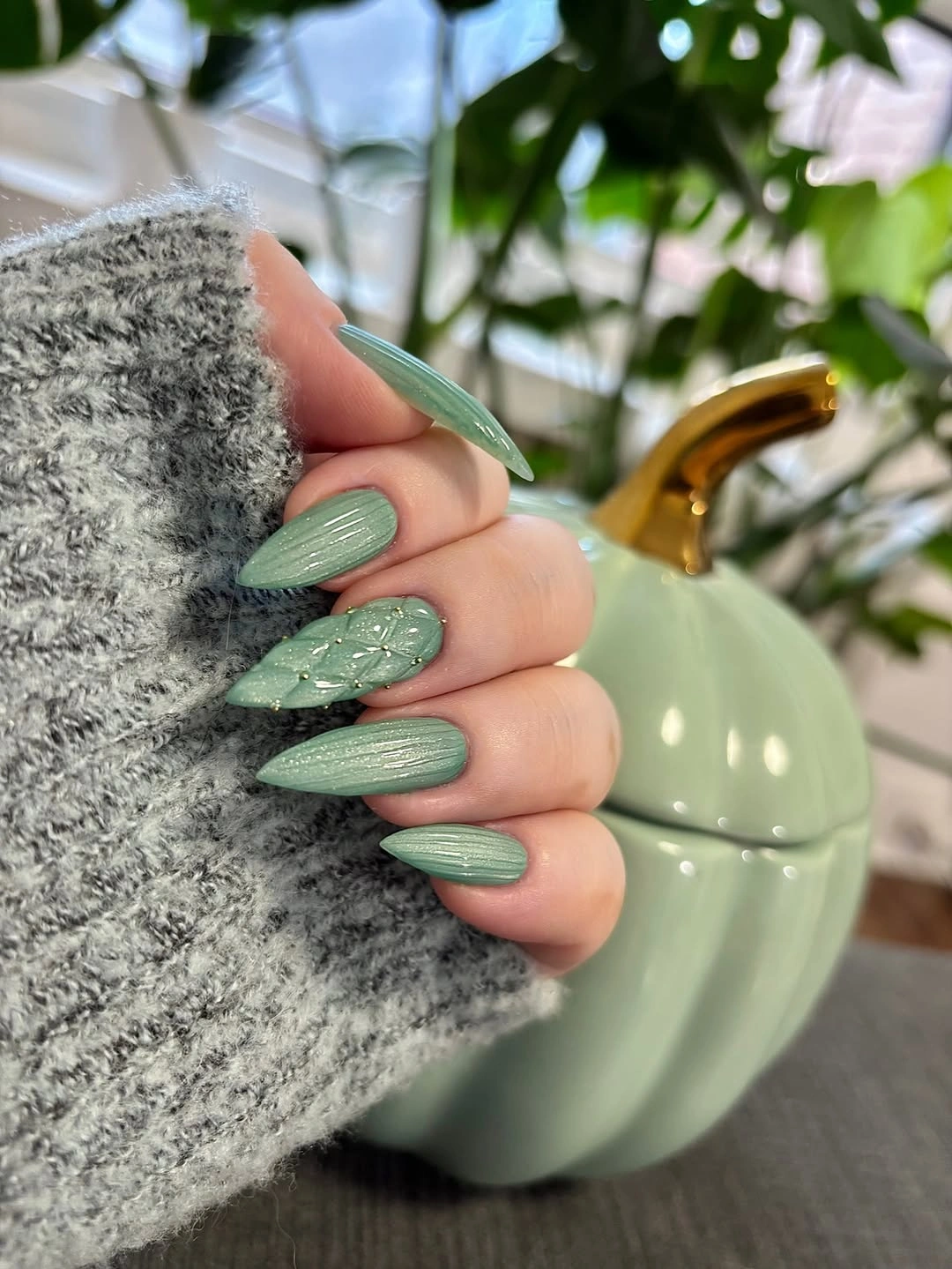
Keep the green smooth on most nails and reserve the textured accent for one or two fingers if you want the hand to feel lighter. A shorter almond can hold the same palette, but fewer grooves will keep the surface from looking crowded. The limitation is that texture is easy to overstate in description, so focus on the visible change between ridged and smooth areas rather than claiming a particular construction or product. The contrast should be felt through light.
Sage looks grounded beside gray knitwear, cream, denim, and warm tan, while a gold ring adds a small opposing point without breaking the monochrome idea. You can also replace the sage with olive or muted teal, but changing both color and texture at once would create a different effect. Preserve one stable element – the repeated green or the ribbed accent – so the set keeps its quiet continuity.
Copper Glitter French on Clear Square Tips
At this longer square length, a translucent pink base supports wide copper glitter edges, a white flower, and warm brown decorative details on selected fingers. The square tip gives the glitter a strong horizontal boundary, while the clear center keeps the color from becoming too dense. Copper is warmer and softer than bright yellow gold, which helps it sit naturally against medium skin. The flower matters because it breaks the metallic repetition with a pale, rounded shape.
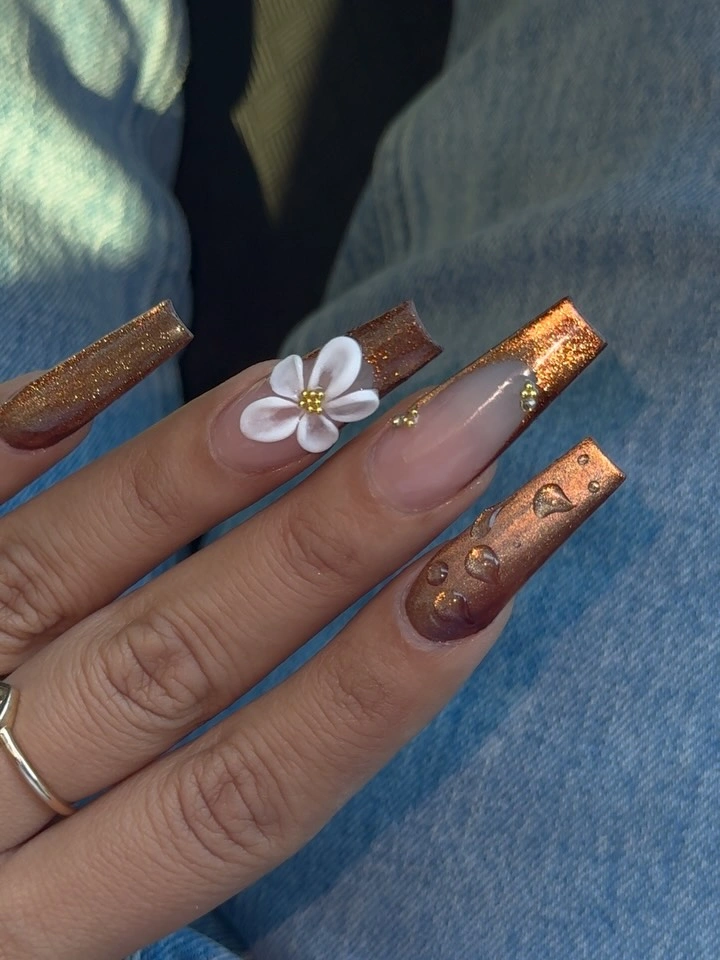
Narrow the glitter edge if you want the clear base to remain the main feature, and keep the flower on one nail rather than repeating several small decorations. A shorter square shape will reduce the formal impression, but the tip still needs enough width to read as an intentional border. The limitation is that glitter can visually shorten a nail when it occupies too much of the free edge, so adjust depth before changing the whole palette.
Copper works beside blue denim, chocolate brown, cream, and muted green because its warmth can bridge both light and dark clothing. Keep the other fingers comparatively plain so the metallic edge has a clear role. The manicure feels balanced when the eye moves from transparent center to bright copper border, then pauses at the pale flower; extra embellishment would interrupt that sequence.
Tortoiseshell Tips with Open Nude Centers
Long pointed nails frame translucent nude centers with warm brown tortoiseshell-like tips and a few tiny gold accents at the transition. The open center lets medium skin remain part of the composition, while the mottled tip adds concentrated warmth near the edge. The pointed silhouette sharpens the contrast and makes the tip feel like a deliberate frame rather than a random patch. Gold appears sparingly, so it guides the transition without competing with the pattern.
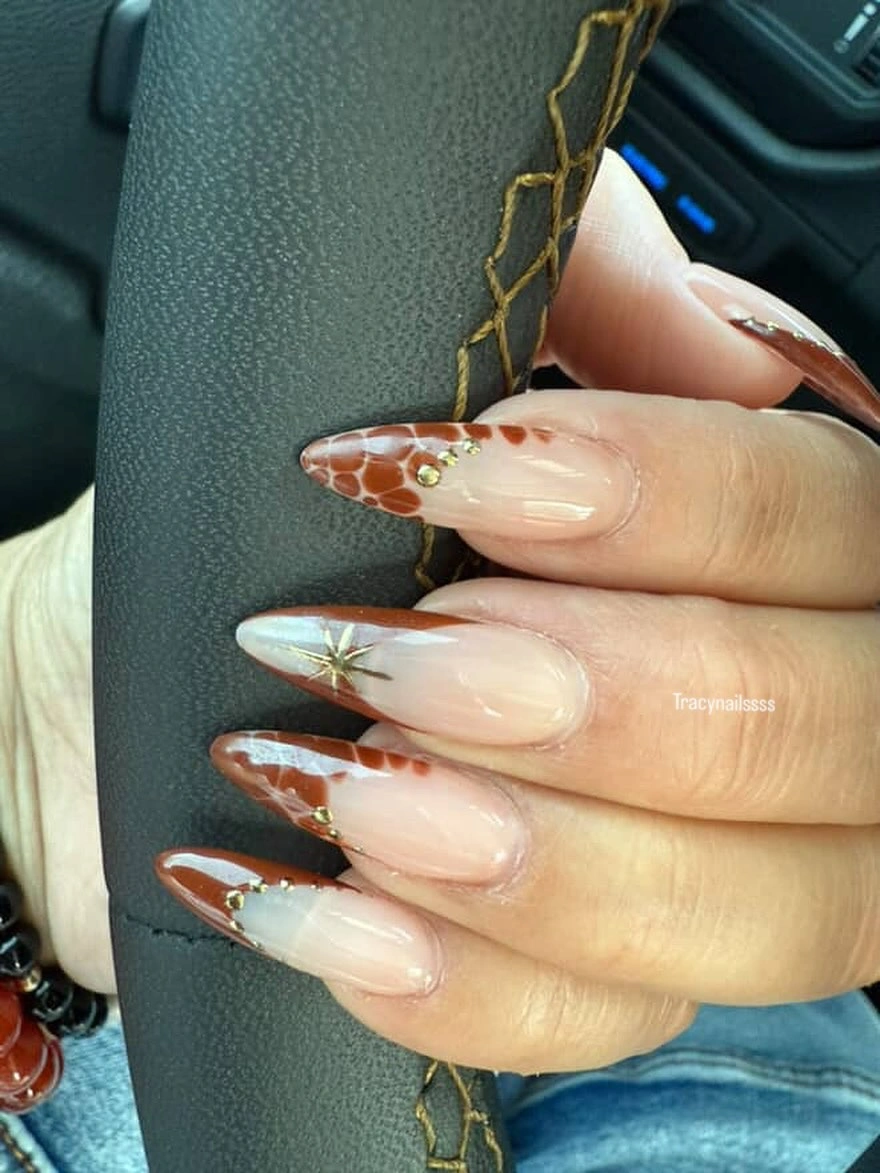
Keep the pattern on the tips and reduce the point to an almond or tapered square if you want an easier everyday version. A caramel-brown pattern will look softer, while a darker chocolate pattern will create a stronger border. The limitation is that a mottled tip can become visually thick on a shorter nail, so preserve a clear nude center and avoid filling the entire sidewall. The negative space is the part that keeps the design light.
Use a plain warm nude on the remaining fingers if you prefer a two-accent arrangement, or repeat one small gold dot to create continuity. The palette sits naturally beside tan, cream, rust, and denim, but it does not require a full autumn wardrobe to make sense. The detail to preserve is the open center bordered by a warm edge; remove extra marks before you remove that contrast.
Solid Olive Green in a Short Shape
Short rounded-square nails are painted in one deep muted olive-green color with a smooth reflective surface and no accent motif. That lack of interruption is the defining detail: the eye reads the shade, then the compact shape, without detouring through decoration. Olive carries enough depth to flatter a range of styling temperatures while remaining softer than black. The small length also keeps the color close to the hand, so the strong pigment does not dominate the silhouette.
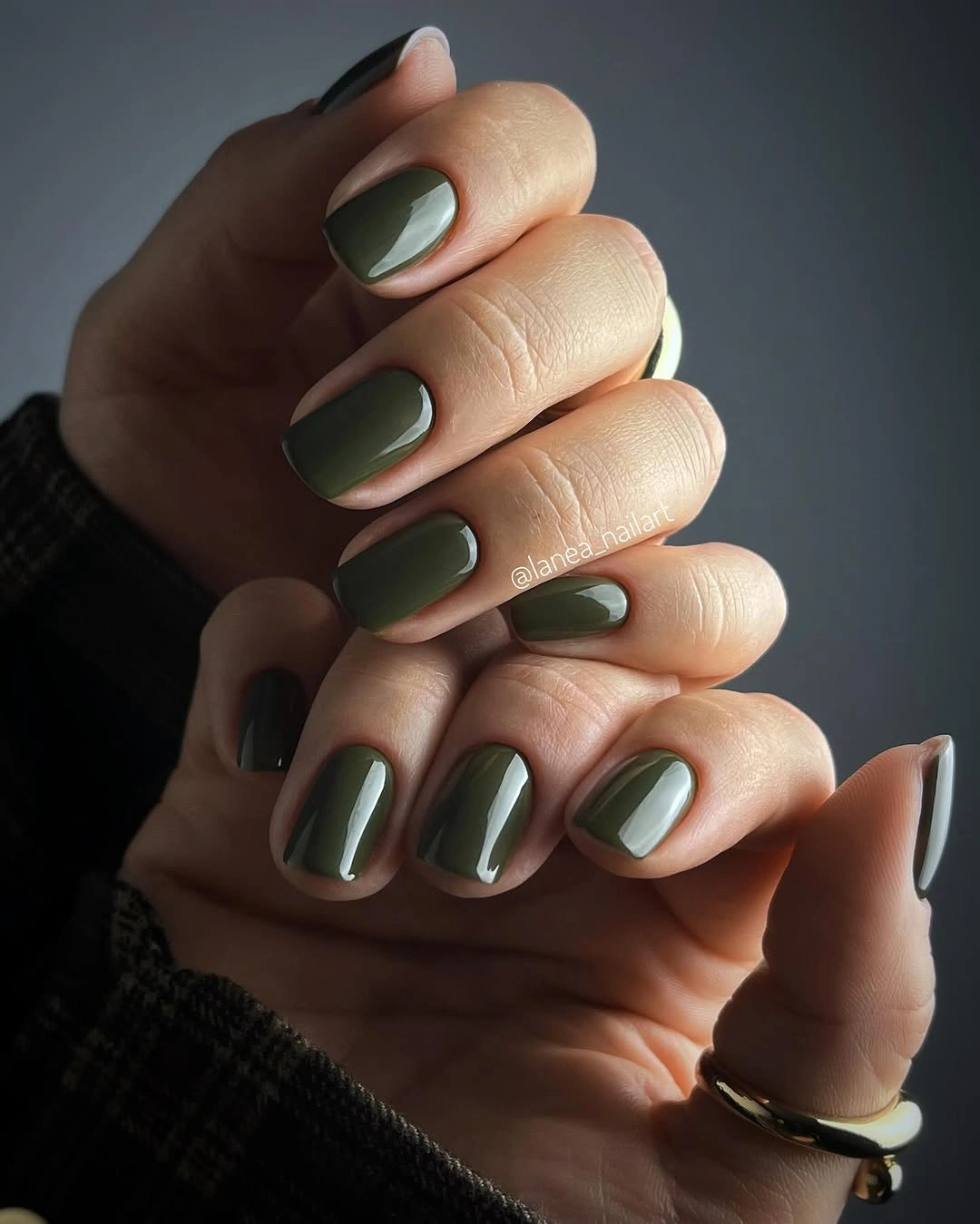
Choose the solid olive approach when you want a seasonal color decision that remains visually orderly. A warmer olive will lean earthy, while a gray-leaning version will feel quieter and more modern. The limitation is that a single dense color reveals uneven edges more clearly than a busy design, so the outline needs to be neat. If the nails are very short, a softly rounded corner may look more balanced than a hard square.
Pair the shade with cream, gray, denim, or warm brown and let the manicure supply the only deep color. If you want a small variation, add one slightly lighter olive nail rather than introducing a contrasting motif. The strength of the set comes from repetition and value, so a controlled tonal change can extend the idea while preserving the clean read of one color across the hand.
Olive Solids with One White Line-Art Nail
Most nails carry muted olive-green solids, while one pale accent nail uses thin black wavy lines that move across the surface. The white panel creates a strong value break against the deeper green, but the narrow drawing keeps the accent from feeling heavy. Olive repeats as the majority color, so the contrast reads as a deliberate pause rather than a new palette. The smallest feature – the line spacing – controls how airy the whole set feels.
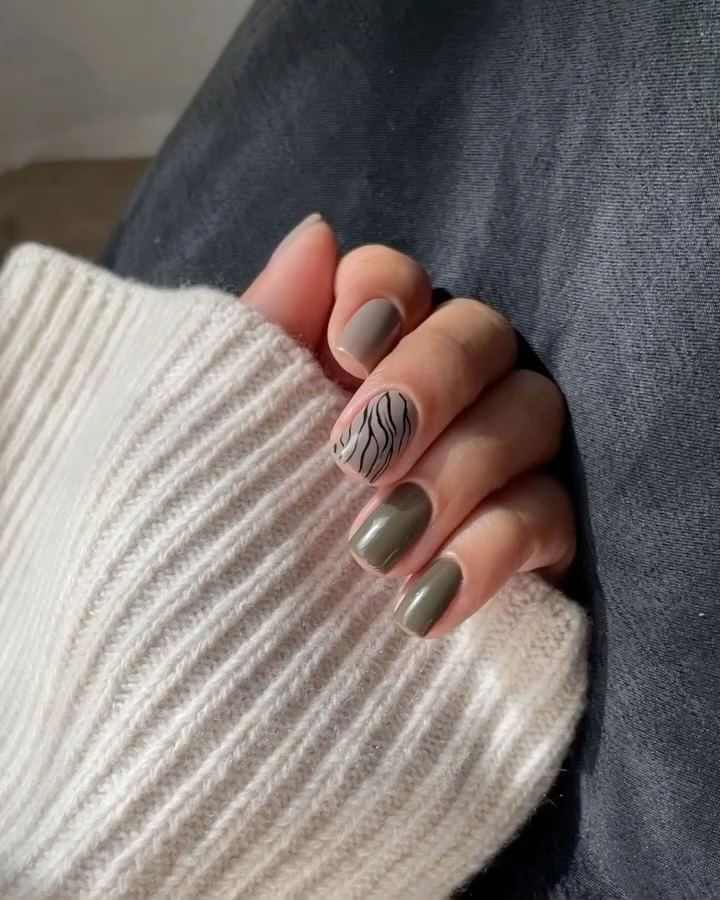
Keep the lines uneven and open rather than stacking them too tightly, especially if the accent nail is short. A pale beige would soften the contrast, while bright white will make the graphic effect sharper. The limitation is that line art loses clarity when it is squeezed into a small area, so reduce the number of curves before reducing the spacing. The accent works because the green solids provide a calm border around it.
This is an easy way to add personality to a solid olive manicure without changing its styling range. The set will still suit denim, gray, and warm neutrals, while the white nail gives a small flash of brightness. If you want two accents, repeat the white base but use fewer lines on the second finger. Keep the dark drawing subordinate to the olive field, and the contrast will stay controlled.
Pink and Green French with Wavy Borders
Long nails mix soft pink and muted green through irregular French edges, dark outlines, and varied almond and square silhouettes. The color contrast is clear, but the wavy borders stop the pairing from looking like a standard straight French tip. Mixed shape adds another layer of movement, although it also makes the composition more noticeable. The design works because the pink provides light, the green provides weight, and the border connects them with a continuous curve.
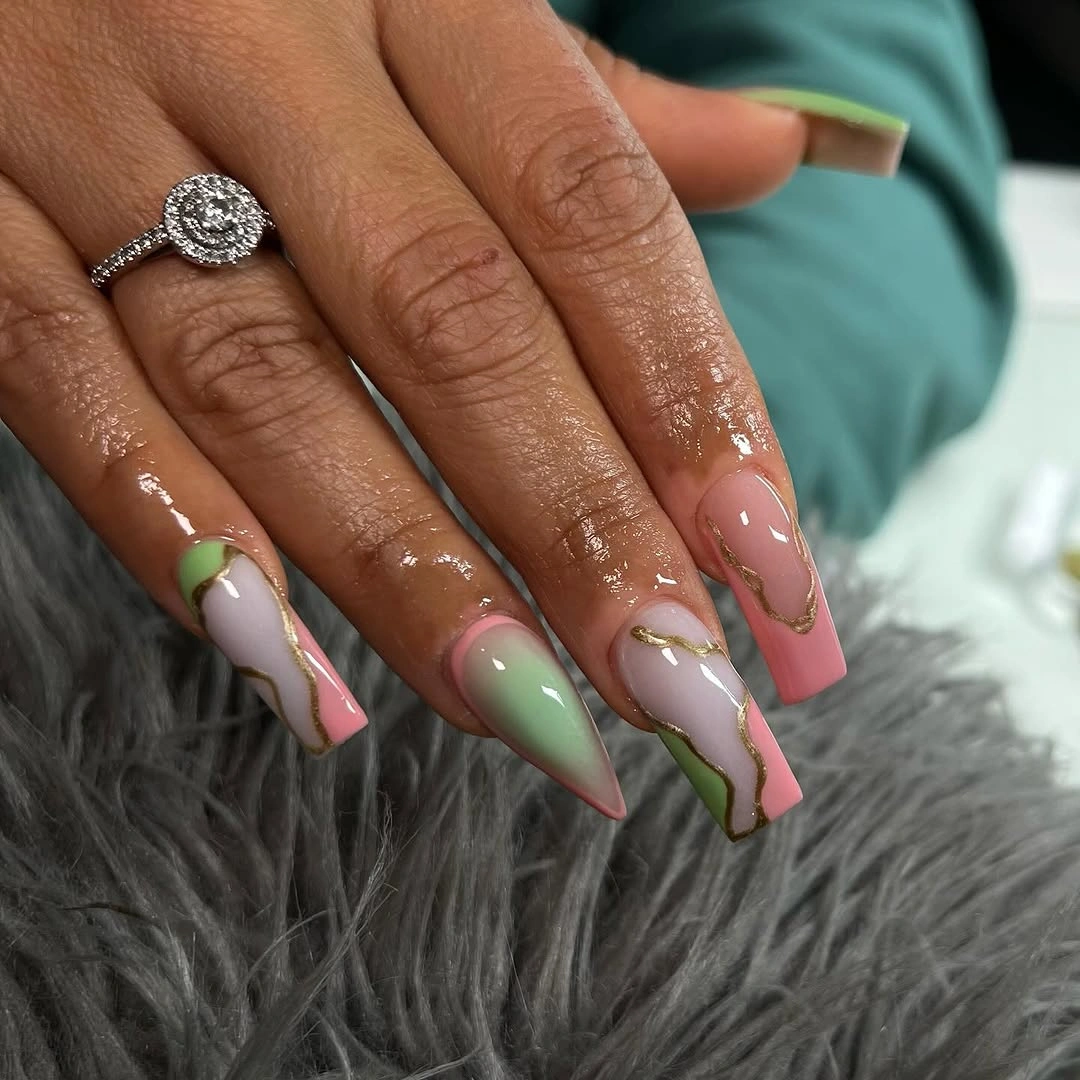
For a more wearable version, use the green only on the tip and keep the border thin, especially on a shorter nail. A neutral nude base could replace the pink if you want the contrast to feel less colorful, while a deeper olive would increase the fall direction. The limitation is that irregular edges need enough room to show their rhythm; on a small nail, simplify the wave into one clear bend rather than several tight turns.
Keep the mixed shapes if you enjoy a visibly editorial set, or choose one silhouette for a quieter result. The palette sits well beside denim, black, white, and warm beige because the two colors are distinct but not neon. Preserve the wavy border as the signature detail; adding glitter or another motif would make the color relationship harder to see.
Repeated Leaf and Gold Transparency
This neighboring set uses the same clear pink square family with warm orange leaf details, gold circular accents, and scattered sparkle, but the balance of marks shifts slightly across the hand. The repetition is useful because it shows how a transparent base can support several accents without becoming visually dark. Gold breaks the orange into smaller points, and the clear center keeps the color relationship visible. Here, repetition itself becomes the smallest consequential detail.
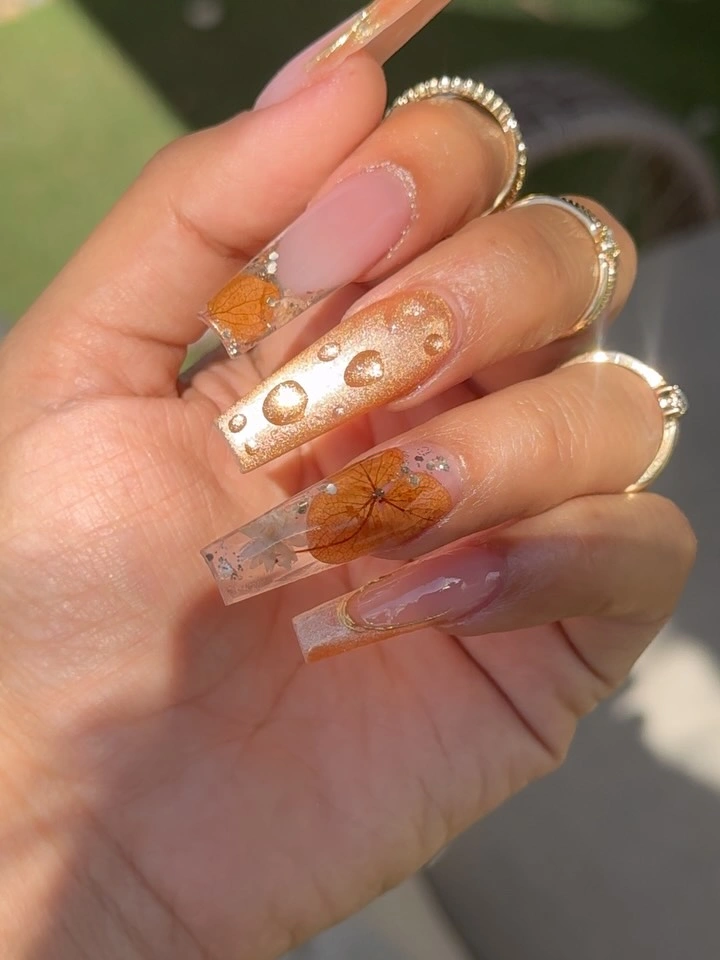
Vary the leaf size or leave one finger plain so the repeated language does not turn into a copied pattern. A soft nude base can preserve the warmth if full transparency is not practical, while a deeper orange will make the accents more concentrated. The limitation is visual similarity between neighboring nails, so spacing and scale should change enough to create a rhythm rather than a row of identical marks.
Keep the gold accents secondary and allow the transparent pink to remain the largest area on every finger. That hierarchy makes the set feel lighter on medium skin and gives the warm details a clear edge. If you are choosing between brown nail designs and orange seasonal accents, this approach shows a useful bridge: keep the base open and let the warm detail do the work.
Soft Purple with a Fine Plaid Accent
Medium almond nails combine pale pink, a deep purple edge, thin plaid lines, and small ornamental marks that remain mostly within the neutral range. The plaid panel is the most structured detail, so it gives order to the softer curves on neighboring nails. Purple adds a cool depth that keeps the pale base from looking flat, while the fine lines remain delicate rather than bold. The key decision is scale: every accent is small enough to preserve the shape.
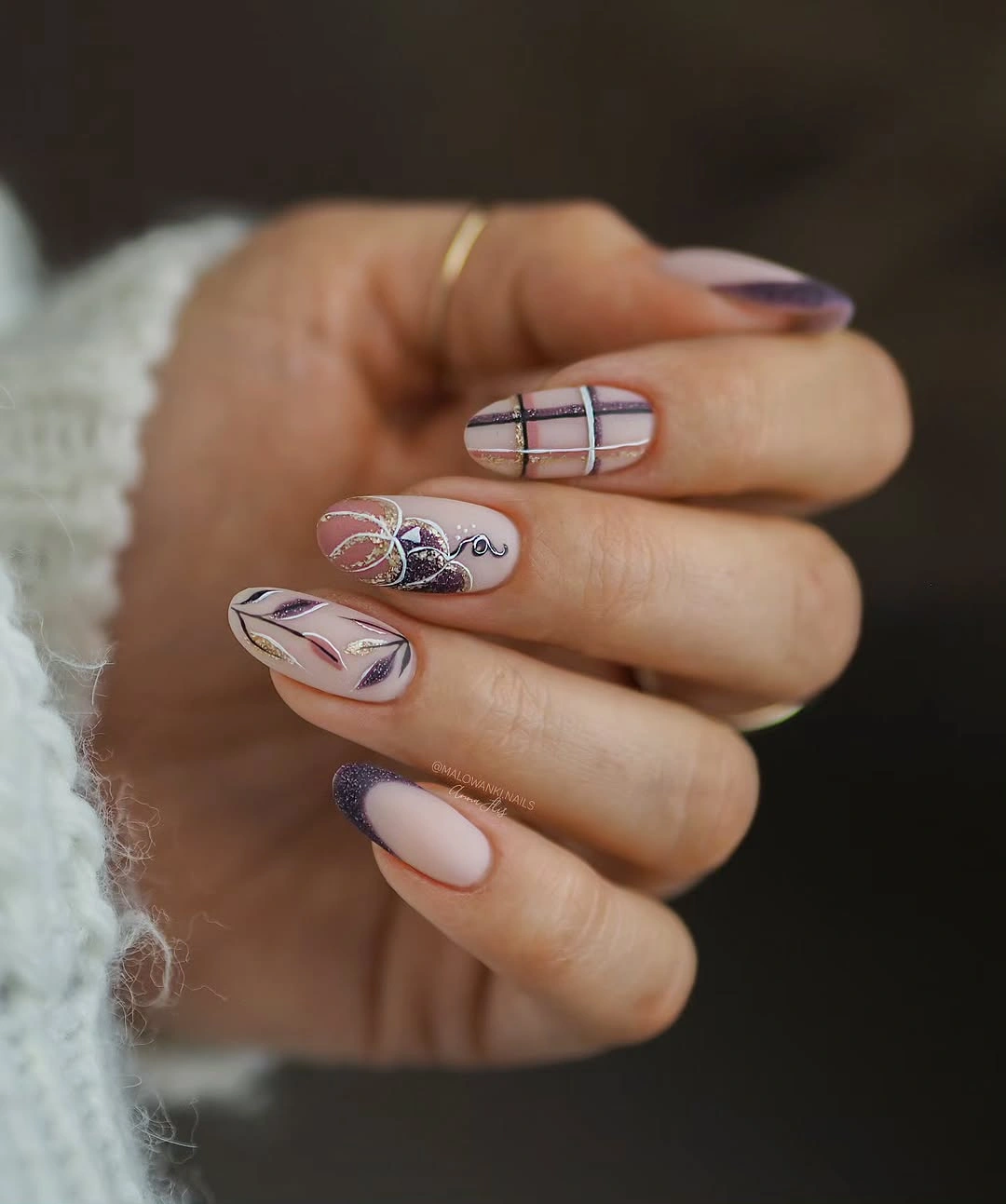
Use the plaid on one finger and repeat only the purple edge elsewhere if you want a less intricate arrangement. A shorter almond can carry the same idea when the intersecting lines are spaced farther apart. The limitation is that plaid becomes muddy if too many lines share a narrow surface, so reduce the number of crossings rather than making each line thinner. The accent needs readable structure, not microscopic detail.
Gray, soft denim, cream, and muted berry will all support the palette because they echo either the pale base or the purple depth. Keep the ornamental mark separate from the plaid so each accent has a clear job. The manicure feels composed when the eye sees one ordered panel beside quieter shapes, not when every finger tries to display the same level of information.
Copper Lines over a Clear Square Base
The clear pink foundation stretches across a long square silhouette, carrying copper glitter edges, warm metallic swirls, and a few tiny gold flecks. The clear surface stays visible between the lines, so the warm accents look placed rather than poured over the nail. Copper follows the square geometry on some fingers and curves across others, creating a balance between edge and movement. The palette is decorative, but the open base keeps it from becoming visually dense.
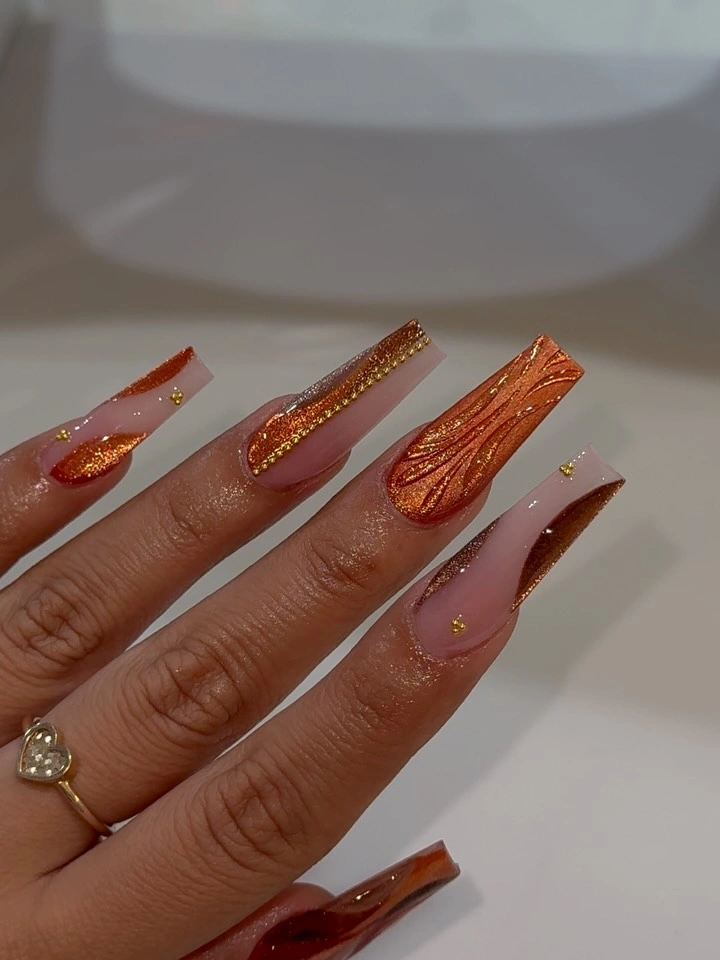
Narrow the copper edge and choose one type of line work if you want the design to feel more everyday. A warm nude base will make the accents softer, while full transparency will increase the airy contrast. The limitation is that several metallic marks can merge when viewed closely, so keep the swirls separated and leave a visible strip of base between them. Clear space is the organizing detail here.
The warm palette can sit beside brown, cream, denim, or muted green, and the square tip gives it a clean editorial frame. If you want to change the mood, use copper on one accent nail and plain translucent pink elsewhere. Preserve the relationship between bright line and open ground; without that ground, the metallic details would lose the delicate edge that makes them wearable.
Black and Gold Double French Lines
Medium almond nails use a pale pink base with thin black and gold double French outlines that trace the tip without filling it. The pale center stays dominant, while the two narrow borders create a precise edge and a small warm-cool contrast. Almond shape supports the curve because it already narrows toward the free edge, so the lines look integrated instead of pasted on. The design is restrained, but its edges are carefully placed.
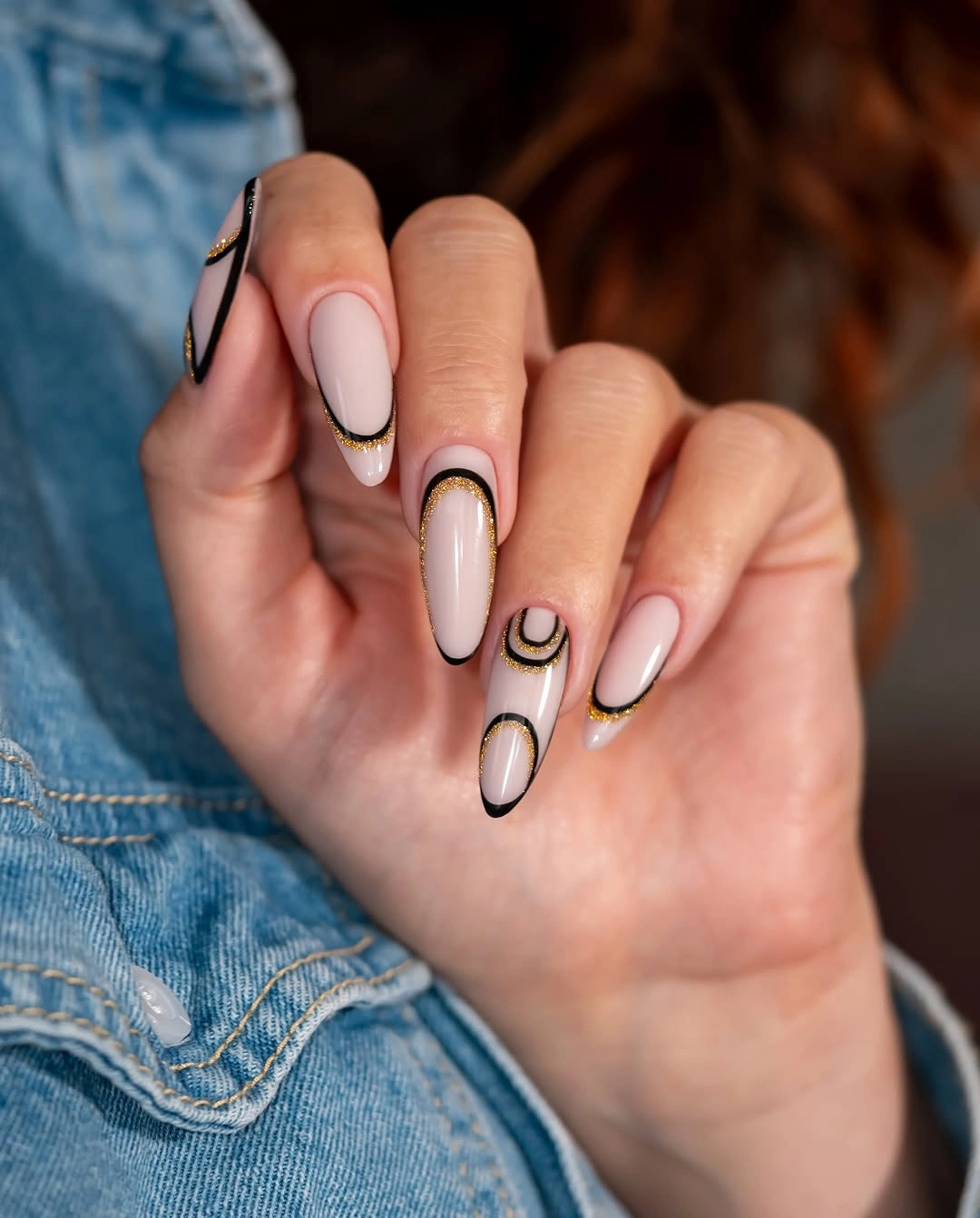
Keep the black on the inner line and the gold closer to the outer edge if you want the border to feel organized. On shorter nails, use one dark line and reserve gold for a single accent finger. The limitation is spacing: two lines need enough room to remain separate, so compressing them too close together will turn the edge into one heavy stripe. The open pink center should remain the largest area.
This palette works with simple gold jewelry, denim, black, white, and warm beige because the lines are fine rather than loud. A matte base would soften the result, while a glossy base would make the outlines feel sharper. Keep the double border as the main detail and resist adding motifs; the manicure already has a clear visual route from pale center to dark line to warm edge.
Brown Matte Nails with Orange Botanical Marks
Short rounded nails use a deep cocoa-brown matte field with small orange botanical marks and one pale pink accent finger. Brown supplies strong value and warmth against medium skin, while the orange marks create a related but brighter note rather than a competing color. The pink accent lightens the set at one point, giving the eye relief from the dark solids. It is a compact palette built from one grounded base and two controlled interruptions.
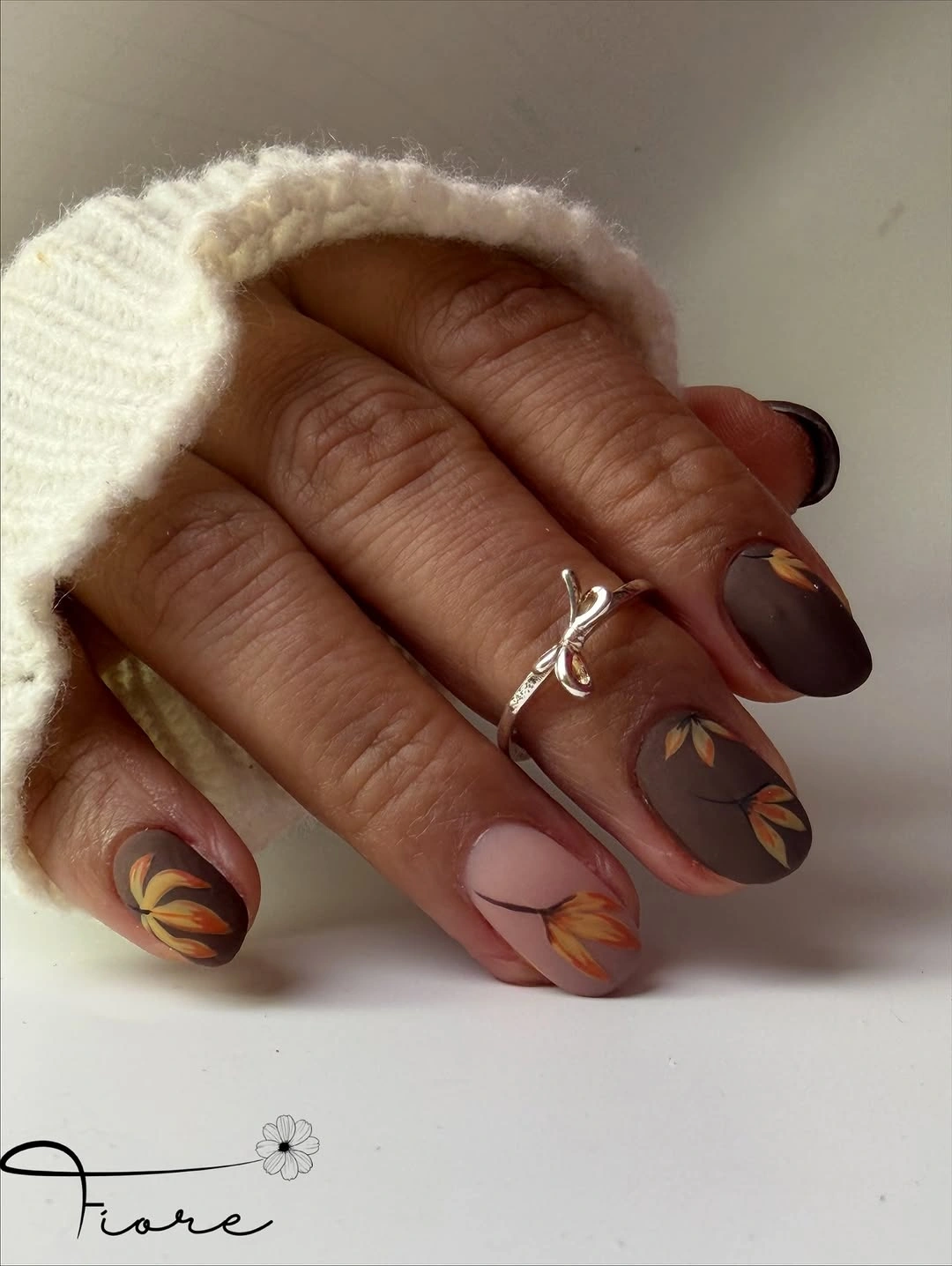
Keep the orange marks broad enough to remain visible on a short nail and use the pink only once if you want the set to stay calm. A warm nude could replace pink for lower contrast, while a darker brown would make the orange look more vivid. The limitation is that tiny botanical lines can vanish against a dense dark base, so simplify the accent into one leaf-like stroke and leave space around it.
The palette suits cream, gray, tan, and denim, and its compact length makes the strong brown easier to wear than a long dark silhouette. If you want more repetition, place one orange mark on a second brown nail rather than adding another color. The visual order should remain stable: brown first, orange detail second, pale accent last.
Nude Centers Framed by Green Borders
Long almond nails leave nude center panels open, frame them with green edges, and add two warm patterned accents with dark orange and black details. The green border creates a cool outline around the pale center, while the warm patterned nails introduce a separate temperature shift that makes the set feel more expressive. Because the nude area remains broad, the several colors do not merge into one block. Placement is the organizing feature.
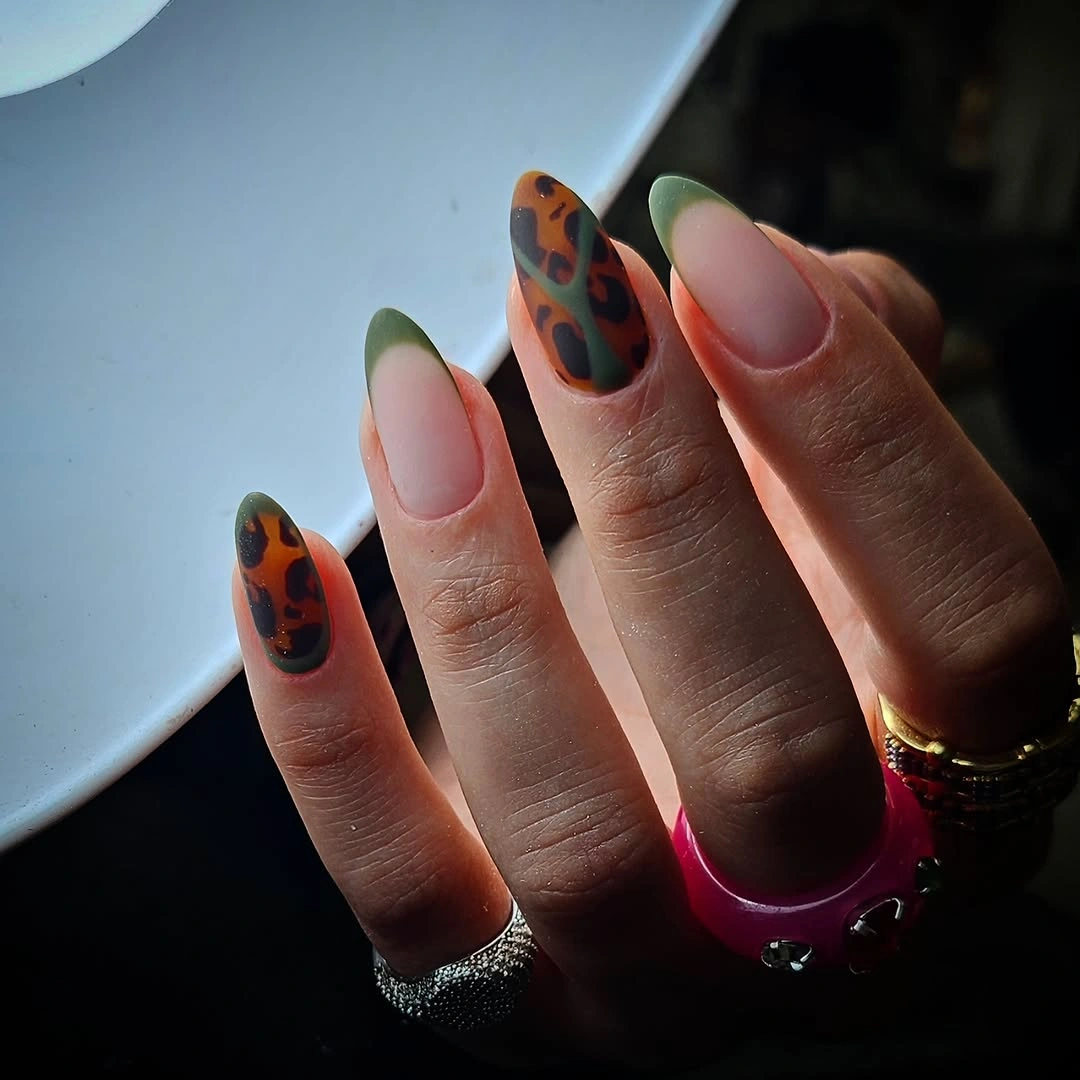
For a quieter adaptation, use the green border on every nail but keep the warm pattern to one accent finger. A shorter almond will preserve the open panel, although the border should be thinner so it does not dominate the nail. The limitation is that two strong accents can compete when the center is too narrow, so protect the nude space and reduce the patterned area before changing the palette.
Muted olive, cream, brown, and denim can all support the color story because the green and warm pattern already provide contrast. If you want a more neutral result, replace the green with taupe while keeping the same open center. The manicure works when the eye travels around the nude panel first, then notices the patterned accent; keep that route clear as you simplify.
Green Solids with Translucent Silver Accents
Short square nails alternate bright green solids with translucent nude panels and small silver botanical-looking accents. The green is the strongest visual element, but the pale panels interrupt it and keep the compact shape from feeling too saturated. Silver adds a cool reflective point without changing the color family, while the square silhouette gives the mixed set a tidy grid. The balance comes from allowing the bright shade to repeat more often than the decoration.
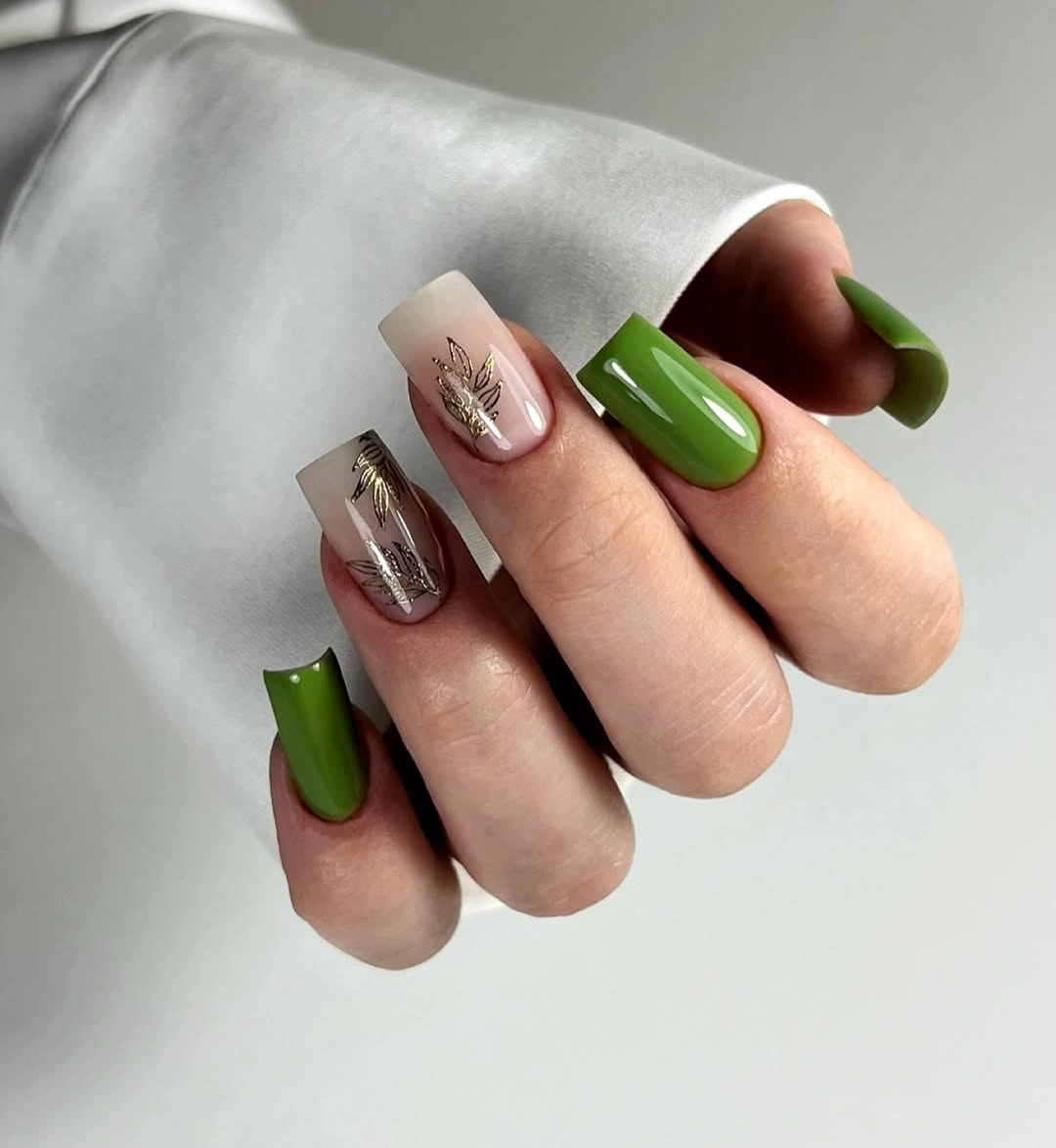
Keep green on two or three nails and use the translucent panel on one accent finger if you want less density. A muted olive will soften the contrast, while a brighter green will make the silver appear more noticeable. The limitation is that small silver details can disappear against a reflective or busy base, so place them on the pale panel where the eye has enough contrast to find them.
Gray, white, denim, and warm beige can all frame the manicure without introducing another strong color. You can repeat the silver on a second accent, but keep the mark smaller so the green remains the lead. The design feels balanced because the pale panel is not decorative filler; it is a light pause that lets the bright solids keep their shape.
Pink Almonds with Deep Brown Curves
Long almond nails use soft pink centers with deep brown curved French edges and tiny gold dots placed near the borders. The brown is more grounded than black, so it adds fall depth without making the pale base look stark. Almond shape supports the curved edge, and the small gold details repeat the warmth in miniature. The result depends on three quiet decisions: pale center, dark curve, restrained point of light.
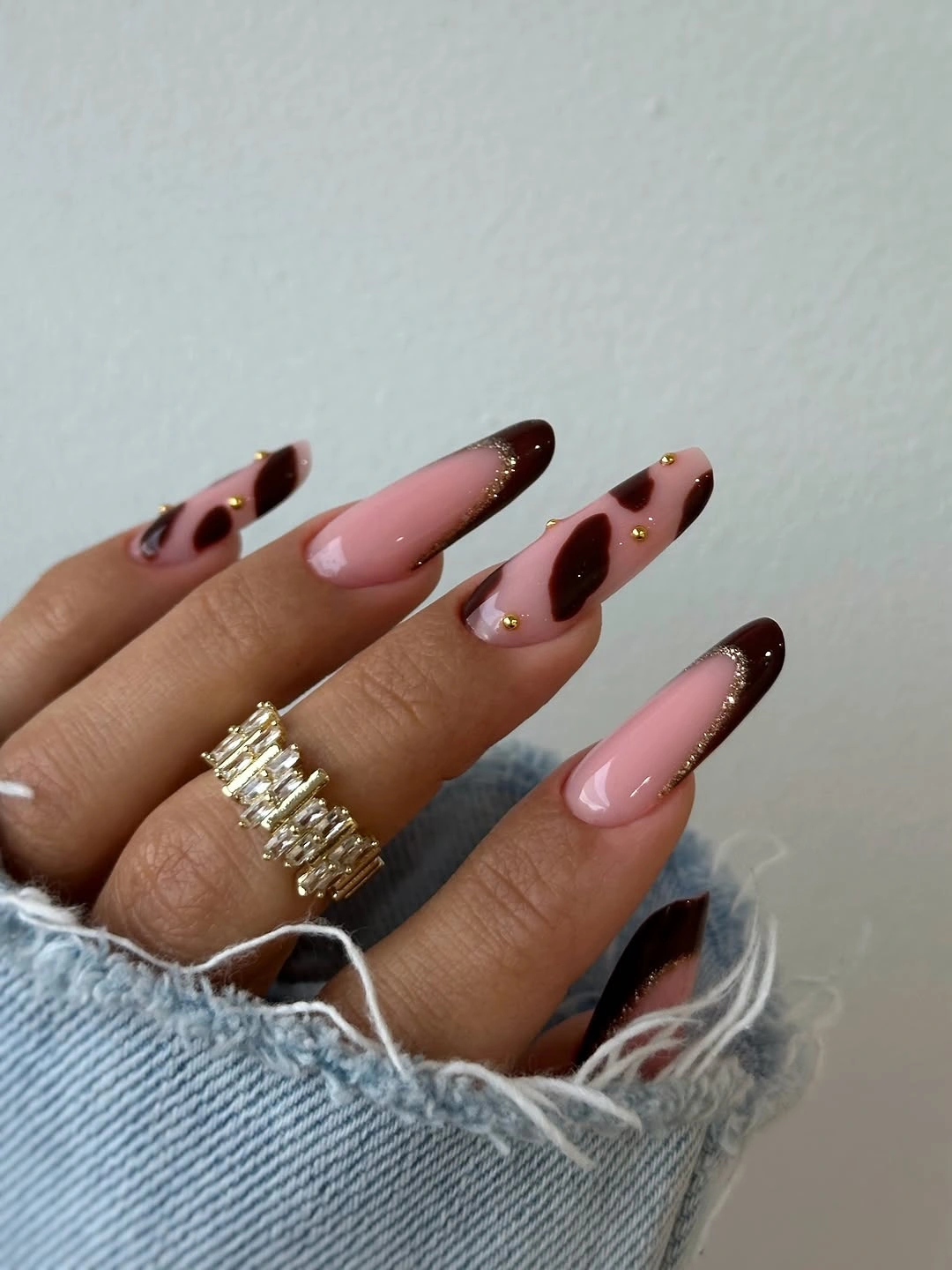
For shorter nails, keep the brown on the outer curve and use one gold dot rather than several. A warmer pink will blend into the brown, while a cooler pink will make the edge look more graphic. The limitation is that a thick dark curve can reduce the apparent length, so adjust the width before changing the entire shape. The pale center should still be visible from a normal distance.
The palette works beside denim, cream, chocolate, and soft gray because the brown edge bridges the pink and the wardrobe. If you prefer even less decoration, remove the dots and rely on the curve alone. The manicure holds together when the gold remains a small echo of the brown warmth, not a separate metallic theme.
Transparent Pink with Gold Glitter Trails
A translucent pink base fills the long square tips, crossed by gold glitter trails and narrow warm metallic lines that move across the surface. The clear pink keeps the hand visible, while the gold creates a bright route through the length of each nail. Square tips add order to the flowing lines, so the design combines a structured edge with a more relaxed interior. The smallest detail is the spacing between trails, which determines whether the set feels airy or crowded.
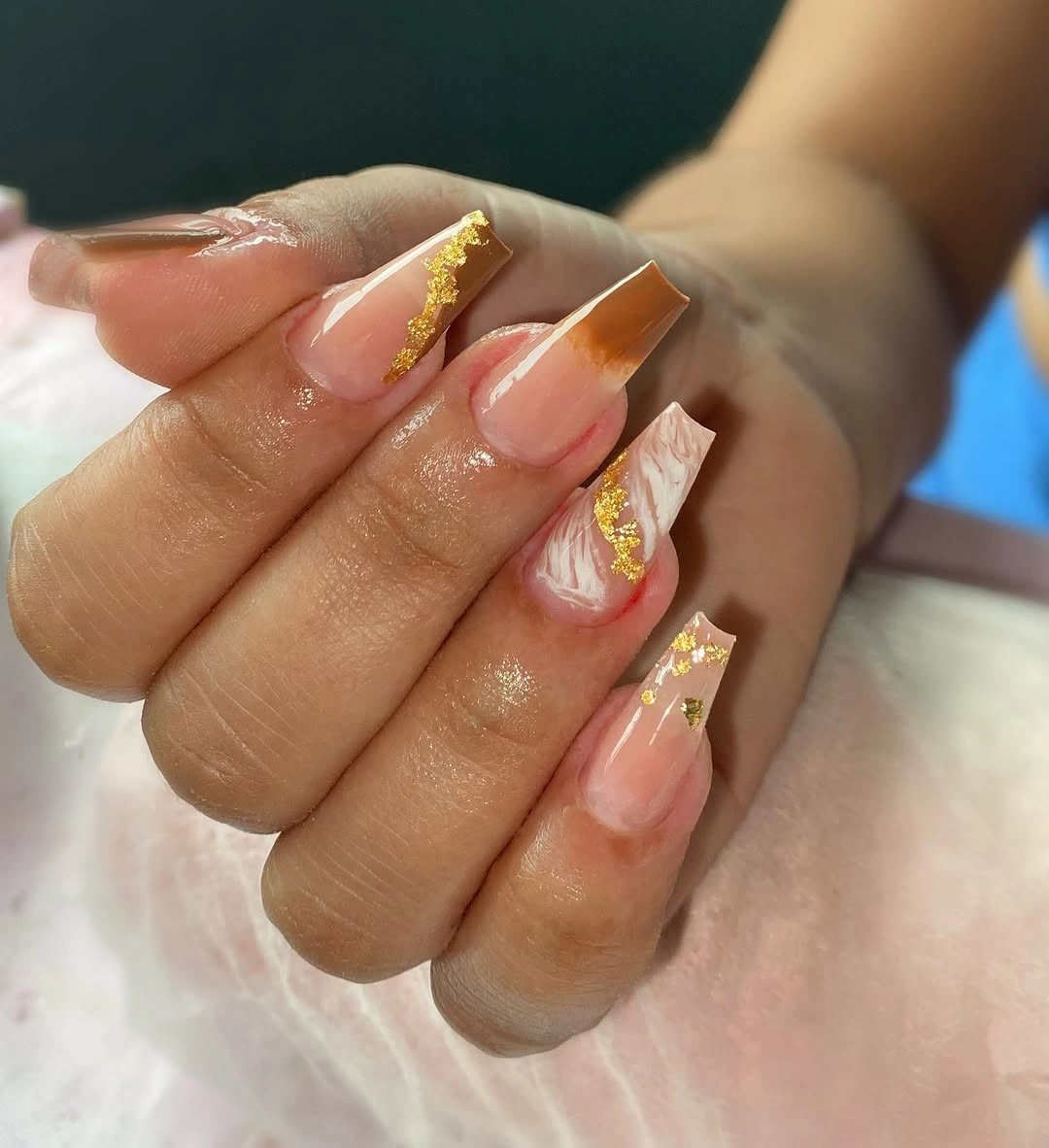
Reduce the number of trails and keep one clear path per nail if you want the design to look lighter. A pale nude base will soften the transparency, while a deeper blush will make the gold appear more concentrated. The limitation is that glitter and metallic lines can merge under strong light, so leave visible pink gaps and avoid filling every corner. Open ground is necessary for the warm accents to stay distinct.
Pair the set with cream, brown, denim, or simple gold jewelry, but do not add another strong pattern unless you want a deliberately ornate result. One plain translucent nail can create a useful pause among the decorated fingers. The manicure works because the gold is directional rather than scattered, so preserve the line of movement even when changing the base or nail length.
Red French Edges with One Spotted Accent
Long almond nails use bright red curved French tips, thin reflective outlines, and one pale accent nail carrying irregular black spots. The red supplies the main color statement, while the spotted accent changes the texture of the set without introducing a competing solid shade. Almond shape keeps the red edge elegant rather than blocky, and the narrow outline adds a small flash of light. Contrast is concentrated at the tip and on one finger.
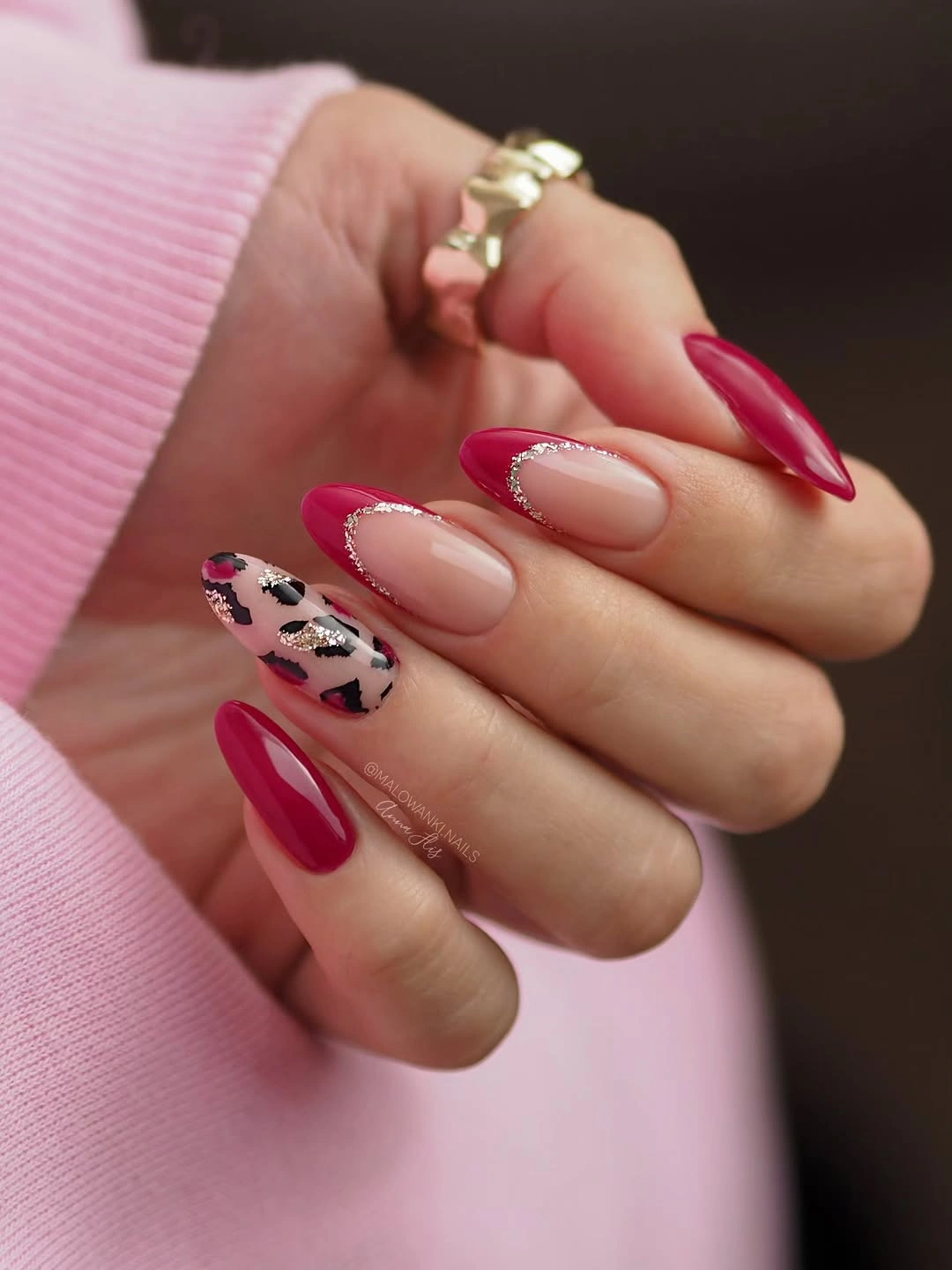
Use a nude base beneath the red and keep the outline narrow if you want the design to feel more balanced on medium-length nails. A deeper burgundy will quiet the contrast, while a brighter red will make the accent look more graphic. The limitation is that a wide red tip can shorten the nail visually, so let the base extend farther toward the edge and use the accent finger as the main point of difference.
Black, white, denim, and warm beige will all support the manicure, while a second animal-print accessory could make the result feel overly matched. Keep the spotted nail pale and let the red remain the majority color. The design is strongest when the eye reads a repeated red curve, then finds one unexpected patterned interruption.
Navy Solids with Pale Floral Decals
Short square nails alternate deep navy-blue solids with pale accent nails carrying small floral decals, gold flecks, and tiny words-like marks that are too small to read. Navy provides a strong cool base against medium skin, while the pale flowers create a clear value break. Gold warms the transition and prevents the set from feeling purely blue. The square shape keeps the contrasting accents orderly, so the detail can remain delicate.
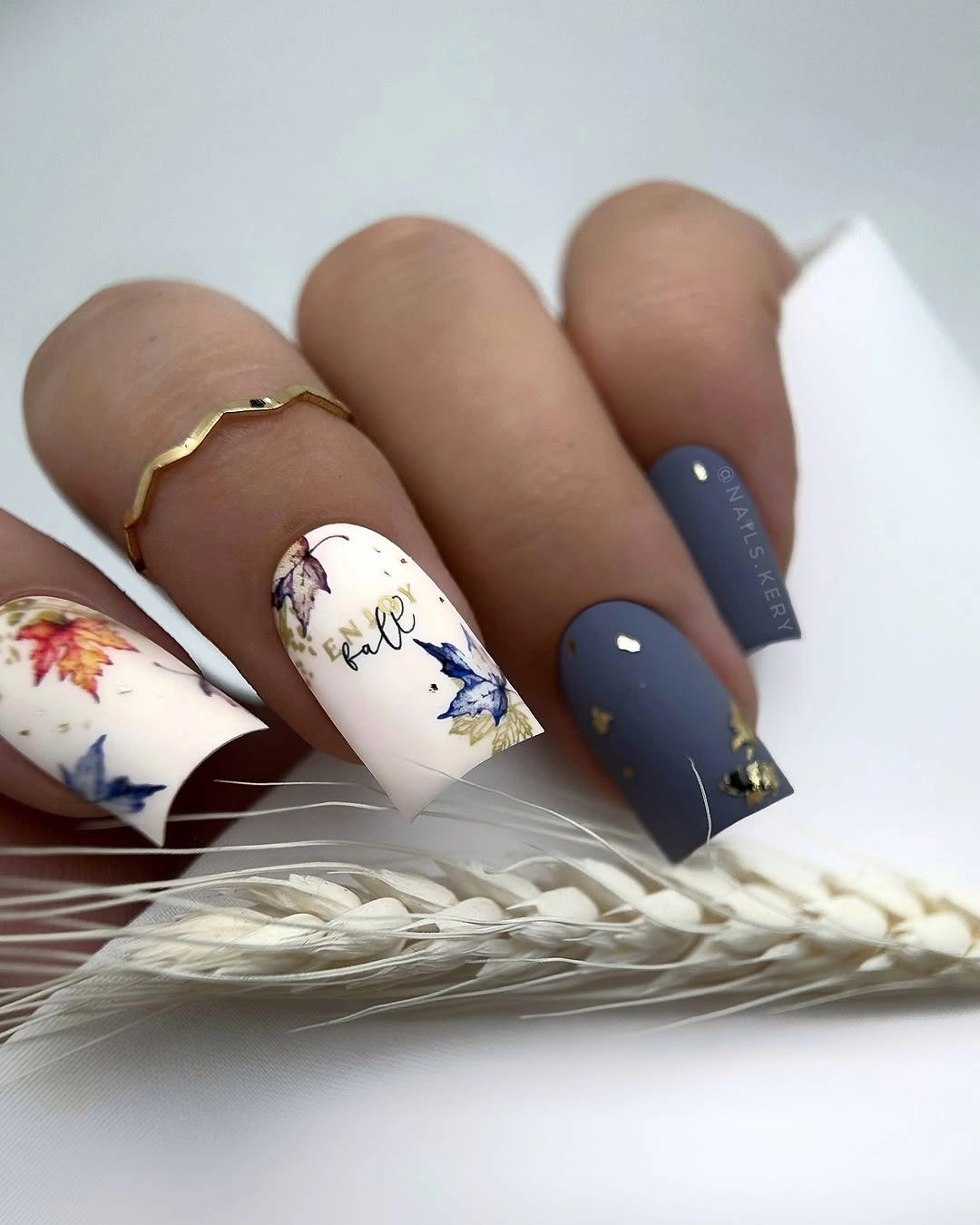
Use navy on most fingers and reserve the pale floral panel for two accents if you want the arrangement to feel lighter. A muted blue-gray will soften the contrast, while a near-black navy will make the flowers look brighter. The limitation is that tiny lettering-like marks should stay treated as visual texture, not interpreted text, and the floral detail needs enough open space to remain legible.
Cream, gray, denim, and gold jewelry can all sit beside the palette without creating a second focal point. If you want a simpler version, keep the flower and remove the smallest marks rather than adding another color. The manicure finishes on a clear relationship: deep cool solid, pale floral pause, small warm glint. Preserve that order and the set will remain readable at a shorter length.