Winter dressing becomes visually confusing when warmth, proportion, and detail all ask for attention at once. A more reliable approach is to set a hierarchy before adding complexity: choose the dominant scale or color, decide where the silhouette should change direction, and allow the remaining elements to support that decision. The result feels considered because its parts relate, not because it contains more pieces.
A useful winter wardrobe conversation starts with structure rather than prediction. Look at how layers overlap, how a narrow or broad shape meets the next one, how footwear anchors the lower edge, and where accessories repeat a tone or break it. Those relationships make different outfits comparable while keeping the language grounded in what is visibly constructed, not in age, identity, location, occasion, or promised trend status.
A Pale Scarf Gives Neutrals a Clear Line
The relaxed taupe upper layer carries most of the width in this look, while the black leggings create a much narrower line from hip to ankle. That difference is not simply a large-top-and-slim-bottom formula, because the upper half also has extensions from the scarf and the bag that keep its outline from reading as one solid block. The result is a compact neutral-and-black arrangement with a clearly defined change in scale.
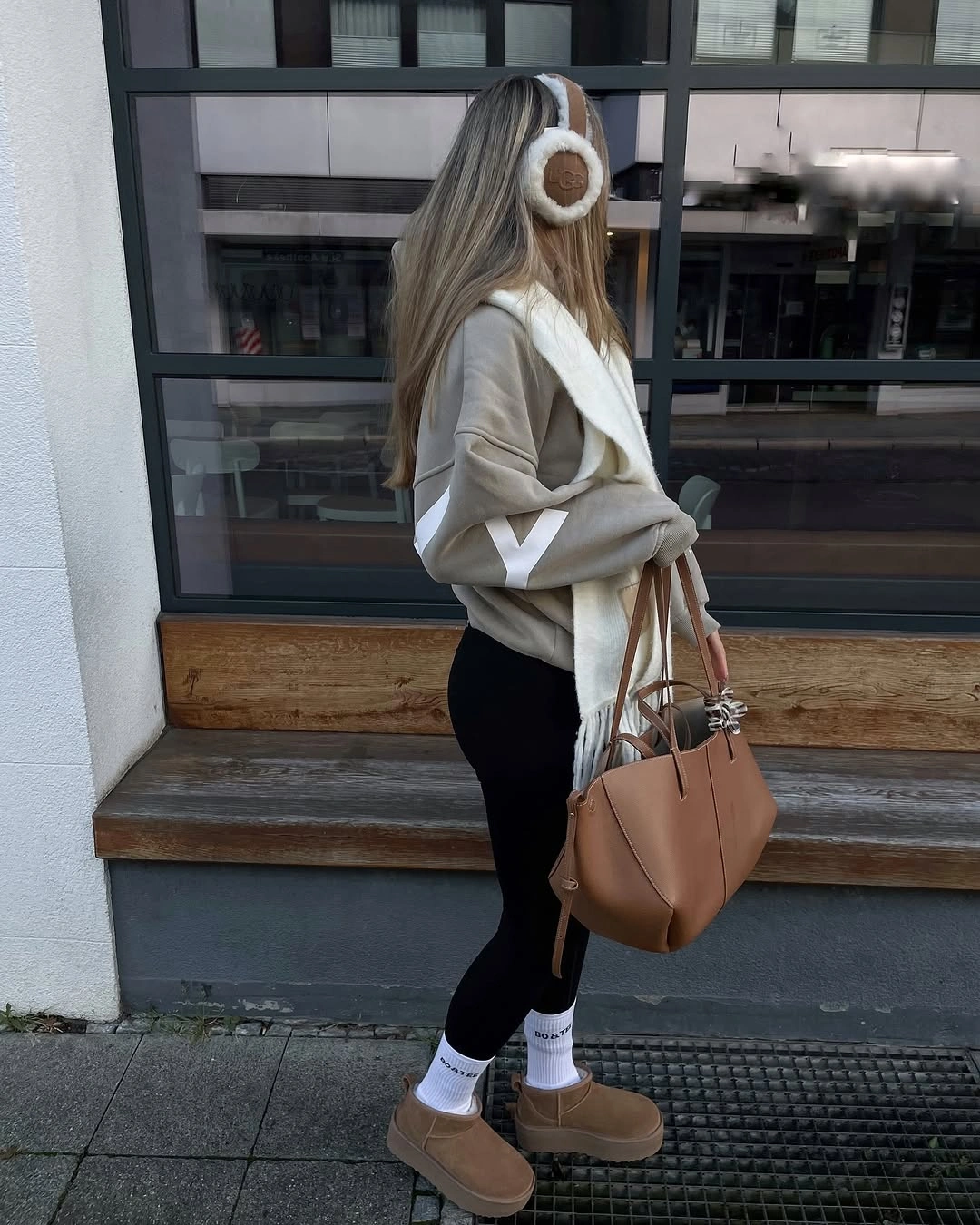
Photo via Instagram
The long white scarf does the most important directional work, dropping a bright line through the taupe area and breaking up its broad neutral field. Near the ground, the white socks repeat that light note in much smaller bands, so the eye finds a second point of connection without needing exact color matching elsewhere. For casual winter fashion for women, this kind of repetition is a simple way to link separate parts of a look without making every layer the same tone.
The tan platform slip-ons and tan-brown handbag add warm neutral weight at two separate levels, one at the feet and one beside the hip. Because neither repeats the white exactly, they broaden the palette while still relating to the taupe top and cream-toned earmuffs, keeping the look connected rather than perfectly matched.
Cream Texture Frames a Narrow Black Center
The full-length cream coat is the largest shape in the outfit, extending from the shoulders almost to the ground and creating a broad pale frame. Inside that frame, the black clothing reads as a much narrower uninterrupted channel, so the eye immediately understands which layer is expansive and which one is visually recessive. The contrast depends on width and length at the same time, not on added color variety.
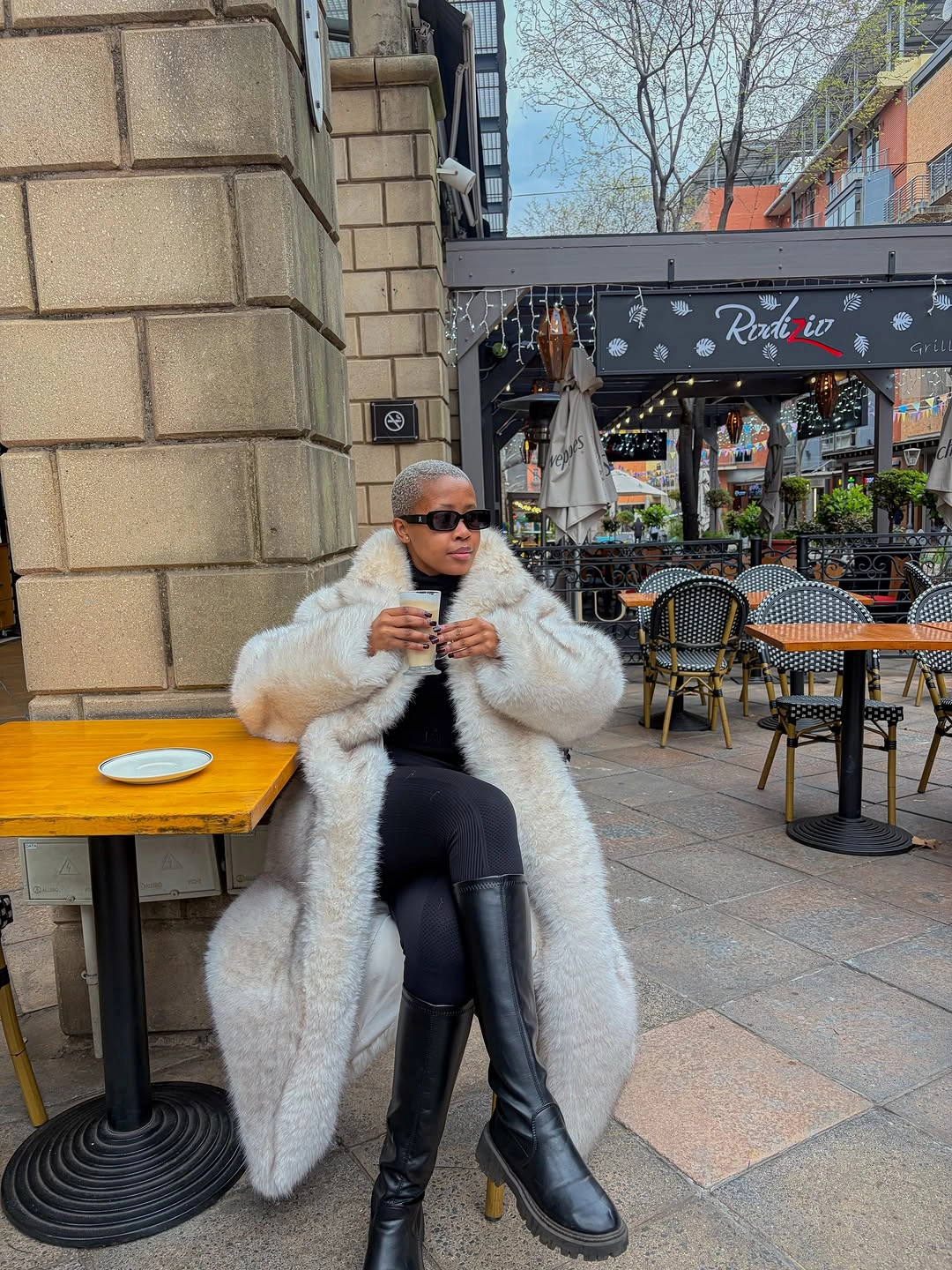
Photo via Instagram
Surface finish deepens that separation. The coat has a visibly plush, fur-textured surface, while the black inner layers appear smoother and more uniform, making the light outer area feel even more distinct without requiring any claim about fiber content. That difference gives the restrained cream-and-black palette enough variation to feel visually rich, and it supports a classy reading based on contrast rather than occasion.
The tall black boots continue the dark center all the way toward the ground, so the inner column does not stop abruptly at the knee or calf. The small dark bag and black sunglasses reinforce the same dark family in compact doses, giving the pale coat a crisp visual boundary from top to bottom.
Rounded Brown Volume Meets Loose Faded Denim
The dark brown puffer-style jacket builds width through its rounded appearance and finishes around the hip, concentrating visual weight high in the silhouette. Because its endpoint is relatively short compared with the jeans, the jacket reads as a contained upper block rather than a long outer frame. That compact shape gives the brown area a clear identity before the lighter denim takes over below.
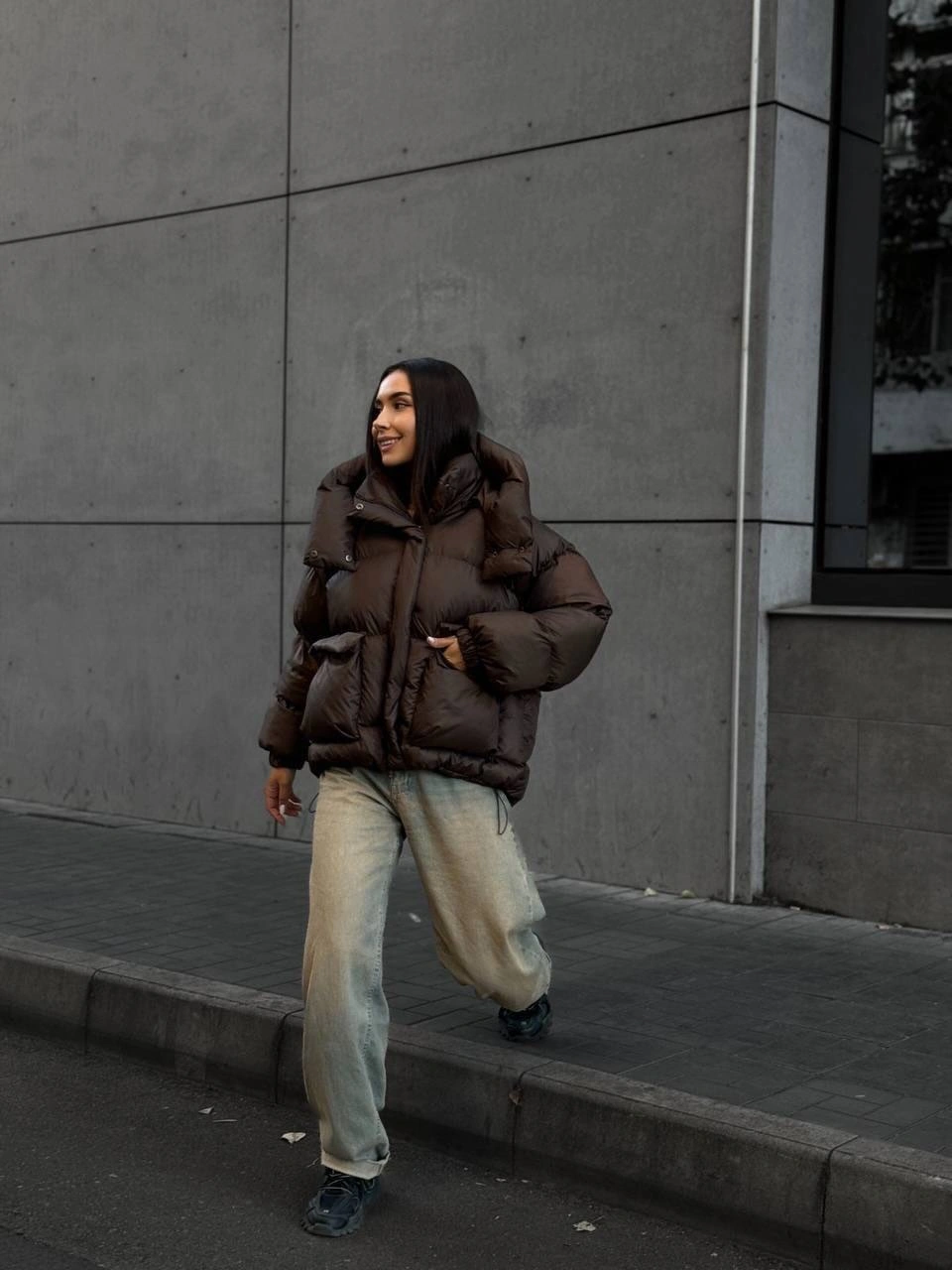
Photo via Instagram
The faded blue jeans move in a different direction: they stay very loose through the legs and fall in long, comparatively straight lines toward the shoes. Their width does not cancel the jacket's volume; instead, it creates a second kind of spacious shape with less rounding and more vertical continuity. For casual winter fashion for women, that distinction is useful because relaxed pieces can work together without sharing the same geometry.
The dark low-profile shoes stay visually quiet beneath the pale denim and do not add another bulky shape at the base. That restraint keeps attention on the conversation between the short rounded jacket and the long loose jeans, rather than introducing a third competing silhouette.
Short Black Layers Create Deliberate Visual Breaks
The black cape-like outer layer spreads outward across the shoulders and torso, forming a broad triangular shape that ends well above the knees. Beneath it, the gray lower layer is very short, so the eye encounters another endpoint almost immediately instead of following one continuous dark column downward. Those close-set breaks make the upper half feel structured by edges and stopping points rather than by a single long outline.
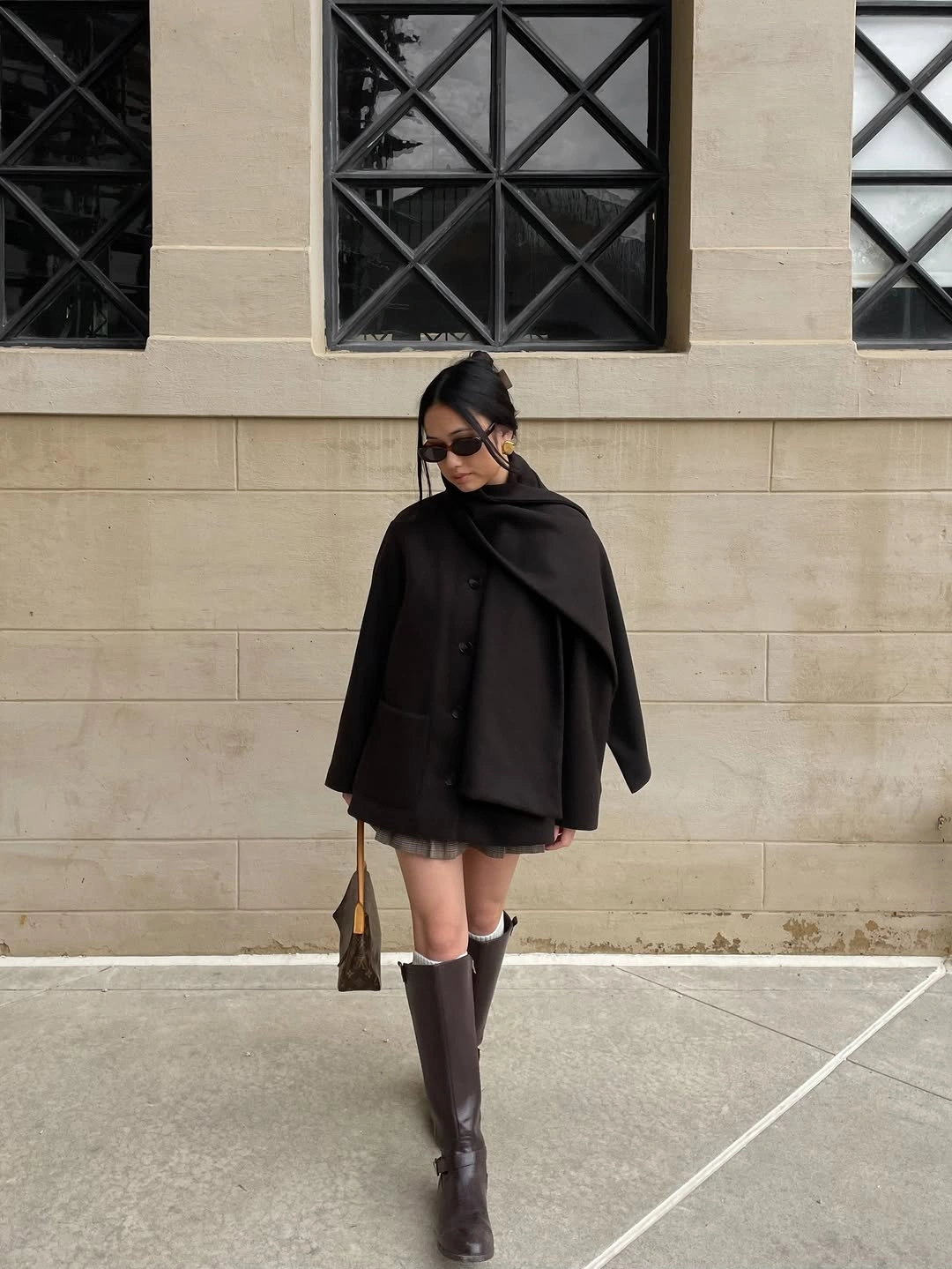
Photo via Instagram
Below the short gray hem, the sheer dark tights keep the leg area visually connected to the tall boots, but the connection is not seamless. Narrow white sock bands appear just above the boot shafts, inserting a small bright break between two dark areas and making the lower half easier to read in stages. The result is a sequence of black, gray, sheer dark, white, and deep boot tones with each boundary doing visible work.
The small brown handbag is the only clearly warm-toned element, and its compact size keeps that contrast controlled beside the broad black outer layer. Instead of redirecting the entire palette, it acts as a contained accent at hand level while the cape-like shape and tall boots remain the strongest forms.
Plush Pale Trim Sharpens a Brown Jacket
The brown shearling-style jacket gets much of its definition from the pale plush-looking trim that traces the collar, front opening, and cuffs. Those lighter borders make the jacket's edges easy to see against the brown body, so the surface contrast is concentrated where the garment changes direction or ends. Rather than relying on several competing colors, the upper half gains structure from this repeated outline.
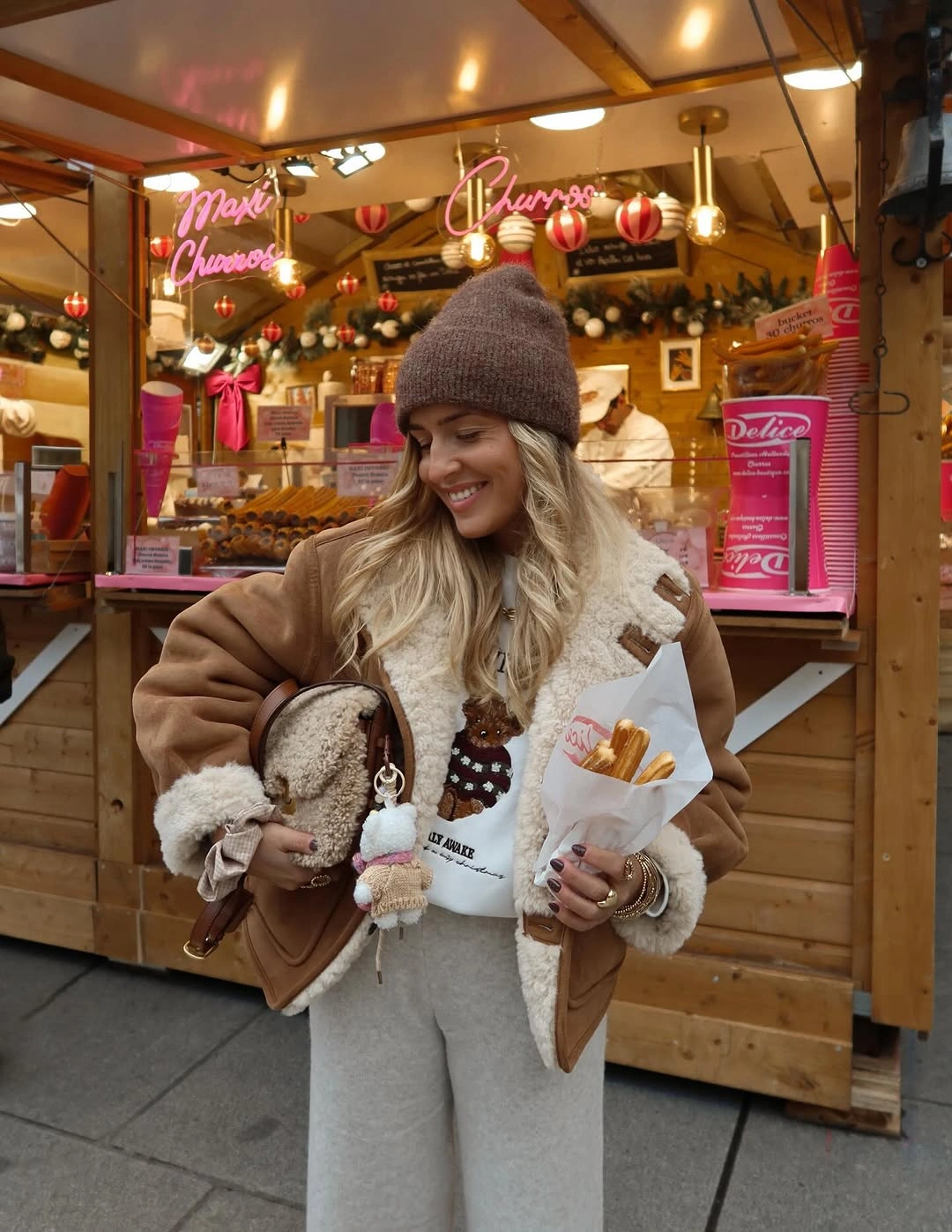
Photo via Instagram
The jacket is relatively compact, while the light gray trousers continue in a long, roomy shape below it, giving the outfit two different kinds of breadth. The upper layer is bounded by contrasting trim and a clear endpoint, whereas the trousers create a quieter uninterrupted field that continues down the legs. This makes the casual styling feel spacious without falling back on a narrow-bottom counterweight.
The brown knit beanie, jacket, and handbag repeat related warm tones at the head, torso, and hand, creating a vertical rhythm without exact matching. The gray trousers interrupt that repetition with a broad cooler neutral field, preventing the brown elements from merging into one continuous block.
Ankle-Length Beige Outerwear Narrows the Dark Center
The ankle-length beige puffer-style coat occupies most of the visible height, while the black high-neck top and close-fitting dark trousers appear through a comparatively narrow opening at the center. Because so little of the base is exposed from side to side, its uninterrupted darkness becomes more noticeable rather than disappearing. This long coat outfit uses coverage itself to control how much visual information the inner layers contribute.
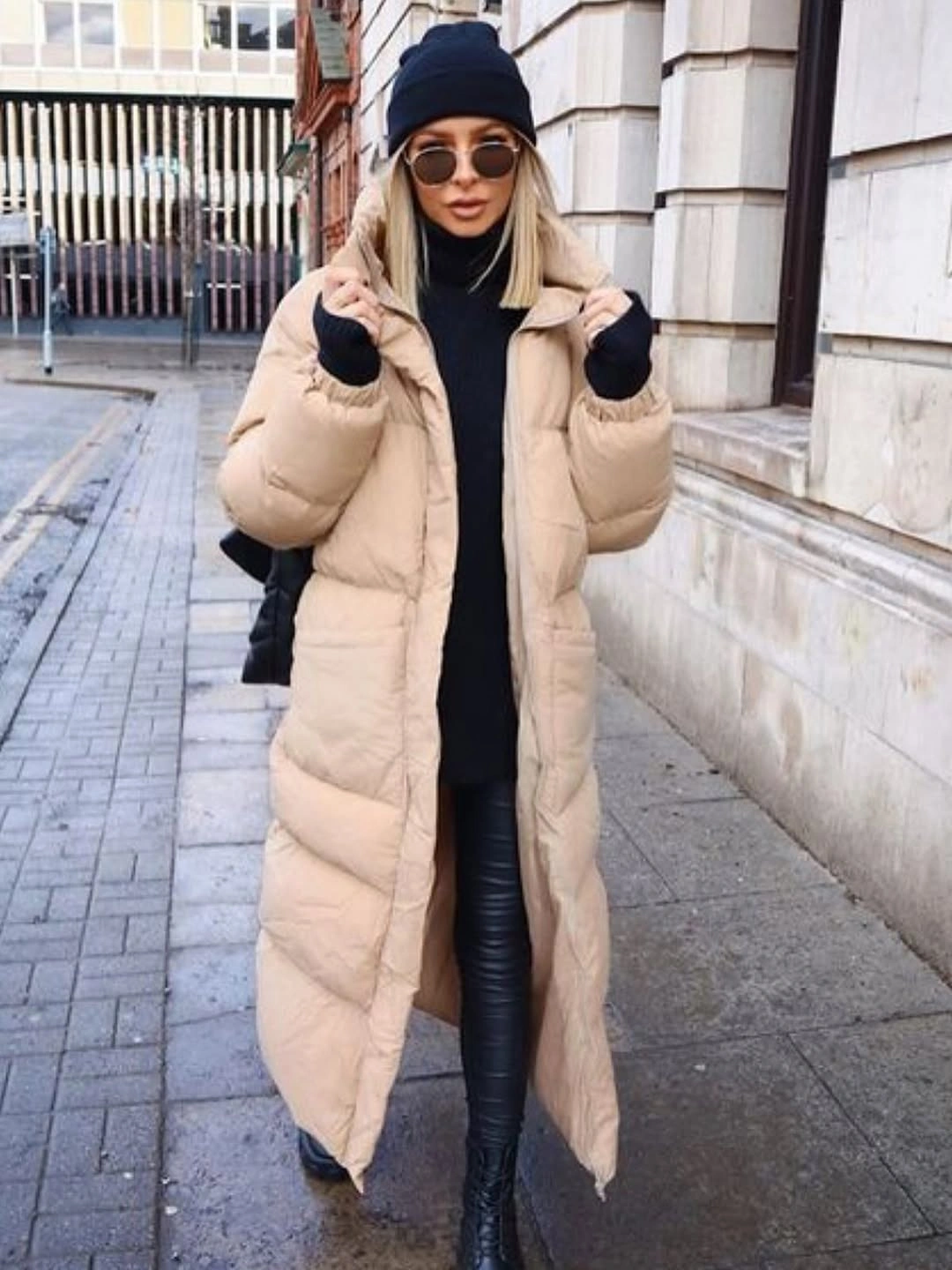
Photo via Instagram
Across the pale coat, the quilted-looking divisions break a very large surface into repeated sections, while the darker clothing inside appears smoother and less segmented. That difference keeps the extended outer layer from reading as one featureless beige mass and gives the eye two different kinds of structure to compare. The effect comes from visible finish and construction only, without requiring assumptions about the coat's fill or exact fabric.
The dark beanie, gloves, high neckline, trousers, and sunglasses place black at several different heights instead of confining it to the center of the body. Those repeated dark points make a simple two-tone palette workable even with an unusually long outer layer, because the black base remains visually present from head level toward the ground.
Toggle Closures Give a Brown Coat Structure
The dark brown coat falls to roughly mid-thigh with a relatively straight outline, giving it enough length to dominate the torso without taking over the entire lower silhouette. Against the black high-neck base and dark lower layer, the brown surface becomes the main color field. What distinguishes this simple combination is not a dramatic change of shape, but the way small fastening details organize that broad area.
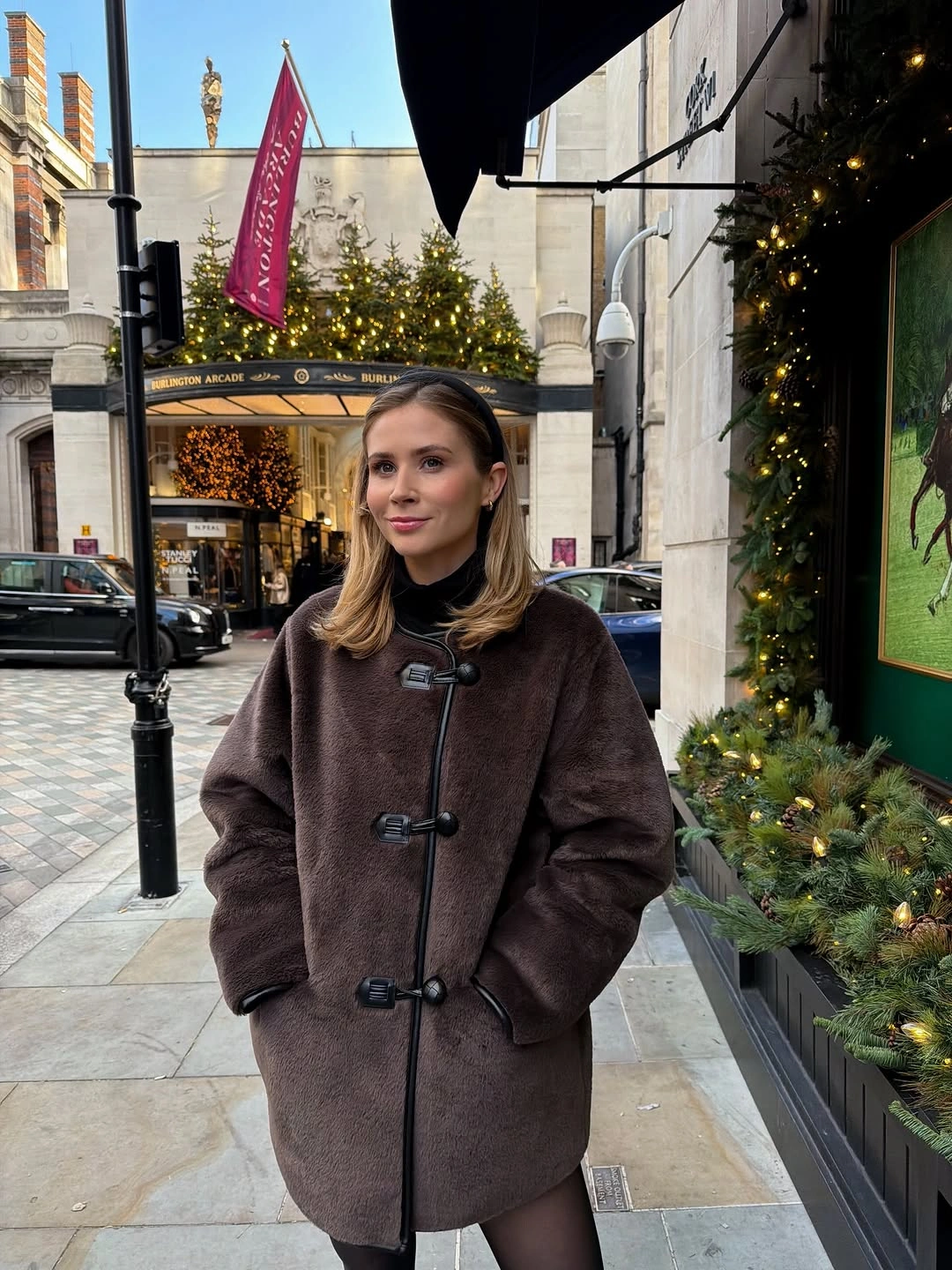
Photo via Instagram
The dark toggle closures appear at repeated intervals down the front, creating short horizontal markers across an otherwise restrained coat. Because they are spaced vertically, the eye moves from one fastening to the next instead of treating the brown front as a single uninterrupted panel. That repeated placement adds rhythm without introducing another bright color, pattern, or oversized accessory.
Black at the neckline and below the coat connects visually with the dark toggles, so the fastenings do not feel like isolated decorative marks. The result shows how a limited palette can still have a clear internal structure when closures, edges, and layer boundaries are allowed to carry the visual detail.
Gray Tailoring Meets Extra-Wide Blue Denim
The long charcoal-gray coat establishes the largest vertical shape, but the upper half contains several smaller layers rather than one uninterrupted gray surface. A shorter tailored-looking gray piece sits inside the coat, while a small area of white remains visible at the center. This nested construction gives the upper body precise edges and multiple depths before the silhouette opens dramatically into the jeans.
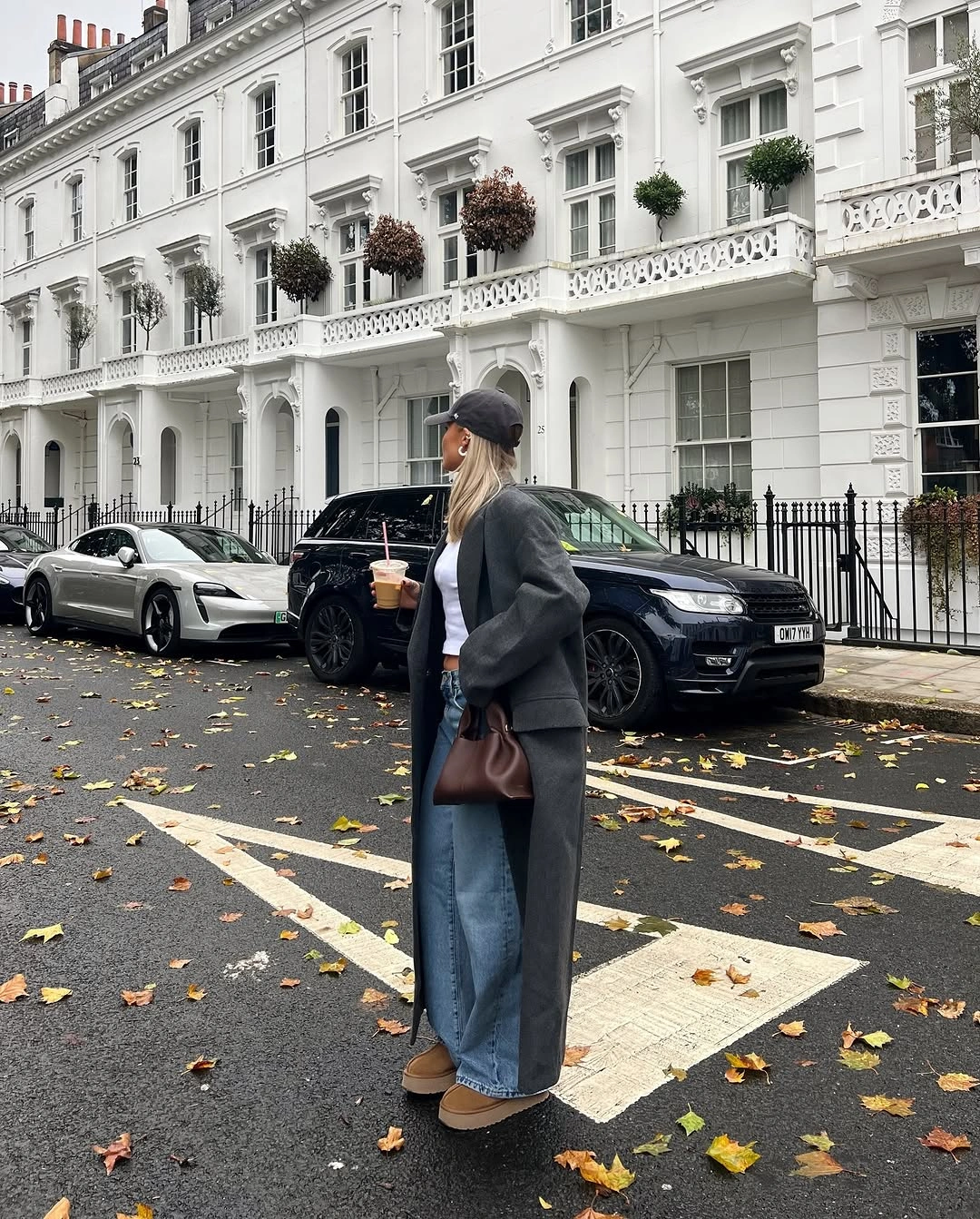
Photo via Instagram
The blue jeans are exceptionally wide through the legs, so they bring a broad, relaxed geometry to a look whose upper layers appear much more controlled and structured. Their width makes the casual element visually substantial rather than secondary, which allows the long coat outfit to combine two very different kinds of shape without either one disappearing. The contrast is about construction and scale, not an assumed destination or dress code.
The gray cap and outer layers keep the upper palette subdued, while the tan platform footwear and dark brown-burgundy handbag introduce warmer values at separate points. Neither needs to function as a generic pop of color; the shoes give the very wide denim a distinct endpoint, while the deeper bag adds compact visual weight beside the long coat.
Deep Red Interrupts an Extended Gray Composition
The full-length gray coat, gray inner layers, and textured gray head covering create a composition with very little color separation across most of its height. That continuity makes the deep red structured handbag especially important because it occupies a sizable rectangular area near the middle of the body. Rather than acting as a tiny accent, the bag creates a deliberate pause inside the broad gray field.
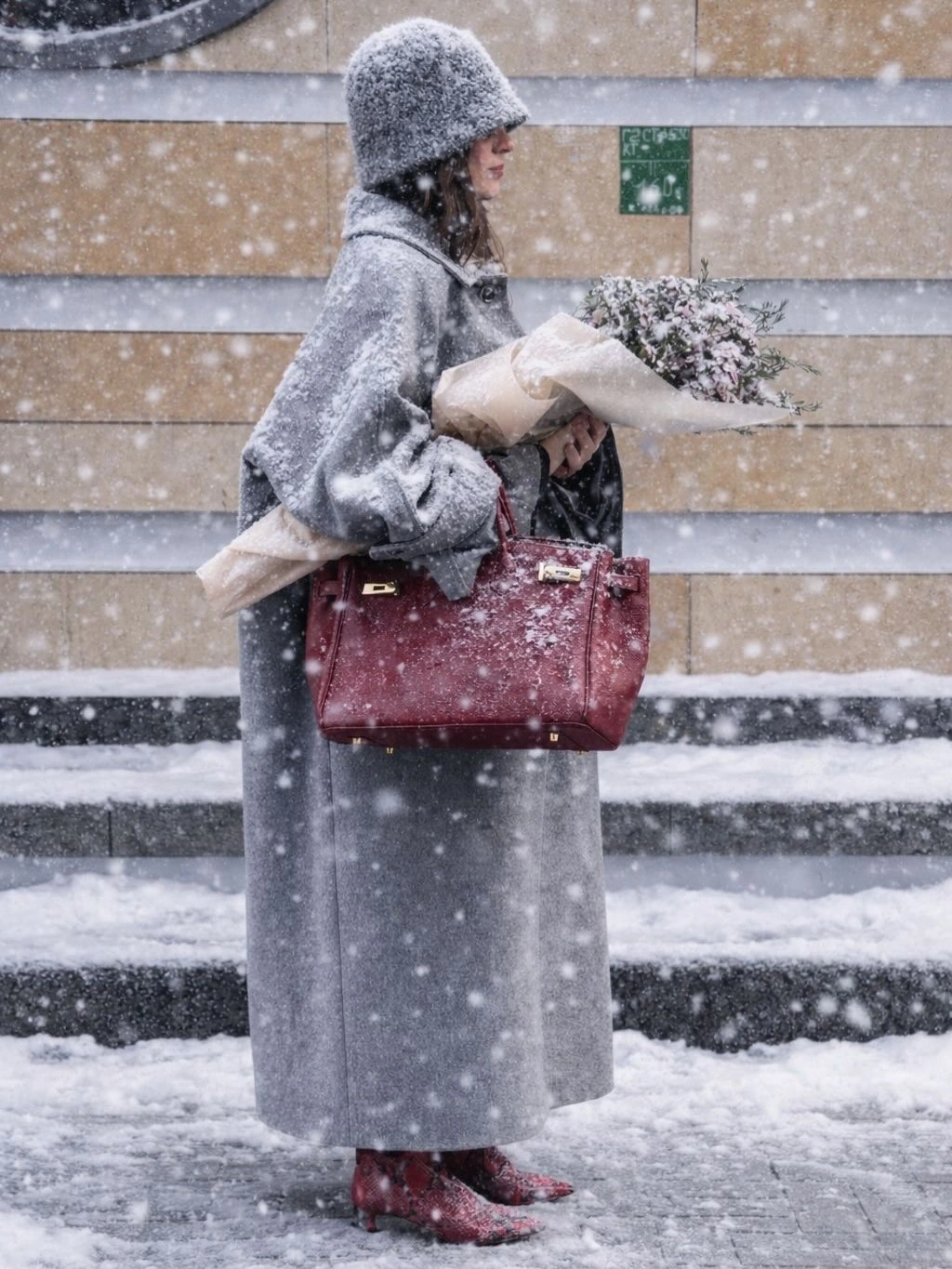
Photo via Instagram
A closely related red returns at the ankle footwear, placing the stronger color near the bottom after it first appears at hand and hip level. The distance between the two red areas matters: gray remains dominant between them, so the eye registers the handbag and footwear as separate anchors rather than one continuous block. This gives the long coat outfit a clear color structure without requiring additional contrasting pieces.
The restrained gray base allows the red elements to feel decisive while keeping the overall palette limited. That controlled distribution can support a visually classy effect, not because of an assumed occasion, but because the large gray areas and two clearly placed red interruptions remain easy to distinguish.
A Dark Cropped Jacket Resets the Light Silhouette
The cropped olive-brown shearling-style jacket places the darkest value high on the body and ends well before the long pale trousers do. That short upper block changes how the outfit is read compared with a long dark or pale coat, because most of the visible height below the jacket belongs to lighter tones. The casual combination therefore feels strongly divided by placement rather than by numerous colors or complicated layering.
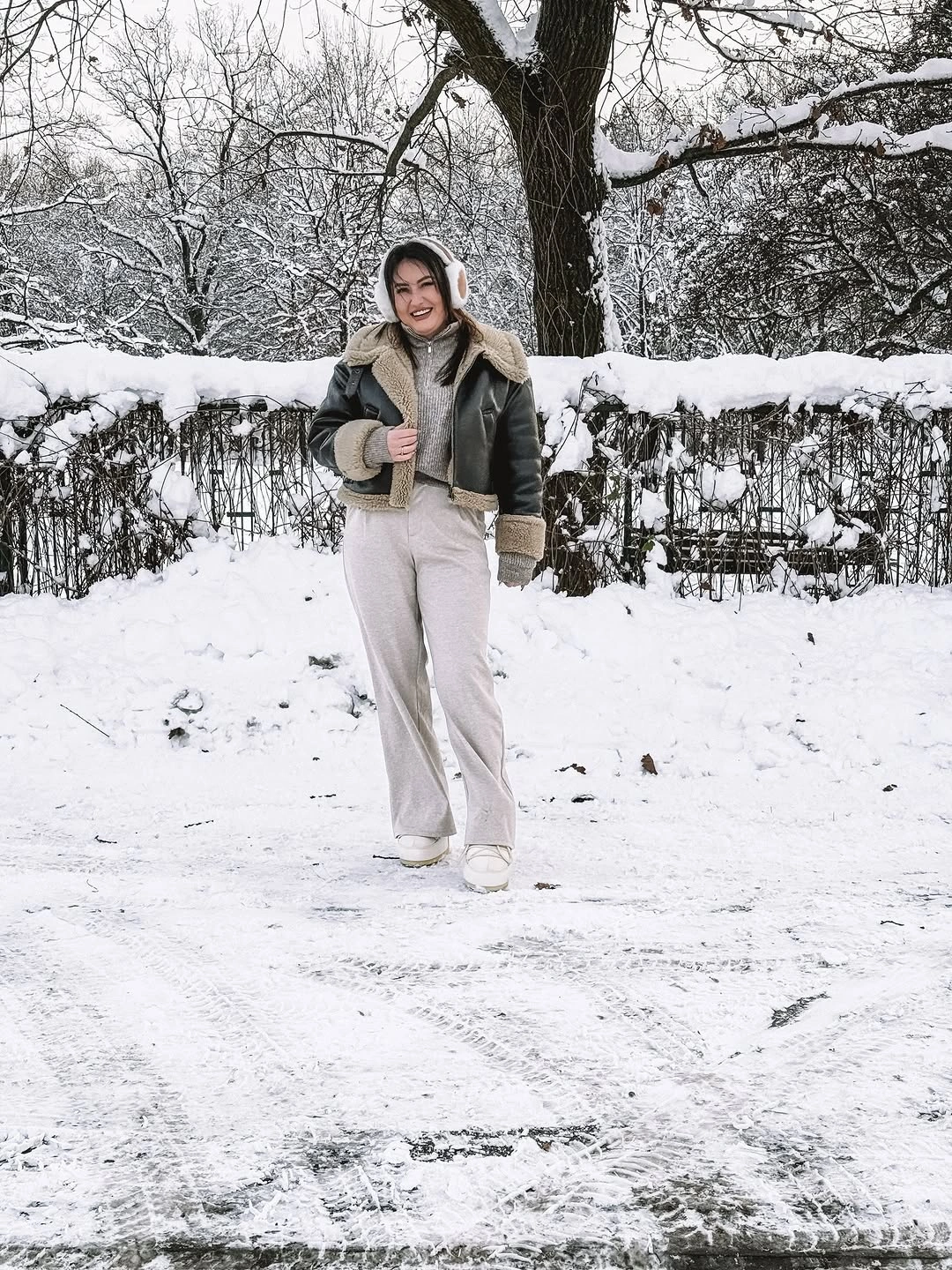
Photo via Instagram
Pale plush-looking trim runs around the jacket and sits close to the light neutral sweater underneath, creating a softer transition between the dark outer surface and the much lighter center. From there, the pale trousers extend the same general value downward in a broad, roomy shape. The trim effectively works as a visual bridge, helping the short jacket relate to the lower half without claiming any specific fur or shearling composition.
Pale sneakers continue the light lower area all the way to the ground, so the trousers do not end in a sudden dark footwear block. With the strongest darkness concentrated in the cropped jacket, the lower half is free to remain expansive and light, giving this casual look a distinctly top-weighted color structure.
Light Tones Make Finish Carry the Contrast
Cream, off-white, and other pale values occupy almost every large area here, so color separation is intentionally limited. The puffer-style jacket, trousers, oversized fluffy-looking hat, and white mittens are distinguished more by their shapes and relative scale than by strong shifts in hue. That restraint makes this a useful example of how a simple palette can remain visually active without adding another dominant color.
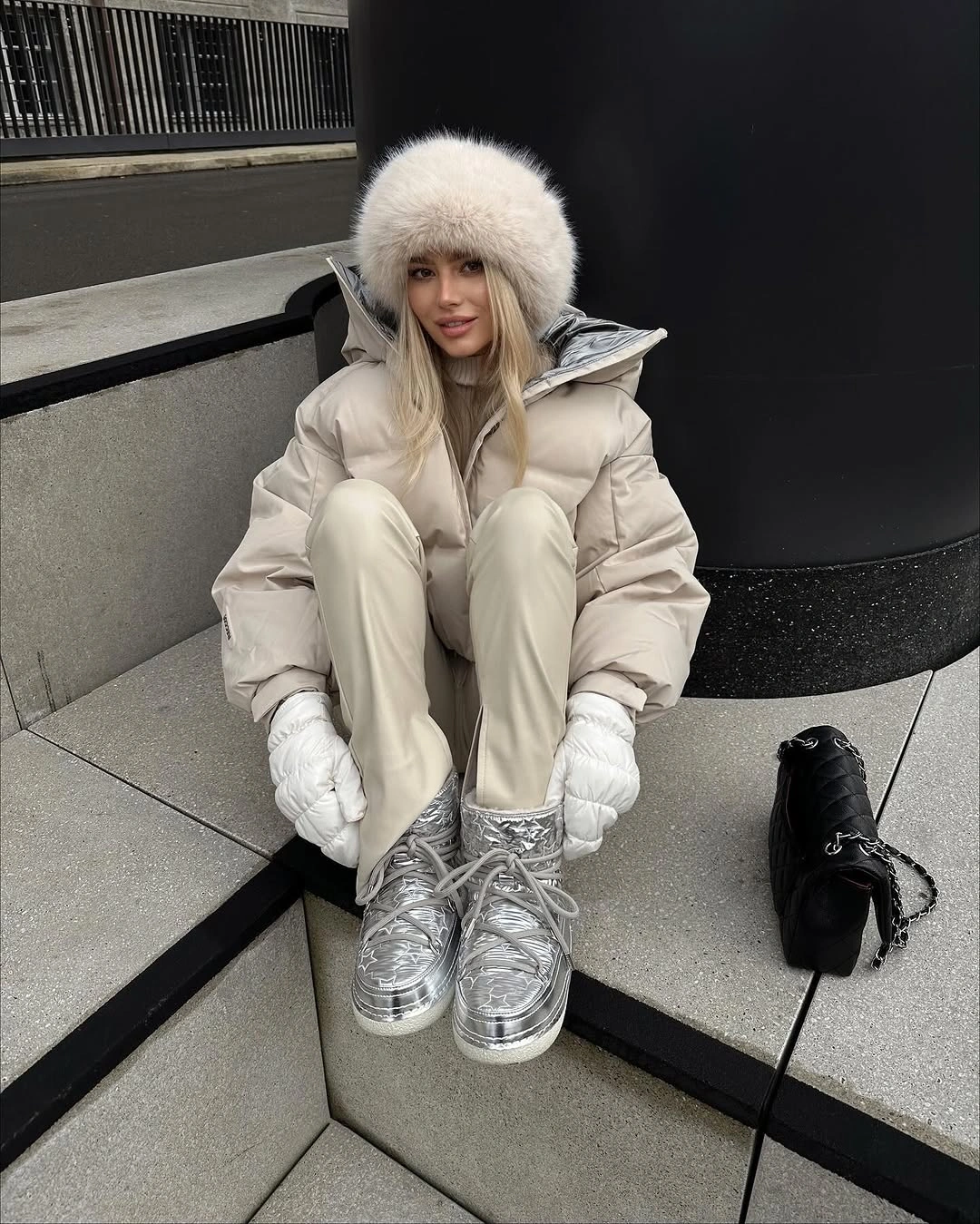
Photo via Instagram
The metallic-looking silver platform boots change the reading through finish rather than through a dramatic move away from the pale palette. Their reflective surface catches attention differently from the softer-looking clothing above, while their substantial platform shape gives the base enough visual presence to register beside the large hat and jacket. The contrast therefore comes from how surfaces behave, not merely from light versus dark.
The compact black handbag works in almost the opposite way: it introduces the darkest value in a much smaller, concentrated area. Because the pale forms are so much larger, the bag does not overturn the light palette; it acts as a precise dark punctuation beside an outfit whose stronger statement comes from scale and finish.
Layered Blues Shift the Lower Rhythm
Several cool tones sit close together without collapsing into one blue block. The long navy puffer-style coat provides the deepest large area, while the medium-blue ribbed top and pleated short skirt create a lighter interior with their own visible surface patterns. Ribbing above and repeated pleat lines below give the center enough structure to stay distinct even though the colors belong to a related family.
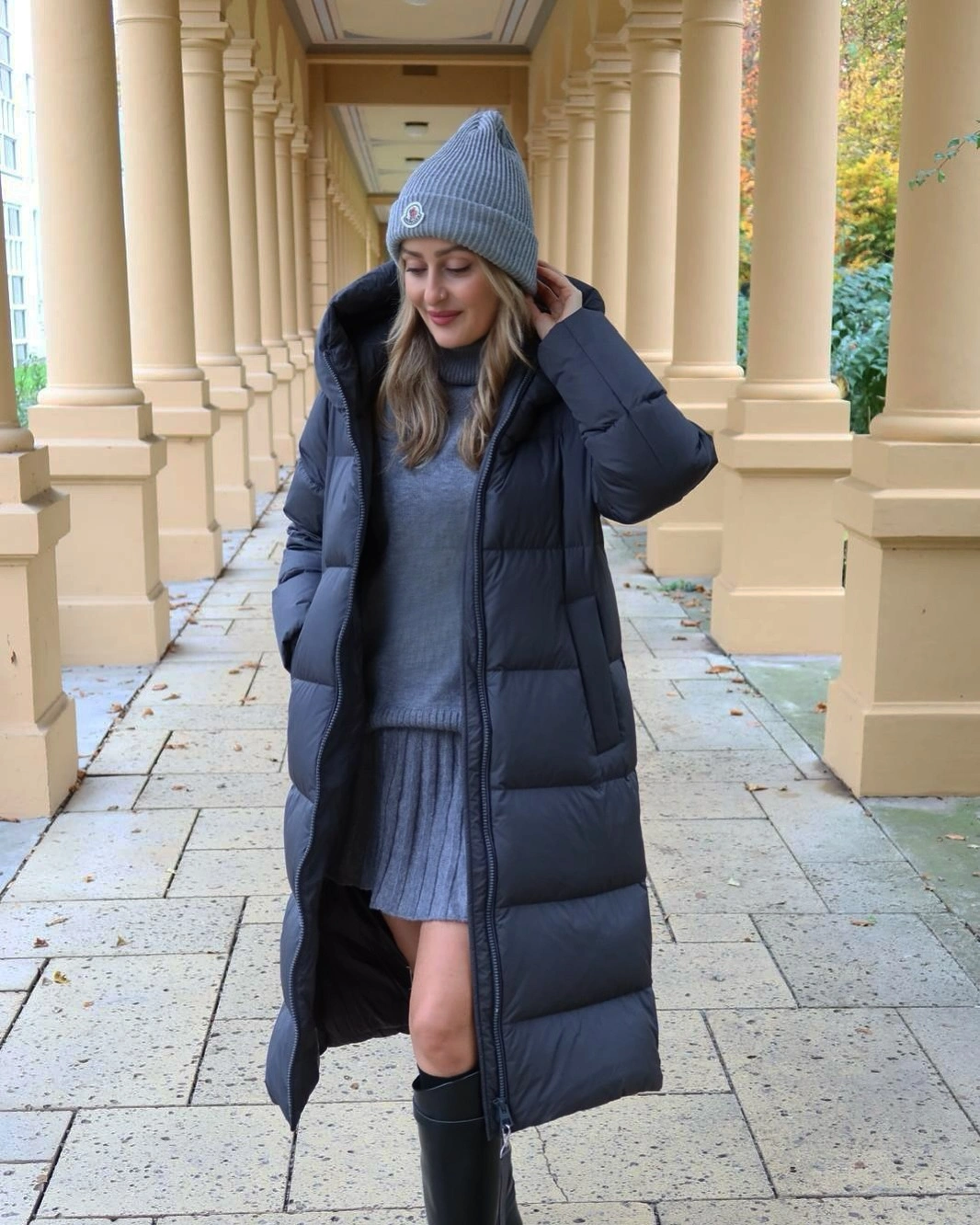
Photo via Instagram
The lower half changes character where the short skirt ends and the tall black boots begin. Rather than producing one uninterrupted dark continuation, the exposed interval between those points creates a noticeable pause before the substantial boot shafts take over near the ground. That spacing gives the lower silhouette a segmented rhythm that differs from the long, continuous presence of the coat.
The gray-blue beanie softens the upper endpoint by staying within the cool palette without matching the navy coat exactly. At the opposite end, the black boots establish a much darker base, so the outfit moves from softened blue-gray near the head through layered blues at the center to concentrated black below.
Taupe Volume Rewrites an All-Black Base
Black remains almost continuous through the coat, inner clothing, beanie, and lower area, giving the outfit a restrained foundation with very few internal color changes. The taupe-brown scarf disrupts that restraint by occupying a surprisingly large portion of the shoulders and chest. Its importance comes less from being a contrasting accessory and more from becoming an additional upper-body shape in its own right.
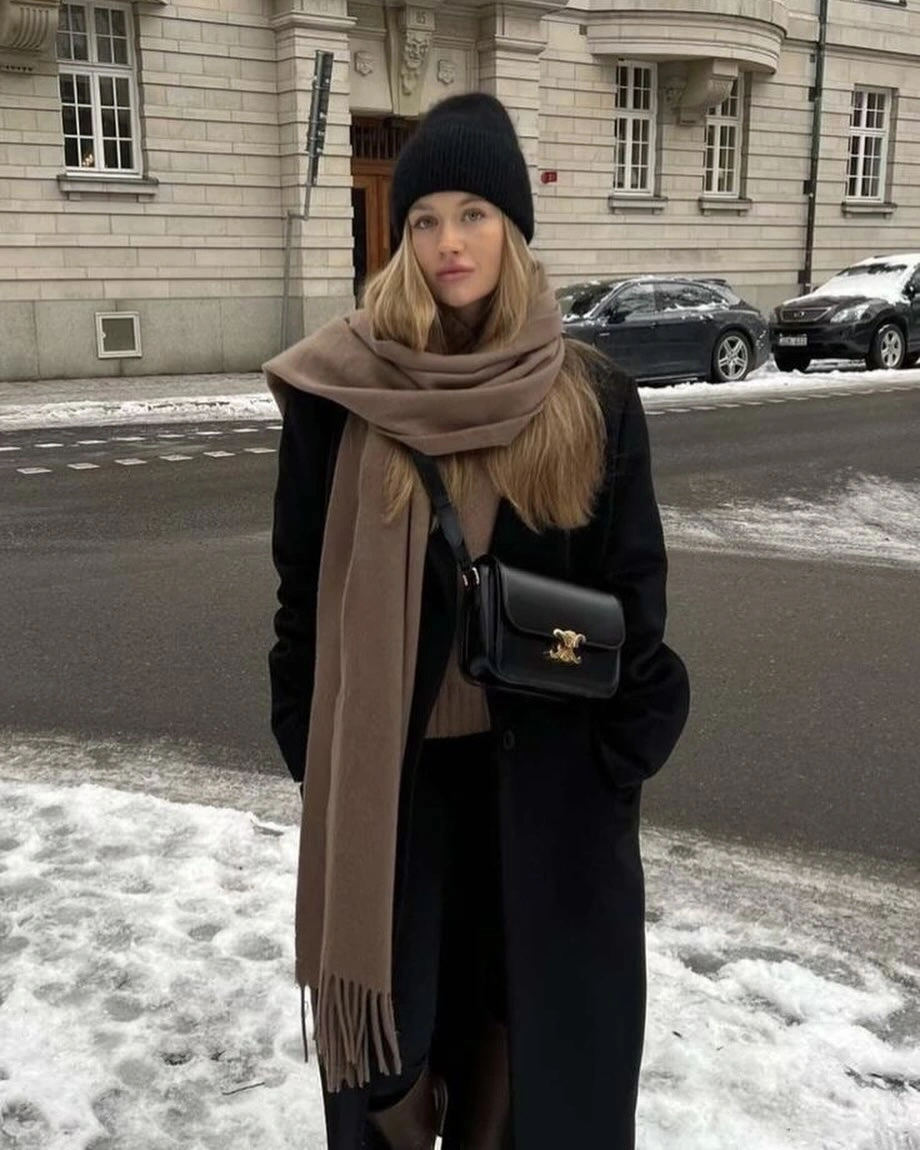
Photo via Instagram
The scarf spreads broadly across the shoulders before descending along the front, so it introduces both horizontal width and vertical length inside the dark composition. That combination changes the visible outline around the neck and upper torso more decisively than a narrow scarf would. It also gives the taupe-brown color enough surface area to compete with black without requiring several separate neutral accessories.
The black beanie and compact crossbody bag visually return to the dark foundation instead of demanding independent attention. That restraint keeps the long coat outfit simple in palette while allowing one oversized neutral element to carry most of the variation in scale, placement, and color.
Low Leopard Print Keeps the Contrast Grounded
The glossy black puffer-style jacket and light blue jeans create the strongest contrast because they occupy the largest areas and differ clearly in both value and finish. The jacket reads as dark, compact, and reflective, while the denim appears lighter and visually quieter across a longer lower section. That major division does more structural work than the smaller patterned detail at the feet.
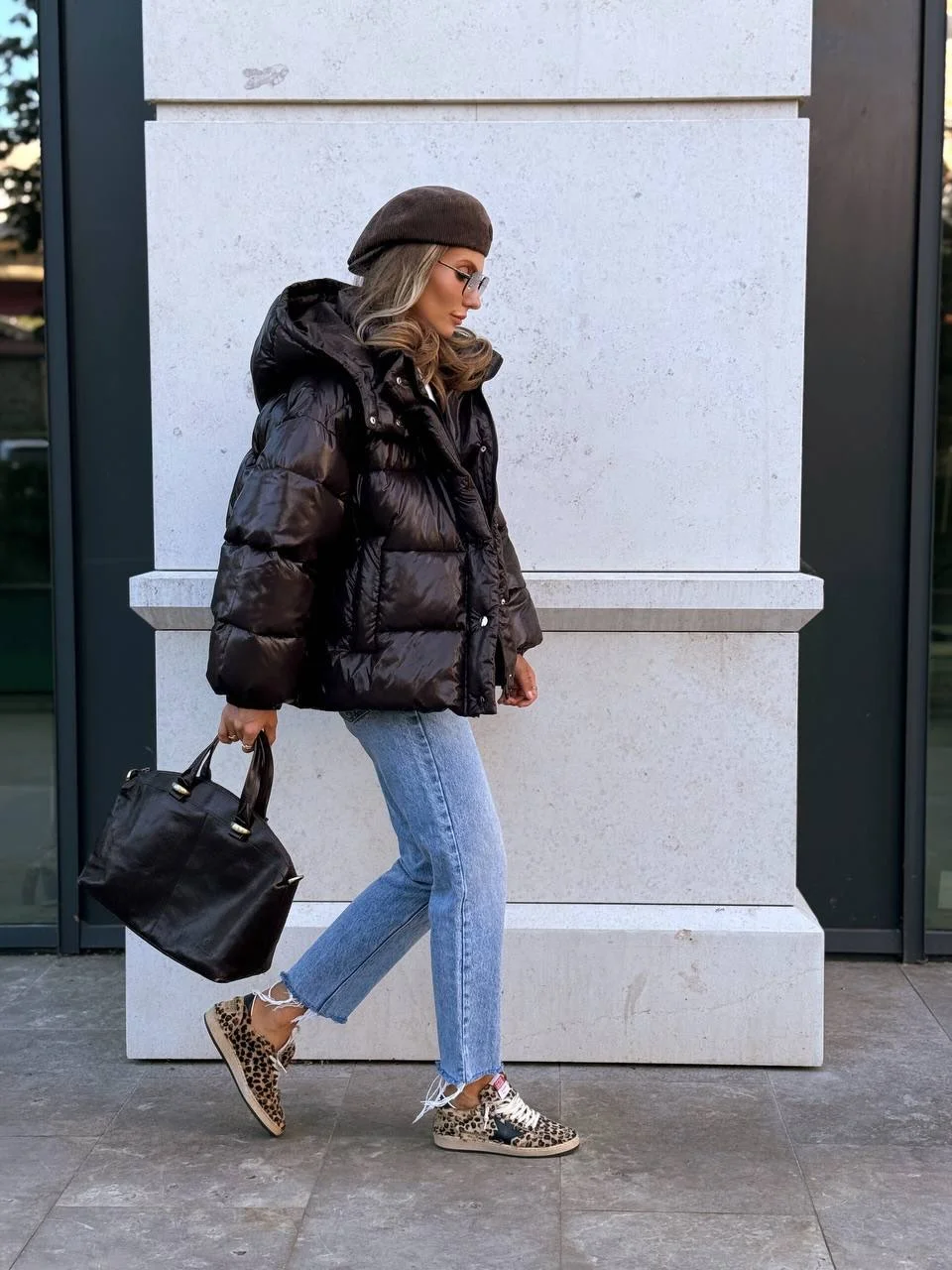
Photo via Instagram
The jeans stop above the low shoes, leaving the ankle area visible as a genuine transition rather than hiding the footwear beneath a long hem or tall shaft. This makes the leopard pattern easy to isolate as a small surface event near the ground. Its limited scale matters: the pattern adds complexity without spreading upward or competing with the glossy jacket for control of the outfit.
The brown knit beanie picks up a warmer family of tones near the top, giving the low patterned shoes a subtle color reference without turning the outfit into an exact matching exercise. For casual winter fashion for women, that kind of separated relationship can add interest while keeping the larger black-and-blue structure easy to read.
Pleats Interrupt an Otherwise Severe Black Structure
Black dominates through the long blazer-like layer, high-neck top, belt, sheer tights, and structured handbag, creating a dark composition with a relatively strict outline. The gray pleated mini skirt interrupts that severity at the center because it is both shorter and visibly more articulated than the surrounding black pieces. Its repeated folds introduce movement and detail exactly where the larger dark areas are most restrained.
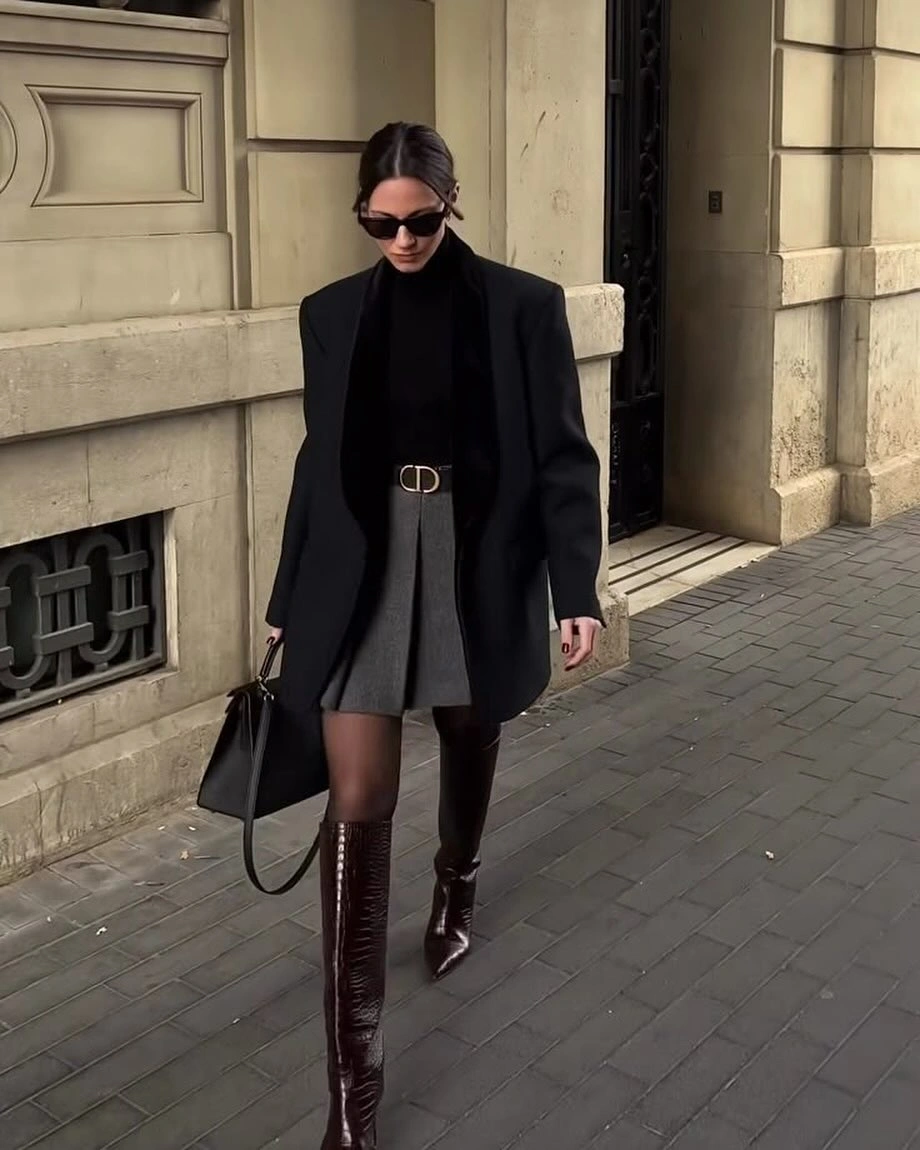
Photo via Instagram
Direction matters as much as color here. The black belt creates one compact horizontal marker at the waist, while the pleats immediately below it repeat downward in narrow vertical lines, giving the center two opposing kinds of structure. That intersection makes the skirt area visually active without requiring a bright hue, large print, or oversized accessory to draw attention.
The tall dark burgundy boots depart from black only slightly, so their color reads as a deep tonal shift rather than a sharp contrast. Their narrow glossy-looking presence gives the lower half a distinct finish and helps the outfit support a visually classy reading based on controlled color, directional detail, and precise placement rather than any assumed occasion.
Glossy Red-Brown Meets Broad Dark Denim
The cropped red-brown jacket concentrates the strongest color and most reflective-looking finish into a relatively compact area above the waist. Its rounded body and high asymmetric-looking collar give the upper half a sculpted presence, while the very wide dark blue jeans travel downward in a much longer, quieter sweep. That difference makes this casual combination feel deliberate without requiring extra layers or competing colors.
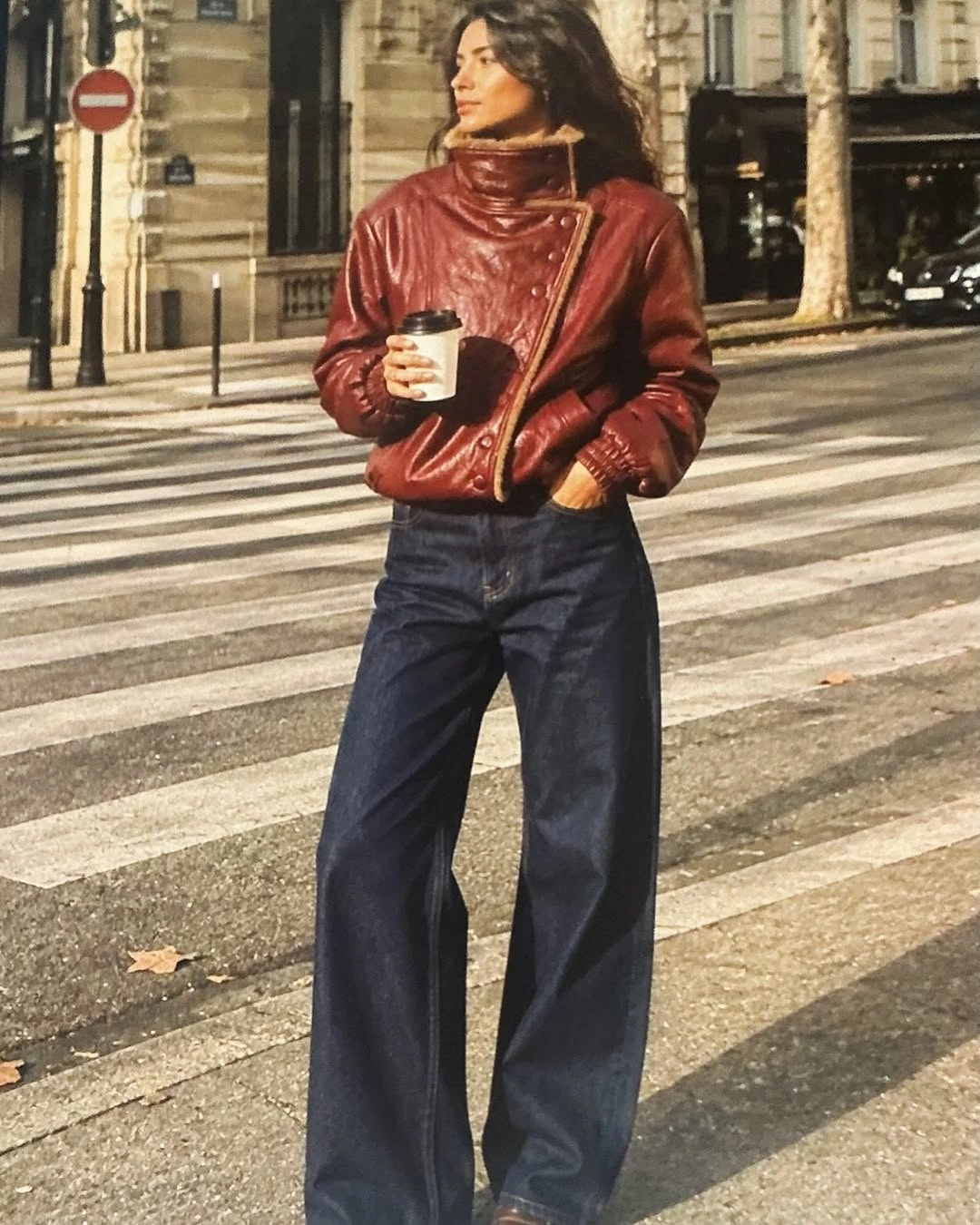
Photo via Instagram
The jeans matter because their width continues almost uninterrupted toward the ground rather than narrowing beneath the jacket. Their darker, comparatively matte-looking surface gives the glossy red-brown upper layer room to stay visually dominant, even though the lower half occupies more total length. This is a useful pairing for someone drawn to roomy silhouettes but still wanting one clearly concentrated focal area.
A narrow dark crossbody strap cuts diagonally across the jacket, introducing a direction that neither the rounded upper shape nor the descending denim provides on its own. Because the strap is slim, it adds definition without dividing the saturated jacket into several competing blocks or distracting from the broad movement below.
Warm Neutrals Surround a Dark Short Center
The camel-beige coat has a short, boxy presence, yet the dark lower layer ends even higher, allowing both endpoints to remain clearly visible instead of merging into one compact shape. That relationship gives the look a deliberately abbreviated upper structure while the tights continue downward with much less visual weight. The result suits a casual preference for shorter pieces without needing an elaborate palette.
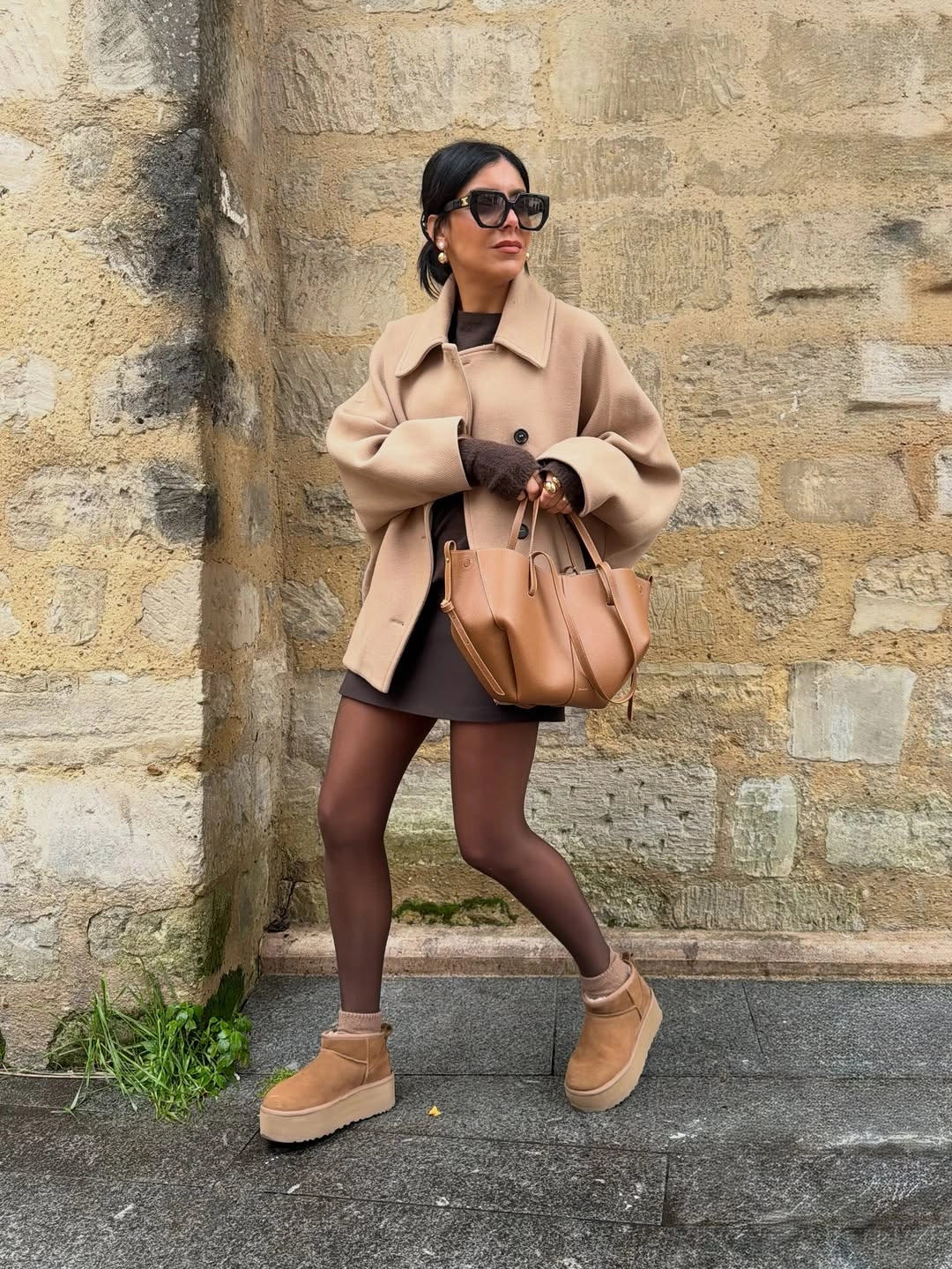
Photo via Instagram
The brown sheer tights do more than fill the space between the short dark hem and tan platform slip-ons. Their translucent brown tone creates a gradual shift from the darker center toward the lighter footwear, avoiding the sharper break that an opaque black section would produce. Visible socks add another small neutral transition at the ankle, making the lower half feel layered even though each element remains easy to distinguish.
Camel at the coat and related tan-brown notes in the bag, socks, and shoes surround the darker middle with a restrained warm-neutral family. The effect is simple without being flat, because those related tones appear in different sizes and positions rather than forming one continuous matched block.
Houndstooth Carries the Pattern Almost Alone
The full-length black-and-white houndstooth coat already supplies a dense graphic surface across most of the silhouette, so the clothing inside does not need another major visual event. A cream ribbed high-neck top and wide white trousers create a much quieter center, allowing the repeated coat motif to remain unmistakably dominant. That restraint gives the long coat outfit a clear hierarchy rather than several patterns competing for attention.
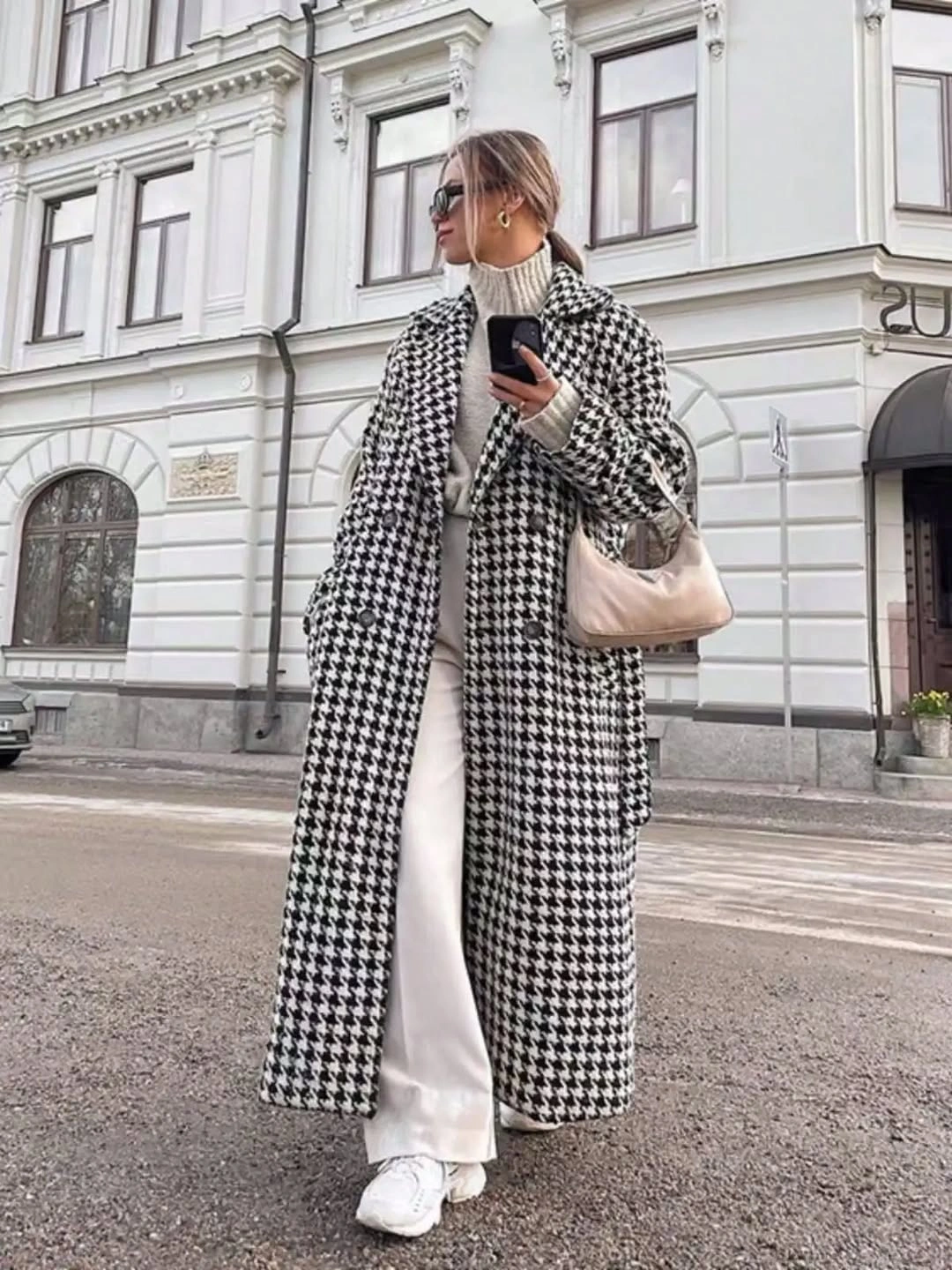
Photo via Instagram
Cream and white are close enough in value to keep the interior calm, but the ribbed upper layer and broad trouser shape still provide visible differences in surface and scale. Instead of trying to match the energy of the coat, these pale pieces function as open visual space beside its tight black-and-white repetition. That contrast can read as classy because the pattern is given room to carry the statement, not because any formal occasion is implied.
White sneakers continue the light lower area without introducing another dark endpoint, while the pale shoulder bag stays similarly quiet near the upper body. With both accessories supporting the interior palette, the houndstooth remains the one graphic element responsible for most of the outfit's visual complexity.
Burgundy Takes Over the Upper Color Field
Deep burgundy covers nearly the entire upper half through the short plush, fur-textured coat, making the color itself a major structural feature rather than a small accent. Its saturated tone and visibly soft-looking surface create a strong block before the outfit shifts decisively into black below. Someone who prefers one expressive color can read this as a controlled way to let that shade carry most of the visual attention.
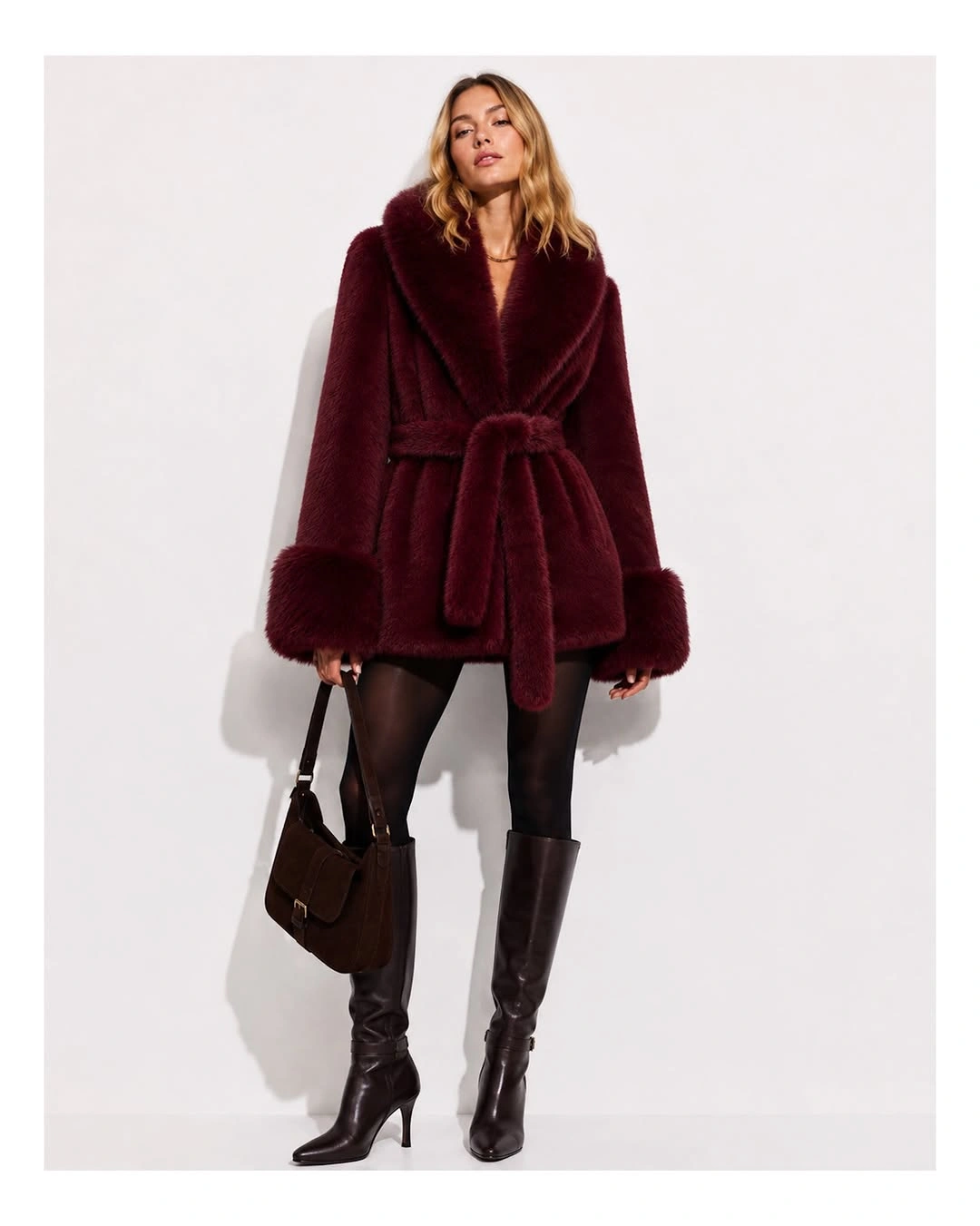
Photo via Instagram
The self-tie belt changes how the large burgundy area is organized by drawing a clear line through the middle of the coat. Above it, the plush-looking surface spreads across the shoulders and torso; below it, the coat continues as a shorter lower section with a more defined endpoint. The belt therefore gives one uninterrupted color field internal shape without requiring another contrasting hue.
Black sheer tights, tall pointed boots, and the black handbag contain the burgundy with a darker set of supporting elements rather than attempting to match its saturation. That controlled contrast can feel visually classy because the strong upper color remains concentrated while the rest of the outfit stays comparatively restrained.
An Oversized Collar Sets the Upper Scale
The oversized dark brown fur-textured collar spreads widely around the shoulders and down the front, making it the largest single detail even though the brown jacket itself is relatively short. Its broad outline gives the upper half substantial presence before the eye reaches the pale center. This casual look shows how one amplified detail can define scale without requiring the entire jacket to be equally voluminous.
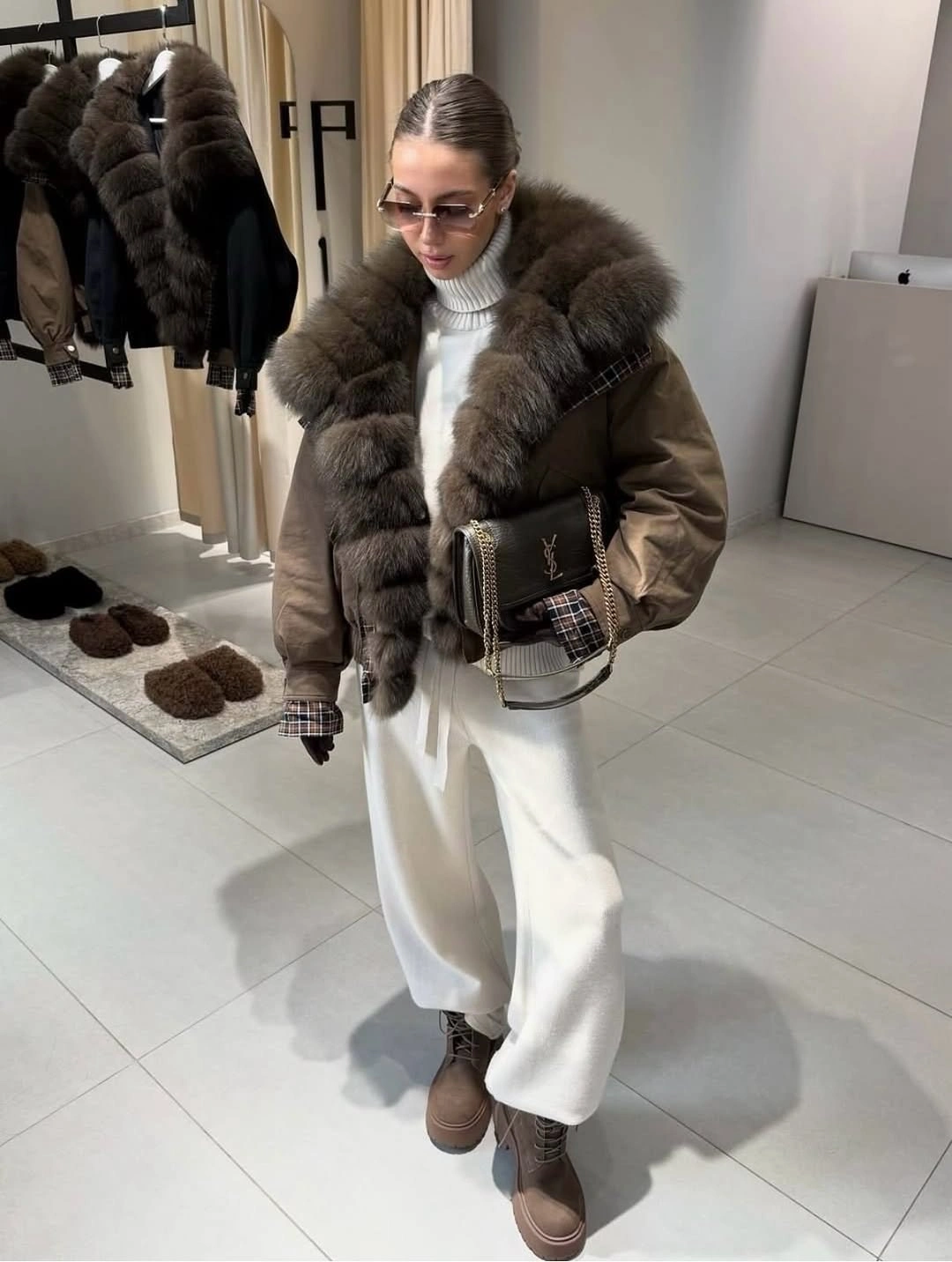
Photo via Instagram
Beneath that darker upper area, the pale ribbed high-neck layer continues into wide white trousers, creating a light center that remains visible from the neck through most of the lower silhouette. The trousers expand rather than taper, so the pale area has enough visual breadth to stand beside the oversized collar instead of reading as a narrow insert. That makes the combination useful for anyone drawn to both statement outer details and roomy lower shapes.
Brown platform lace-up footwear returns to the outerwear family at ground level, while the dark structured shoulder bag introduces a smaller, sharper shape near the torso. The shoes reinforce the warm outer color from a distance, but the compact bag works differently, adding definition beside the softer-looking collar rather than simply repeating its scale.
Layered Gray Lengths Build a Staggered Silhouette
The gray pieces do not merge into one continuous shape because their endpoints arrive at distinctly different heights. The long coat reaches farthest down, the coordinated vest stops around the waist, and the tailored shorts create another much higher edge below it. Those descending lengths let several related gray tones remain separately readable, giving the outfit complexity through placement rather than through a busy palette.
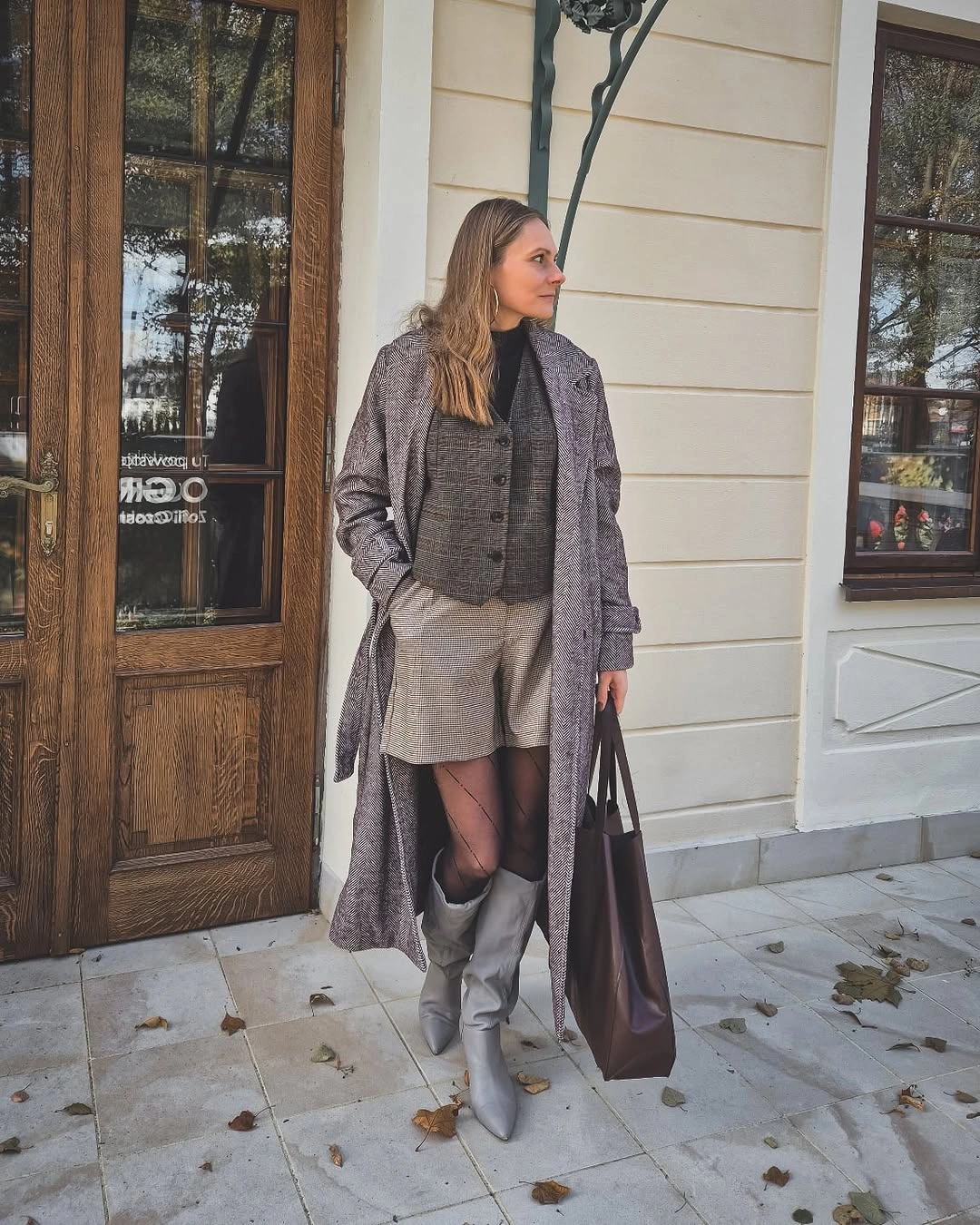
Photo via Instagram
Black appears in two separated zones: the high-neck top creates a dark area at the center of the upper body, while the sheer dark tights establish another beneath the short gray hem. The gap between those black areas is occupied by the gray tailoring, so the darkness works as punctuation rather than becoming the dominant color. Tall gray boots then bring the outer palette back into the lower half without simply duplicating the coat's shape.
The oversized dark tote has enough width and visual weight to participate in the silhouette rather than functioning as a minor finishing detail. Its scale beside the layered gray tailoring helps the look support a visually classy reading, while the effect still comes from visible proportion, color placement, and accessory size rather than an assumed office or formal setting.
Saturated Blue Returns From Collar to Heels
Saturated blue occupies nearly the entire upper silhouette through the long coat, while the large fur-textured collar expands that color around the shoulders and neckline. The belt creates a clear center point within the broad blue area, separating the upper volume from the section below without introducing another hue. That internal division keeps the strong color readable as a shaped garment rather than one uninterrupted expanse.
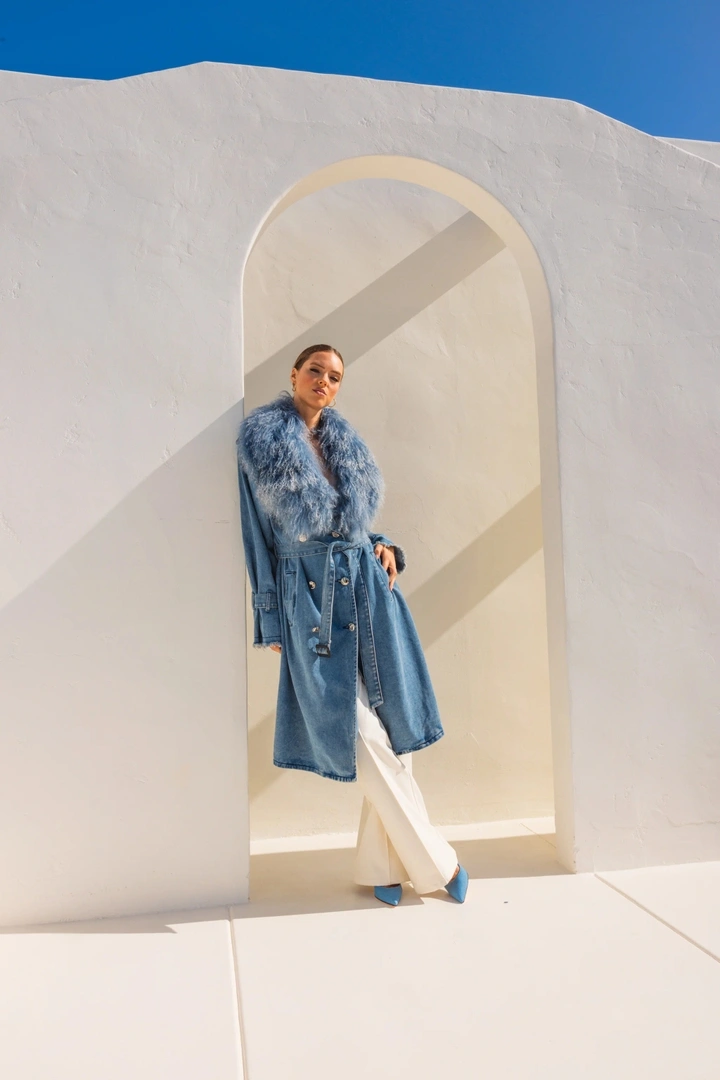
Photo via Instagram
Wide white trousers emerge below the coat as a bright vertical interruption, creating a clean separation between the large blue outer shape and the footwear. Because the trousers have their own generous width, the pale area feels substantial rather than incidental, which gives this long coat outfit a strong two-color construction. The contrast is especially clear because neither section needs print or extra ornament to establish its place.
Pointed blue heels return the dominant coat color at ground level, but in a much smaller and sharper form than the collar or coat body. That distant repetition gives the palette a visually classy finish while preserving the white trousers as the main pause between the two blue areas, with no need to assign a formal occasion.
A White Hem Separates Red From Black
The oversized bright red high-neck sweater establishes the strongest color and the broadest upper shape, while the wide black trousers create an equally substantial but darker area below. Without another layer between them, those two large blocks would meet directly and produce a much harder division. The visible white shirt hem changes that relationship by inserting a narrow third band exactly where the strongest colors would otherwise collide.
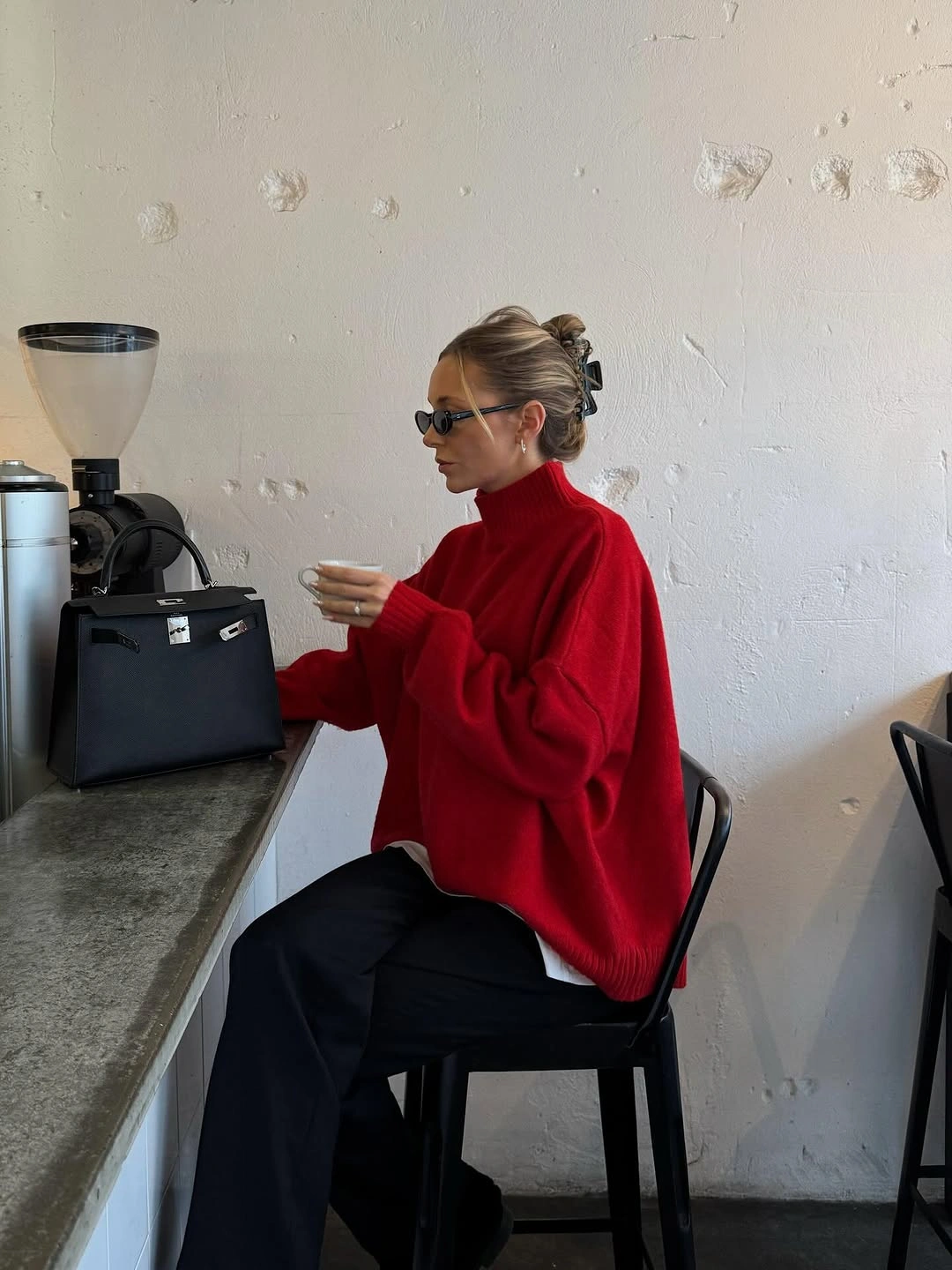
Photo via Instagram
That white strip is small compared with the sweater and trousers, yet its placement gives it disproportionate visual importance. It creates a clear pause between saturated red and deep black, making the outfit easier to read as three distinct levels rather than two oversized shapes stacked together. This kind of simple color separation keeps a casual combination visually deliberate without requiring additional pattern, complicated layering, or multiple accent colors.
The wide black trousers contribute broad lower-body weight, while the structured black handbag condenses the same dark value into a much smaller geometric shape beside the torso. Narrow black sunglasses add one more precise dark detail near the face, leaving the red sweater dominant while the white hem preserves the clean separation that holds the entire red-white-black arrangement together.