Fall burgundy nails with design have a particular tension: the deeper the wine shade becomes, the more carefully the hand needs a point of relief. Without one, a glossy surface can flatten into a single dark block; with too much interruption, the color loses its low, reflective pull. The most memorable result lets darkness stay present while one edge, opening, or glint gives the eye a way through it.
For a wearable choice, decide where the light should enter before deciding how much decoration to add. Give the darkness one controlled counterpoint and keep it subordinate to the wine tone, so the hand still reads as deep and reflective rather than busy. That discipline matters even more when the nail length already supplies enough drama on its own.
Pointed Burgundy with a Quiet Cuticle Crescent
Long stiletto nails carry a deep glossy burgundy-red color that narrows into sharp points, while a few nails leave a softly visible crescent near the cuticle. That small opening keeps the saturated surface from becoming completely solid and gives the eye one pale pause before the color moves toward the tip. The silhouette is the first decision here, with the finish supplying the after-dark energy rather than a separate motif.
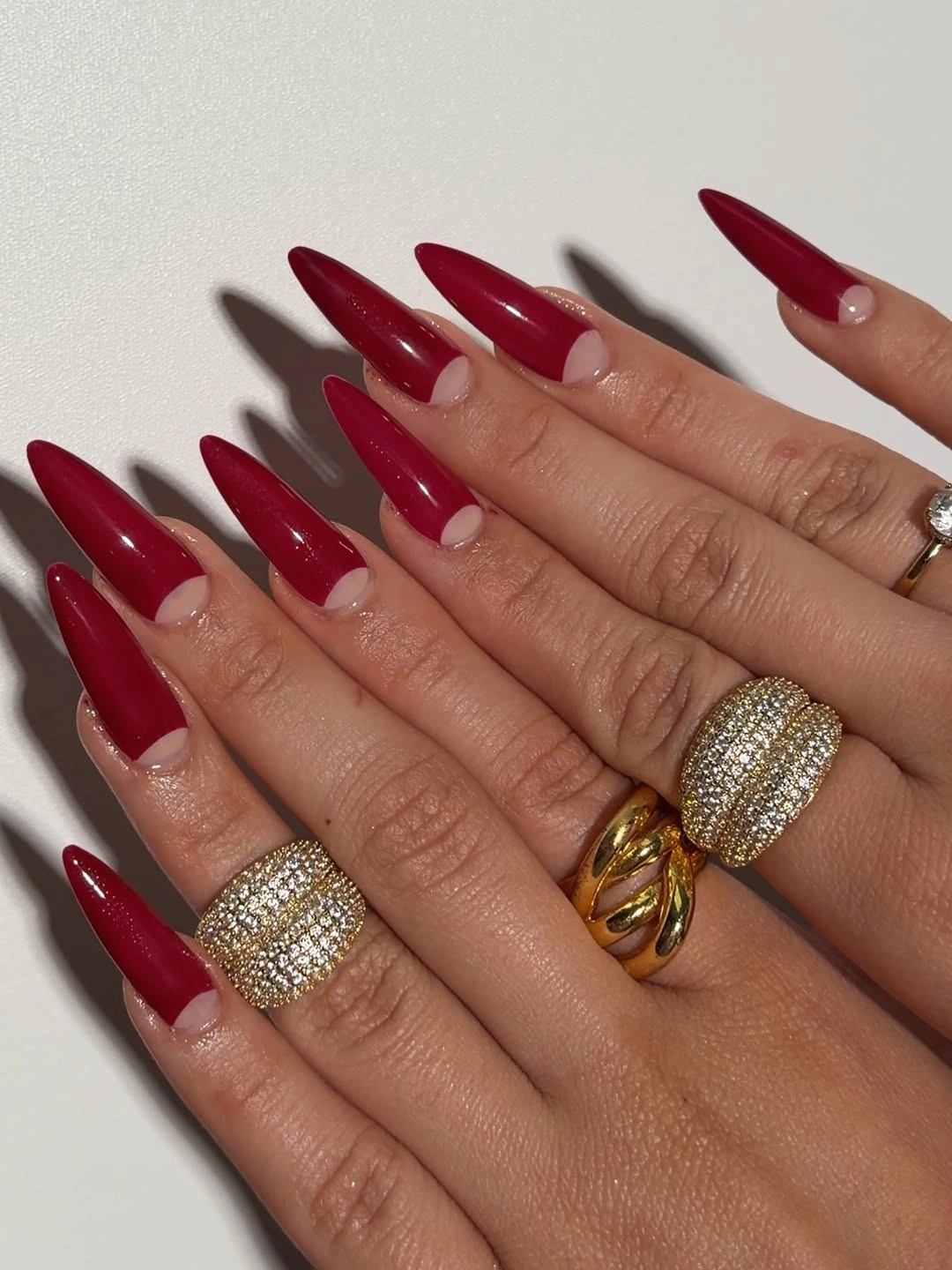
The negative-space crescent is subtle, but it matters because it changes how the dark color meets the skin. A medium almond or oval can keep the wine tone and the open base while reducing the sharpness of the point. If the nails are already short, a narrow nude half-moon will preserve the same contrast, though the solid burgundy should remain the main field.
Stiletto length gives this look its strongest tension and also its clearest limitation, the same balance that defines many dark fall nails. The points create an unmistakable silhouette, but they ask for more care in ordinary movement than a rounded short shape. Wear it when the outline itself is the statement, or soften it to an almond if the goal is a deep color with less structural commitment.
Short Burgundy Rounds with Sheer Floral Relief
Short rounded nails stay mostly glossy and deep burgundy, while one accent opens into a sheer pale base with tiny red and gold floral flecks. The light nail breaks the dark field without abandoning the wine palette, and the small metallic points echo the jewelry around the hand. This is a restrained way to introduce decoration because the floral detail is isolated rather than repeated across every finger.
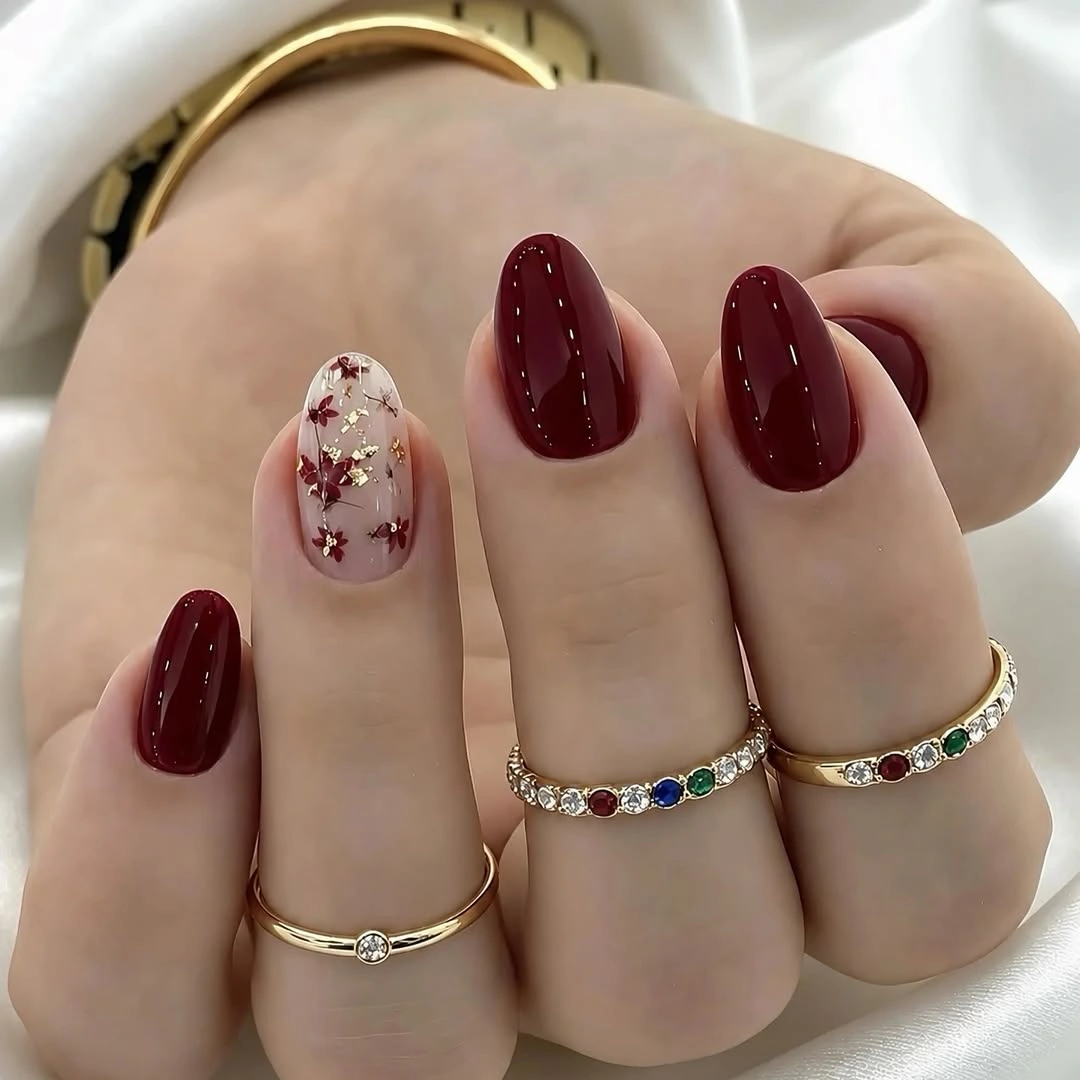
The contrast between solid and translucent surfaces gives the manicure depth on a compact shape. A single pale accent can be enough, especially when the floral marks remain small and scattered. For easier upkeep, replace the flecks with one painted flower or a few gold dots, keeping the rest of the nails plain so the color still feels close and controlled.
Short rounded tips make the dark shade more approachable, but burgundy still shows chips clearly because the color is saturated. The pale accent may need a clean edge to stay delicate, and the metallic pieces should not crowd the free edge. The mood is polished and quiet when the decoration remains a counterpoint, not a second dominant palette.
Long Almond Wine with Pure Gloss
Long almond nails return to a single deep wine-burgundy color, with a smooth reflective finish that follows the taper from cuticle to tip. No motif competes with the silhouette, so every highlight along the curved surface becomes part of the visual effect. Compared with the pointed opener, the almond shape feels softer even though the length remains unmistakable.
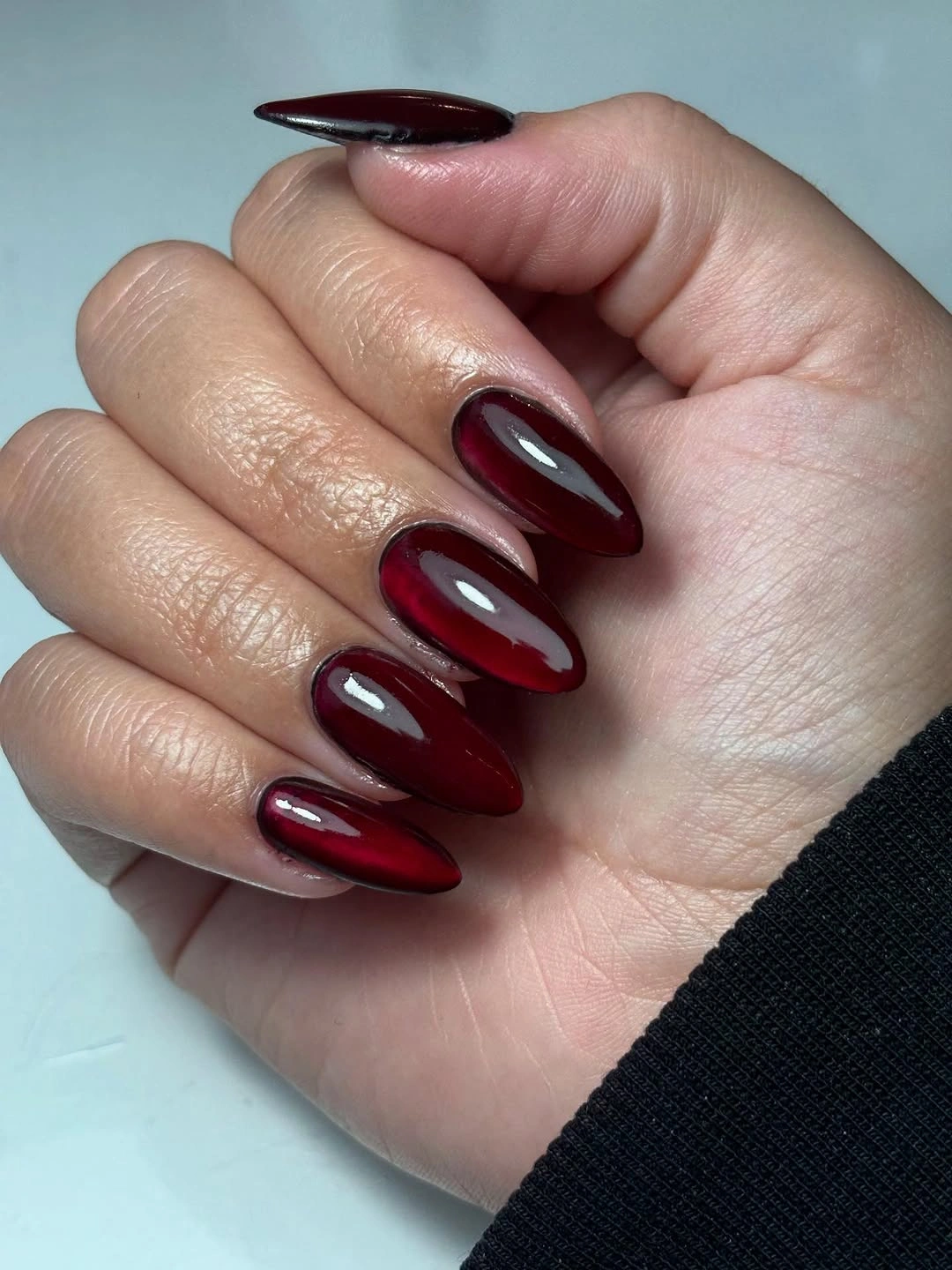
The strength of this design comes from restraint. A medium almond can retain the same elongated line while making the solid color more practical, and a rounded oval can soften it further without changing the palette. If an accent is needed, keep it to one nail or a barely visible shimmer so the wine surface continues to read as the central choice.
Long almond shapes distribute the length more gently than a stiletto, but the extended tip still changes what feels comfortable in daily tasks. Deep gloss can look sleek in low light and bright light alike, though it will reveal surface marks. Keep the finish uninterrupted, and the manicure remains controlled rather than decorative.
Wine Glitter with Sheer Floral Accents
This long almond set layers deep burgundy solids, red glitter, and translucent pale accents carrying floral marks with fine gold detail. The dense nails and open nails alternate, so the sparkle has space to register and the pale accents do not disappear into the wine color. It is a fuller decorative direction, but the palette stays coherent because every surface returns to burgundy, red, or a light counterpoint.
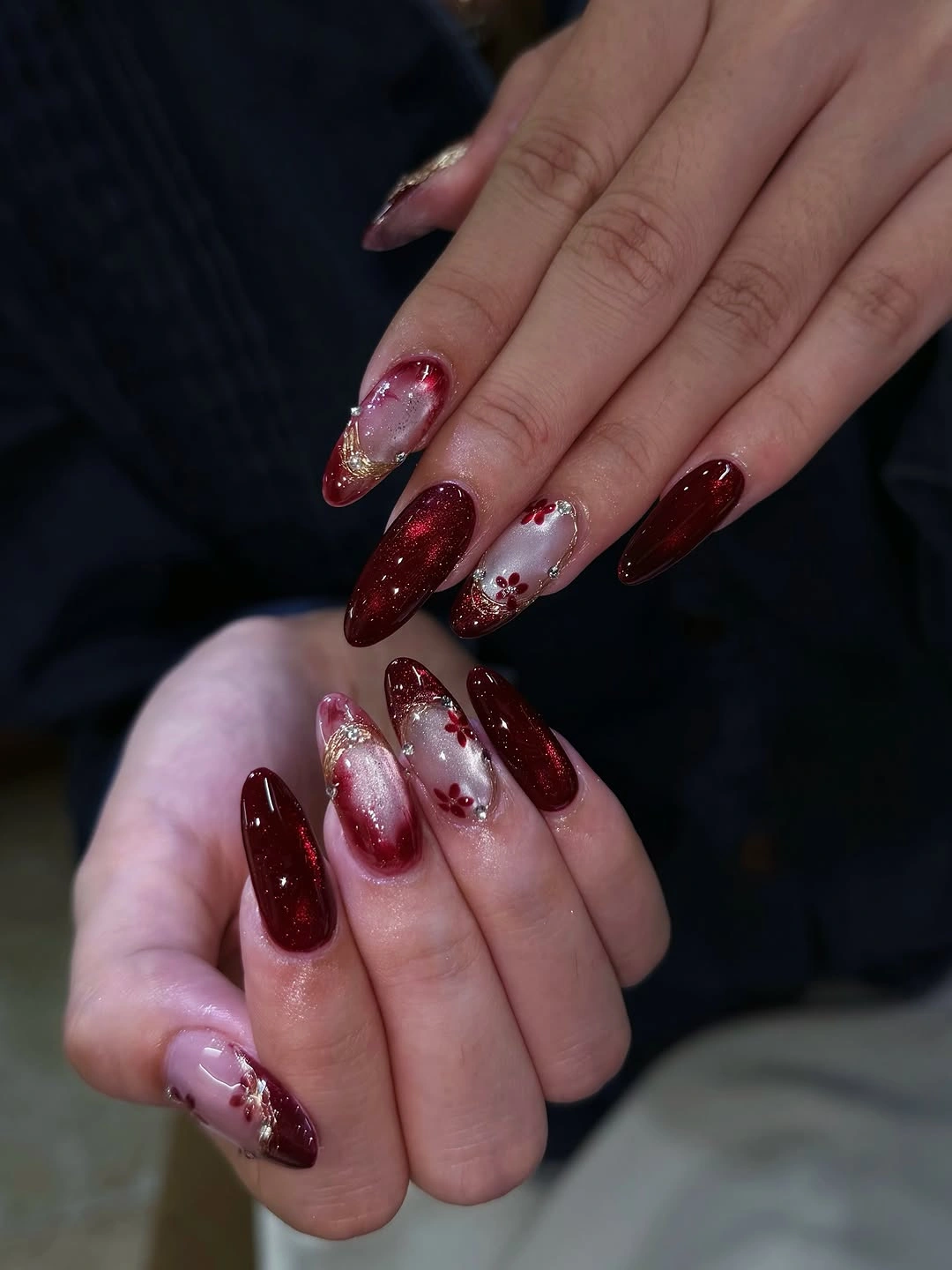
Alternation keeps the design from becoming a continuous wall of glitter. A medium almond can use one glitter nail and one floral accent while the remaining fingers stay glossy wine, preserving the same movement with less weight. If the glitter is strong, keep the gold detail tiny; both accents do not need equal visual volume to feel connected.
Long length gives the floral panels room, but it also makes the set more occasion-oriented than the short burgundy options. Glitter can catch on fabric or become visually dense in daylight, while the sheer accent may show grow-out more clearly. Keep the open nails light and the sparkle concentrated, and the mood remains moody and sleek rather than overloaded.
Short Burgundy with Nude Botanical Panels
Short square nails alternate deep burgundy solids with nude panels carrying black botanical lines and a narrow glitter accent. The branches run vertically, giving the open nails a little extra length while the solid wine nails provide a dark anchor on both sides. This design is compact, but it still has a clear rhythm between dense color, empty space, and fine line.
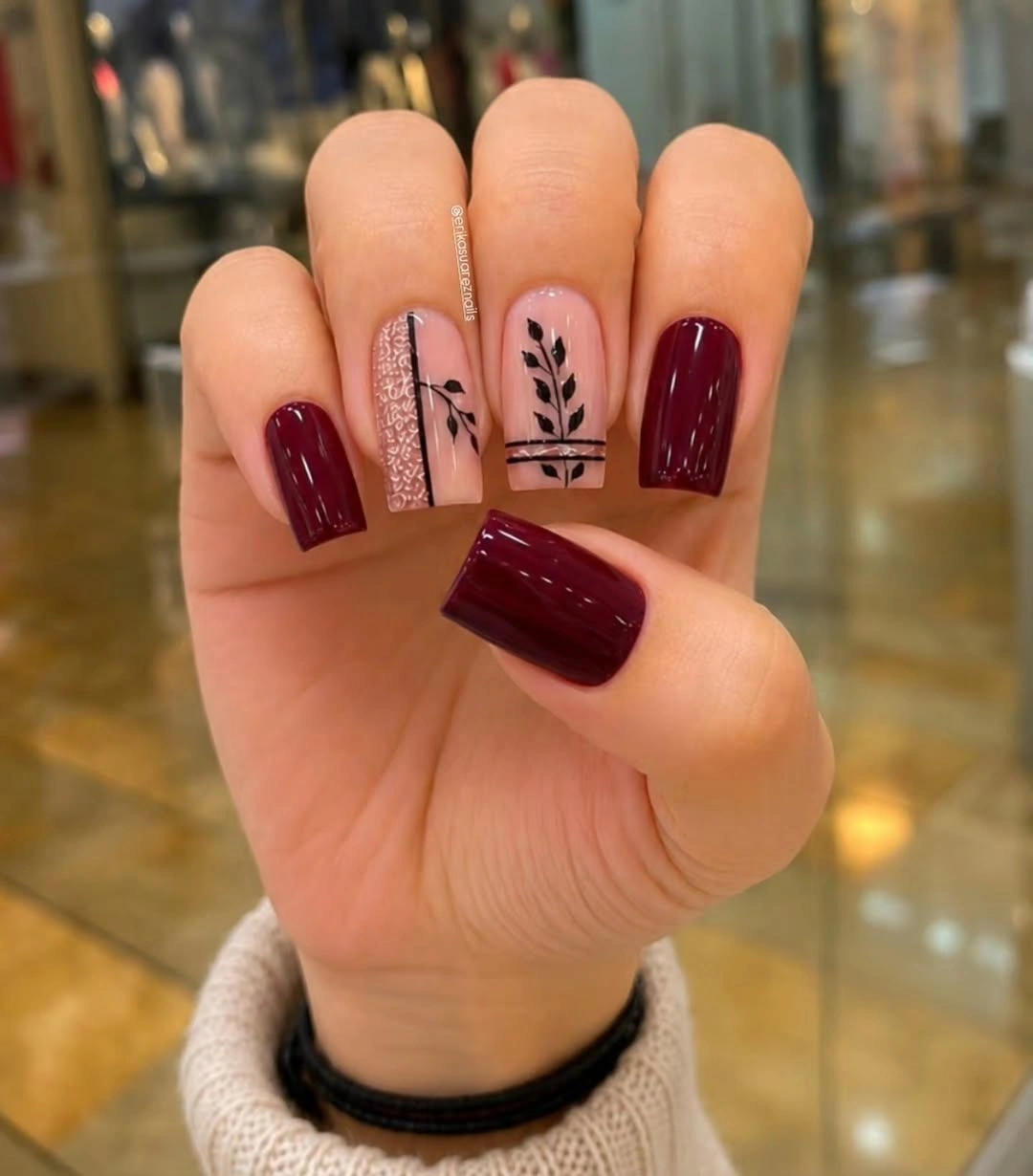
The nude panel is doing more than lightening the palette. It gives the black branches a surface where they can remain visible and stops the burgundy from becoming visually flat. Keep one branch on each hand for a shorter or simpler version, and let the remaining nails stay solid so the botanical detail remains a focal point rather than background noise.
Short squares support this composition well because the vertical lines use the available length instead of demanding a large canvas. Glitter should remain narrow, especially if the nail plate is small, and the branch marks should not spread into a dense leaf cluster. The result carries fall mood through wine and texture without relying on a literal seasonal symbol.
Sheer Almonds with Burgundy Floral French Tips
Long almond nails use a sheer nude center, deep burgundy French tips, and small floral strokes placed inside the open area. A tiny gold point appears at the center of one flower-like mark, adding a controlled glint without changing the light balance. The dark tip gives definition, while the translucent middle prevents the design from looking closed or heavy.
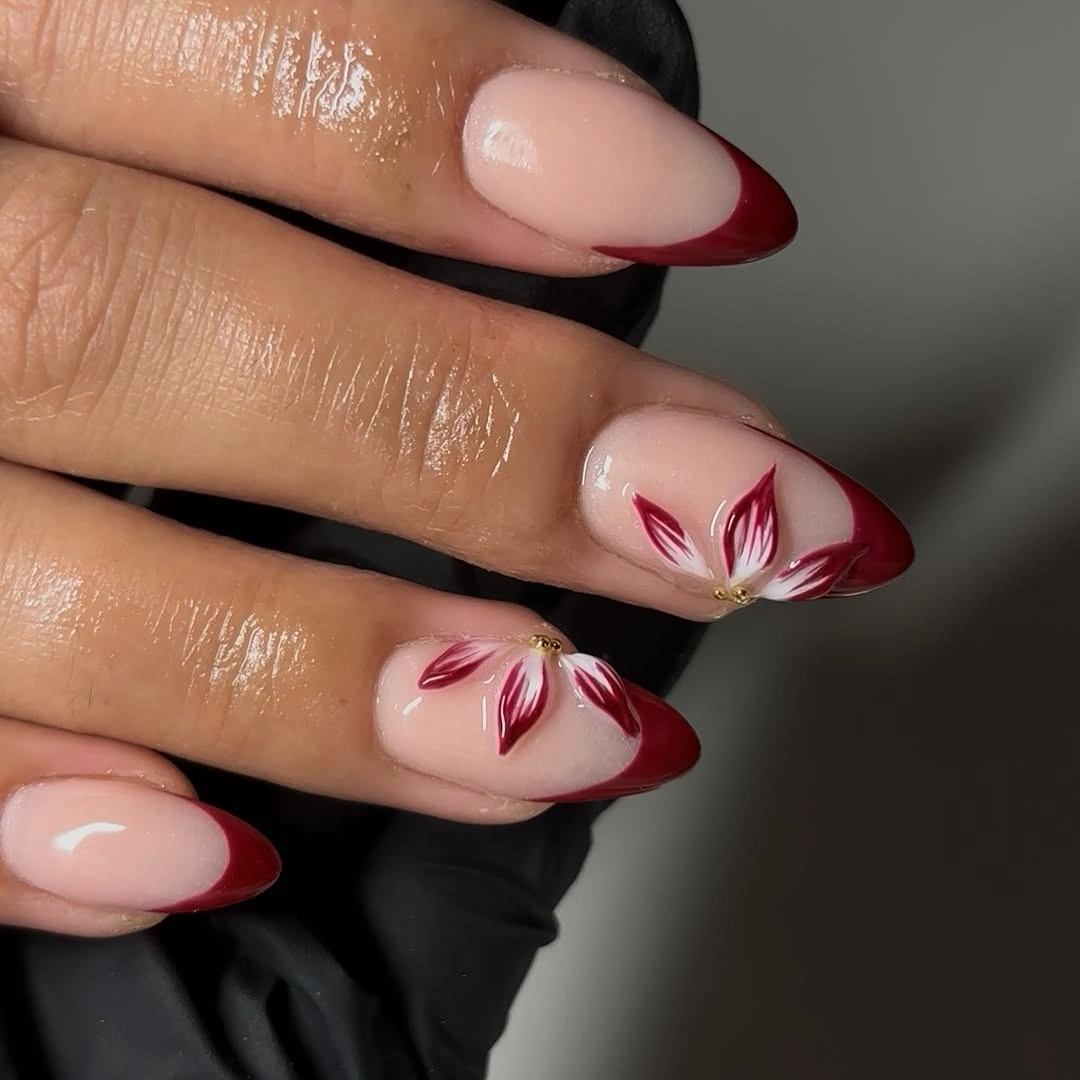
The broad nude center is the reason the burgundy tip feels elegant rather than dense. On a medium almond, narrow the tip and keep the floral mark on one accent nail; on a short oval, use a wine side French instead of a full edge. The idea survives because the contrast between open center and dark border remains clear.
Floral line work is softer than a full burgundy solid, but the long almond still gives the manicure a formal presence. A tidy tip line matters, and too many petals would shorten the visible nude space. Keep the marks small and the border dark, and the design can suit an occasion without becoming dependent on glitter or large embellishment.
Translucent Wine Panels with Gold Bands
Long square nails mix translucent pink-burgundy panels, deep wine blocks, thin gold bands, and small gold embellishments. On selected nails, the bands cross the surface in a ladder-like arrangement, giving the manicure a structured rhythm beside the softer rounded panels. The palette remains close to burgundy, but metallic lines add a sharper architectural edge.
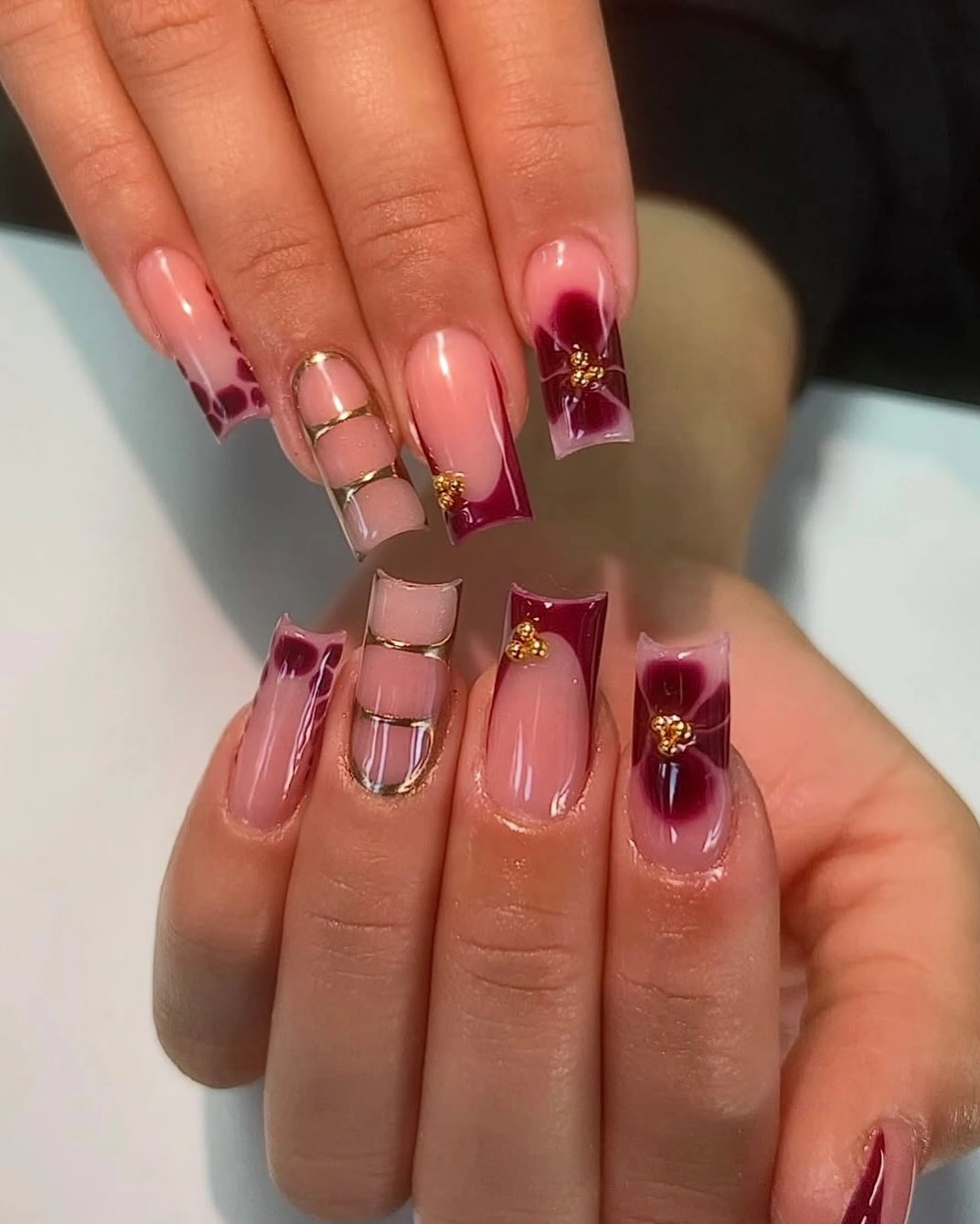
Gold works best here when it is used as a separator rather than a full metallic field. A shorter square can keep one horizontal band or a single gold point, allowing the wine panels to stay visible and the shape to remain light. If several bands are used, leave a little space between them so the pattern reads as deliberate structure instead of a crowded grid.
The long square provides room for stacked lines, but it also increases the chance that the design will feel busy in everyday settings. Small embellishments can catch at the edge, so low placement and limited repetition are more practical. Keep the translucent panel open where possible; it supplies the relief that makes the gold feel precise rather than excessive.
Burgundy Almonds with Nude Gold-Foil Accents
Medium almond nails alternate glossy burgundy with nude accent nails marked by dark floral or marbled strokes and small gold foil fragments. The foil is irregular, not a continuous line, so it bridges the dark and light surfaces without turning the manicure into a metallic set. Solid wine nails carry the depth, while the open accents create the relief that keeps the palette readable.
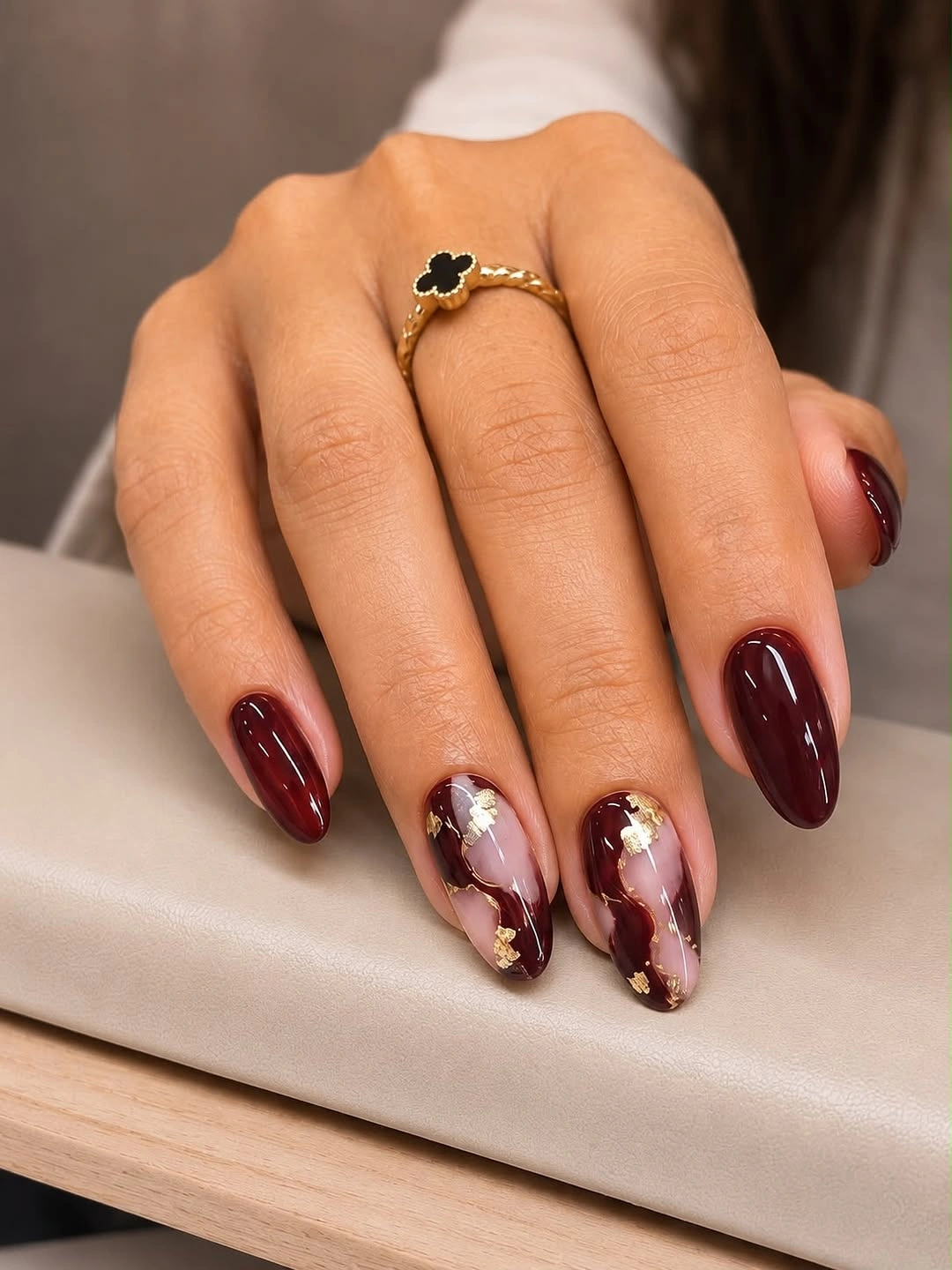
Use one open accent and keep the rest solid if you want the simplest interpretation. Gold fragments can remain uneven and still look intentional, but they should not climb across the entire nail because the almond shape already supplies a strong line. A cream base would soften the contrast, while a dusty mauve would keep the mood deeper.
The design is more layered than a plain burgundy manicure but less dense than a full floral set. Foil may catch light or texture, so a small amount near the center is easier to live with than pieces at the edge. The balance depends on allowing the wine color to take up more space than the decorative accent.
Reflective Red Burgundy on a Tapered Almond
Medium almond nails are covered in a reflective metallic red that shifts between bright crimson and deep burgundy as the light moves. The surface remains free of motifs, so the changing highlight becomes the only decoration. That finish gives the shape motion without adding line, glitter, or a second color to explain the design.
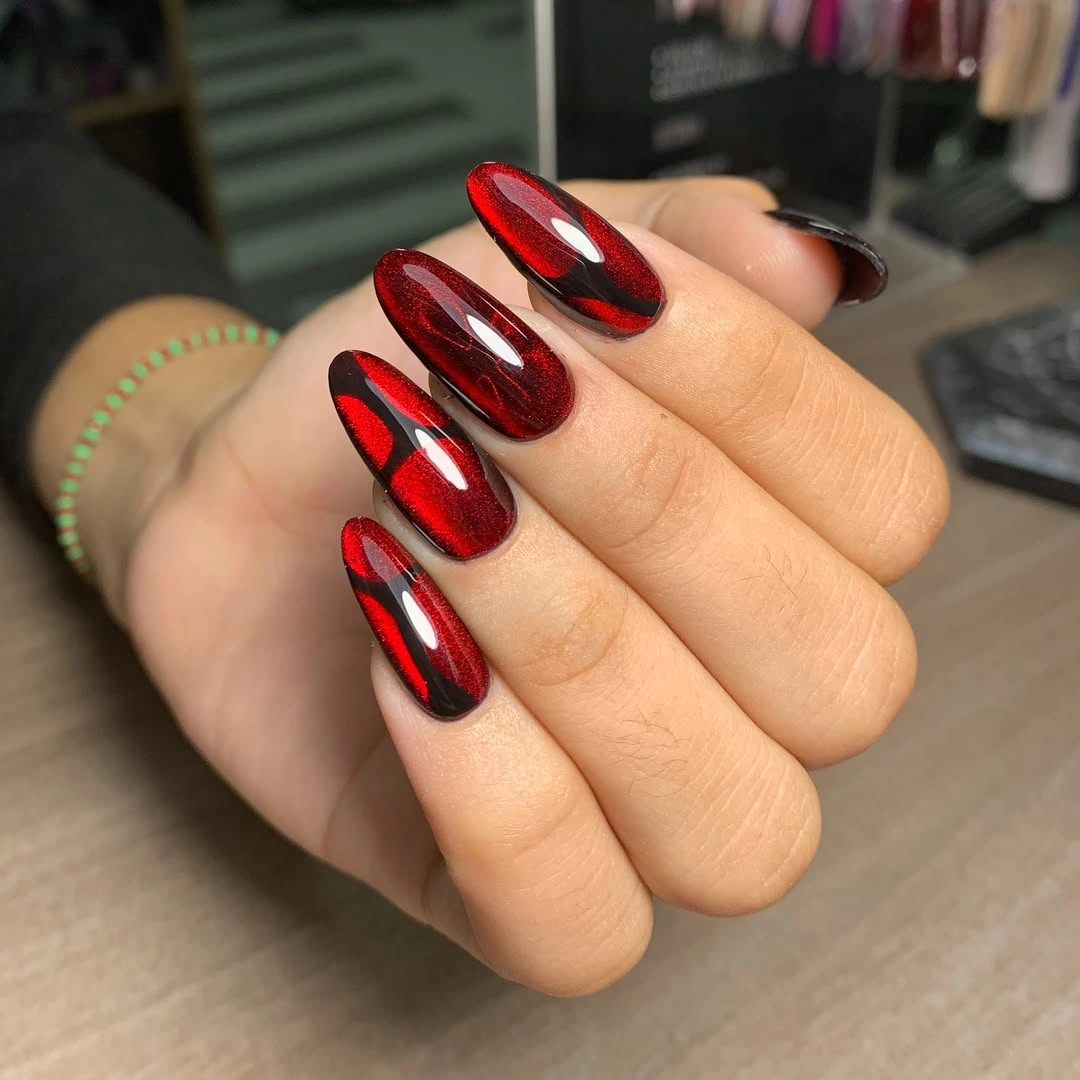
A reflective wine finish is most effective when the silhouette stays even and the surface is smooth. Use it on two accent nails beside a quieter burgundy solid if a full metallic hand feels too strong, or keep the almond medium so the color does not overpower the fingers. The finish can also shift warmer or cooler without changing the central idea.
Metallic color reveals every long highlight, which is why this finish suits the deeper end of fall red nails while showing uneven texture more honestly than a speckled design. It also catches attention in daylight, so extra jewelry or art may be unnecessary. Let the red-burgundy surface remain uninterrupted, and the manicure keeps its sleek control instead of slipping into visual clutter.
One Leopard Accent in a Burgundy Square Set
Long square nails are mostly deep burgundy, with one accent panel carrying irregular dark spots over a pale translucent base. The animal-inspired marks supply texture, but the surrounding wine nails keep the overall palette focused and prevent the accent from taking over. That single focal point makes the design more balanced than a full spotted set would be on the same length.
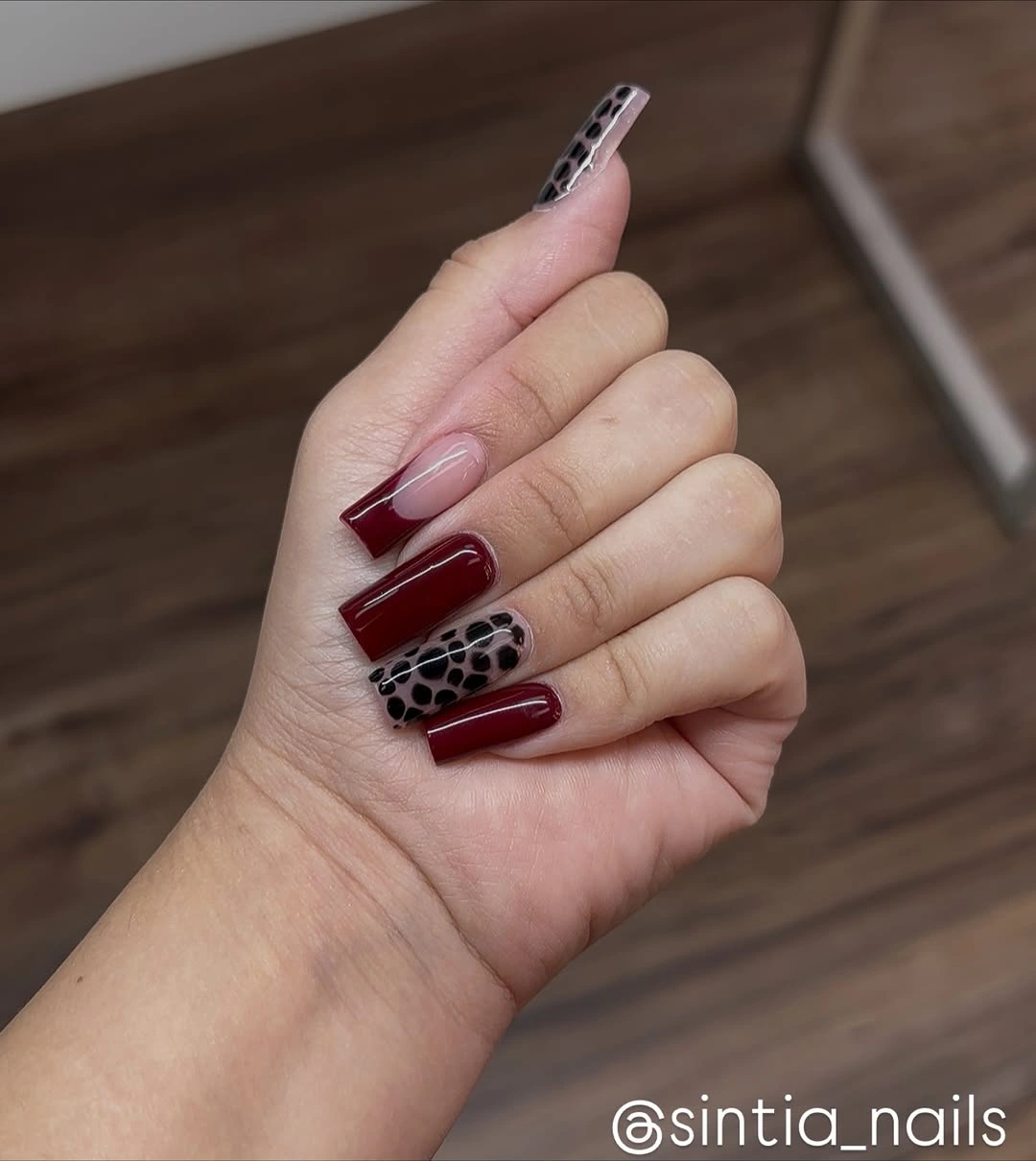
The accent needs the plain neighbors to stay legible. On a shorter square, use fewer and larger spots inside a small nude panel, or swap the pattern for a softer tortoiseshell-like mix. Keep the burgundy solid nails glossy and the print contained, because the contrast between quiet and busy is the reason the design works.
Animal pattern has a strong visual voice, especially beside a dark saturated color. A dense print can make long square nails feel heavier, while one open panel creates a clear stopping point. This is a useful option when the goal is texture without full coverage, and it can move from evening styling to ordinary wear by shortening the shape.
Short Wine Shimmer with One Knit-Like Accent
Short rounded nails mix burgundy shimmer, soft pink shimmer, and one pale accent carrying a repeated dark pattern that resembles interlaced knit or leaf-like loops. The shimmer gives the solid nails quiet depth, while the patterned nail introduces texture without asking every finger to carry an illustration. This shifts the burgundy mood toward sweater-season comfort while keeping the palette close.
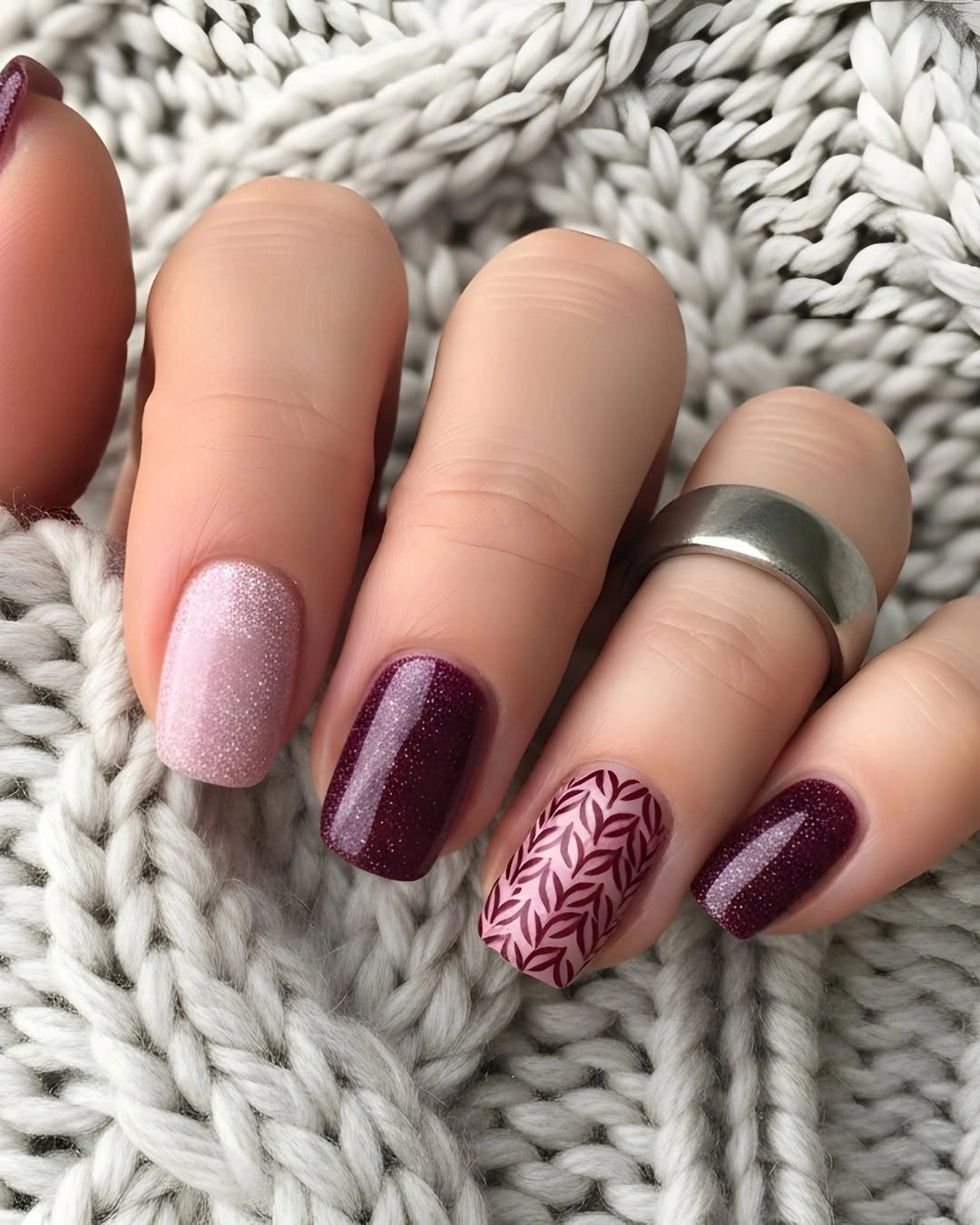
A single patterned accent prevents the short shape from looking crowded. Use a flat dark curve instead of raised texture when comfort matters, and keep the pink field open enough for the design to read. A deeper plum shimmer or muted mauve can keep the same contrast if bright pink feels too light beside the wine.
Shimmer reflects softly, so it does not compete with the small motif the way chunky glitter might. The patterned accent still needs careful scale, especially on a short nail where tight loops can merge. Let the wine color occupy most of the hand and the texture appear as one point of relief, not a repeated formula.
Wine Squares Framed with White and Glitter
Long square nails place deep burgundy centers inside bright white framing at the tips and sides, with glitter concentrated near the cuticle. The white border creates a crisp rectangular outline, while the sparkle at the base softens the transition into the dark color. This is a high-contrast design built around edges: the center stays strong, but the frame keeps it from reading as a plain block.
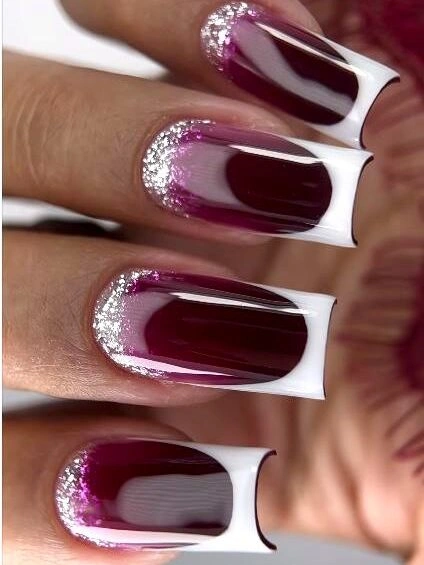
The frame needs enough length to remain balanced, yet the concept can be reduced to one white side edge on a short square. Glitter is most useful as a narrow transition rather than a full base, and a fine shimmer can replace larger sparkle for a quieter finish. Keep the center burgundy visible because that is the visual anchor beneath the border.
White and glitter make this look more editorial than an everyday solid, especially on long square tips. The sharp outline will show any unevenness, and texture near the cuticle may need more care. Use it when the contrast is meant to be noticed, or remove the glitter and keep a slim white tip for a calmer interpretation.
Metallic Wine Chrome on Long Almonds
Long almond nails return to an uninterrupted burgundy chrome, flashing between wine red and plum as the curved surface catches light. The pointed taper supplies the silhouette, while the reflective finish creates a clean highlight on each nail. There is no extra motif, so the look feels controlled through depth and reflection rather than through decoration.
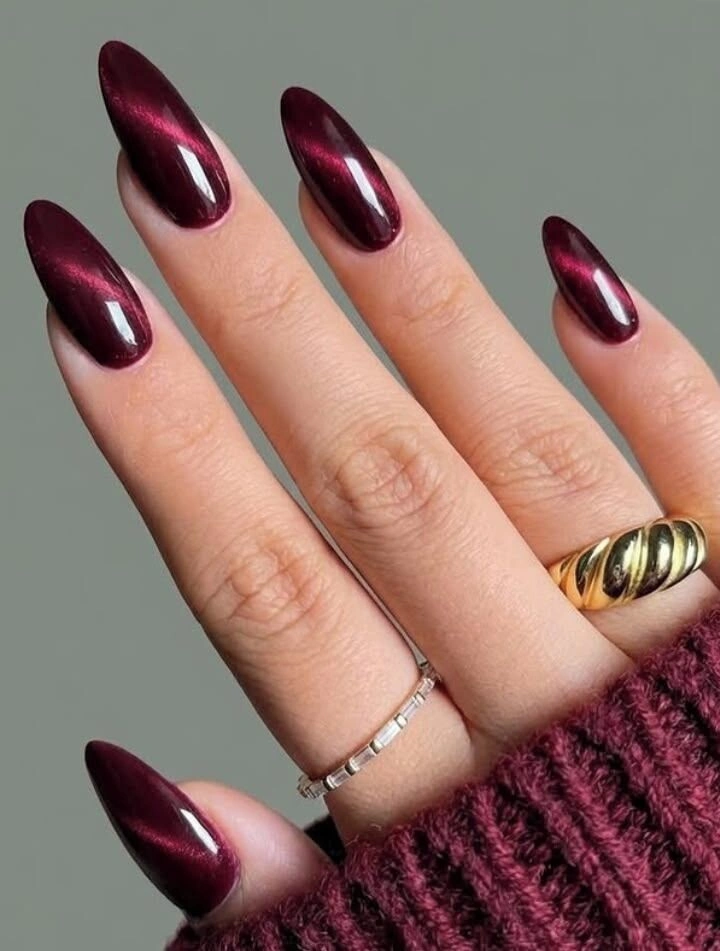
Chrome is strongest when the almond shape is even from nail to nail. A medium length can keep the same reflective surface while reducing the visual intensity, and two chrome accent nails can sit beside a glossy solid burgundy for a quieter shift. Keep the rest of the hand free of competing art so the metal-like color has room to change with movement.
The finish is sleek but revealing: scratches, uneven surfaces, and tip wear can catch the light. That is the tradeoff behind chrome nail designs, where the reflective effect looks different from one angle to the next. If the goal is a practical set, keep the color saturated and glossy without forcing the full chrome effect across every nail.
Short Burgundy Borders around Open Nude Space
Short square nails use deep burgundy along the tips and corners while leaving a sheer nude center open. Thin dark outlines trace the perimeter, making the negative space feel planned rather than unfinished. The composition is compact and graphic, but its visual weight stays lighter than a full wine manicure because the nude area is doing as much work as the color.
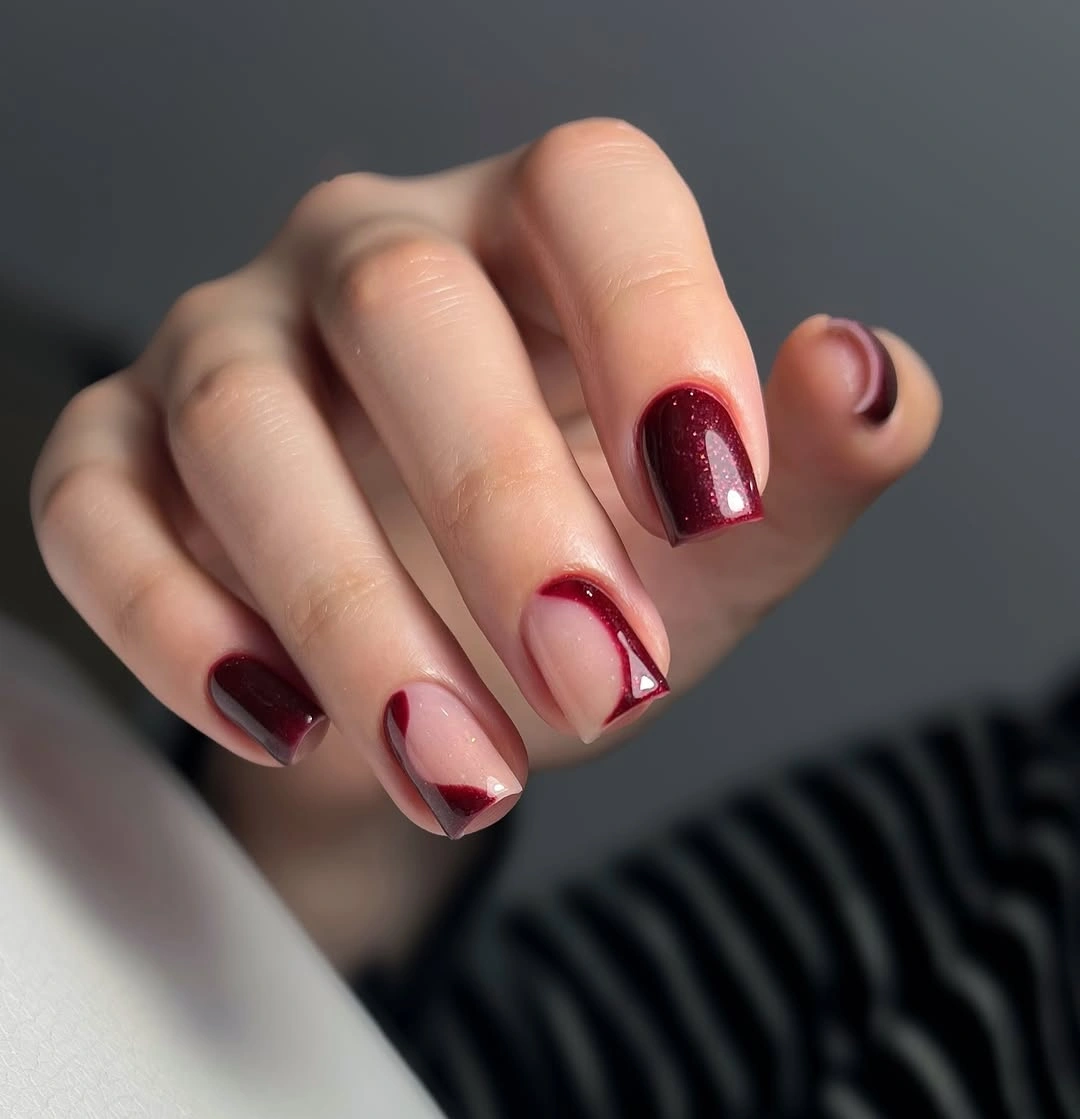
The border is easy to scale because the empty center can remain large even when the nail is very short. Use burgundy on one corner or one side for a softer version, or keep the full outline on two accent nails and leave the others glossy nude. The important choice is the relationship between the dark edge and the open middle.
Negative space can be practical because grow-out is less obvious than it is on a solid saturated base. Precision still matters around the border, and a rough line will break the clean contrast quickly. Keep the contour thin and the wine color controlled, and the manicure offers after-dark depth without requiring length or heavy decoration.
One Silver Sweep on Glossy Burgundy Squares
Long square nails are coated in glossy deep burgundy, with a narrow silver or pewter curve sweeping across selected surfaces. The metallic line is much thinner than the wine base, so it reads as one deliberate movement rather than a full second pattern. Against the dark color, the curve has a sharp, modern presence without needing glitter or multiple accents.
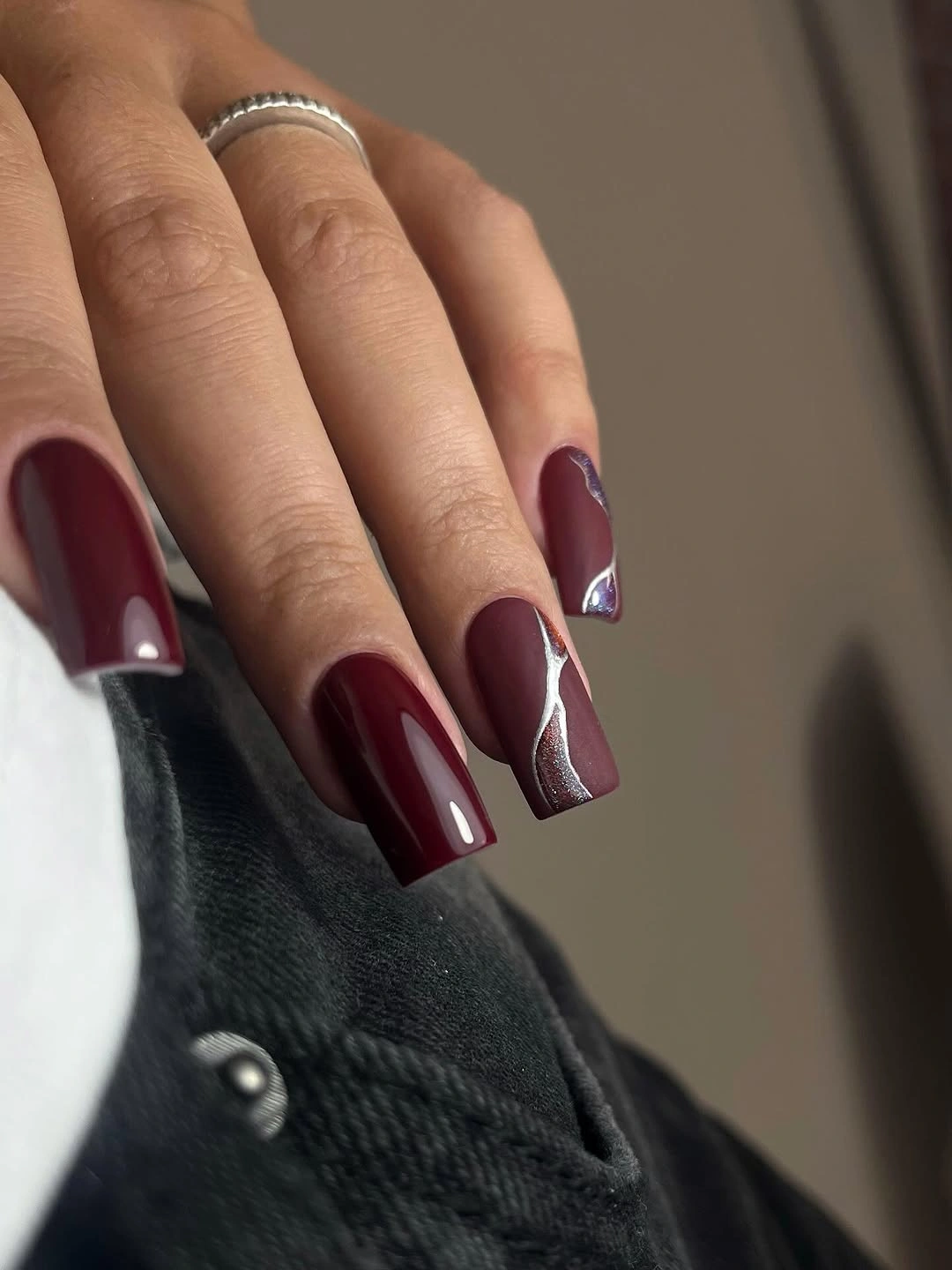
The line works best when it has space around it. On a shorter square, use one side stripe instead of a full sweep, or place the curve on just one accent nail beside plain burgundy. Pewter can soften the contrast, while bright silver will make the design feel more graphic and reflective. A clean gap around the stroke keeps the dark base in control.
Long square tips give the curve room to travel, but they also make the line more visible and the silhouette more demanding. A saturated base will show chips, while the metallic detail may highlight a rough surface. Keep the accent isolated, and the result stays sleek because darkness remains the main visual field.
Short Burgundy with One Multicolor Glitter Nail
Short square nails are mostly glossy burgundy, with one accent densely covered in multicolor glitter that flashes through pink, gold, and silver. The dark solid nails create a quiet frame around the sparkle, so the glitter feels like a single light source rather than a repeated surface. A book and dark setting add atmosphere, but the simple hand composition keeps the manicure easy to read.
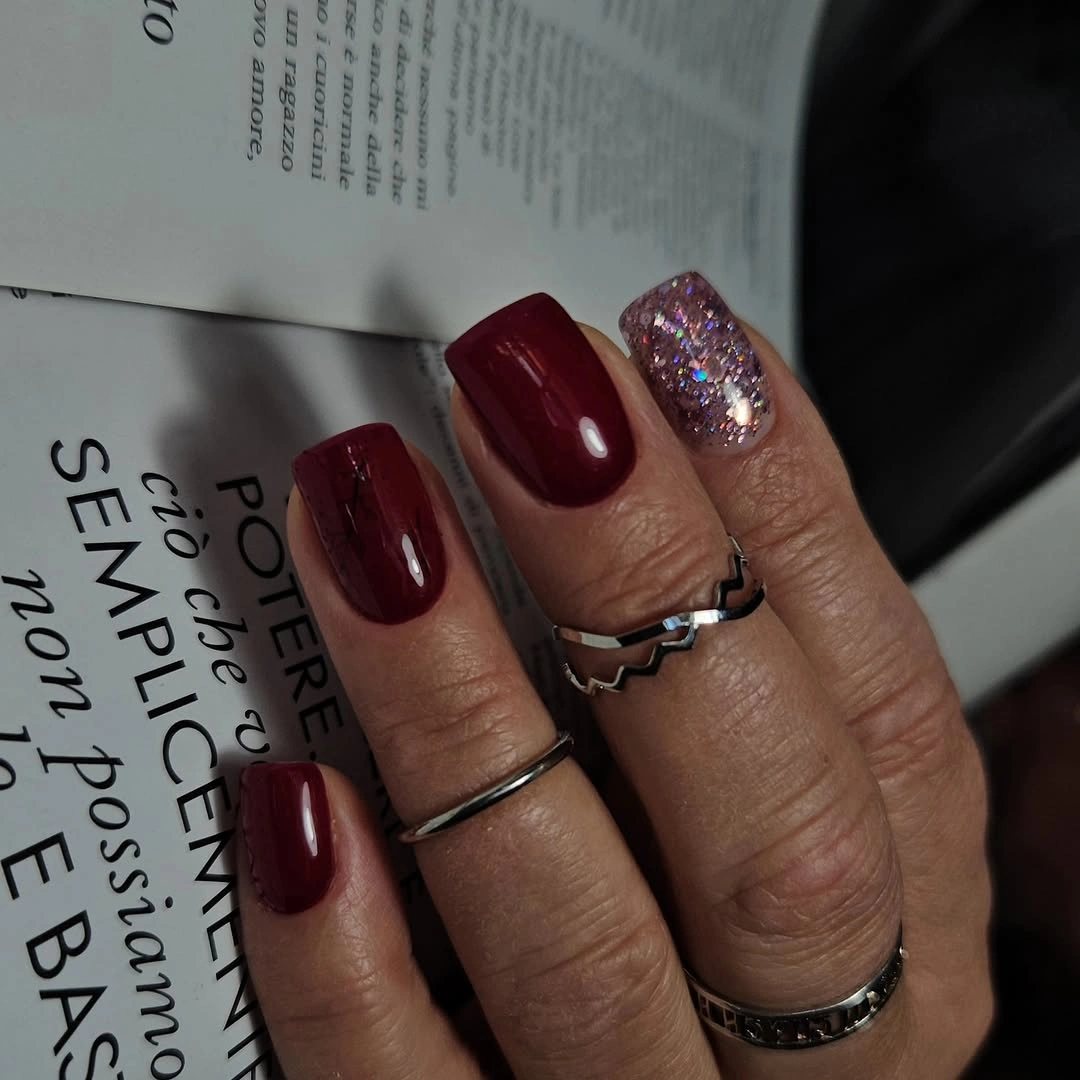
One dense accent is enough to change the energy of the set. A fine shimmer wash can replace the larger pieces for a flatter finish, or the glitter can move to the ring finger while the others remain wine. Keeping the nails short helps the contrast stay focused and makes the idea more practical than a full glitter hand.
Glitter catches light from every direction and may create texture at the surface, so it can feel more occasion-oriented than a plain burgundy solid. The accent should stay away from the free edge when comfort matters. Let the rest of the hand remain dark and smooth, and the sparkle reads as a deliberate break rather than an attempt to decorate everything.
A Burgundy Bow on a Clean Square Base
Short square nails carry a glossy burgundy color, while one nail features a small raised black bow. The sculptural accent is centered against the wine base and surrounded by plain nails, so the design has one clear focal point with plenty of dark space around it. That controlled placement keeps the bow from competing with the shape or turning the set into a novelty collection.
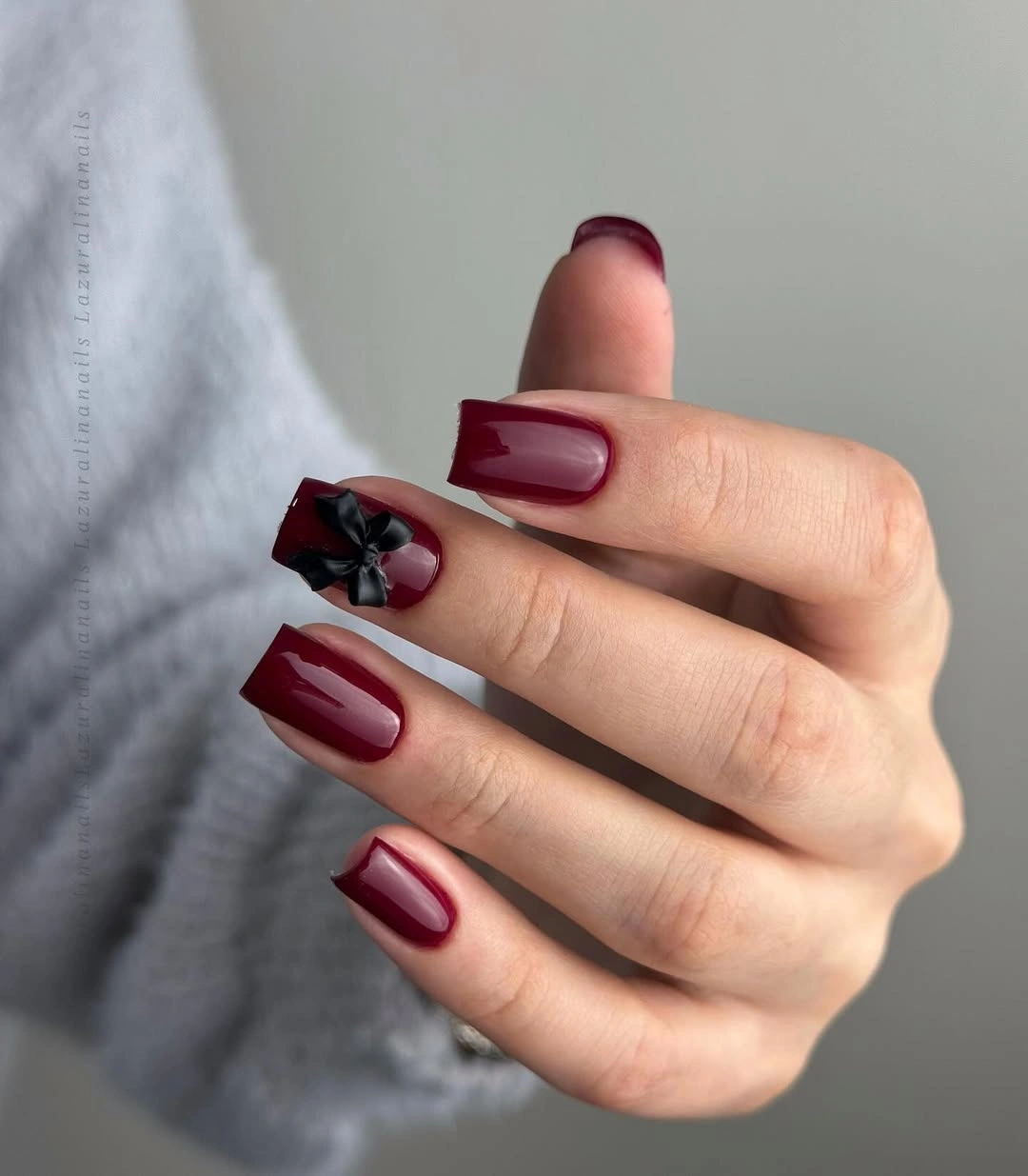
The bow can be adapted flat without losing its identity. Two painted black loops or a small outlined knot would be easier to wear around fabric, while keeping the accent on one nail preserves the visual pause. A burgundy base with a dark plum bow would soften the contrast, but black gives the clearest silhouette.
Raised detail is the honest limitation here because it can catch on clothing or hair and may need more care than a painted line. The solid burgundy neighbors are easy to refresh, which makes the single accent a reasonable compromise. This look works when a small sculptural object is wanted, but the dark base should remain quiet enough for it to stay special.
Burgundy French with Creamy Leopard Accents
Long almond nails combine deep burgundy French tips with creamy nude centers, irregular wine-colored leopard marks, and tiny metallic studs. The open nude surface softens the dark tip, while the animal-inspired accent brings texture without covering every nail. Several ideas are present, but the color family keeps them connected and the tapered shape gives the composition room to breathe.
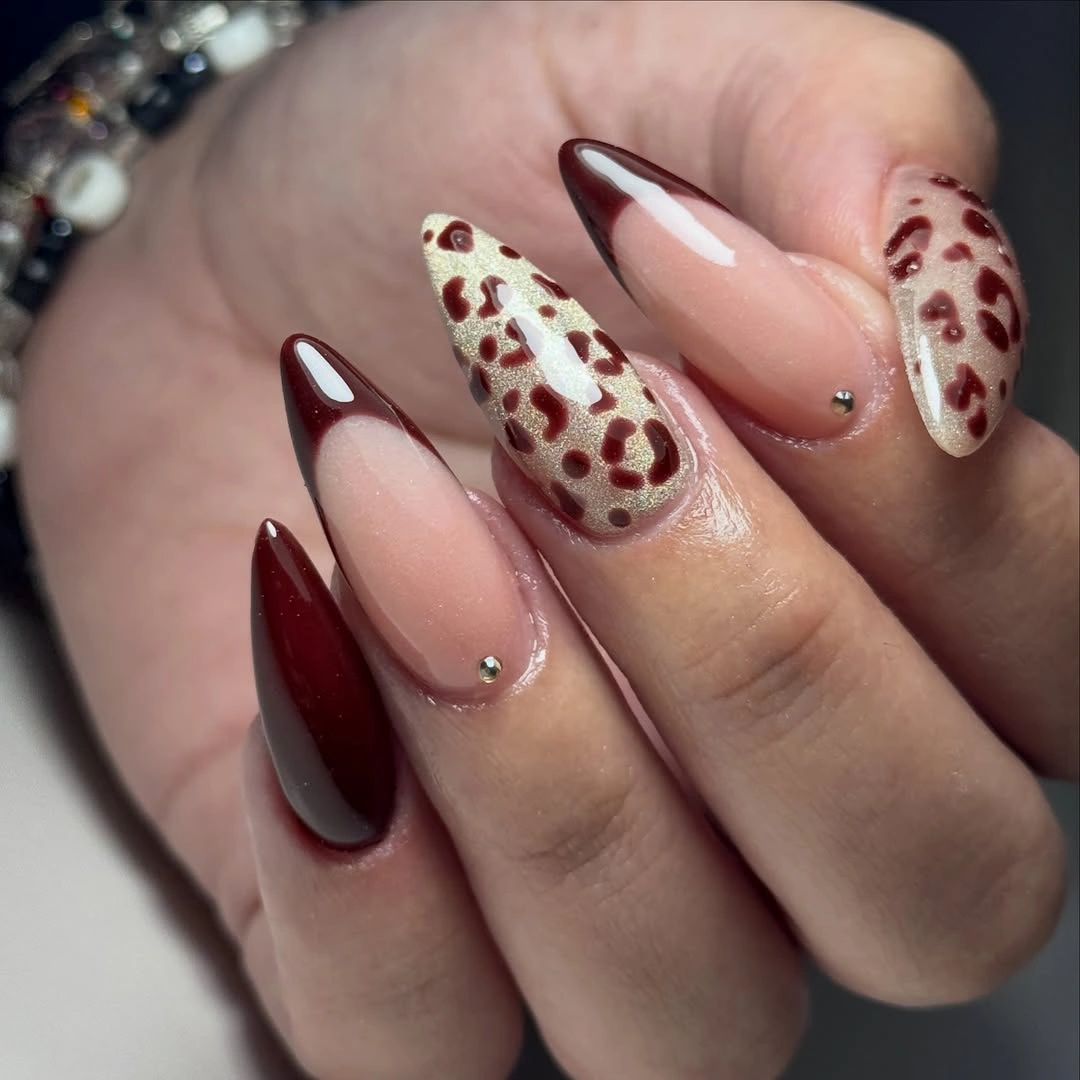
The easiest way to wear this idea is to reduce the number of focal nails. Keep a plain burgundy French on most fingers, then place the spotted detail near the cuticle on one or two accents. A medium almond will preserve the long line with less visual commitment, and the studs can be replaced by tiny painted points if a flatter surface is preferred.
Creamy nude is doing important balancing work because it keeps the dark tip from shortening the whole nail visually. The pattern will feel rich in low light, but too many spots, studs, and tips can make a long set look heavy. Keep one element dominant at a time, and the result remains layered without losing its controlled mood.
Mixed Burgundy Finishes on Long Squares
Long square nails move through several burgundy treatments: glossy wine solids, a metallic plum nail, and pale panels with pink floral artwork. The set is varied, yet the repeated wine family gives every finish a shared base, so the hand reads as a composition rather than a collection of unrelated samples. The contrast comes from surface and panel changes more than from a new color on every finger.
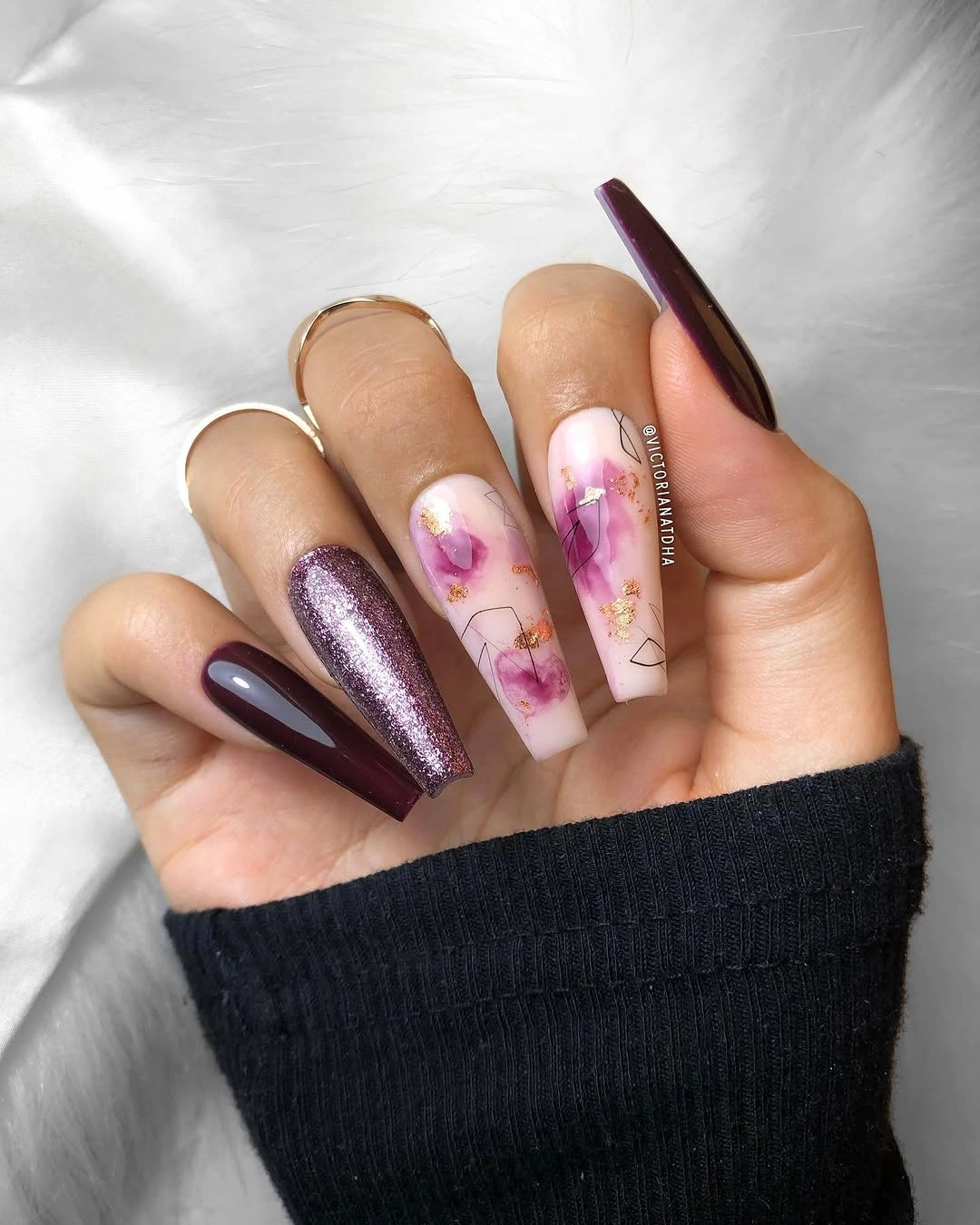
Choose one secondary direction when adapting the set. A single metallic plum accent can sit beside solid burgundy, or one pale floral panel can carry the lighter relief while the rest stay dark. Shortening the square shape will make the art more compact, so a decorated accent should remain simple and avoid tiny marks that need long space to breathe.
Several finishes create depth, but they also create more opportunities for the manicure to feel busy. Repeating the burgundy undertone is what keeps the variety controlled, and removing one accent will usually strengthen rather than weaken the idea. Let the wine solids occupy most of the hand, then use metallic or floral detail as a measured interruption.
Glossy Burgundy Framed by Cream Knit
Long square nails return to a saturated glossy burgundy with no visible art, set against a chunky cream knitted sleeve. The pale texture around the hand supplies the seasonal atmosphere, while the manicure itself stays pure color and shape. That contrast shows how a simple solid can feel distinctly autumnal without adding leaves, glitter, or a second nail shade.
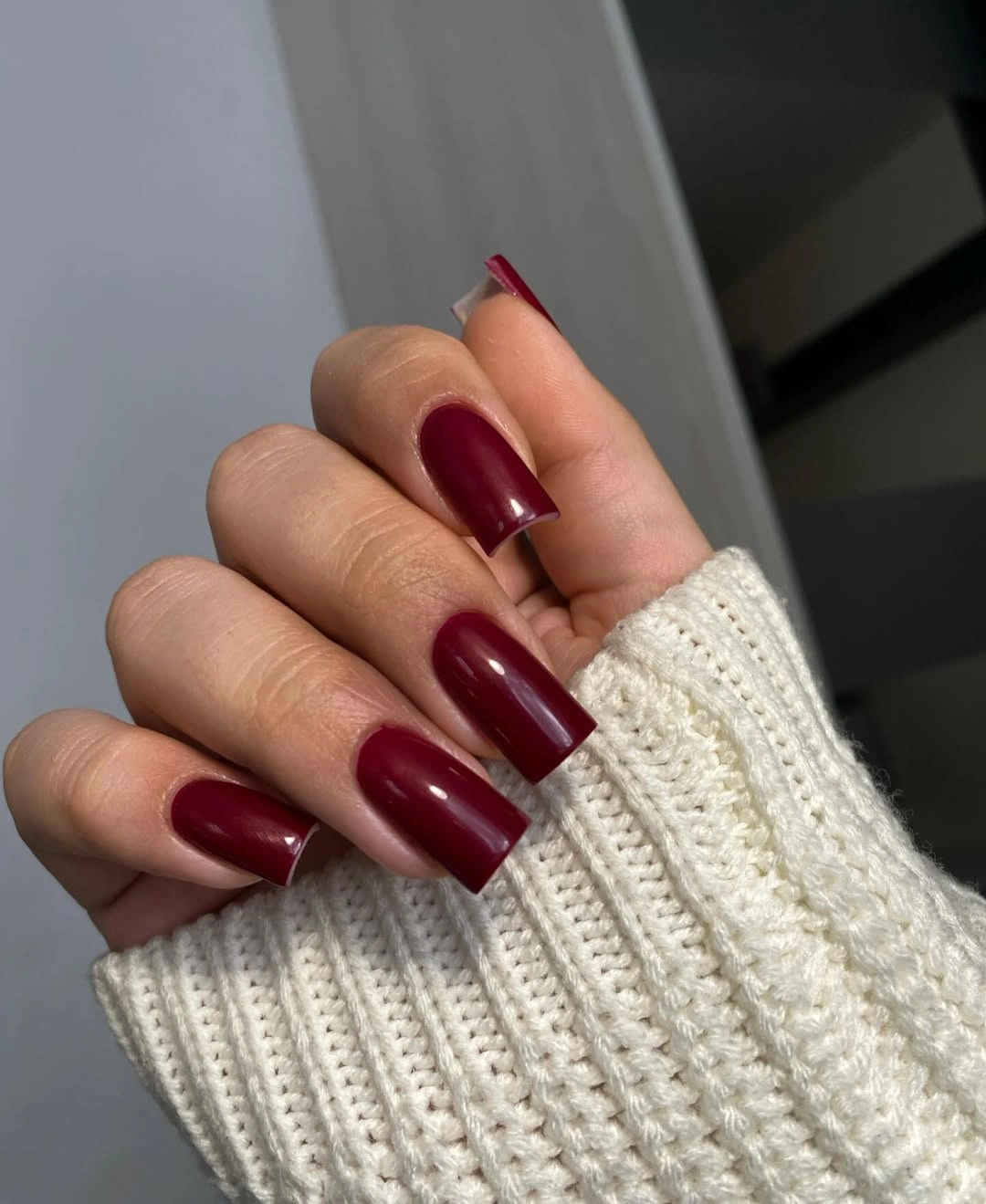
The sleeve acts like a light background that makes the wine color look deeper, but the same pairing can be recreated with cream clothing, a pale wall, or a soft neutral accessory. If long squares are not practical, a medium square or short rounded shape will keep the color-and-texture relationship. The manicure does not need extra art because the surrounding contrast already supplies the relief.
Solid burgundy is straightforward, but the extended square silhouette remains a strong choice and can feel more formal than the color alone. Tip wear will show, especially against a glossy dark field, so a shorter version offers a useful maintenance compromise. Keep the surface clean and the background light, and the look stays sleek rather than overly heavy.
Nude Almonds with Burgundy Glitter French Edges
Medium almond nails use a sheer nude center with burgundy glitter gathered at the tips, while selected nails carry a fuller wine shimmer. The glitter is concentrated at the free edge, so the nude middle remains open and the tapered shape still appears elongated. This creates a lighter version of the collection’s dark palette, with sparkle acting as an edge instead of a full surface.
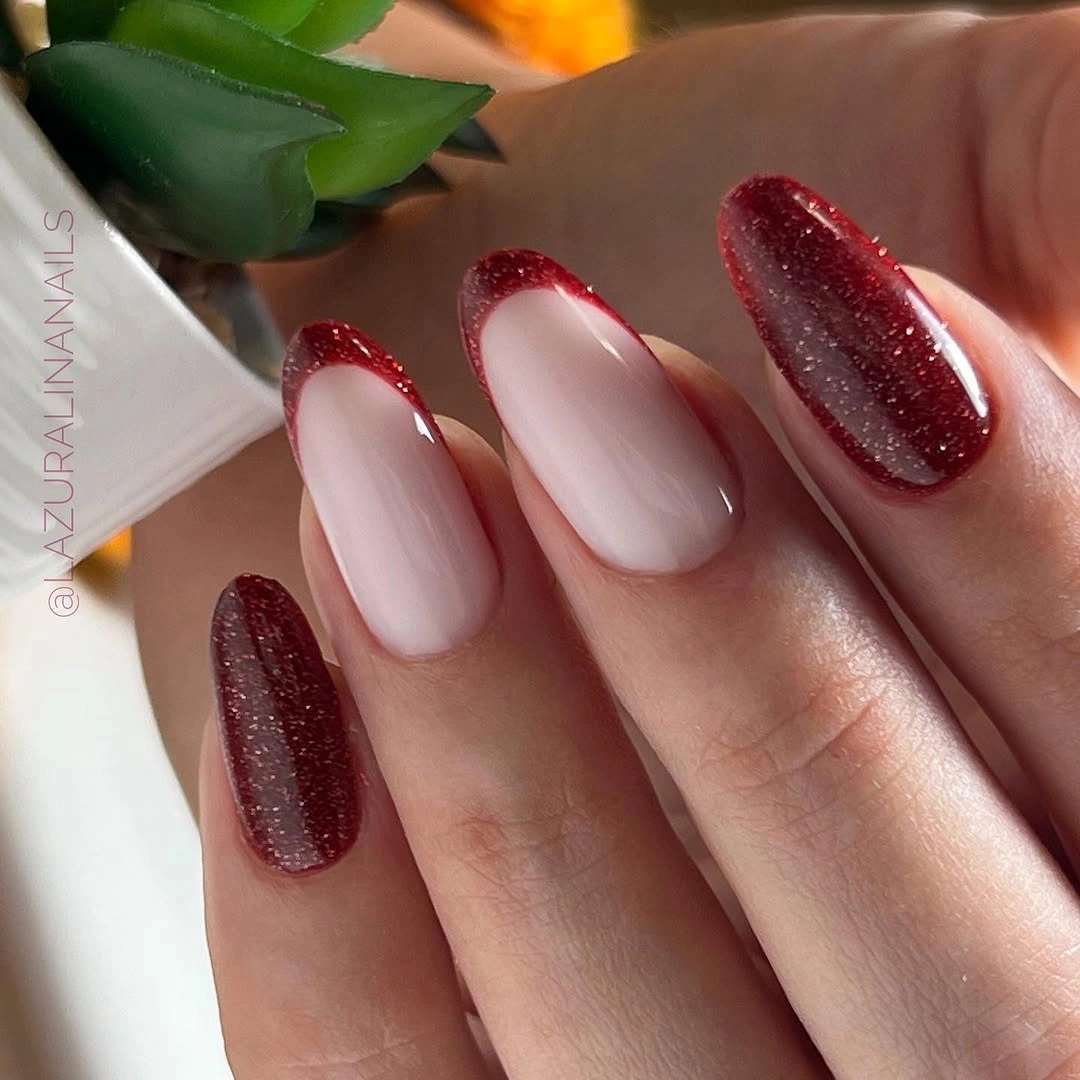
The French placement is easy to scale. Use glossy burgundy instead of glitter for a quieter everyday version, or keep glitter on two accent nails and leave the other tips plain. A shorter oval can carry the same contrast when the edge is narrow, while a medium almond gives the sparkle enough room to look intentional rather than crowded.
Glitter tips can hide small changes at the free edge better than a stark solid line, but dense sparkle may still catch light and feel more formal. The nude center is the balancing element, so avoid letting the burgundy climb too far toward the cuticle. Keep the middle open, and the design stays polished, readable, and softer than a full wine hand.
Wine Solids with Pale Marbled Accents
Long square nails close the collection with saturated burgundy solids beside pale pink-white accents carrying blurred wine marbling and watercolor-like patches. The strong color returns on several fingers, while the light accents break the block and create movement across the hand. Outdoor paving supplies a busy background, yet the contrast between dark solids and pale art keeps the manicure easy to identify.
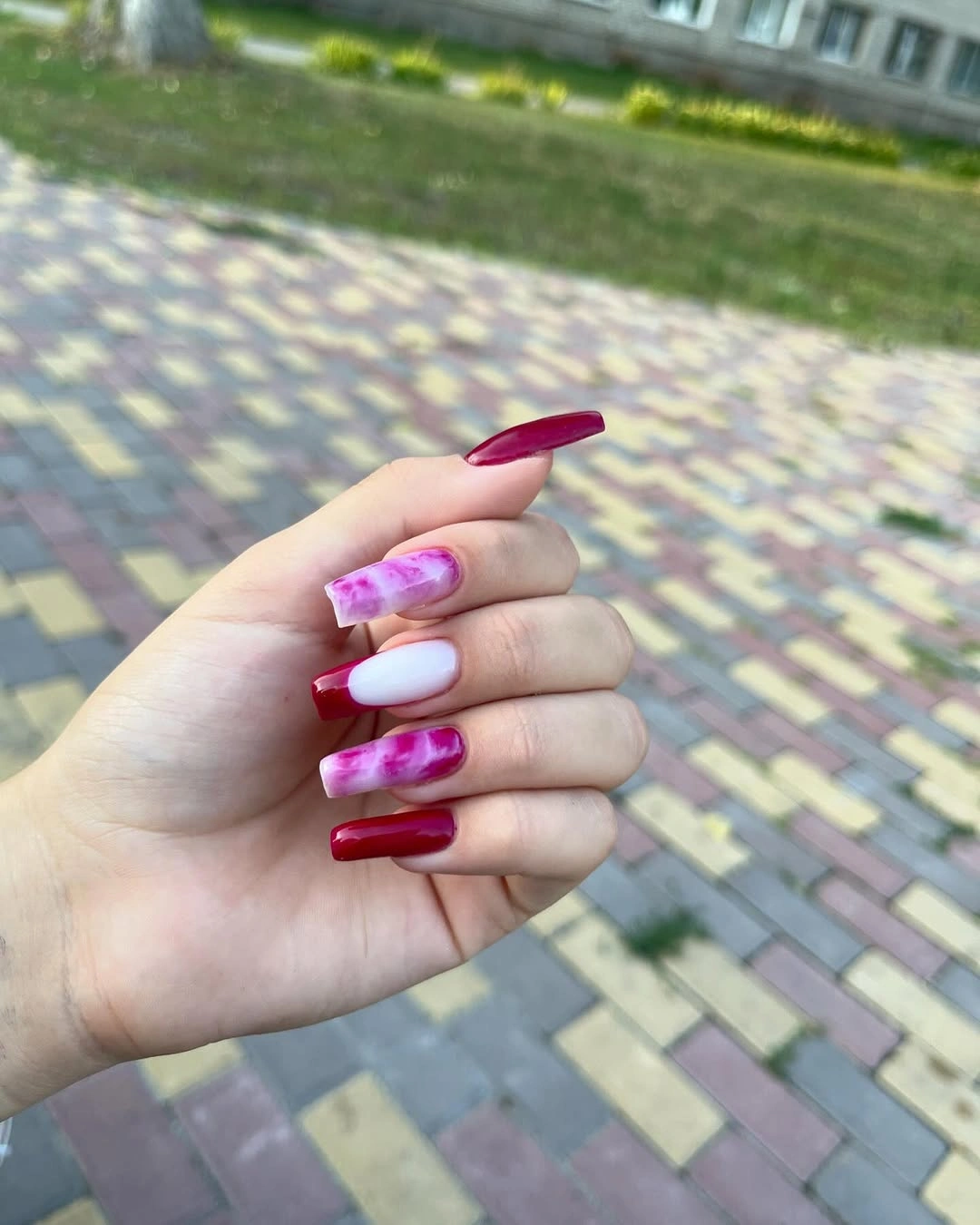
The pale marbling works because it is not forced into a repeated identical motif. A shorter square can keep one marbled accent and make the rest solid burgundy, or use a cream base with one wine swirl for a quieter variation. The key is to let the open light nail interrupt the dark sequence without introducing a completely unrelated color family.
Long square length gives the marbled panels space, but it also makes the overall look more statement-driven than a short rounded set. Soft marbling is forgiving about exact lines, while the saturated solids will reveal tip wear and shape changes. Ending with this contrast keeps the mood controlled: the burgundy remains deep, but a lighter accent gives the darkness somewhere to breathe.