The smallest mark can decide whether a manicure feels edited or overloaded. A line that stops early can make a shape feel lighter, while the same line repeated across every nail can flatten the rhythm. Good nail art is not a contest to fill available space; it is a decision about where the eye should pause and where the hand should be allowed to breathe.
Choose the detail that carries the mood, then remove anything that competes with it. Broad shapes usually survive a shorter surface better than tiny marks, while a pale ground gives a fine drawing room to stay legible. Protect the strongest contrast, repeat it only when repetition adds rhythm, and let the quiet nails do real compositional work.
Pastel Tips With A Full Motif Menu
This flat nail-tip display is less about one finished hand and more about the scale of small seasonal ideas. Lavender, blush, pumpkin, leaf, bow, ghost, and star-like motifs sit on separate tips, so the eye can compare how each symbol behaves against a pale background. The variety is useful because it shows that autumn does not require a dark base.
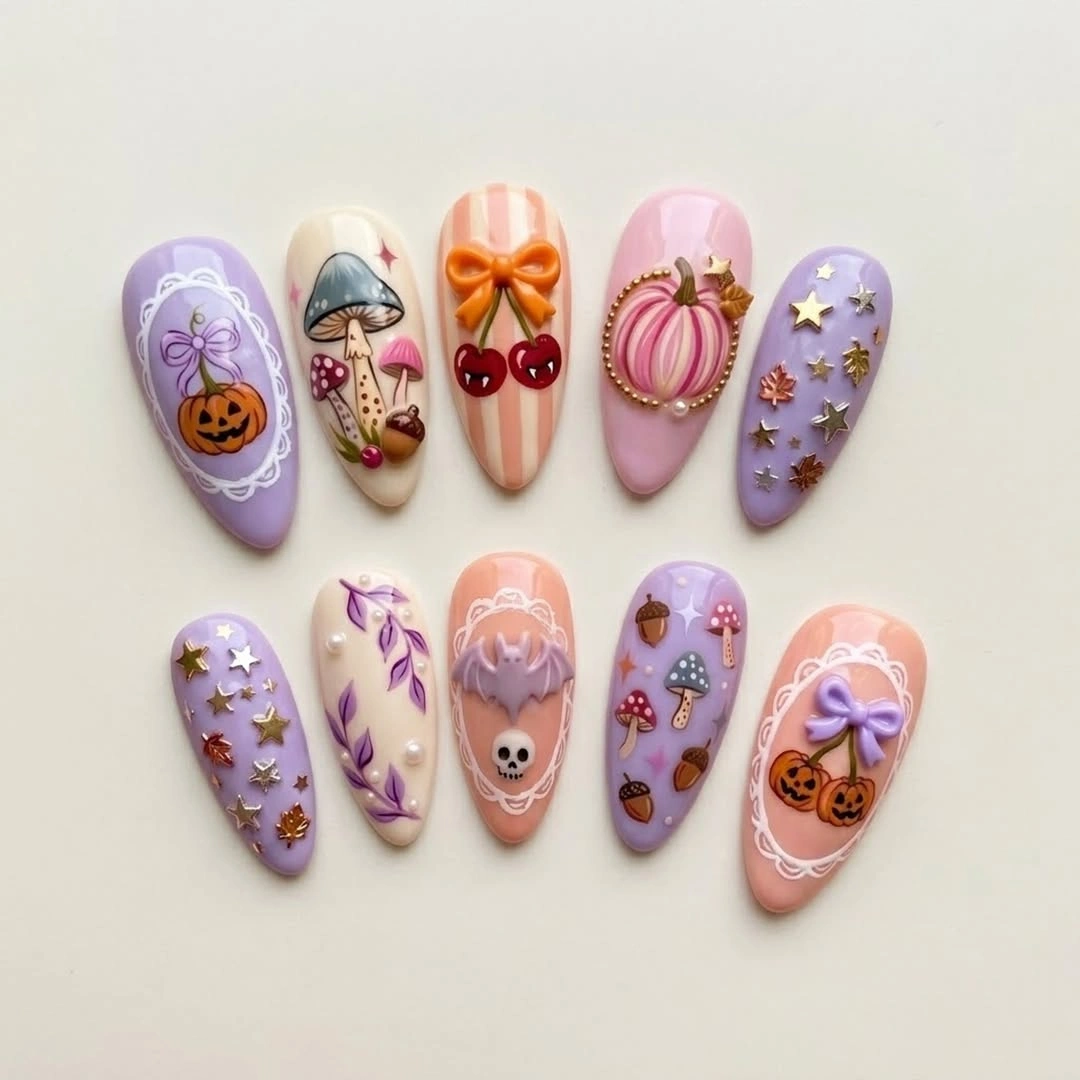
The important detail is the open space around the marks. Each tiny illustration has enough background to remain readable, even when the palette changes from purple to pink or warm orange. Because the tips are shown separately, the display also makes a practical point: a finished hand will feel more coherent if it chooses one motif family instead of collecting every available symbol.
For a wearable set, select two or three tips with similar line weight and repeat their colors across the hand. A pumpkin with a small leaf can work on an accent nail, while bows or stars can fill the quieter spaces. The limitation is that miniature motifs need room, so compressing all of them onto short nails would lose the clarity that makes the display appealing.
Black Leaf Sketches On A Blush Base
Long almond nails use a pale blush ground to make black leaf drawings easy to read. A few orange and burgundy marks warm the composition, but the most noticeable detail is the dark linework placed across otherwise open nails. The design feels seasonal because of the shapes and color accents, not because the base is heavy or intensely saturated.
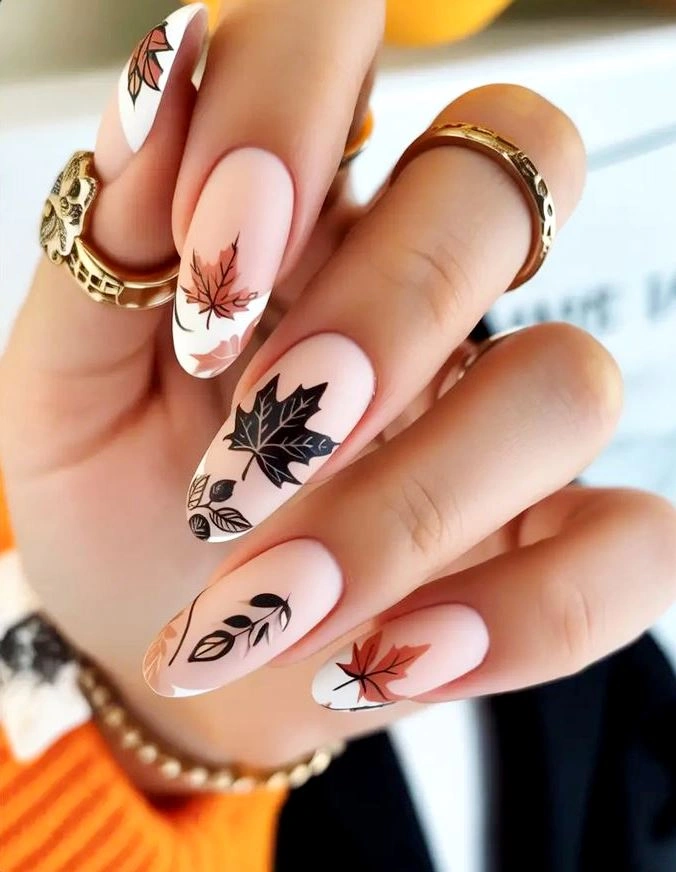
The edge of each leaf carries more weight than the small warm accents around it. Crisp black lines create the contrast, while the pale base keeps the drawings from merging into one dark patch. The almond silhouette gives the sketches vertical space, so the motifs can stretch with the nail instead of being forced into a compact corner.
If the nail bed is shorter, keep one leaf on an accent nail and reduce the supporting marks to a single rust-colored dot or short stroke. That preserves the visual hierarchy and avoids turning fine linework into a blur. The honest tradeoff is that the long almond shape adds elegance, while a shorter version will feel simpler and more casual even with the same blush, black, and warm palette.
Forest Green French Edges On Pale Pink
The defining detail here is not the pale base but the dark green edge that follows the almond tips. Several nails add tiny black marks or dots, yet most of the surface remains soft pink and open. That placement makes the forest color feel like a border rather than a full manicure, which keeps the fall reference subtle.
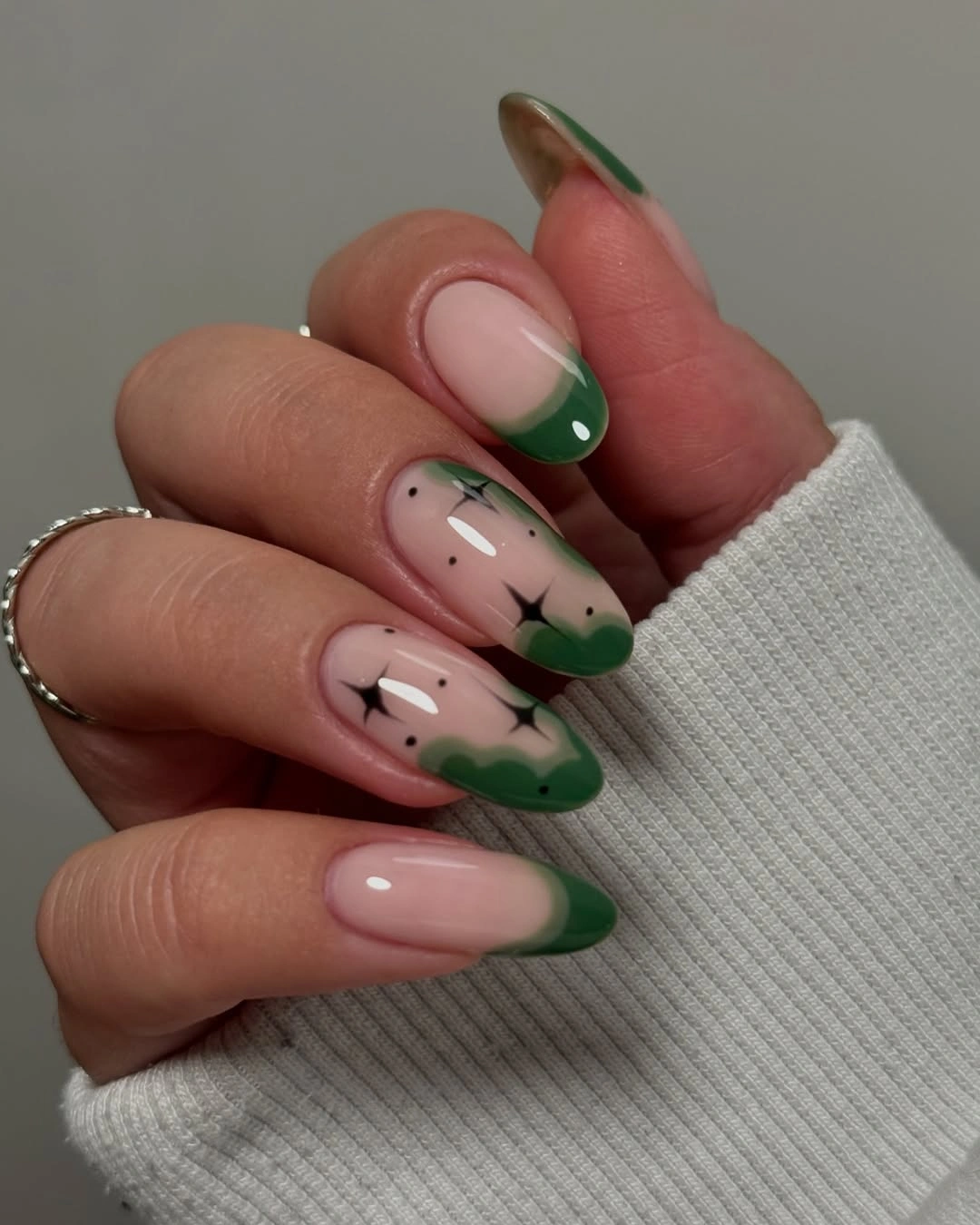
The green edge works because it repeats the direction of the shape. The eye follows the almond point, meets the saturated color, and then returns to the pale center, creating a clean loop across the hand. The small marks add personality, but they are secondary; the manicure would still read clearly if they were removed.
For a shorter adaptation, make the green band thinner and place it on two or three nails rather than every finger. A medium oval can carry the same temperature contrast, although the edge will feel rounder and less elongated. If you add art, use one dark dot or curved line, because the strength of this idea comes from a readable border with enough pale space around it.
Three Purples And One Dotted Accent
This medium almond set builds interest from neighboring purple tones instead of several unrelated motifs. Lavender, mauve, and deeper violet appear as glossy solids, while one nail adds darker rounded dots that interrupt the otherwise smooth rhythm. The detail is small, but it changes the hand from a simple color story into a considered piece of fall nail art.
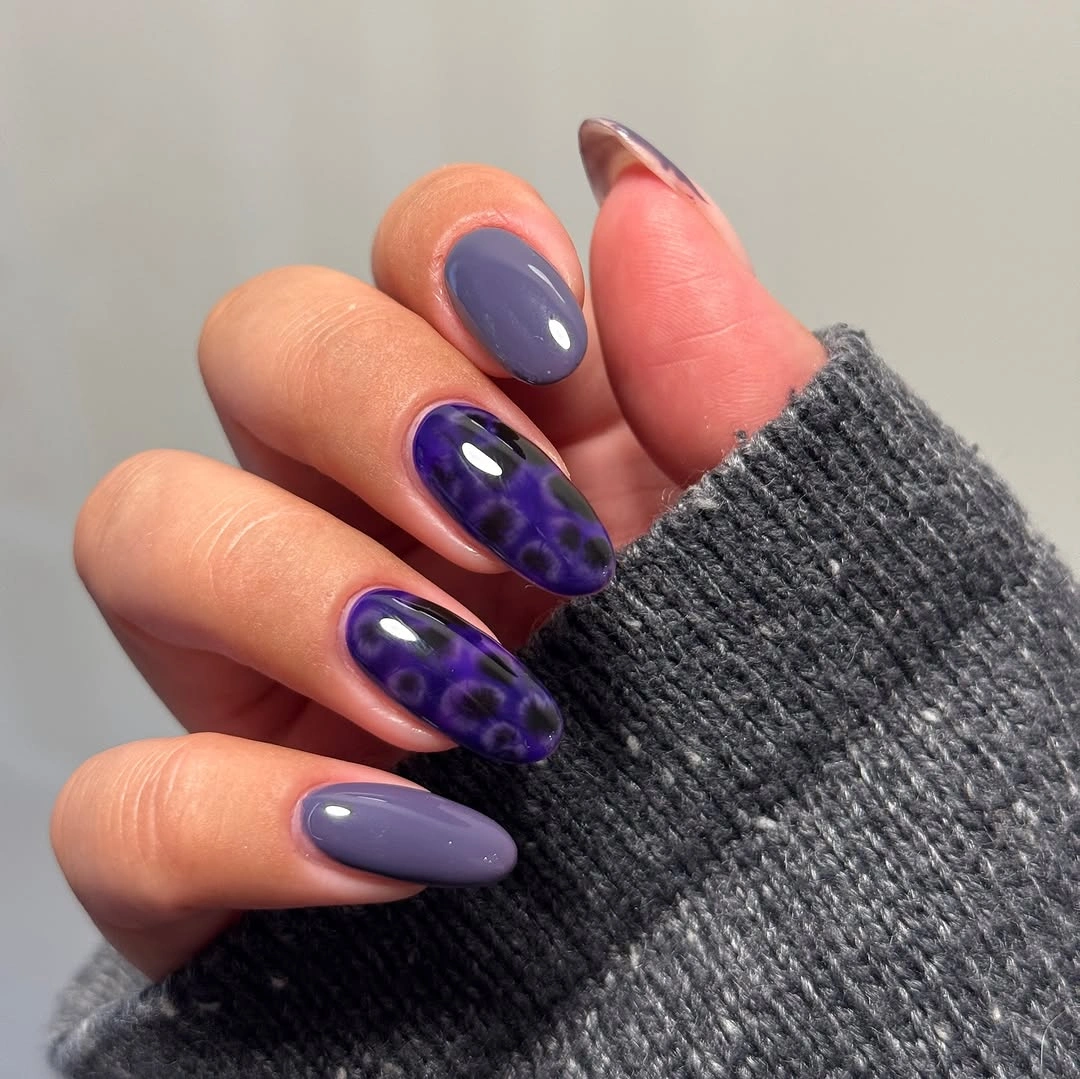
The dots work because they are not repeated everywhere. Most nails establish a quiet tonal scale, then the single patterned surface gives the eye a place to pause. That restraint matters: if the same dots appeared on every nail, the difference between the purple shades would become less important and the set would lose its clear focal point.
Use two purple tones for a simpler version and keep the dotted detail on the ring finger. On a shorter shape, make the dots slightly larger and leave more blank space between them so they do not merge. This is a useful choice when you want seasonal depth without leaves or pumpkins, but it still asks for a little control in spacing to keep the accent from looking accidental.
Orange And White Lines Following Stiletto Tips
The long stiletto silhouette gives the orange and amber accents a strong direction. Bright color appears near pointed edges, white space cuts between the warm panels, and dark outlines add a graphic frame. The result suggests motion without needing a literal motif, because each line travels toward the same sharp destination.
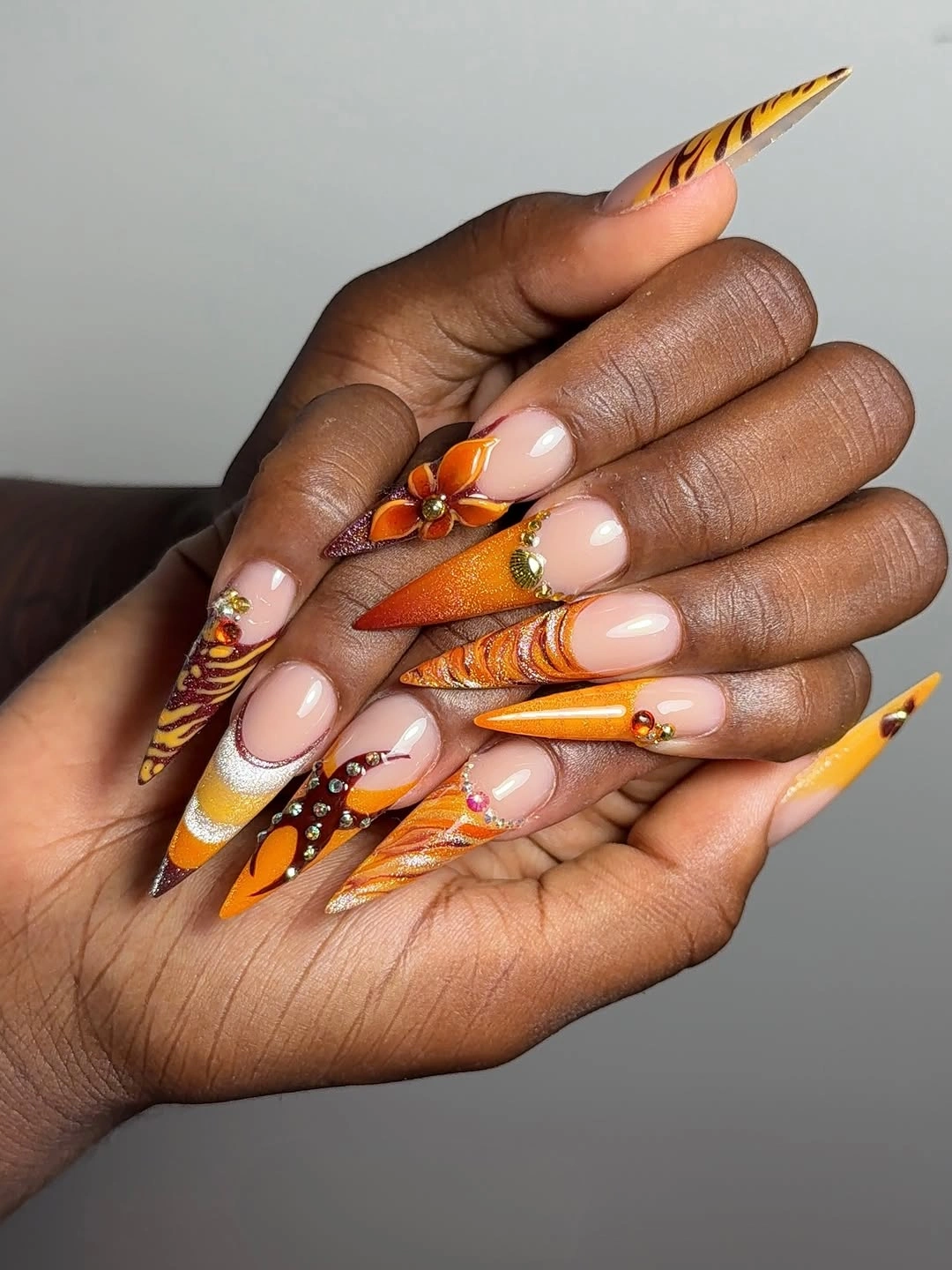
The smallest visible feature is the spacing between the orange shapes and the white ground. That gap keeps the warm color crisp and prevents the nails from reading as one solid orange mass. The dark outlines then sharpen the separation, making the design feel deliberate even though the individual accents vary from nail to nail.
For a more wearable adaptation, retain the orange-white contrast on two medium almond nails and simplify the dark marks to one line. A shorter shape will reduce the flame-like direction, but it will also make the color easier to pair with everyday clothes. The tradeoff is straightforward: the extreme length delivers the strongest graphic movement, while a compact version puts the emphasis on palette rather than silhouette.
Silver And Black Spots On Short Nails
Short rounded nails use metallic silver as the steady background and reserve black spotted detail for only a couple of fingers. The surface is compact, but the contrast is immediate: bright gray catches light while the darker marks make the hand feel more graphic. Because the accent is limited, the design stays clear rather than turning into an all-over pattern.
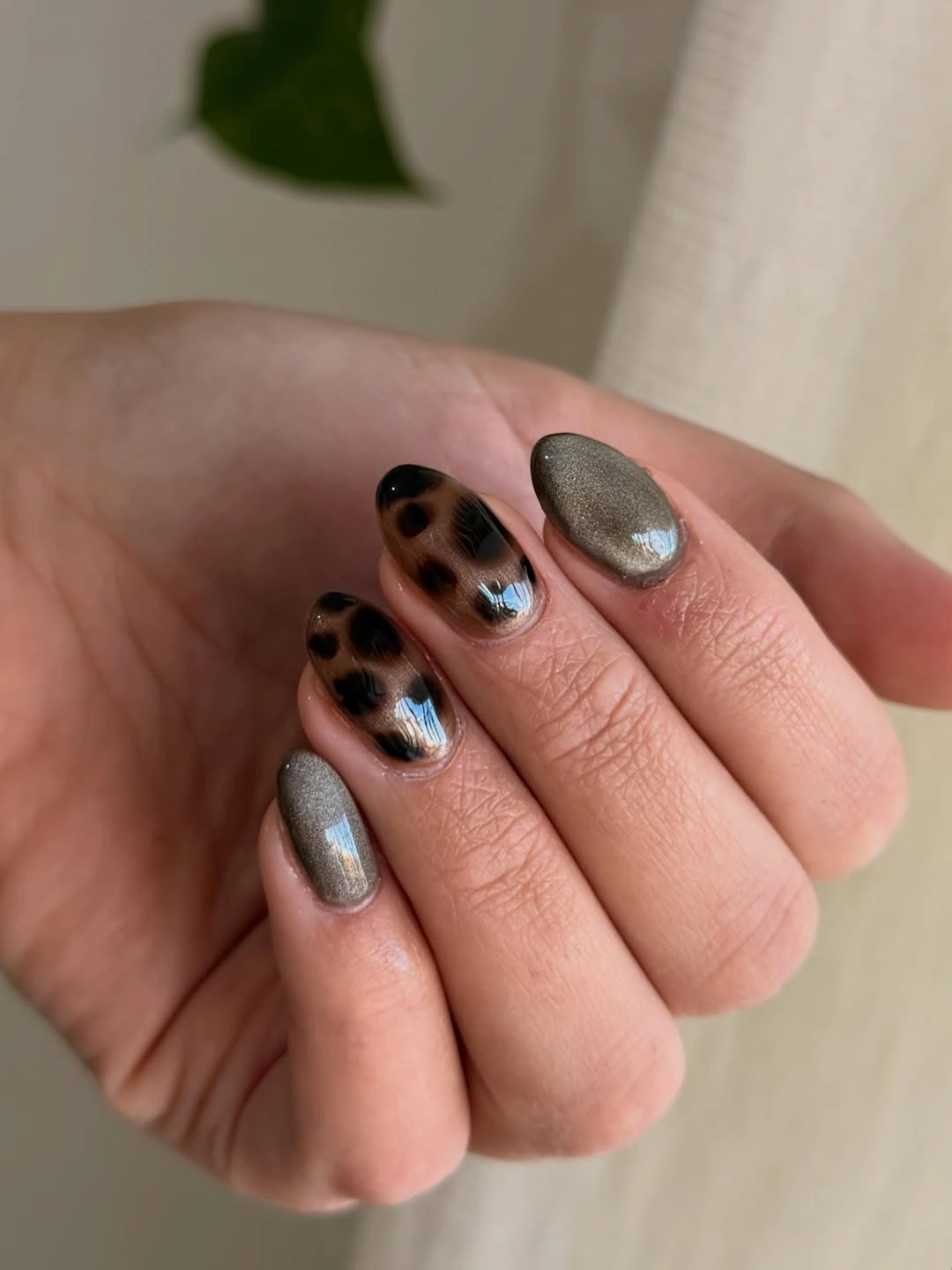
The placement of the spots is doing more than their shape. They sit on selected nails, so the silver solids create pauses between the darker surfaces and give the eye a reliable rhythm. That arrangement is especially helpful on short nails, where a dense pattern could cover the available space and make the shape look smaller.
Use one spotted accent nail per hand and keep the others metallic gray, charcoal, or black. If the surface is very short, choose wider marks with generous gaps rather than many tiny dots. The finish discipline behind fall matte nails is useful here too: protect the main contrast and accept a little irregularity instead of forcing perfect repetition.
Warm And Cool Panels Divided By A Band
These medium almond nails use a precise horizontal division to hold together mustard, rust, blue-purple, and reflective neutral tones. Each nail looks like a warm and cool panel separated by a narrow bright band. The unusual detail is the placement, not just the color choice, because the band gives every finger the same visual interruption.
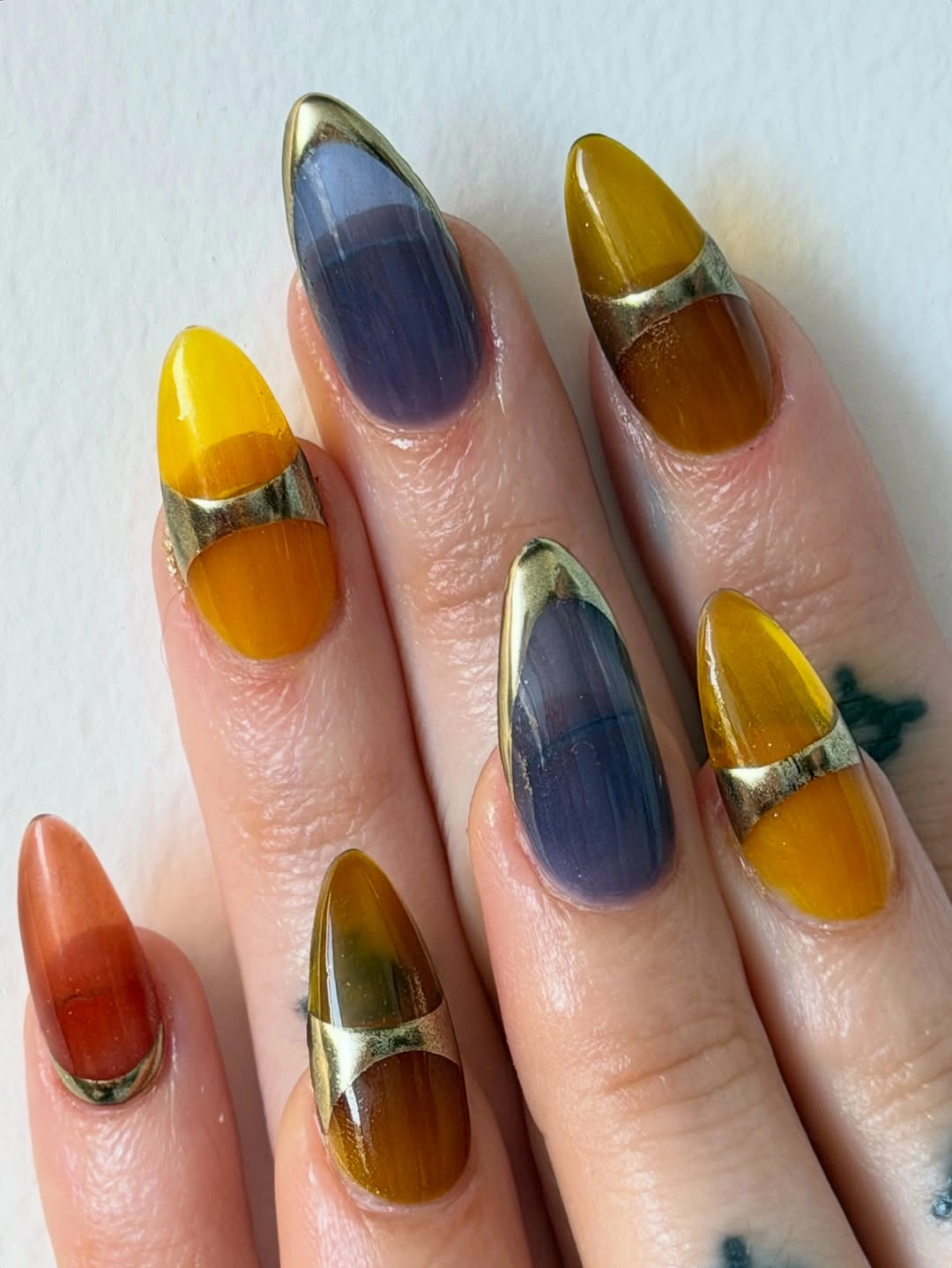
The repeated division keeps the mixed palette from becoming random. Warm yellow and orange bring the fall association, while the deep blue center supplies contrast and stops the set from leaning entirely earthy. The band acts like punctuation between the temperatures, so the eye can read the color blocks as one system even when their proportions shift.
For a less demanding version, keep the warm-cool split on two nails and use one mustard or rust shade on the rest. A shorter oval can carry the idea if the band is made broader and the panels are simplified. Do not add extra motifs unless the surface feels empty, because the most consequential detail is already present in the clean division between warm and cool.
Blue Graphic Curves Against Pale Pink
The pale pink base in this set gives vivid blue and violet curves enough room to stand apart. Some nails are mostly neutral, while others carry rounded dark lines and compact graphic accents. The design feels detailed because the eye follows the paths, but the open ground prevents the curves from becoming a dense full-coverage pattern.
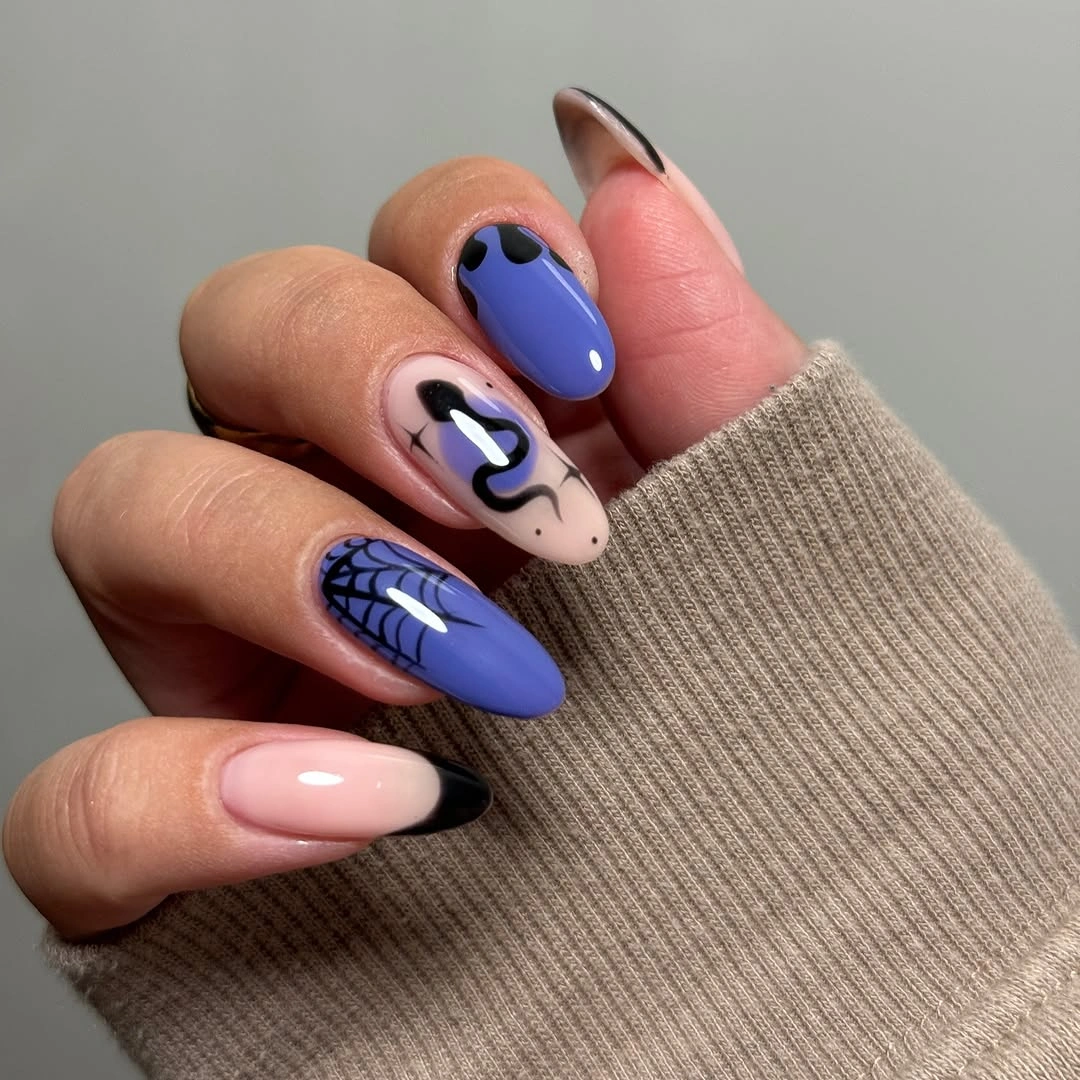
Placement changes the mood here. The blue marks sit where a solid color could have gone, yet they stop short of covering the entire nail, so the hand keeps a light center. That balance lets the saturated accents feel intentional and makes the pale base part of the design rather than an empty leftover space.
On a shorter almond or oval, keep one broad curve on an accent nail and use a small dot or short line elsewhere. Fewer turns will make the graphic idea easier to read, even if the finished set feels less intricate. The tradeoff is useful: preserving the open pink ground will usually do more for clarity than adding another blue shape to compensate for reduced length.
Brown Orange Flowers With Tiny Gold Points
Medium almond nails carry a soft blush base with small brown, orange, and gold details. The motifs sit lightly across the hand, so no single flower or leaf takes over, and the pale ground remains visible around every mark. This is a close-looking design: the interest comes from small placement decisions rather than a bold silhouette.
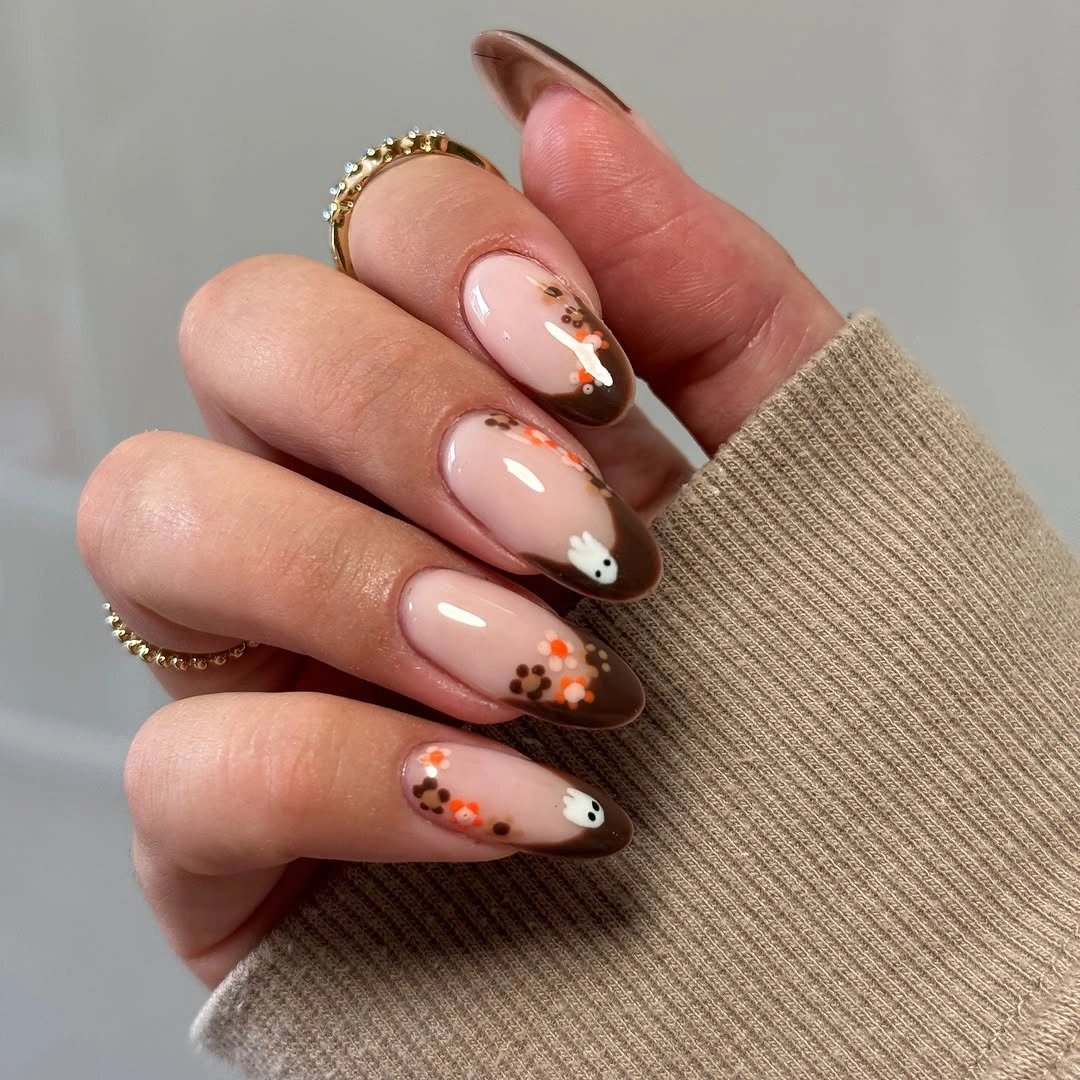
The gold points are most effective because they are sparse. Brown gives the linework definition, orange supplies the seasonal warmth, and the tiny metallic notes catch light without changing the whole palette. If the gold were repeated on every nail, it would compete with the warm marks; here it behaves more like a quiet highlight inside a larger neutral composition.
For a short version, choose two accent nails and keep the rest sheer blush or warm brown. A single orange mark can replace a more detailed cluster when space is limited, while the gold can be skipped entirely without losing the main idea. The limitation is resolution: very small accents need enough contrast to remain visible, so restraint should mean fewer marks, not necessarily paler ones.
Warm Accent Clusters On A Nude Base
This nearby direction also uses blush as the ground, but the warm details gather closer to the tips and sides. Brown curves, orange dots, and tiny floral-looking accents create small clusters instead of evenly spreading across each nail. The difference is subtle, yet it changes the rhythm from scattered decoration to a few deliberate points of emphasis.
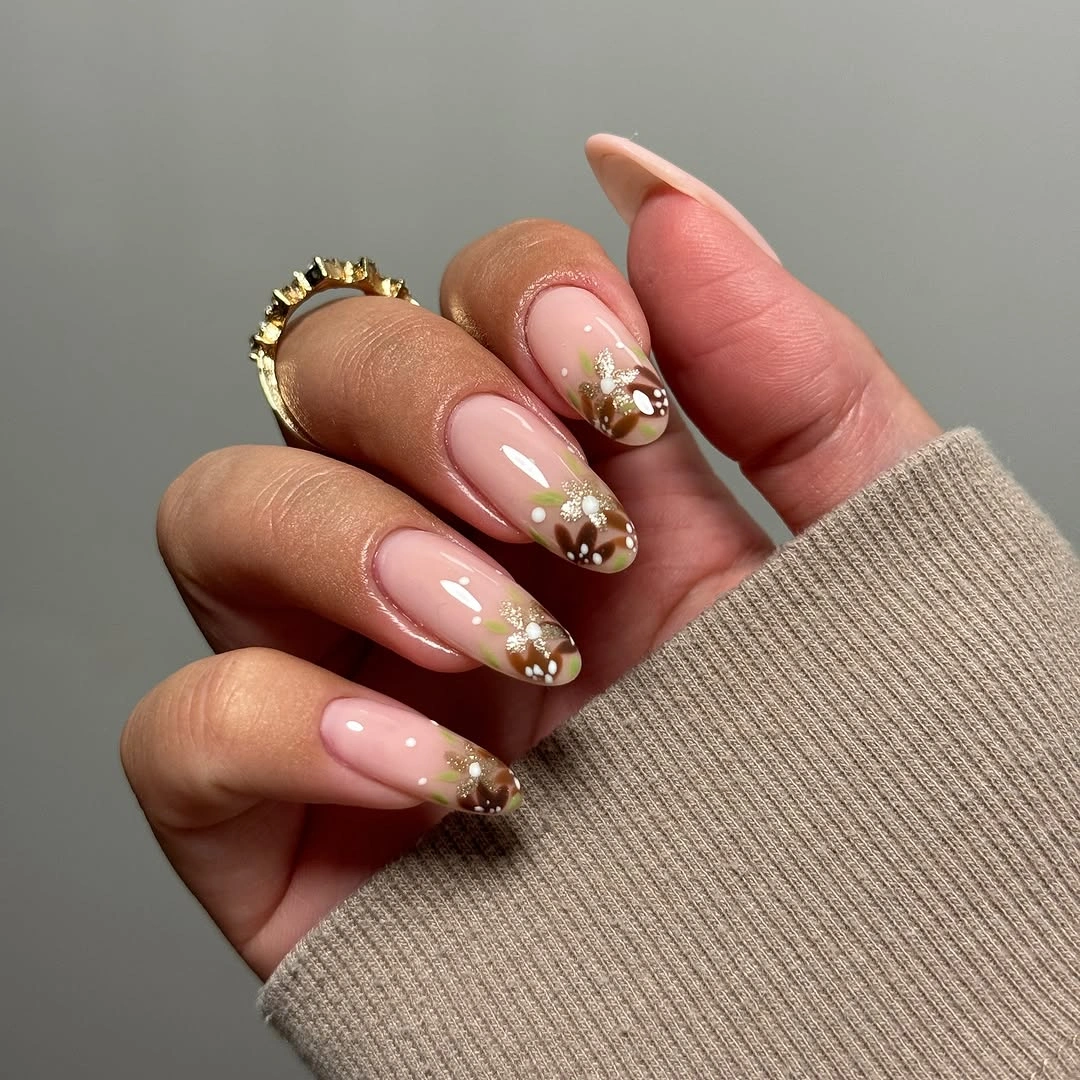
The clear center makes the placement easy to notice. The eye sees the pale nail first, then discovers the warm cluster near the edge, which keeps the manicure feeling lighter than a full illustration. That spacing also gives the almond shape more length visually, because the unpainted-looking center leads the eye toward the tip before the darker mark arrives.
Keep the cluster on two nails and use one warm color on the others if you want the design to feel edited. A short round shape can carry the same arrangement, but the cluster should be larger and simpler so it does not become a row of tiny dots. The honest limitation is that the closer the marks sit to the tip, the more noticeable any growth or edge wear becomes.
Autumn Colors As A Complete Composition
Here the manicure treats color itself as the main detail. Medium almond nails alternate warm orange, red, yellow, and brown, with only a small leaf-like mark interrupting the solid surfaces. The surrounding autumn foliage reinforces the palette, but the nails already communicate the seasonal idea through their sequence of tones.
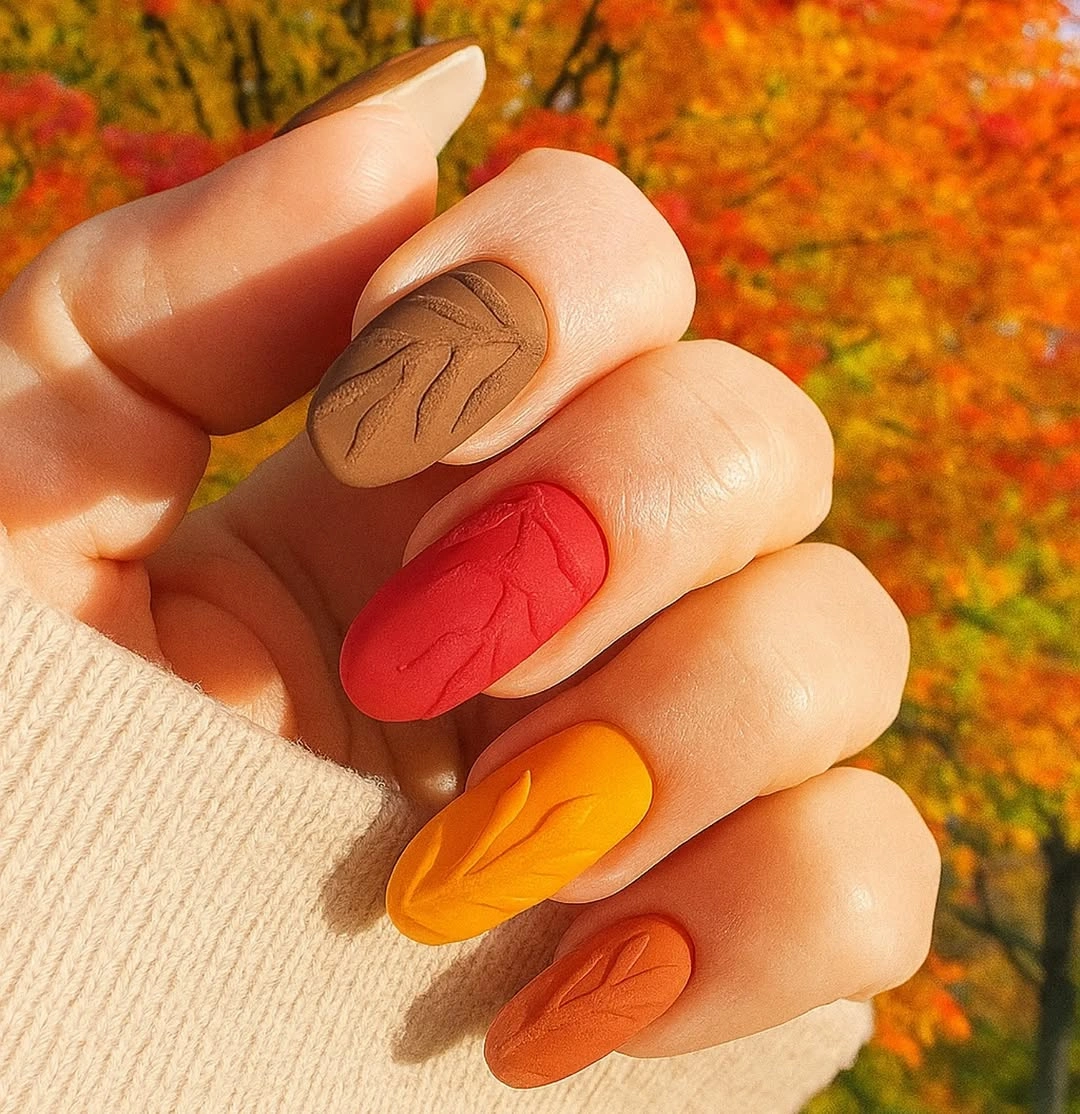
The order of the colors creates the visual rhythm. Yellow and orange bring light forward, red adds saturation, and brown gives the hand a darker place to settle. Because each nail remains mostly solid, the eye can compare the shades directly instead of decoding a separate motif on every finger, which makes the design easy to adapt.
Choose three colors that already appear in your wardrobe rather than copying every visible tone. A short rounded shape will make the palette feel more casual, while a longer almond will emphasize the color progression. The limitation is balance: several warm shades can look loud when placed together, so one muted brown or soft neutral may be needed to give the brighter colors room.
Burgundy And Cream Blocks On Short Nails
Short rounded-square nails make a strong graphic statement with only burgundy and cream. The pale sections curve into the darker base, creating compact panels that look more designed than a standard tip. There is no need for tiny art because the most visible detail is the clean boundary where the two colors meet.
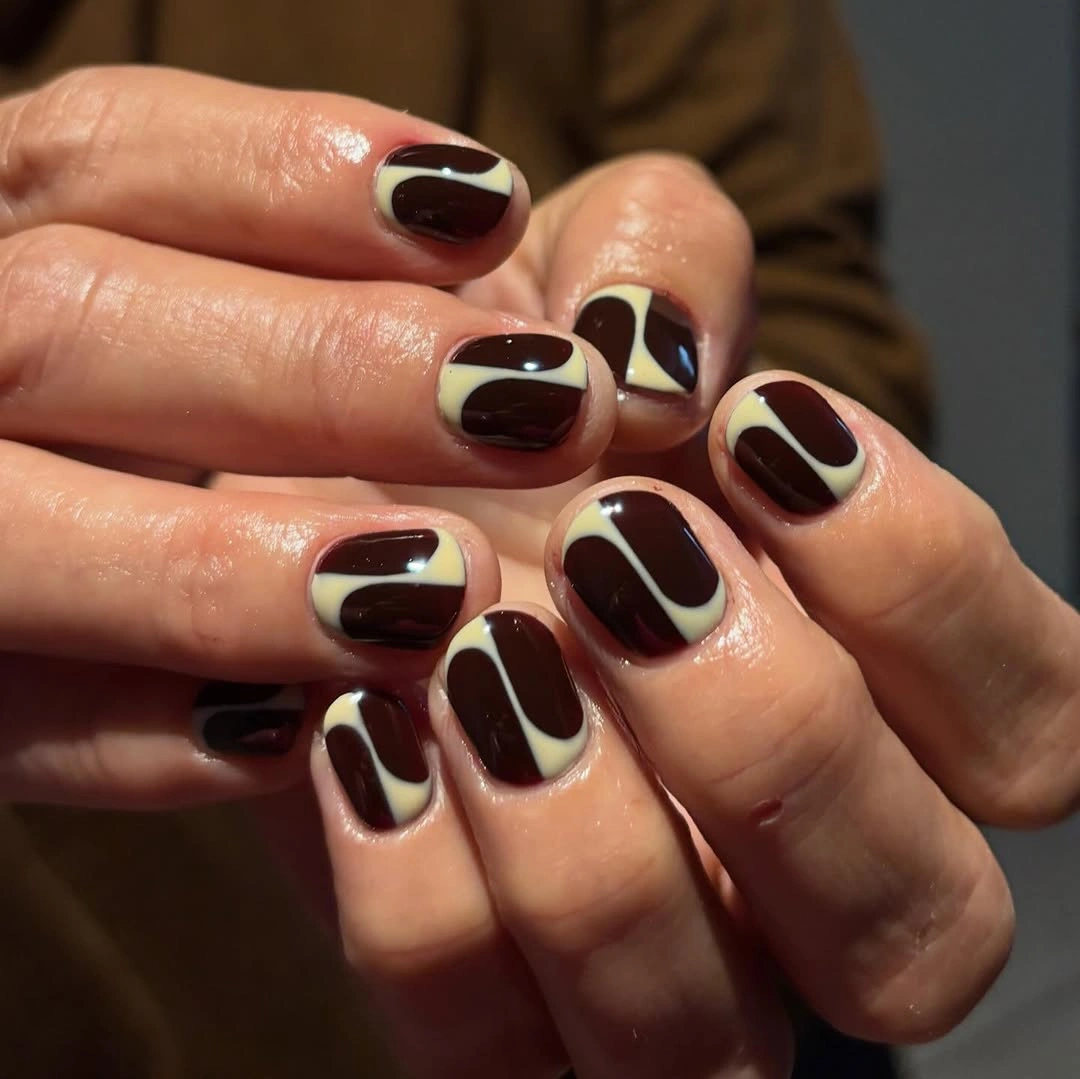
The short shape benefits from this kind of broad contrast. Large blocks remain readable on a small surface, while the wine tone adds enough depth to keep the pale sections from feeling sugary. The curved boundaries also soften the geometry, so the manicure feels deliberate without becoming as rigid as a strict checkerboard or straight stripe.
For a calmer version, keep the cream panel on two nails and use plain burgundy on the rest. A short oval will make the blocks feel softer, while a rounded square will preserve the graphic character. The tradeoff is that the design depends on clean spacing, so adding several small marks would weaken the strongest feature rather than make the manicure richer.
Miniature Seasonal Sketches In Open Space
Medium almond nails use a sheer-looking nude base for tiny leaf, berry, and autumn line motifs. The marks are small enough to feel like sketches, and most of the nail remains open so the hand does not become a dense illustrated wall. The detail-first appeal comes from discovering a new little mark without losing the pale shape underneath.
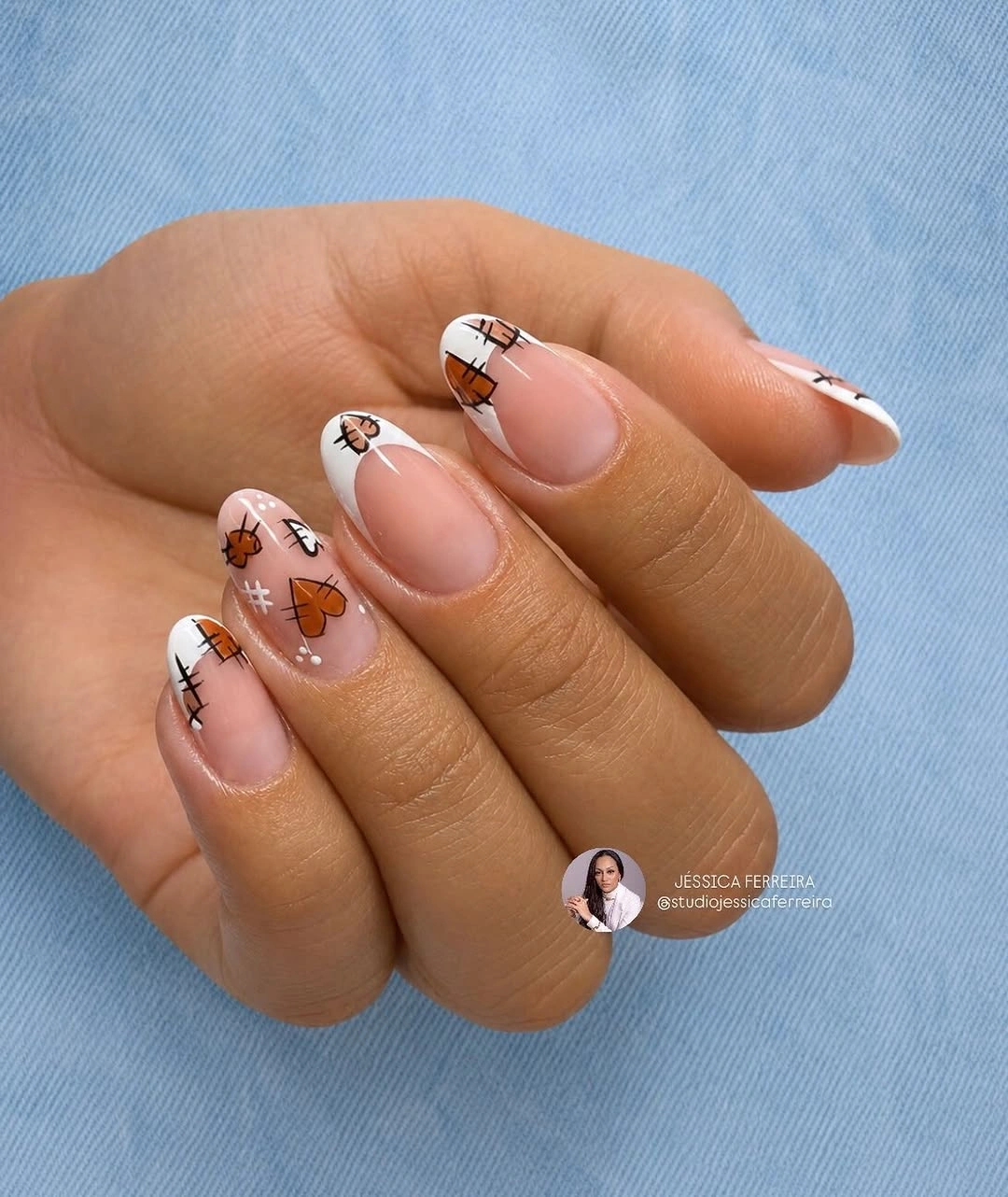
The background is just as important as the drawings. It separates the black, brown, and warm accents, allowing each small shape to retain its outline and keeping the overall manicure airy. The almond length gives the sketches room to sit vertically, but the composition would still work if the marks were reduced to one carefully placed accent per hand.
Choose one motif family before adding a second, since a leaf and a berry can share a palette but still compete if both are repeated everywhere. On shorter nails, enlarge the chosen mark slightly and leave the surrounding space plain. The limitation is obvious but useful: intricate miniature art rewards a close view, while a busier or longer-range design needs broader shapes and stronger contrast.
Soft Pink With One Pale Floral Accent
Short rounded nails keep the base soft pink and place pale floral details on selected fingers. The flowers or petals are light rather than strongly contrasting, so the manicure feels gentle and tactile instead of graphic. Small gold points add a little warmth, but the eye still returns to the blush surface and compact shape.
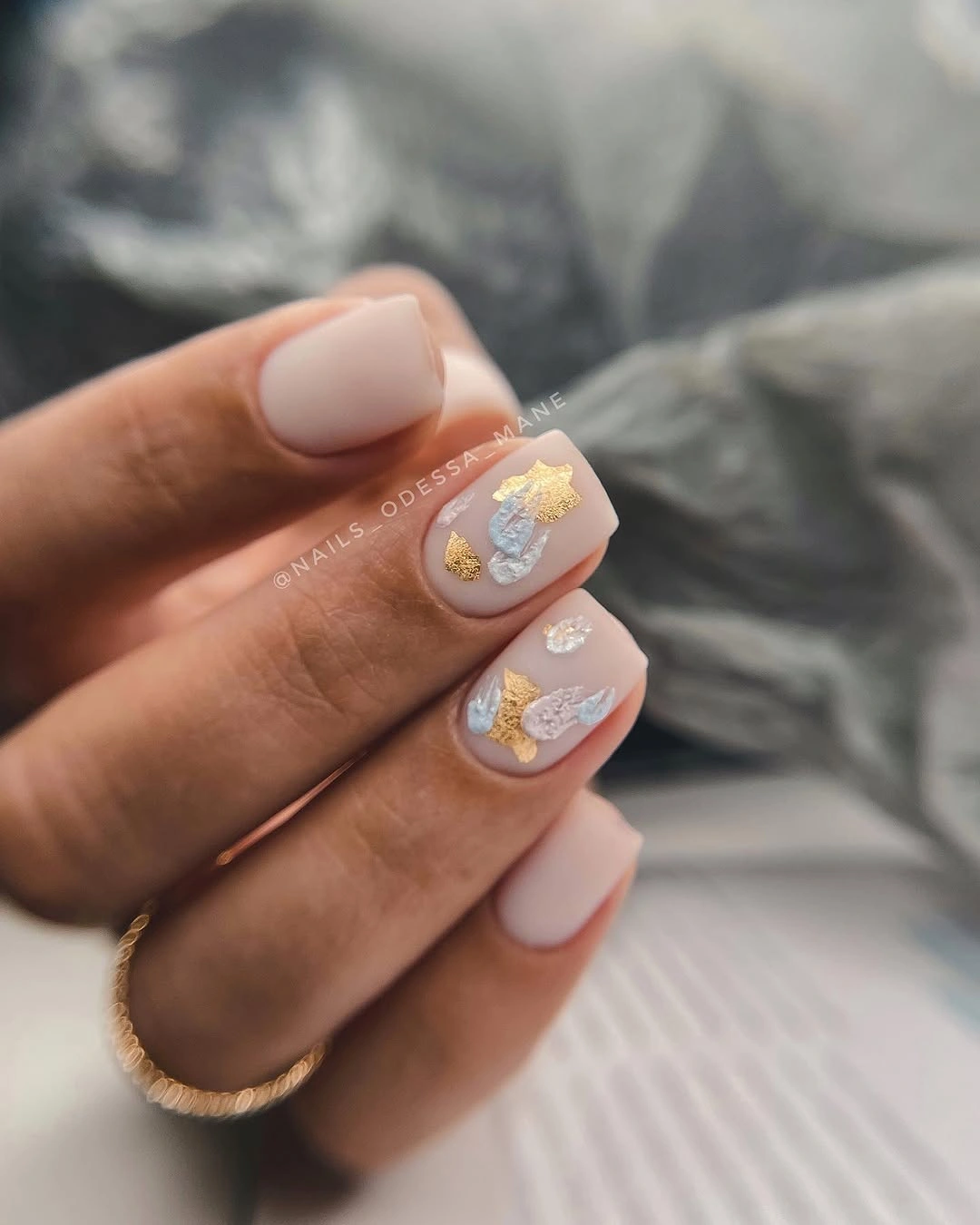
The key detail is the relationship between similar values. Pale flowers do not shout against the pink; they appear when the light catches their edges, which gives the design a quiet dimensional quality. That subtle contrast is why the set feels different from a dark floral manicure, where the outline would usually carry the entire motif.
Place the light flower on one nail and keep the gold detail tiny if you want the idea to remain occasion-neutral. A short oval will preserve the softness, while a rounded square will make the accent look more graphic. The limitation is contrast: if the base and flower become too close in tone, the detail may disappear, so a slightly darker outline or one warm point can help.
Pale Yellow With Olive Loop Details
Medium almond nails use pale yellow as a quiet background for olive and brown abstract loops. The marks are broad rather than hairline-thin, and the yellow remains visible around them, giving the design a muted graphic quality. One darker accent tip adds weight, but the palette stays soft enough to avoid looking neon.
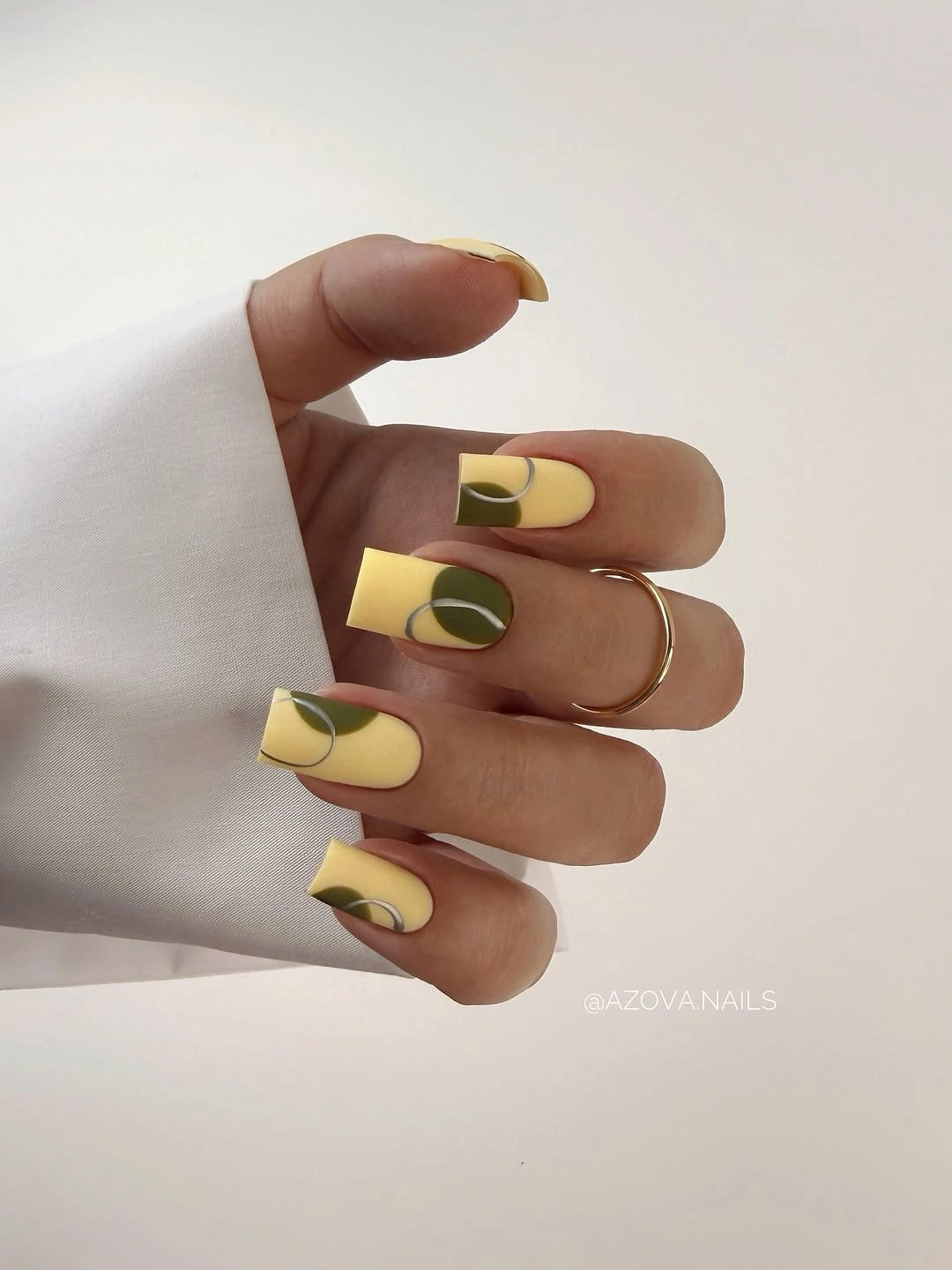
The success of this manicure rests on saturation control. Pale yellow brings light, olive lowers the brightness, and brown gives the curved marks enough definition to be seen. Because the loops are broad, they remain legible as a shape instead of dissolving into decoration, which makes the idea more adaptable than a set built from many tiny lines.
Use one looped accent nail and let the others stay pale yellow or olive if you want less visual variety. A shorter oval can carry the same contrast, but the curves should become simpler and wider. The tradeoff is that the muted palette may look understated in low light, so this is a choice for considered color relationships rather than instant high-impact sparkle.
Botanical Layers On A Light Ground
Long square nails turn a pale base into a small botanical collage. Yellow, green, and brown leaf-like shapes overlap across several nails, with reflective warm details adding points of light. The design feels full because the motifs are layered, yet the light background prevents the colors from becoming as heavy as they would on black or dark brown.
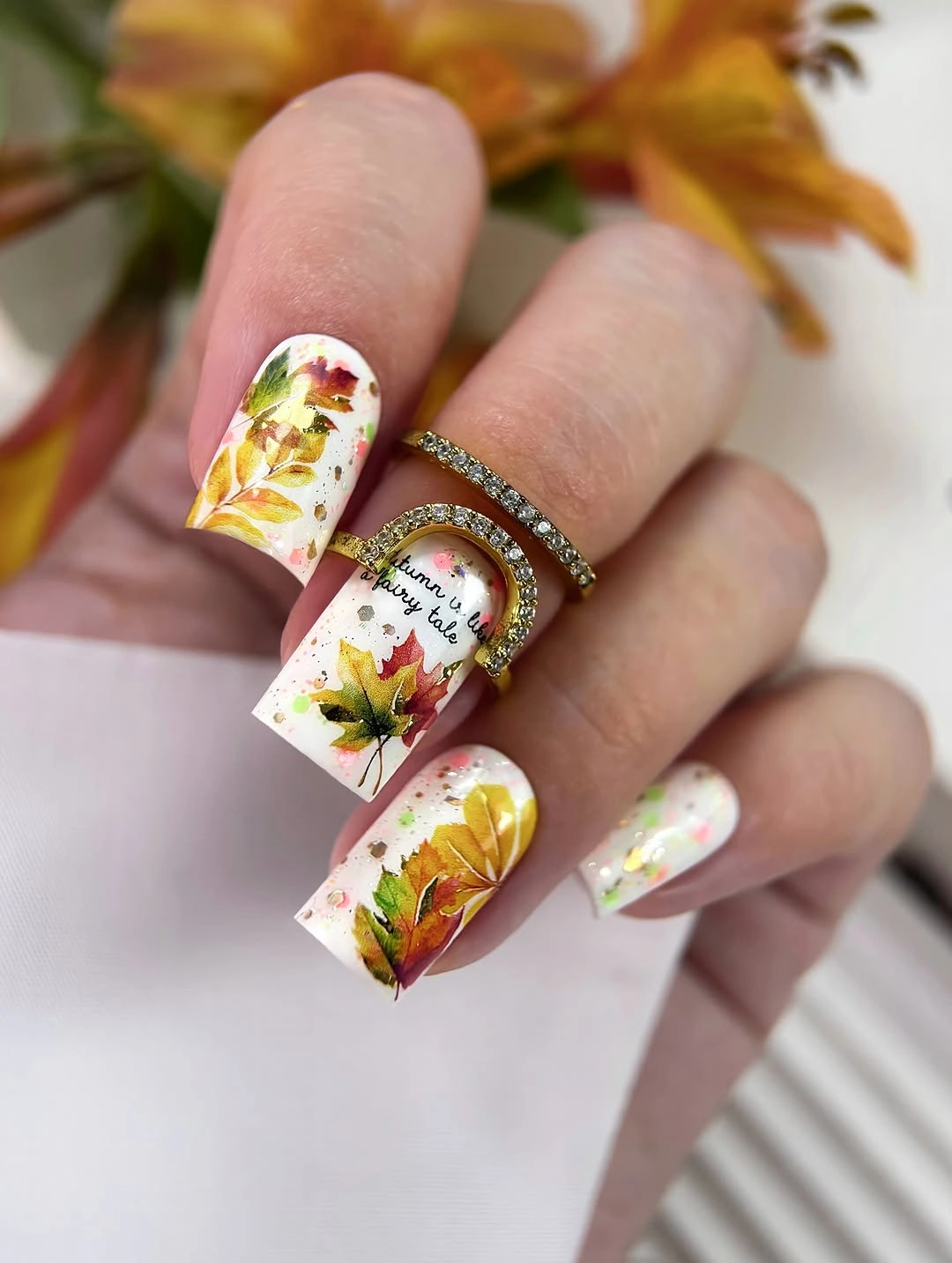
The smallest consequential feature is the amount of space left between the clusters. The leaves are detailed, but they do not cover every millimeter, so the eye can separate one shape from another and still recognize the pale nail underneath. The long square outline also gives the collage a stable frame, keeping the composition from feeling too loose.
For a shorter shape, choose one larger leaf cluster and remove the smallest supporting marks. Repeat the yellow-green palette on plain nails so the set still feels connected, even with less detail. The limitation is density: copying every layer onto a small surface would blur the focal shapes, so the best adjustment is subtraction rather than simply changing the colors.
Translucent Orange With Dark Branch Lines
Medium almond nails use a warm orange base that looks partly transparent, then add dark branch and leaf-like lines over the surface. The orange behaves like a stained warm ground, while the black marks give the manicure a clear direction. Because the color is not fully opaque-looking, the result feels lighter than a solid orange set with the same seasonal temperature.
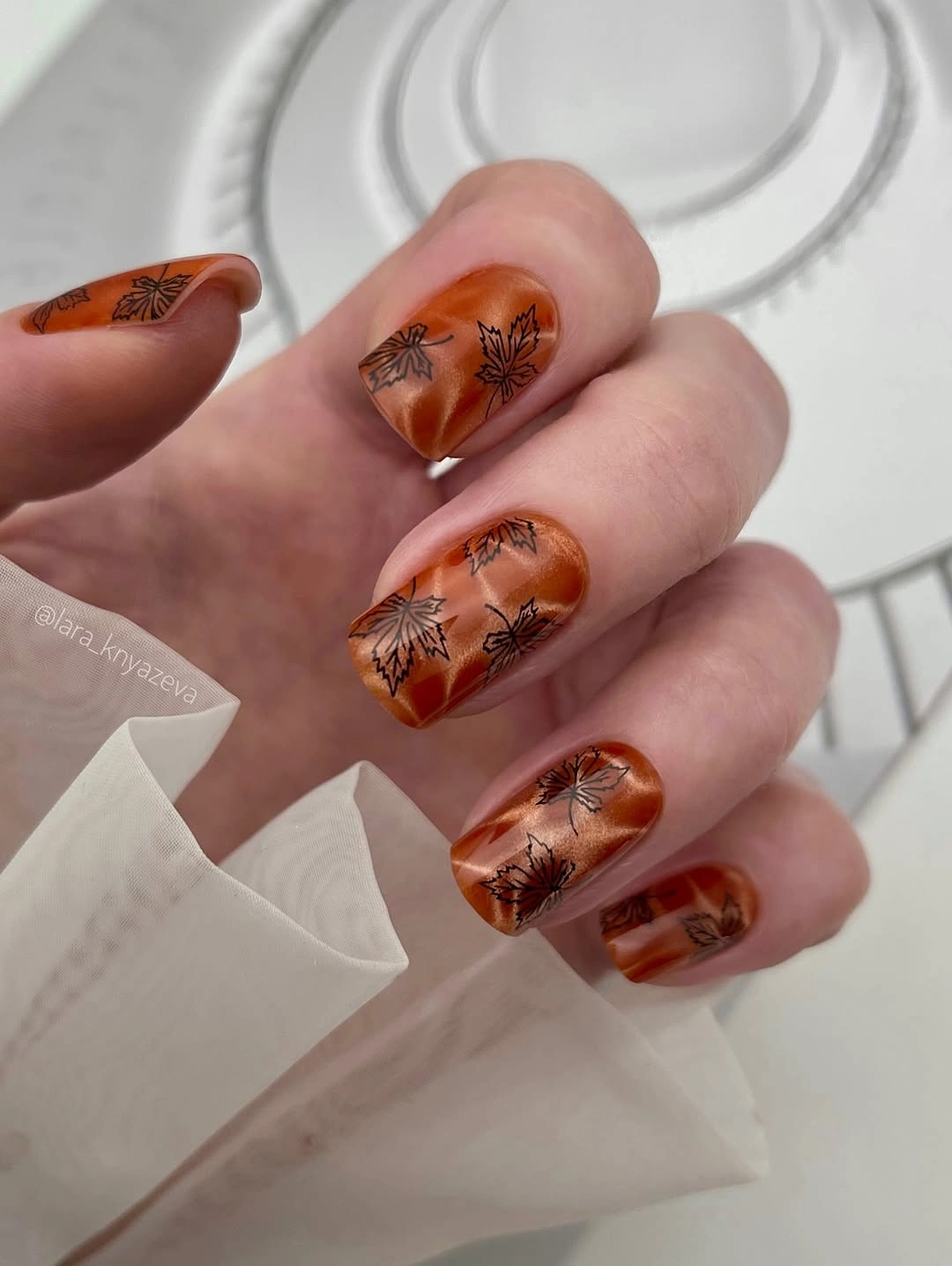
The line placement creates the main rhythm. Dark branches travel through the orange rather than sitting only at the edge, so the eye moves across the nail and discovers the warm color in the spaces between. That structure keeps the design from becoming a collection of isolated dots and gives the transparent-looking base a reason to remain visible.
On short nails, use one broad branch on an accent finger and keep the orange plain elsewhere. The base will still carry the seasonal warmth, while fewer lines will protect legibility and reduce the risk of a cramped composition. Do not add another bright color unless necessary, since the strength of this direction is the contrast between a warm field and dark, restrained drawing.
Orange Focal Nail With Deep Green Support
This long stiletto set uses one bright orange nail to lead the eye through darker green and black neighbors. Additional warm details appear as narrow graphic marks, but the solid orange surface remains the clearest focal point. The pointed silhouette adds drama, yet the color hierarchy is what makes the mixed manicure feel organized.
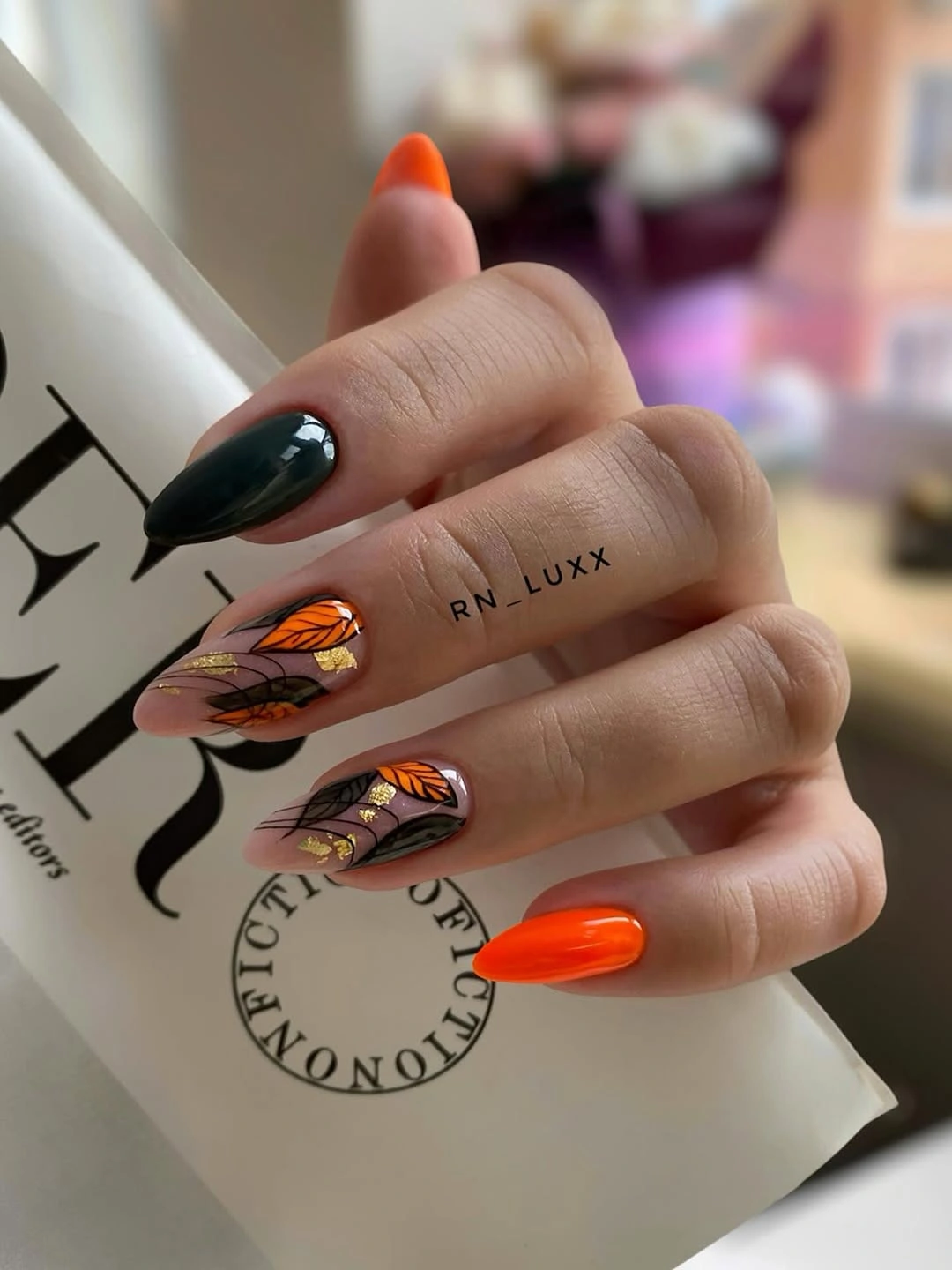
The orange works because it is not repeated at full strength on every nail. Deep green and black create a quiet frame, allowing the saturated accent to feel intentional rather than loud for its own sake. The viewer can read the hand in one step: dark support, bright center, then smaller lines that echo the warm focal color.
Keep the orange on one accent nail and move the rest to medium almond if you want a less theatrical version. A single black or green line can repeat the direction without adding more color. The limitation is that the long stiletto tips are part of the original visual force, so shortening them will make the result more wearable but less sharply graphic.
Red Orange And Monochrome Graphic Contrast
Short rounded nails combine a glossy red-orange solid, black-white graphic linework, and one orange-black striped accent. The design is lively because each nail has a different visual task, yet the short shape keeps the set from becoming too elaborate. The hottest color gets immediate attention, while the monochrome marks provide a cooler pause between warm accents.
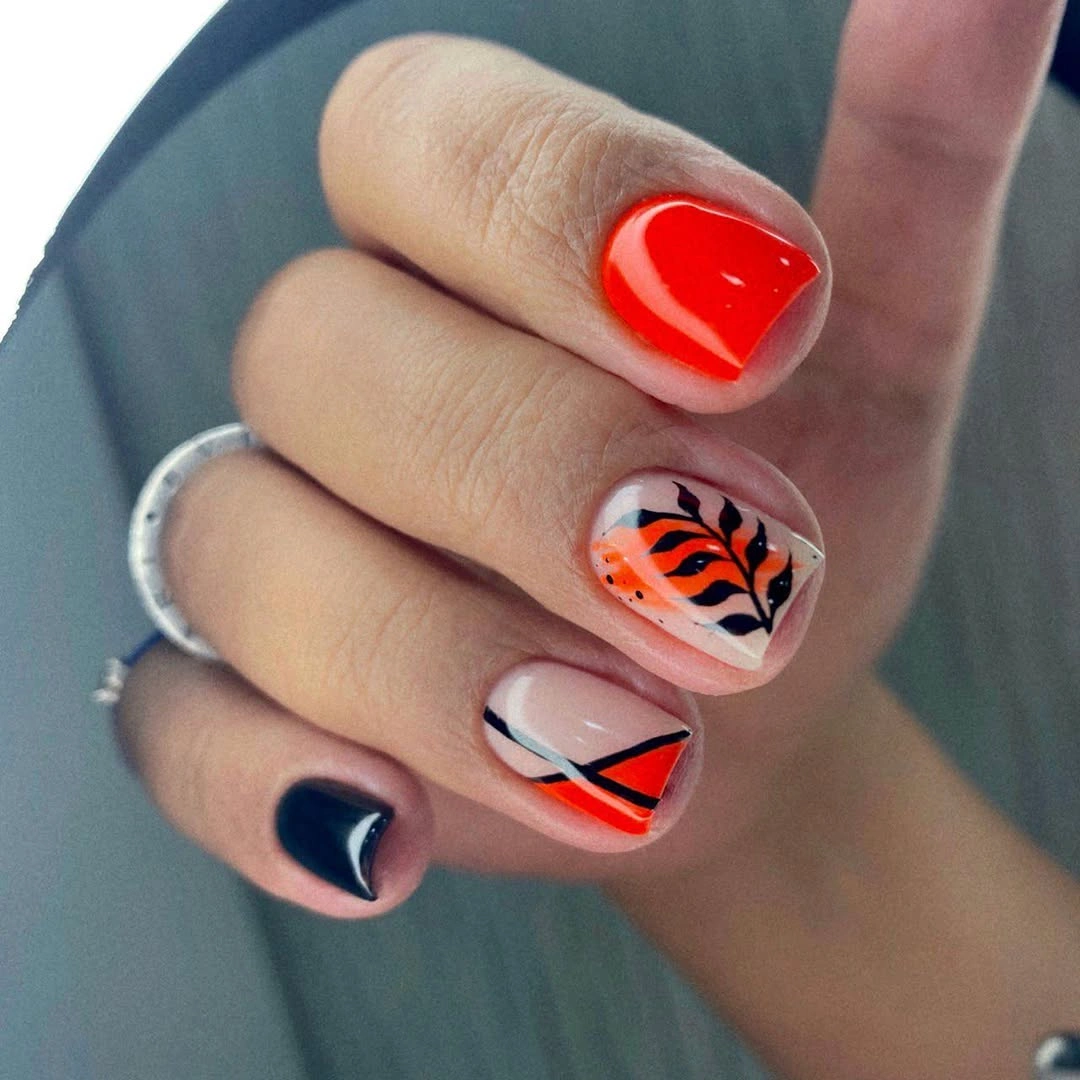
The most important detail is the editing of the pattern. Stripes appear on one nail, linework on another, and the solid red-orange surface carries the visual weight elsewhere. That distribution lets the hand feel varied without asking the eye to decode the same motif repeatedly, which is particularly valuable when the available nail surface is limited.
For an easier adaptation, choose either the striped accent or the black-white linework and remove the other. A short square can hold broader marks, while a rounded shape will make the warm color feel softer. If one detail deserves to lead, the editing principle behind fall nails with accent nail is useful: one clear focal point usually improves balance and maintenance.
White Nails With One Zebra-Like Accent
Long square white nails stay almost completely solid, then one dark striped accent changes the tone of the hand. The clean white surfaces create a strong blank field, so the narrow black-and-white pattern is immediately visible without needing bright seasonal color. The design is proof that fall nail art can come from contrast and restraint rather than a literal leaf or pumpkin.
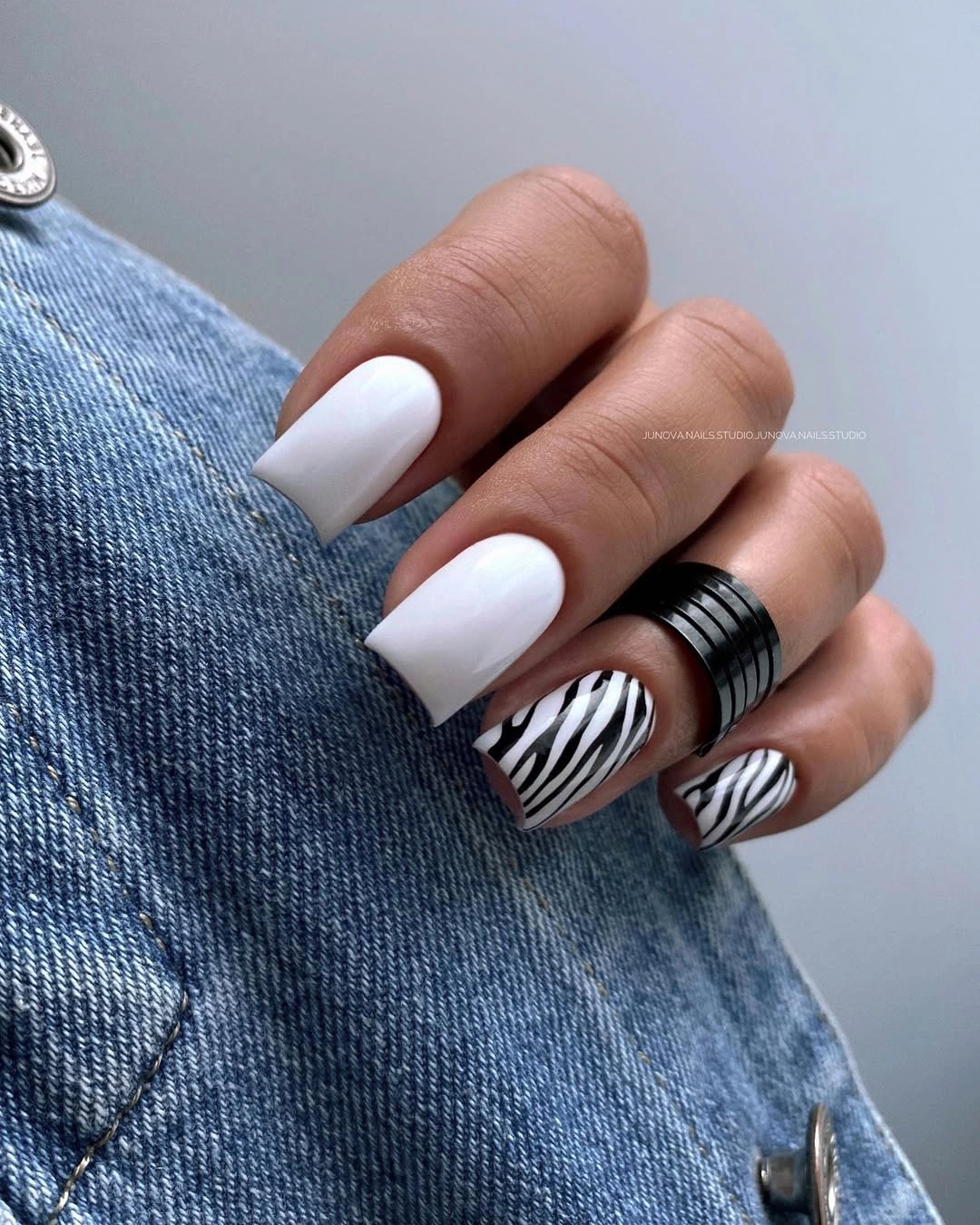
The single accent has disproportionate visual weight because the surrounding nails are so quiet. It gives the eye a focal point, then the plain white nails provide relief and repetition. The long square shape also makes the contrast feel crisp, though the same idea would still work on a shorter nail if the stripes were made wider and fewer.
Use a deep brown stripe instead of black if you want a warmer seasonal connection, or keep the pattern on one hand only. A short rounded square will make the set more casual while preserving the one-accent logic. The limitation is that white reveals edge wear clearly, so the design rewards neat upkeep and a willingness to refresh the solid base when it loses its clean contrast.
Short Mismatched Nails With Miniature Art
The final set combines short square orange, gray, white, and small illustrated accent nails. A warm solid color anchors the hand, gray and white create pauses, and tiny autumn marks add personality without covering every surface. The important detail is not any single illustration but the proportion between plain nails and decorated ones.
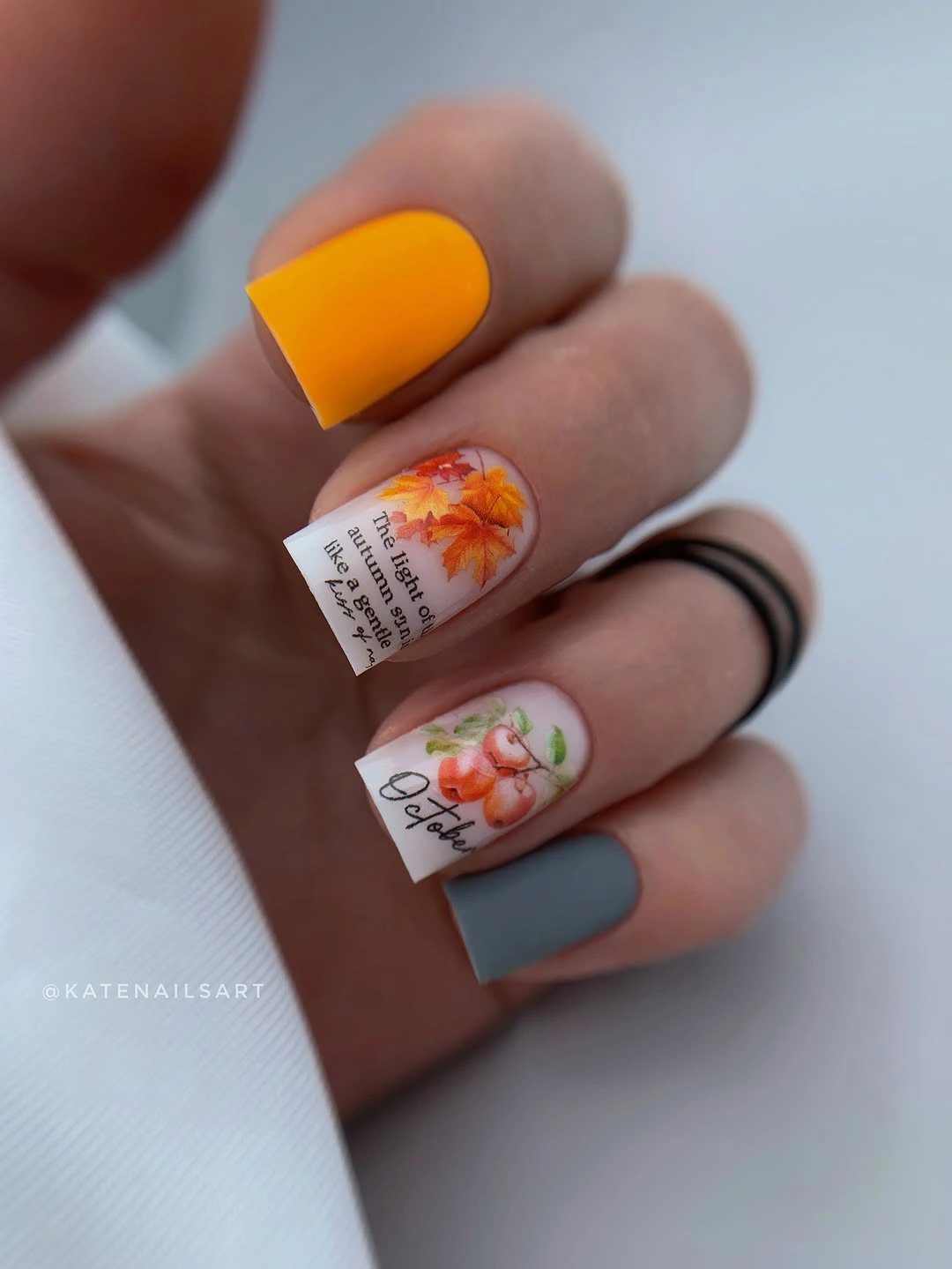
The mismatched arrangement works because the solid nails do most of the visual work. Orange supplies warmth, gray lowers the intensity, and white opens space for the small marks to remain readable. That sequence creates a practical rhythm for short nails, where too many fine details would compete with the shape and make the hand feel busier than intended.
Choose one warm solid, one neutral, and one illustrated accent if you want a cleaner version. Keep the tiny text-like or decorative marks suggestive rather than trying to reproduce every line, since the main value lies in the edited mix. The tradeoff is that a simplified set will lose some of the playful collage feeling, but it will gain clarity and easier day-to-day upkeep.