A small repeated mark can organize an entire manicure more effectively than a larger decoration. A dot changes character according to the space around it: held near an edge it reads as a crisp border, while scattered across a visible base it sets a steadier rhythm. The polka dot nails trend 2027 feels current not because the motif is new, but because its scale and placement can shift from barely-there detail to a deliberate point of contrast.
Start with the amount of negative space you want to preserve, then decide whether dots should support a tip, interrupt one accent nail, or carry the main pattern. Keeping one decision dominant is what prevents several colors, curved edges, and small details from competing for the same focal point. A more compact shape usually benefits from a finer scale, while a longer nail can hold a broader edge without making the design feel crowded.
Small Color Notes Break Up Black and White Dots
Long almond nails pair a translucent-looking pink base with black-and-white polka dots, yet the small yellow details and single lime-green accent are what keep the pattern from settling into a familiar monochrome formula. The dots appear in more than one placement, with some clustered near tips and others covering fuller areas. That variety gives the manicure a playful rhythm while the pale base leaves enough breathing room around every high-contrast mark.
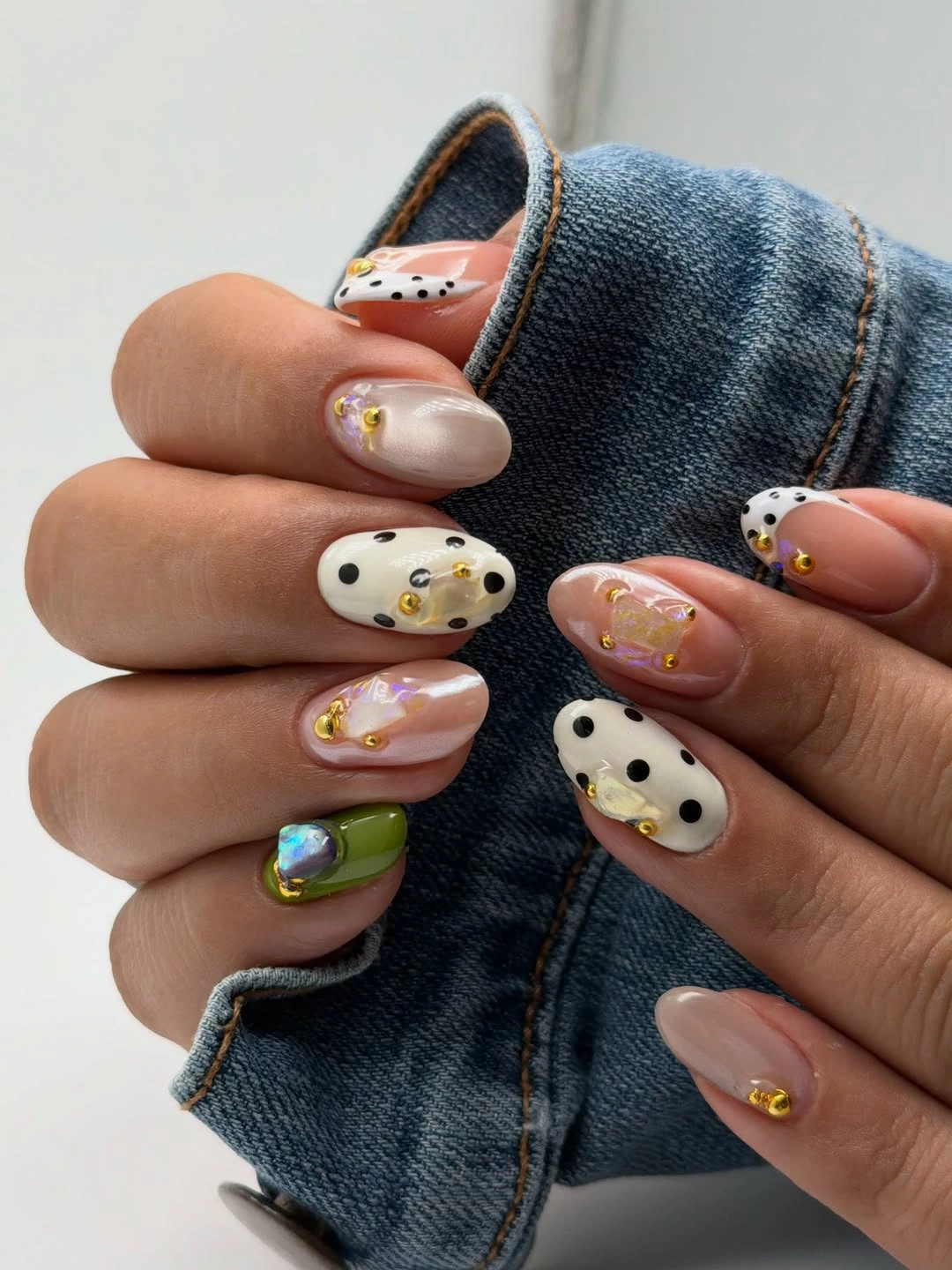
The colored details work because they remain small and selective rather than turning every nail into a different color block. Yellow is used as a tiny point of light, while the green accent creates a more noticeable pause among the black-and-white dots. If you want a calmer interpretation, remove the green nail and retain only one yellow detail near a dotted tip. The manicure would still feel lively, but the neutral pattern would become the clearest visual message.
With several motif placements in play, keeping the base pink and glossy-looking is a sensible grounding choice. A darker base would make the tiny yellow and green elements harder to notice and could turn the full-dot nails too dense. The tradeoff is that the design needs careful editing as it grows out visually, because dots near the cuticle would make the base area feel less open. Preserve the clear pink space around most nails if you want the mixed pattern to stay light rather than crowded.
Black Dots Stay Light Along a Soft Tip
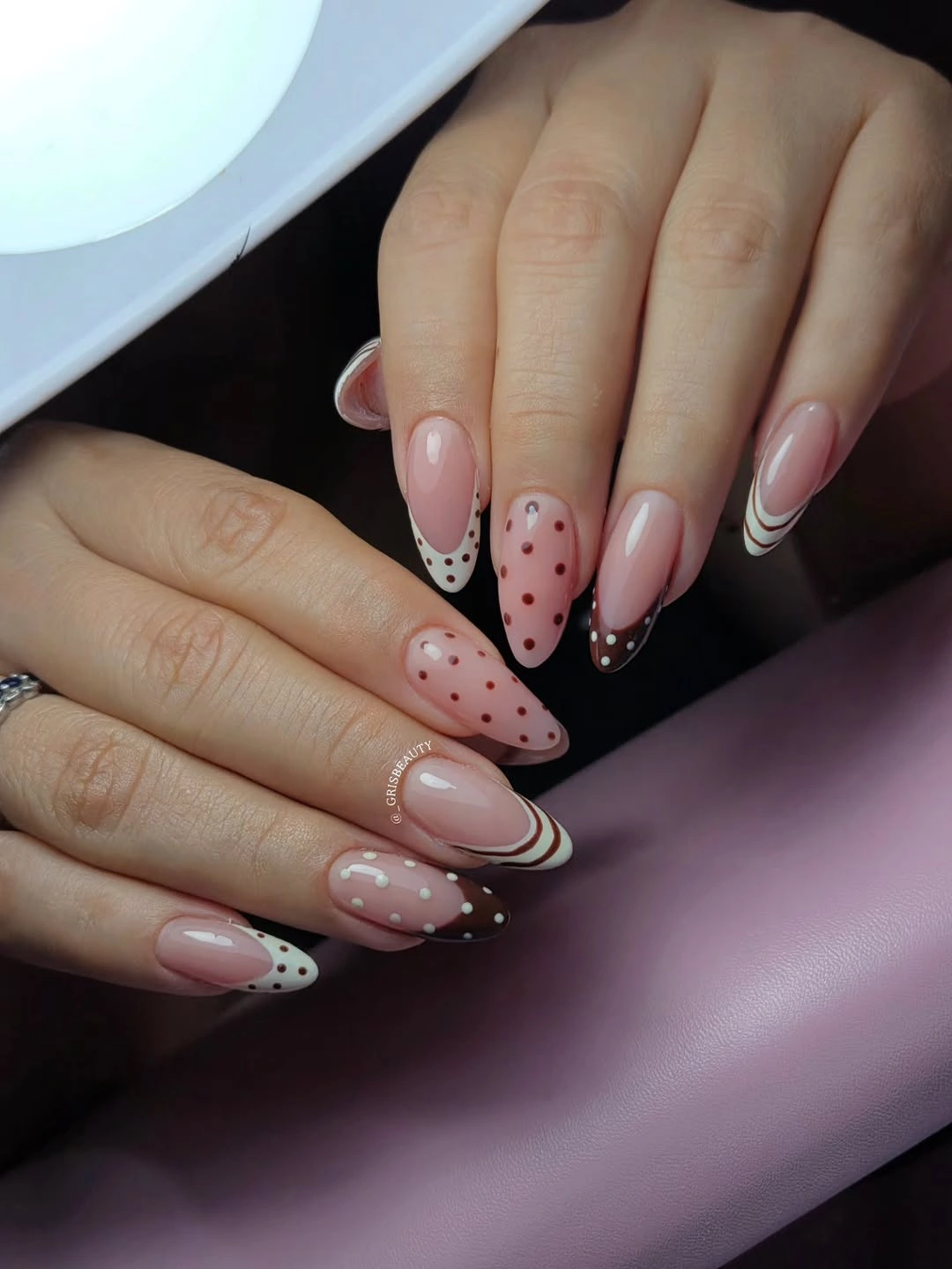
Pale pink almond nails use white or very light French-style edges as a narrow field for black dots, leaving most of each nail quiet and glossy-looking. The spotted pattern is concentrated at the free edge, so it reads as a small graphic finish instead of an all-over print. A deeper mauve-toned tip on a selected nail adds subtle variation, but it does not disturb the soft nude-to-white progression that holds the set together.
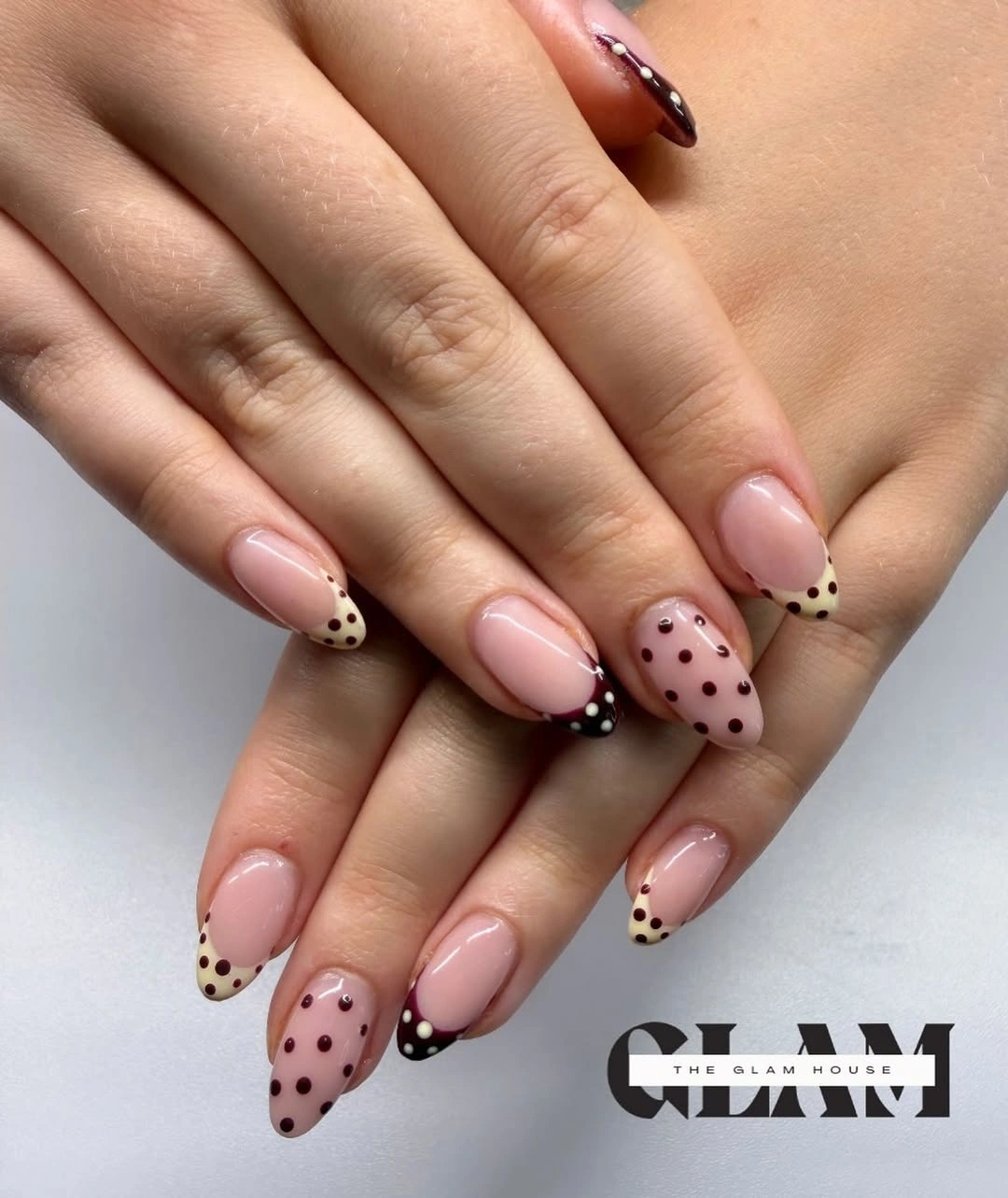
Tip-only dots are useful when you want a familiar motif without giving up negative space. The pink base remains visible from cuticle to most of the nail length, which makes the black dots look deliberate and keeps the almond shape readable. For a softer contrast, exchange black dots for deep brown or muted burgundy while keeping the pale edge. You would retain the same placement logic, though the finish would feel less graphic against the light tip.
The strongest detail here is not the number of dots but the narrow boundary that contains them. A wider white tip would allow larger dots, but it could overpower the gentle pink base and make the manicure feel more decorative. Keep the free edge slim if the goal is an everyday-friendly version, then reserve the mauve accent for one or two nails. That small shift in depth gives the set character without requiring a second pattern or a more elaborate central motif.
Red Dots Pause for One Floral Accent
Small red dots animate the pale pink almond nails, while one accent nail introduces a red flower-like detail with green leaves. The floral element is limited to a single nail, so it changes the rhythm without turning the entire manicure into a botanical design. Red remains the main contrast across the set, appearing in tiny, evenly spaced marks that allow the glossy-looking pink background to stay visible and calm.
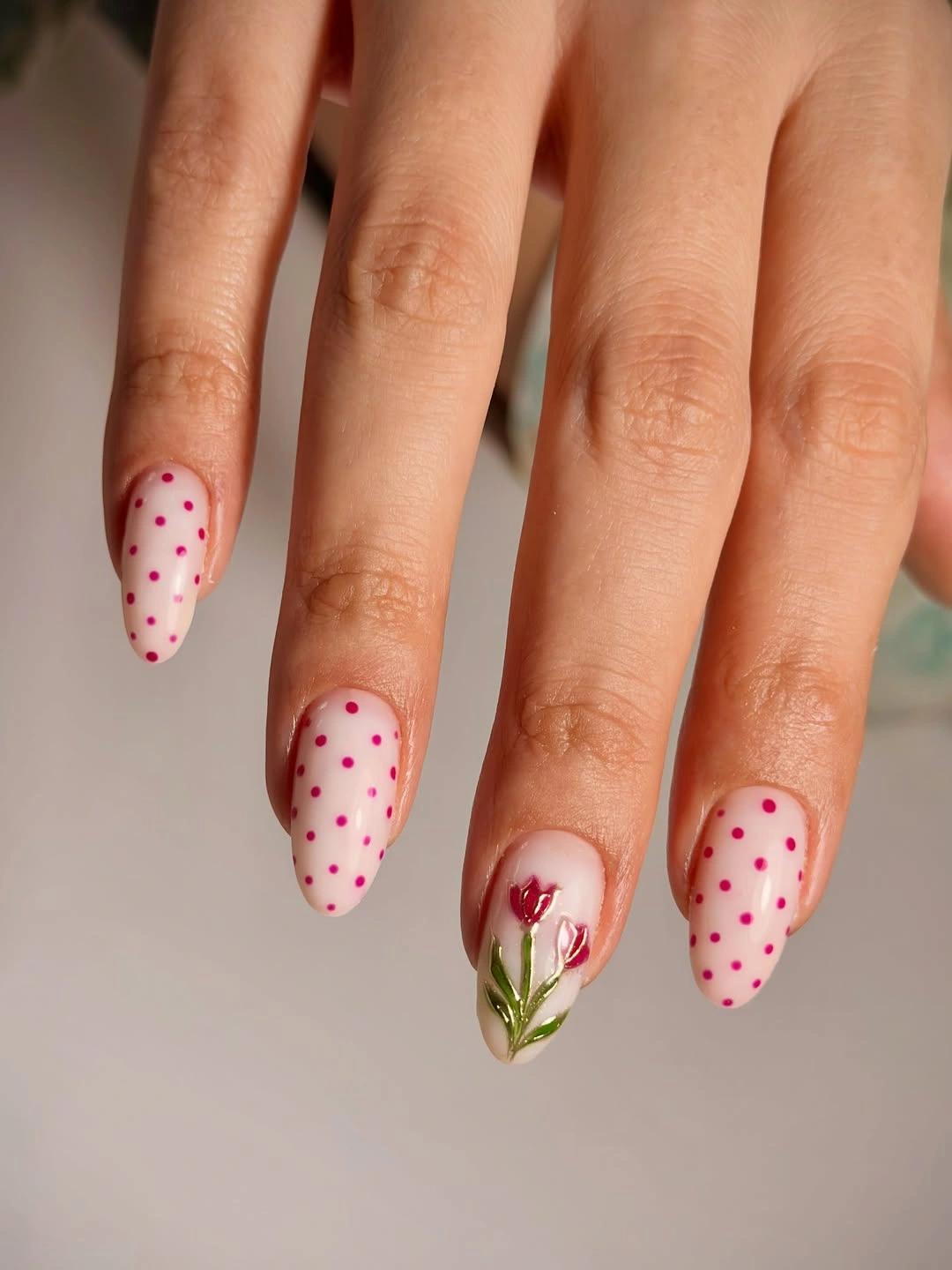
Placing the flower-like motif apart from the dotted tips is what makes the design feel organized. The dots create repetition, then the larger accent gives the eye one place to rest and notice a different shape. If you prefer less decoration, omit the green leaves and keep a red petal detail on one pale nail. That adjustment would make the color story even tighter while preserving the useful contrast between small repeated dots and one broader curved motif.
Red dots can read sharper than white or pastel dots, so keeping their scale small is important on a light base. A large red circle on every nail would likely overwhelm the almond shape, whereas the current placement works like a fine trim around the tips. This is a good option when you want a polka-dot manicure with one extra detail but do not want several competing accents. Let the floral nail stay isolated, and allow the other nails to support it through repetition rather than duplication.
Dots and Flowers Get Separate Space
These long pale pink nails divide their decorative work carefully: white tips with black dots appear on selected nails, while bright pink flower-like motifs occupy others. A small yellow detail adds another playful note, but it remains contained so the pink, black, and white structure still leads. That separation is the reason the manicure stays legible even with several motifs – no single nail is asked to carry every color, dot, petal, and edge at once.
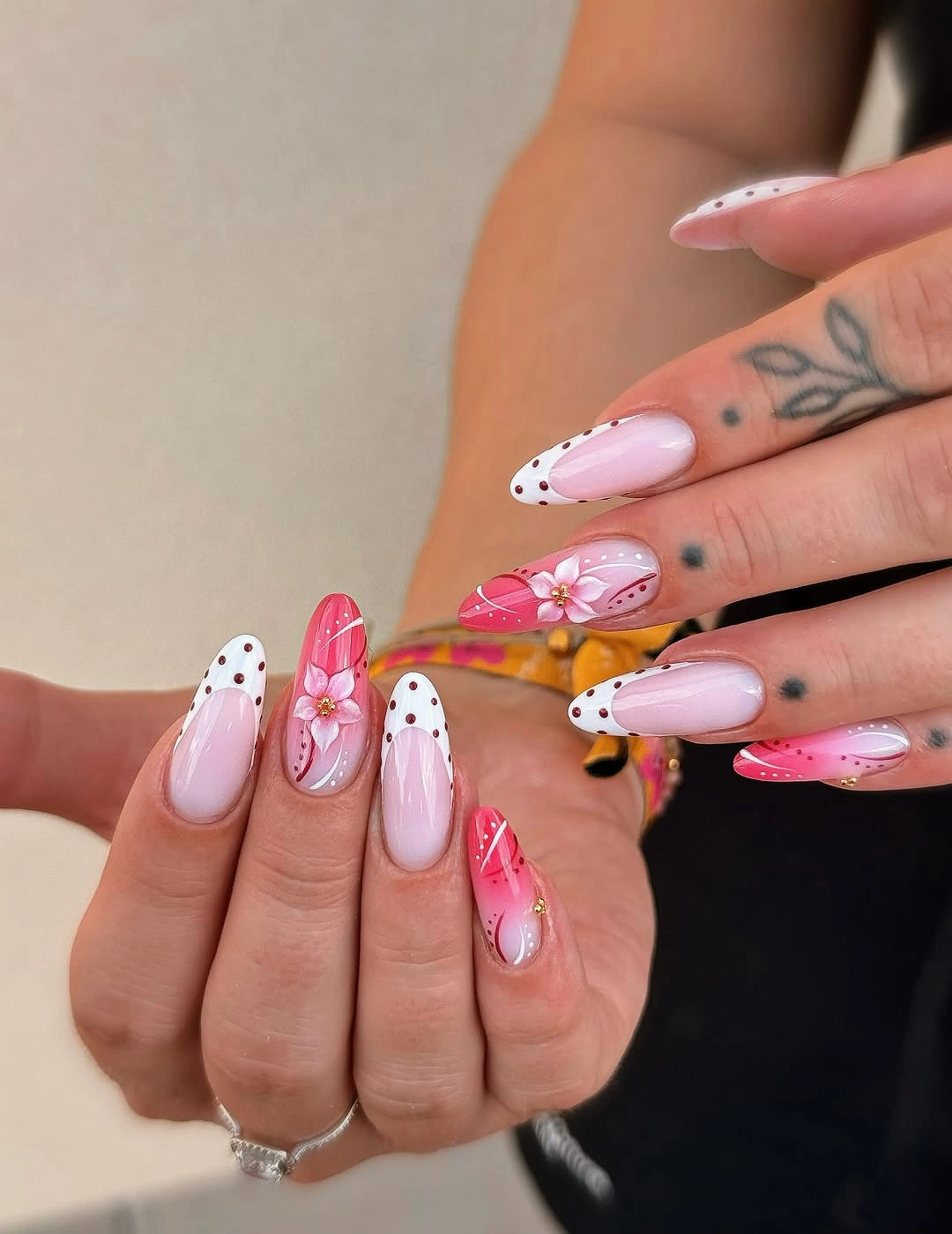
When combining dots and flowers, assign each motif a specific nail or part of the nail instead of stacking them in the same small space. The dotted tips create a simple border, while the flower accents take on a larger, more curved role. For a shorter version, keep only one flower-like nail and place the dots on two tips rather than all of them. The design would remain recognizable, but the reduced length would have more room to look intentional rather than overly filled.
The yellow accent is effective because it is not repeated everywhere; it acts like a tiny visual surprise among the pink and black details. Adding yellow to every flower would flatten the hierarchy and make the manicure more busy than necessary. A clear pale base is doing quiet work here as well, giving the eye a pause between motifs and helping the pink floral pieces look distinct. Preserve that open base if you want the varied elements to read as an edited collection rather than a crowded cluster.
Red Stripes and Dots Share One Tip Palette
Pale pink nails use white tip areas as a stage for fine red stripes, red dots, and a few curved red edges. The pattern varies from nail to nail, but the repeated red keeps every version in the same family and prevents the set from feeling random. Because the lines are thin and the dots are small, the white tips remain visible enough to make the manicure feel crisp rather than dominated by one solid red block.
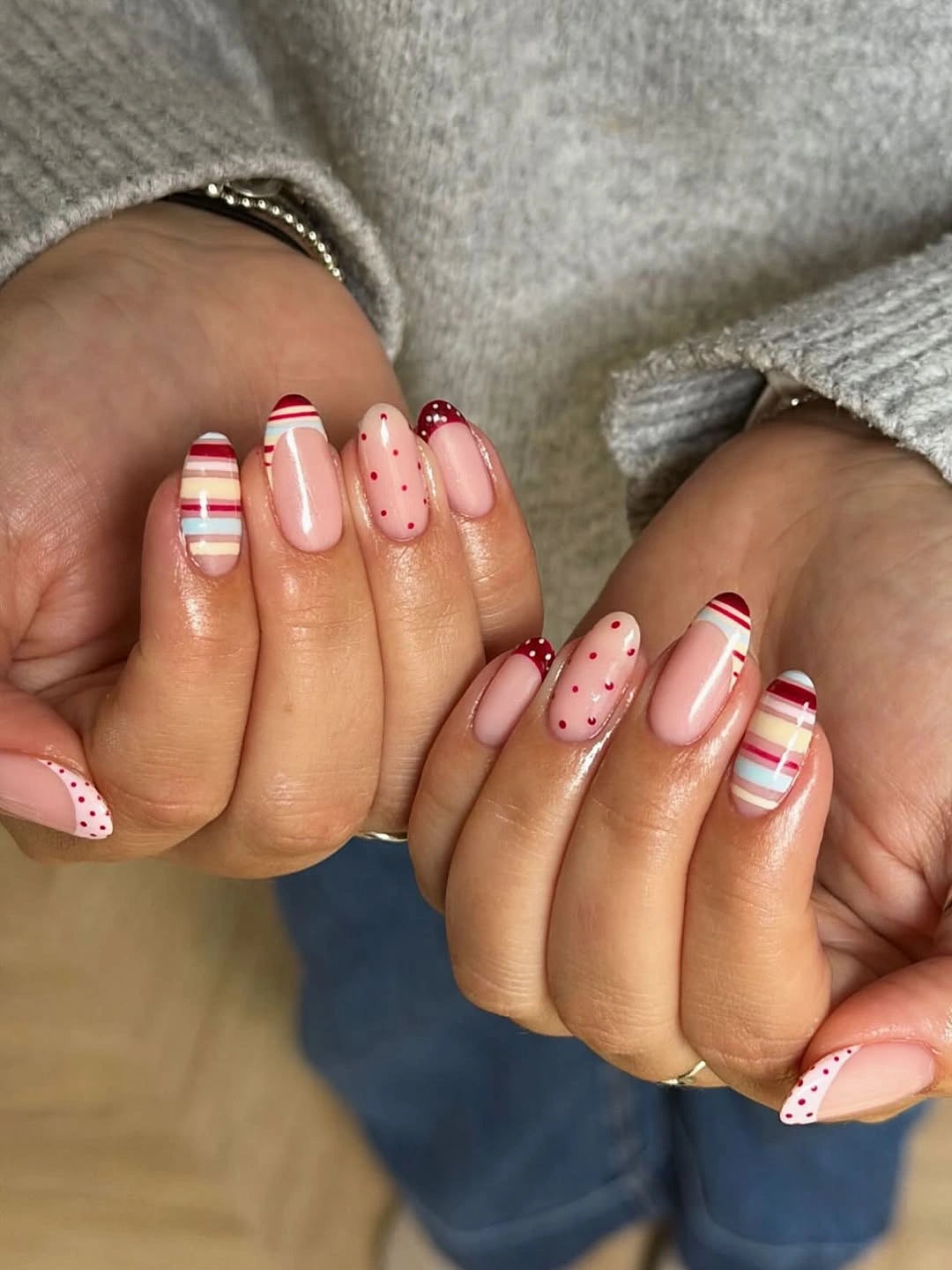
Using red as both linework and dot work is a smart way to create variation without adding more colors. The stripe changes direction and the dots soften the graphic edge, giving different nails their own role while retaining a shared visual language. If you want to simplify the idea, choose either striped tips or dotted tips and keep the red curve on only one accent nail. That will make the individual details easier to see, especially at a shorter length.
The main tradeoff is between a neat tip design and a more playful mixed-edge effect. Thin red stripes look especially clear when the tip remains narrow, while larger dots need slightly more white space around them. Do not widen both elements at once, or the pink base will lose the airy quality that makes the red feel fresh. The best part of this set is its controlled repetition: red appears often enough to unify the nails, but every use of it has a slightly different job.
Square Tips Give Dots a Graphic Frame
Long square nails pair a soft pink base with white tips filled by black dots and fine dark outlines. The squared edge changes the mood of the motif, making the spotted pattern feel more architectural and direct than it would on a rounded silhouette. Dots remain near the tips, leaving the center of each nail pale and open, while the small outline details add definition without turning the French-style border into a solid dark band.
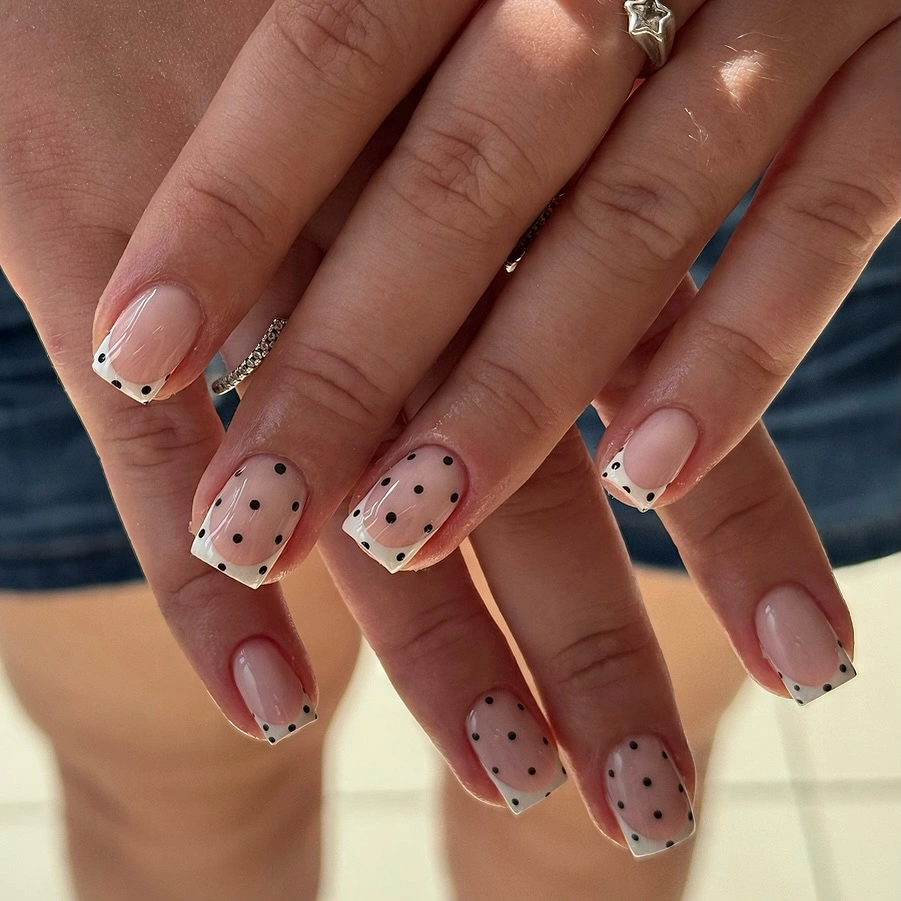
Square tips naturally create a broader horizontal edge, so they can support dots that would look crowded on a narrow almond point. The important thing is to keep the dot scale consistent and avoid letting them drift too far toward the cuticle. For a softer take, use a cream tip with chocolate-brown dots rather than stark black. The same placement would remain graphic, but the contrast would sit closer to the pink base and feel less pronounced.
Fine dark lines are helpful here because they make the tip shape readable from a distance, yet they should stay secondary to the dots. If the outline became too heavy, the manicure would shift toward a bold black French design and the spotted detail could disappear. For extra visual inspiration about intentional small details, the site’s October nails design article is a relevant companion. This set shows that nail shape can be as important as color when deciding how graphic a dot pattern will appear.
Sky Blue Accents Refresh Dotted French Tips
Most of the pale pink almond nails use black-and-white dotted tips, but two introduce soft sky-blue curved sections that change the mood without abandoning the original pattern. Blue is kept to selected nails rather than repeated across the whole hand, which allows the neutral dots to remain the foundation. The cool accent makes the black and white feel less expected, while the pink base continues to provide a warm, quiet area around the tip details.
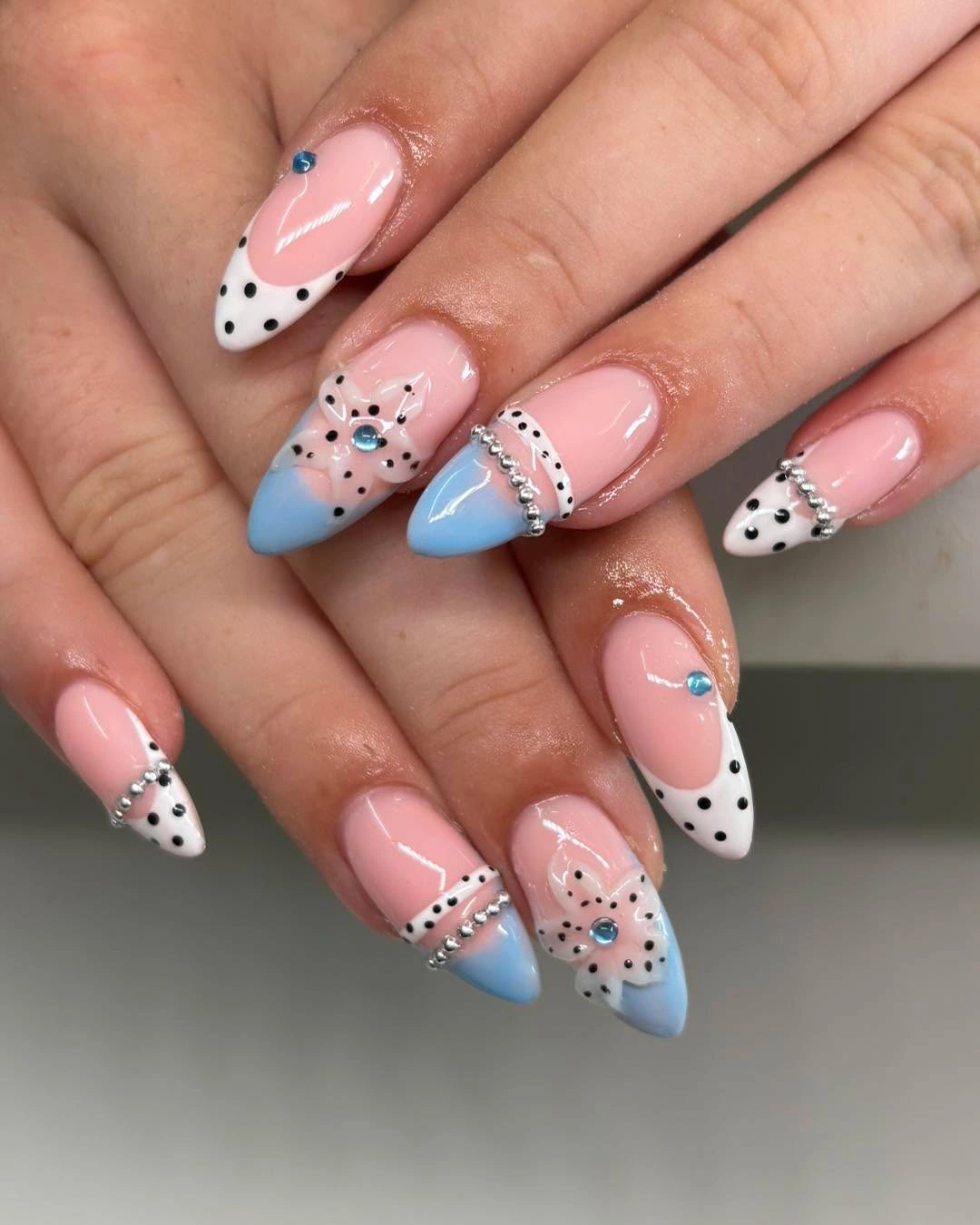
A pair of blue accents works because the eye can register them as a deliberate variation, not as a new color scheme competing with the dots. If blue appeared on every tip, the manicure would become more color-led and the black-and-white pattern would lose its clean contrast. You could try pale lavender or muted mint in the same two-nail placement for a different temperature. Keep the accent color light enough that it supports the dots rather than covering their crisp edge.
The benefit of a limited color change is that it gives the design freshness without demanding a more complicated motif. Blue sits in a smooth curved area, while dots stay in their familiar small, repeated role, so the different elements do not compete for the same space. A shorter nail could use the same concept with blue on one thumb or ring finger only. Reduce the number of dots slightly in that version, since compact tips have less room to show both the color block and the pattern clearly.
Mini Dots Suit a Short French Edge
Shorter almond nails use a pale nude base, small white tips, and very fine black dots concentrated along the free edge. The compact length changes the scale of the motif completely: instead of looking like a pattern field, the dots read as a delicate punctuation around the tip. The nude area remains wide enough to show the curve of each nail, making the contrast feel tidy and measured rather than dense or heavily decorated.
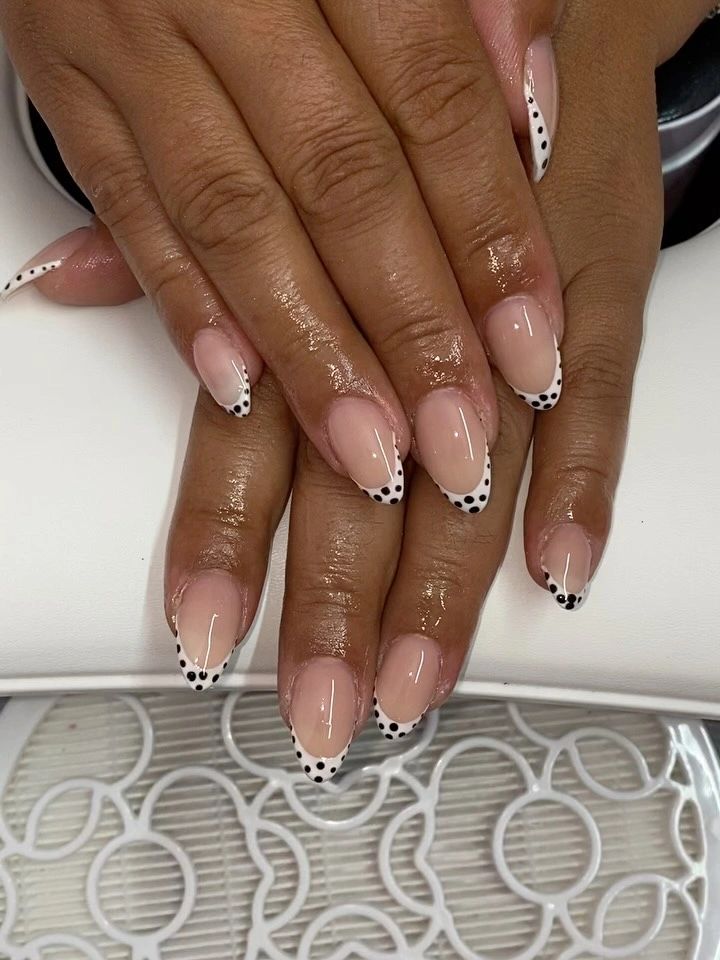
Small dots are the right choice for a short French edge because larger circles would quickly fill the available white space and blur the tip shape. Keep the pattern close to the outer edge if you want the manicure to remain low-maintenance in appearance as the base area becomes more visible. A soft brown dot could replace black for an even quieter finish, though black offers the clearest graphic result against white. The short length is not a limitation here; it is what makes the design feel so controlled.
The practical appeal lies in how little visual weight sits near the cuticle. Most of the detail is reserved for the tips, so the manicure keeps a clean center and does not rely on a complex accent nail to feel complete. If you enjoy a more neutral palette, use creamy white tips and charcoal dots rather than bright white and black. That tiny change will soften the contrast while preserving the same mini-dot rhythm. The key detail to preserve is scale, not the exact color combination.
A Narrow Dotted Border Keeps Nude Nails Open
Medium almond nails hold a soft nude-pink base under white curved tips with black dots gathered close to the edge. The dotted border is narrow, so the manicure has contrast without sacrificing the open central space that makes nude shades feel clean. Each dot appears as part of the tip line rather than as a separate motif floating across the nail, which gives the whole design a very contained, calm rhythm.
There is a useful balance between the width of the white tip and the size of the black dots. A slightly wider tip would allow more dots but could make the manicure feel heavier, especially on a medium length. For a softer option, reduce the dot count and let more white show at the edge. The design would become more minimal, but the curved French outline would still provide enough contrast to make the nude base look deliberate rather than bare.
Because the dot pattern stays close to the free edge, rings and neutral clothing will not compete with it visually. The manicure has one clear high-contrast zone and a large quiet zone, which is often easier to style than a full-coverage print. A tiny black line at the very edge could make the dots feel even more graphic, but it is not necessary. Preserve the narrow spotted border if you want a design that remains light, polished-looking, and clearly focused on shape as much as motif.
Black and White Dots Change Their Background
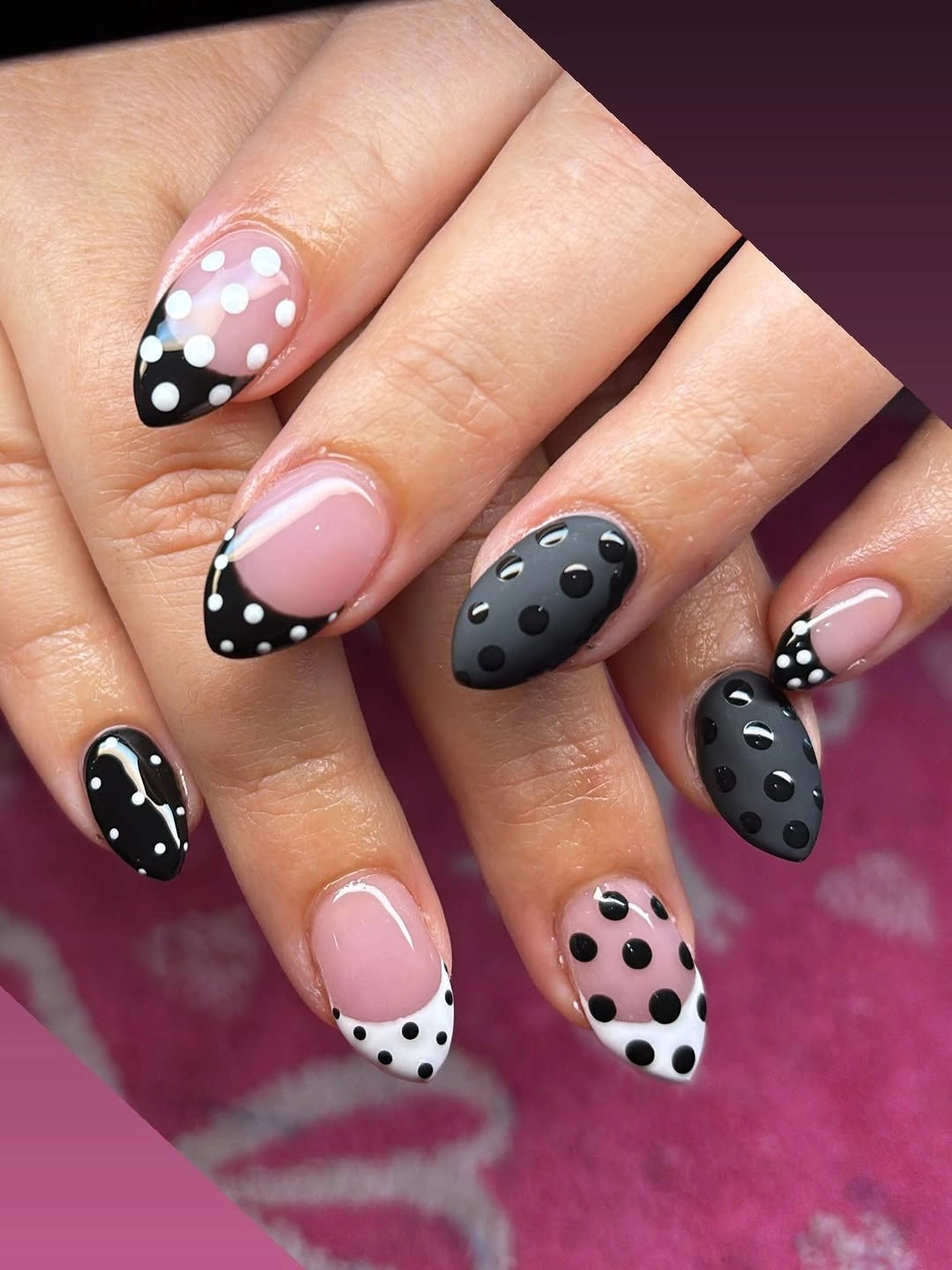
Pale pink nails alternate between white tips with black dots, black full nails with white dots, and a bold black curved accent near one tip. Switching the background color changes the character of the same circular motif: black dots on white feel crisp and classic, while white dots on black look denser and more graphic. The pink nails around them prevent the contrast from becoming too severe and give the eye a softer place to rest.
Using both black and white backgrounds is an effective way to make a two-color manicure feel varied without introducing a third accent shade. The key is to limit the black full nails so they remain focal points rather than taking over the set. If you want a less dramatic version, keep one black dotted nail and use white dotted tips on the rest. That adjustment keeps the visual idea intact while allowing the pink base to become more prominent again.
The bold curved black edge is important because it gives the palette one larger shape among many small dots. Without it, the design could feel like a collection of repeated circles with no hierarchy. On shorter nails, replace that broad curve with a half-moon accent at one tip so the dark area does not crowd the nail. The detail to protect is contrast in scale: small repeated dots need one controlled larger black element to keep the manicure visually dynamic.
Black Dots Connect a Maximal Mixed Palette
Nude pink, black, yellow, gray, and white appear across this mixed manicure, with dotted tips and graphic accents giving each nail a different treatment. The repeated black dots are the feature that keeps the set from becoming random, because they reappear even when the background shifts from pale pink to black or gray. One yellow graphic detail adds a brighter focal note, but it stays contained rather than taking over the overall color arrangement.
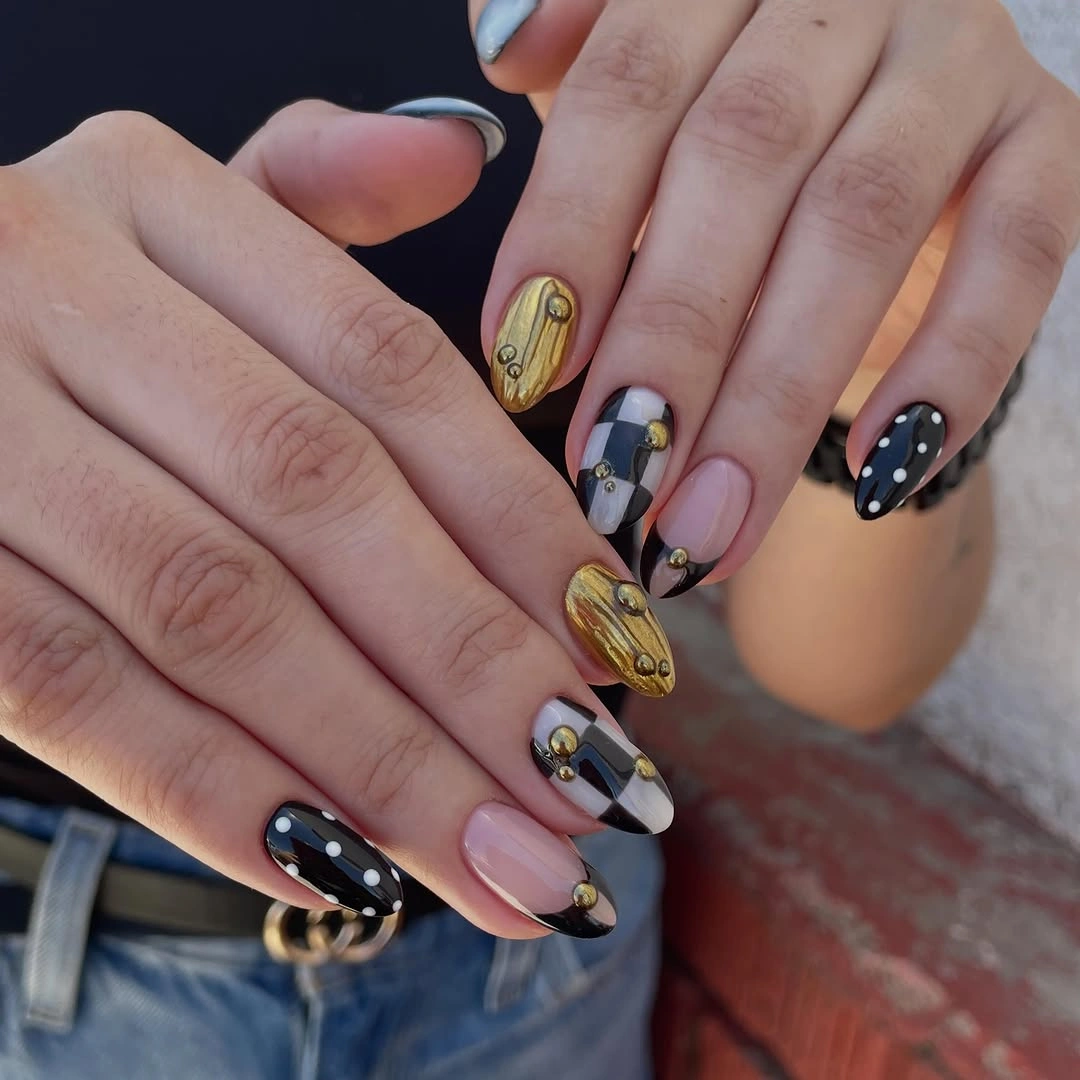
When a manicure uses several colors, one repeated motif is more helpful than trying to make every nail match exactly. Here, the dots act like a visual thread while the other nails explore different shapes and tones. For a more wearable variation, remove either the gray or yellow accent and retain the black-and-white dotted elements as the core. The design would still feel creative, but the reduced palette would make the individual shapes easier to notice at first glance.
There is an honest tradeoff with a maximal set: it offers more detail to look at, but it also asks for restraint in placement. Keep the most graphic nail isolated and let a few nude bases stay relatively simple, otherwise the dots lose their connecting role. A clear glossy-looking finish helps every color read separately, while a matte finish might make the small details less distinct. The goal is not to make every nail equally busy; it is to give each one a distinct role inside a coherent black-dot rhythm.
A Reversed Accent Changes Short Square Tips
Short square nails use soft nude bases and white tips with small black dots, but one nail reverses the contrast with a black curved edge carrying white dots. That single inversion changes the whole set because it gives the eye a darker focal point among otherwise light French-style borders. The compact length keeps each detail close to the edge, so the manicure remains neat even though it uses two opposite dot-background combinations.
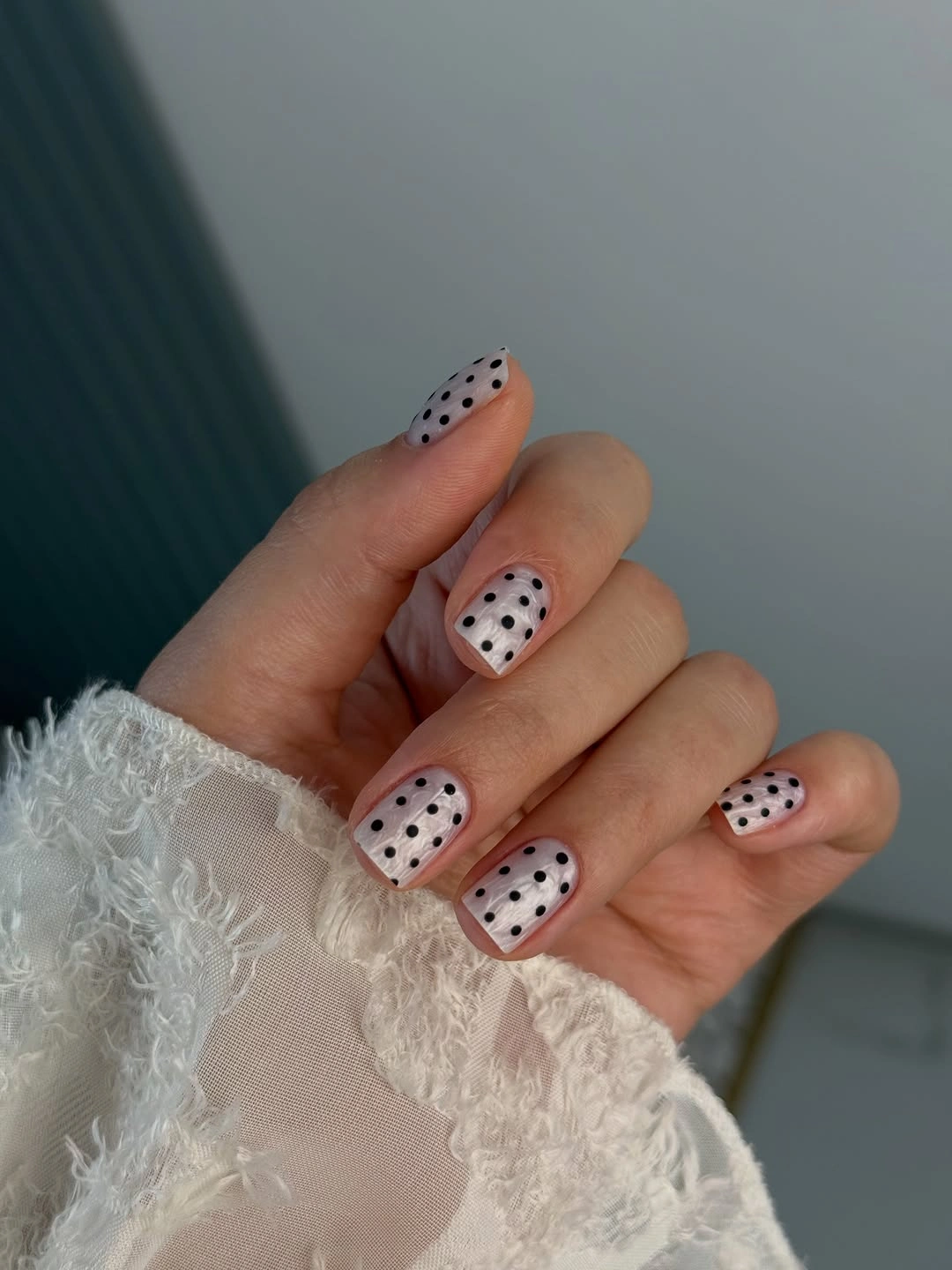
One reversed accent is enough to create variety on a short manicure. If more nails used black tips, the design would become heavier and the delicate white border on the others would lose its effect. You could use deep brown with cream dots instead of black and white for a lower-contrast version, but keep the reversal on a single nail. The point is not a new color palette; it is the small shift in positive and negative space that makes the dot motif feel more considered.
The white sleeve in the supporting view makes the black-and-white tips appear especially crisp, but the manicure itself still relies on the nude base for balance. A pinker base would make the look warmer, while a beige-neutral base would emphasize the graphic edge more strongly. Either choice can work if the dots stay compact and the black accent remains isolated. This design proves that short nails can carry a noticeable contrast when it is focused on one carefully placed detail rather than spread over every surface.
Fine Lines Add Drama Around Dotted Tips
Long pink nails combine white tips with black dots, fine white radiating lines, and a black-and-white flower-like accent. Each decorative element has a different scale: dots are small and repeated, linework is thin and directional, and the floral detail is broad enough to become a single focal point. That hierarchy prevents the set from feeling overloaded, even though it moves beyond a simple French-tip pattern into a more detailed visual story.
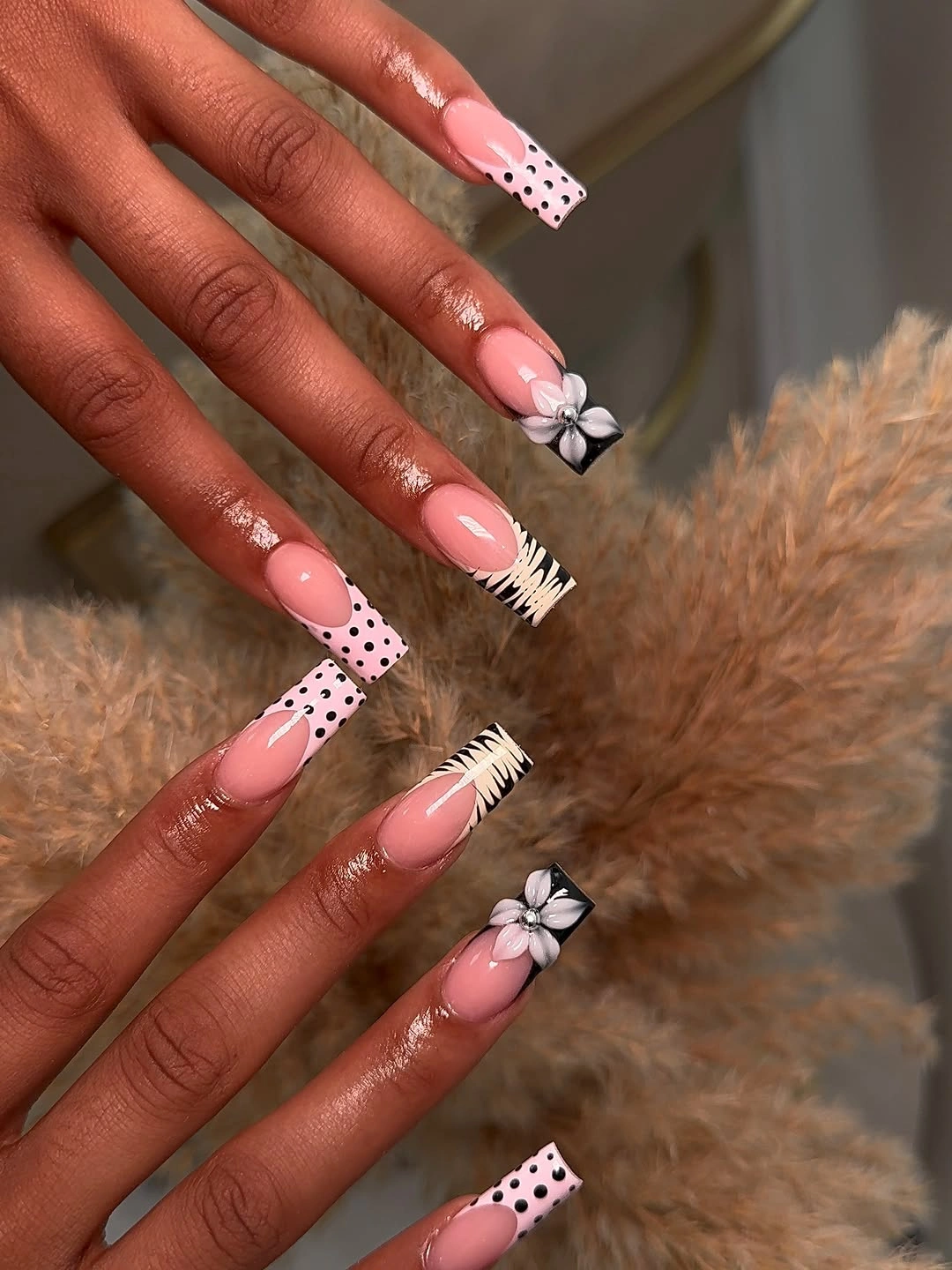
Linework is most effective when it supports the tip shape rather than crossing every nail in the same direction. Here, the fine white lines give one area extra movement, while the dotted tips continue to provide the repetitive base. If you want to simplify the design, leave out the flower-like accent and retain one lined nail beside several spotted tips. The manicure would feel less decorative, but the relationship between delicate lines and rounded dots would still give it more dimension than a standard polka-dot French.
Because the design includes several small details, maintaining clear separation between them matters more than adding more color. Black and white are enough to make the lines, dots, and flower-like shapes distinct against the pink base. A small silver ring or neutral outfit would not compete with this pattern, whereas a bright accessory could make the overall effect busy. Keep the most ornate nail as a deliberate pause, and let the others repeat simpler tip motifs so the viewer can understand the design one decision at a time.
Soft Blue Turns Full-Coverage Dots Playful
Short rounded nails use a soft light blue base covered with evenly spaced small black dots, creating a much more complete pattern than the tip-focused designs nearby. A pale pink or nude accent nail interrupts the blue field and gives the eye a little variation without changing the simple two-color logic. The rounded shape supports the all-over dots well because there are no sharp corners competing with the even circular spacing.
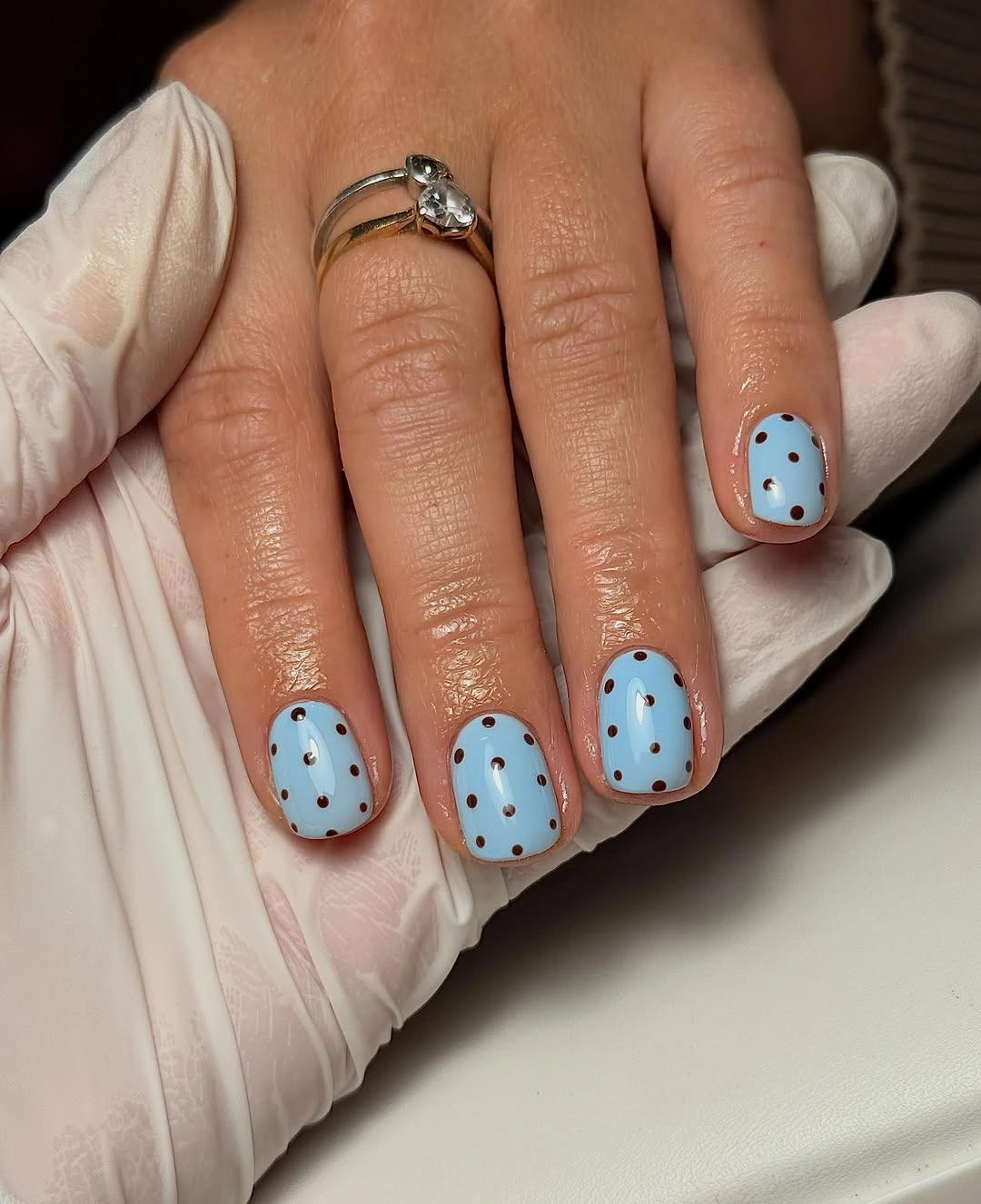
Full-coverage dots need consistent spacing to look intentional, especially on a short nail where a single oversized circle can throw off the rhythm. The small black marks are evenly distributed enough to let the blue remain visible between them, so the design feels patterned rather than dark. If you prefer less contrast, use navy dots on a muted blue base or switch the accent nail to the same blue with fewer dots. The current pale pink break is useful because it makes the blue-and-black pattern feel less uniform.
This is one of the more direct takes on the polka dot nails trend because the motif covers most of the visible blue nails rather than appearing as a trim. That makes it playful, but it also means the dot scale should stay modest as the nail length changes. On longer nails, use more space between dots instead of simply adding many more, or the base color will disappear. Preserve the soft blue field if you want the pattern to retain its friendly, even rhythm rather than become visually heavy.
Large Pink Flowers Need Quiet Dotted Neighbors
Long pale nails pair white tips with black dots, then introduce larger pink flower-like accents and one translucent-looking pale nail with fine dotted detail. The flowers have more visual weight than the dots, so limiting them to selected nails is what keeps the manicure balanced. The dotted French tips act as quieter companions, repeating a simple black-and-white motif while the pink floral shapes provide the more dimensional-looking focal moments.
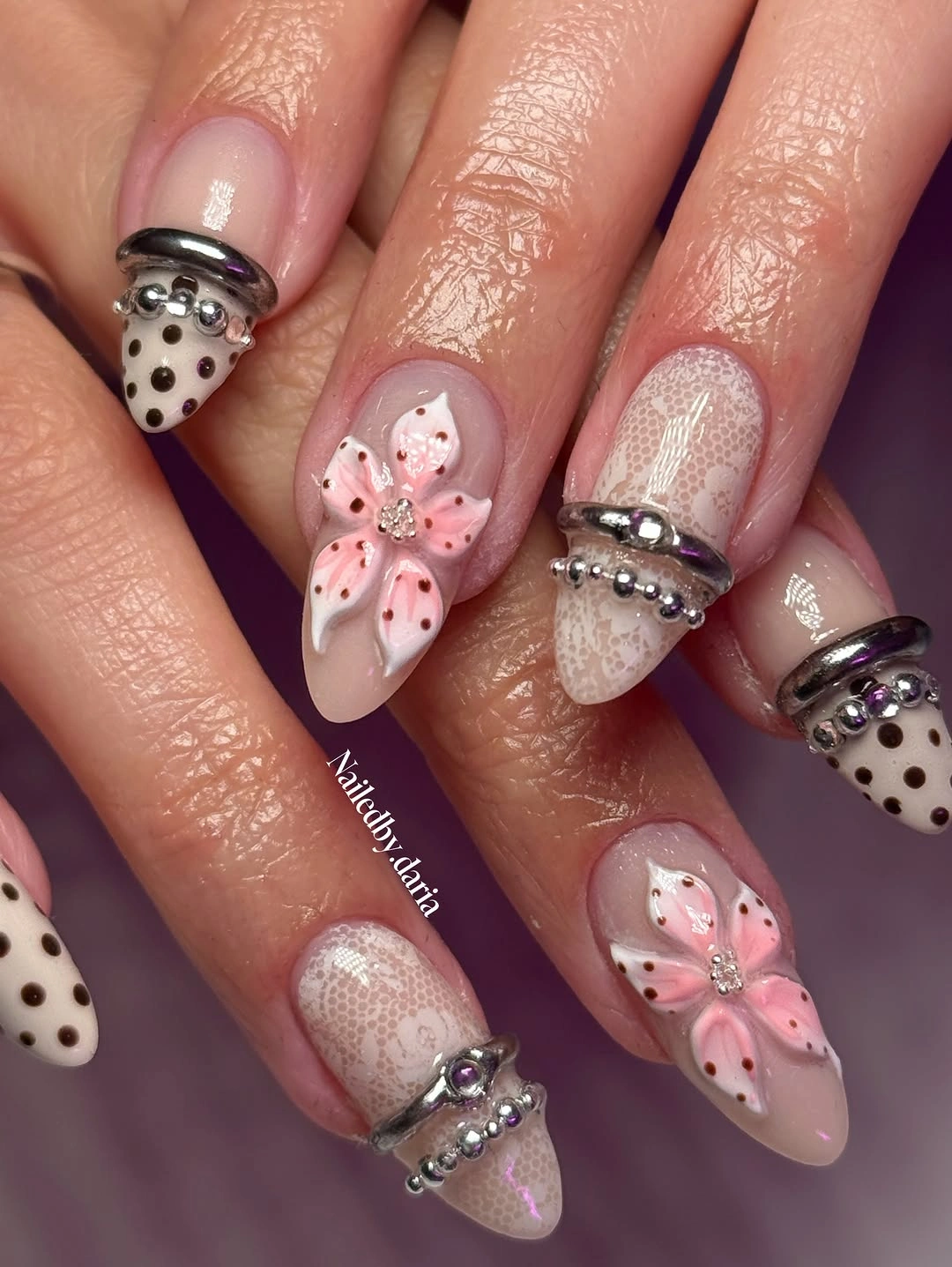
When larger floral decorations sit beside tiny dots, the two should not occupy the same part of every nail. The flowers need their own pale background, while the spotted tips work best as a narrow edge on neighboring fingers. For a more restrained version, keep one flower-like accent and change the other to a plain pink French tip. You will preserve the color connection but give the black dots more room to function as the repeated pattern rather than a background texture.
The translucent-looking accent adds a useful softer surface among the more defined pink and black elements. It should stay simple, because adding another large flower or a dense pattern there would make the design lose its quiet pause. If you are choosing jewelry, a slim silver band works better than several ornate rings because the nails already have their own layered detail. Let the flowers remain the largest shapes, keep the dots small, and allow at least one nail to provide visual relief between the two kinds of decoration.
A White Accent Lightens Red Dot Density
Pale pink nails use red dots, a bold red French-style edge, and one white accent nail with red marking, creating a lively but contained high-contrast set. The white nail matters because it introduces a clean pause among the repeated red-on-pink details, while a tiny green-black element adds a small unexpected note. Red has several roles here – dot, tip, and accent – yet the pale bases keep those roles from merging into one dense surface.
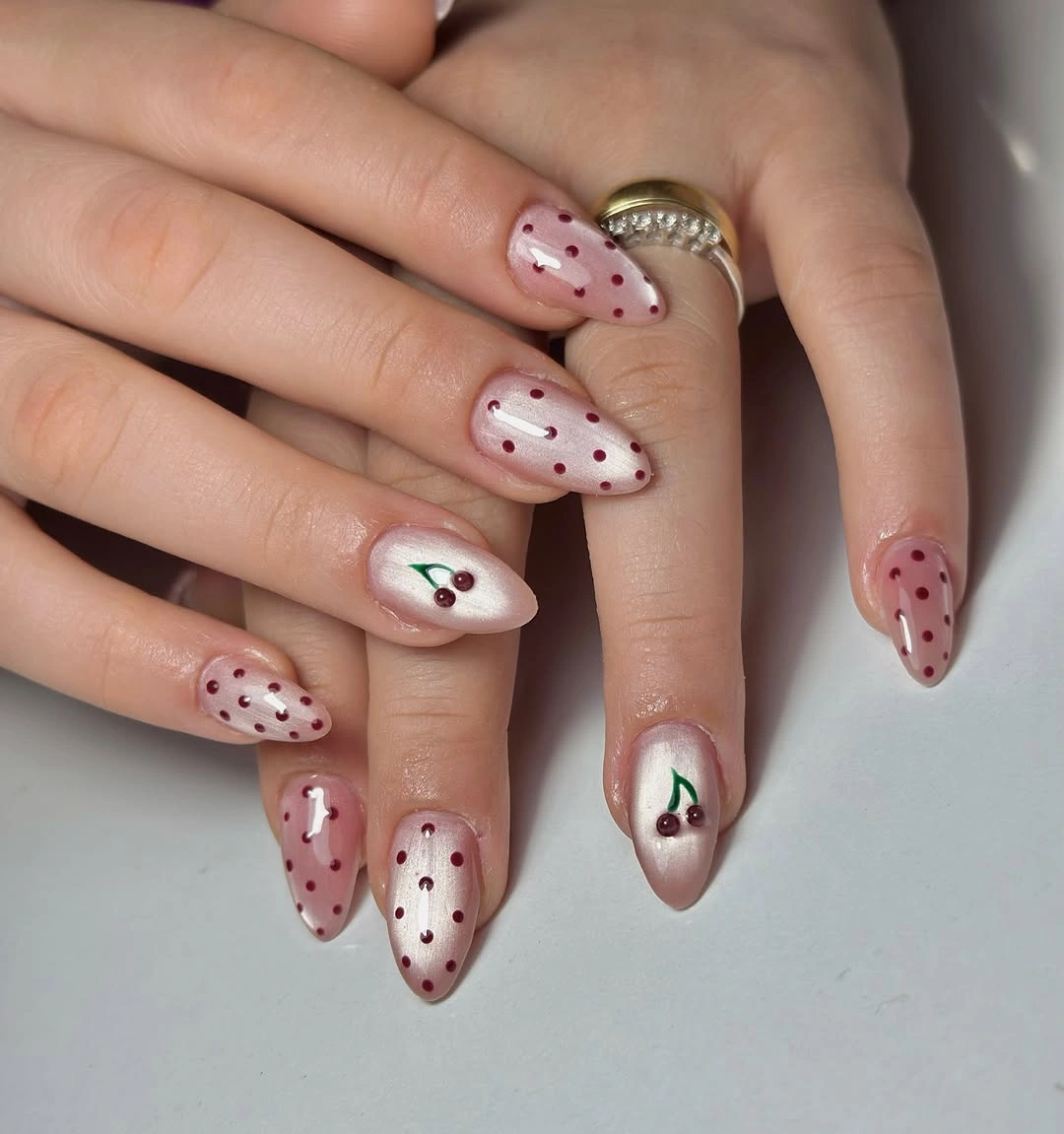
Red is visually strong on a pale base, so separating it into a dotted nail, a French-edge nail, and an accent nail creates more balance than repeating one treatment everywhere. If you remove the white accent, make the red tip thinner so the manicure retains an open area. A deeper berry red would create a more muted mood, but it should still be confined to tips and dots rather than painted across every nail. The design succeeds through contrast in placement, not through adding even more color.
The small green-black detail is most effective as a surprise rather than a second color theme. It gives the eye a brief point of difference without challenging red’s position as the main accent. For readers interested in how a palette can stay organized across several details, the site’s October nail colours article offers related color-structure ideas. Keep the white nail and one clear red edge if you want this manicure to remain bright, airy, and easy to read at a glance.
White Dots Make a Gentle Nude Pattern
Warm nude-pink almond nails use soft white dots around pale curved tips, creating a low-contrast version of the polka-dot motif. The dots are spaced lightly and do not fully cover the tip, so the base color remains the largest visible area on each nail. That restraint gives the manicure a soft, almost fabric-like rhythm, especially compared with black-dot designs where every small circle immediately becomes a strong graphic statement.
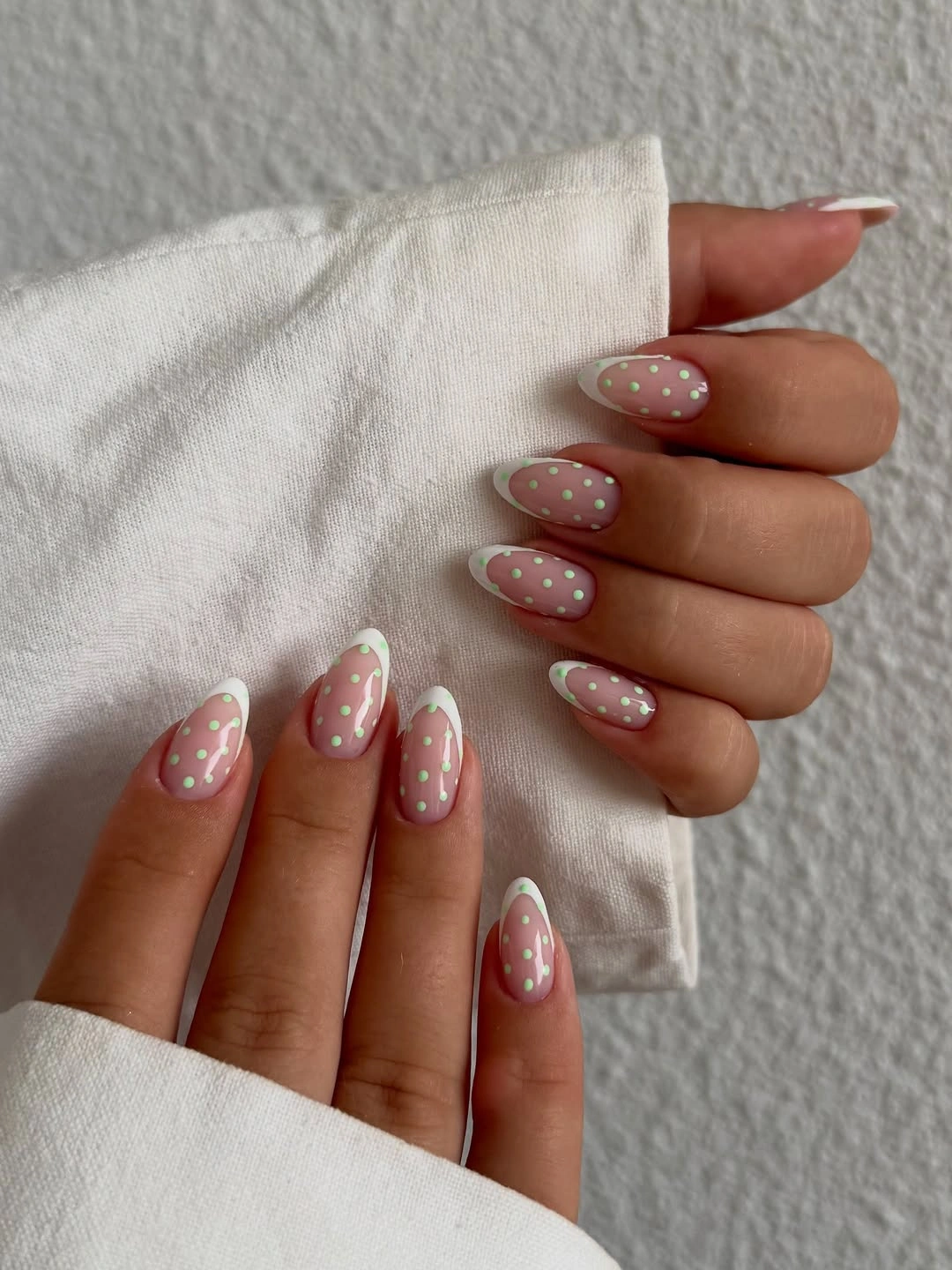
White dots are useful when you want pattern without a sharp contrast line. Their subtle value means the shape of the nail and the pale tip edge remain important, rather than the motif taking over completely. If you want a little more definition, add a fine white outline to one tip or use pearl-like dots on two nails only. Avoid making every dot larger, because the appeal here comes from their quiet scale and the generous nude space around them.
The design would adapt well to a shorter almond or oval shape, though the dot count should decrease with the available surface. On a compact nail, a few evenly spaced white dots near the edge will look cleaner than a dense cluster. A warm beige base would make the look more neutral, while a blush pink base would make it slightly more romantic, but neither change should disturb the low-contrast balance. The detail worth protecting is the gentle spacing: white dots need room to feel intentional rather than faint and accidental.
Gold Details Add Sparkle to Dotted Tips
Short nude nails use white French-style tips with black dots, then add small gold bead-like details and tiny colored accents on selected fingers. The gold elements are compact and sit near the patterned areas, so they give the neutral palette a point of shine without replacing the dotted motif. Because most of the base remains nude and open, the extra details read as accents rather than turning the manicure into a fully embellished design.
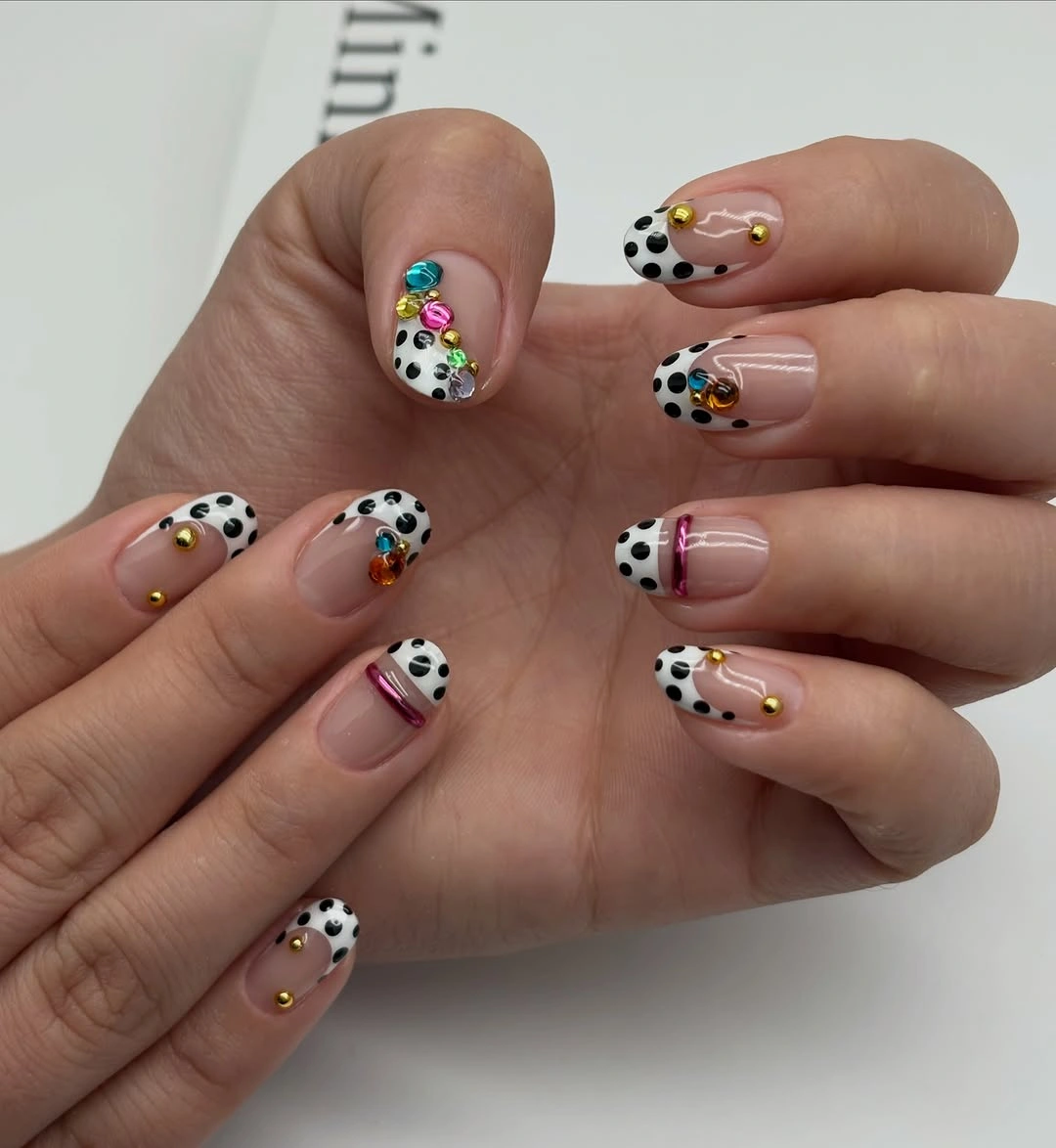
Small reflective-looking details work best when they are treated like punctuation. Placing them on every nail would make the black dots less visible and would increase the amount of upkeep the design appears to require. For a simpler version, keep one gold detail on a ring finger and use dotted tips elsewhere. The manicure would still have a moment of shine, but the white-and-black pattern would remain the strongest visual idea from a normal viewing distance.
The colored accents are so small that they do not need to match a wardrobe or a ring exactly. Their purpose is to add a brief spark of variation inside a mostly neutral structure. A pale gold line at the tip could be substituted for the bead-like details if you prefer a flatter-looking finish, but it should stay thin. Preserve the nude base and the black-dot edge as the primary contrast, then let any gold-like accent serve as a small highlight rather than a second major motif.
Micro Color Dots Refresh a Neutral French
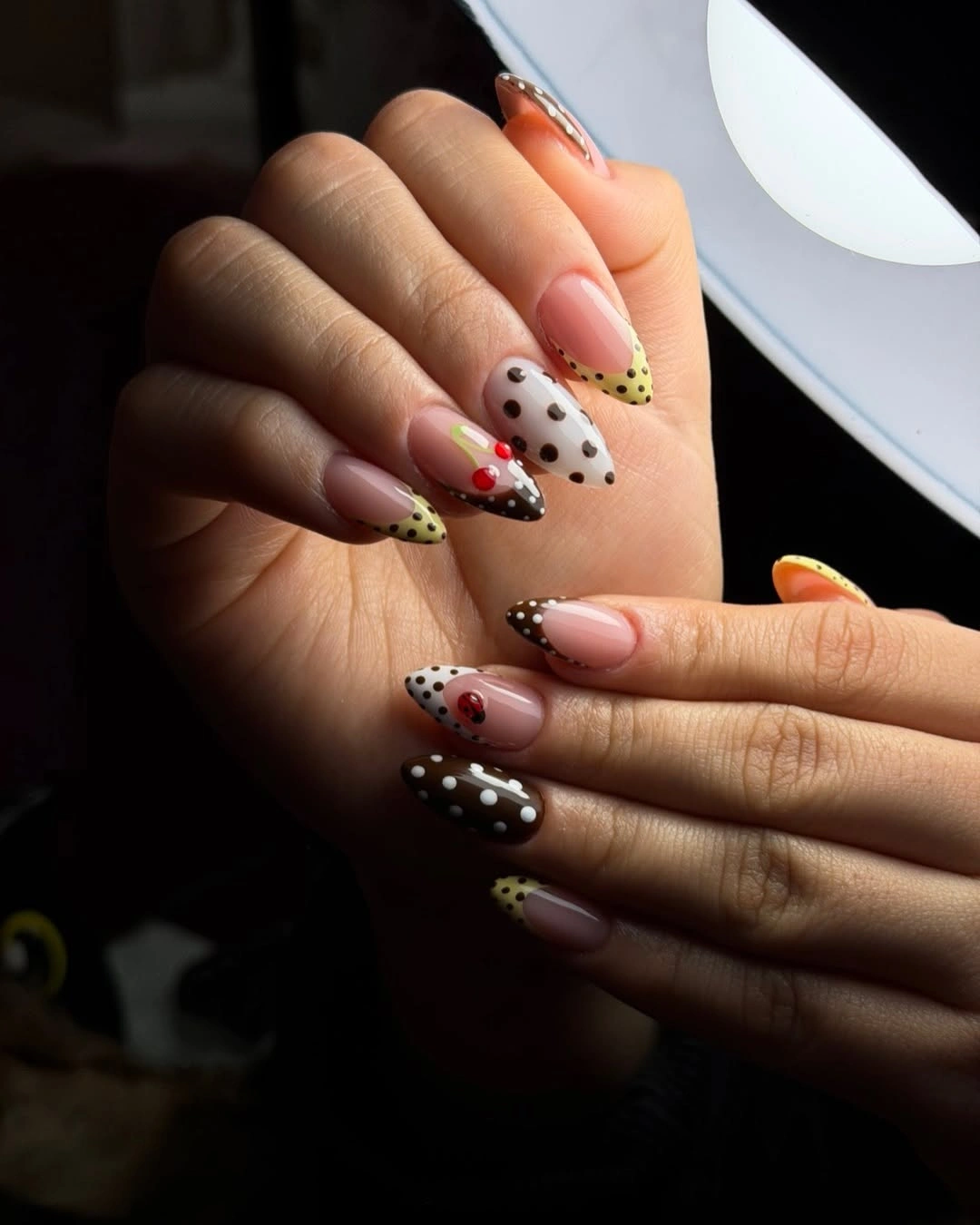
Nude bases and black-and-white dotted tips remain the main structure of this manicure, while tiny yellow, green, and purple-toned dots add micro accents on selected nails. Small gold bead-like details appear sparingly, creating a little extra point of focus without changing the overall neutral foundation. The colored marks are far smaller than the black and white pattern, which is why they feel like a fresh variation instead of a competing multicolor design.
Several accent colors can work together when each is limited to a tiny dot and none is given a full nail of its own. The larger black-and-white contrast continues to guide the eye, while the smaller colors reward a closer look. If you want to reduce the detail, choose just one accent color such as yellow or green and keep it on two nails. That edit would make the manicure more restrained while preserving the idea of a neutral dotted French with a small unexpected twist.
The gold-like details should remain near the accent dots rather than scattered across all tips, since too many small highlights can make a short manicure feel visually noisy. A clear glossy-looking finish helps the tiny color notes stay distinct against the nude base, while a heavily textured surface could obscure their scale. This design is a good option when you enjoy variety but still need a pattern that reads as one cohesive set. Keep black and white dominant, and let the micro colors remain supporting characters.
Red Dots Work on a Compact Pink Length
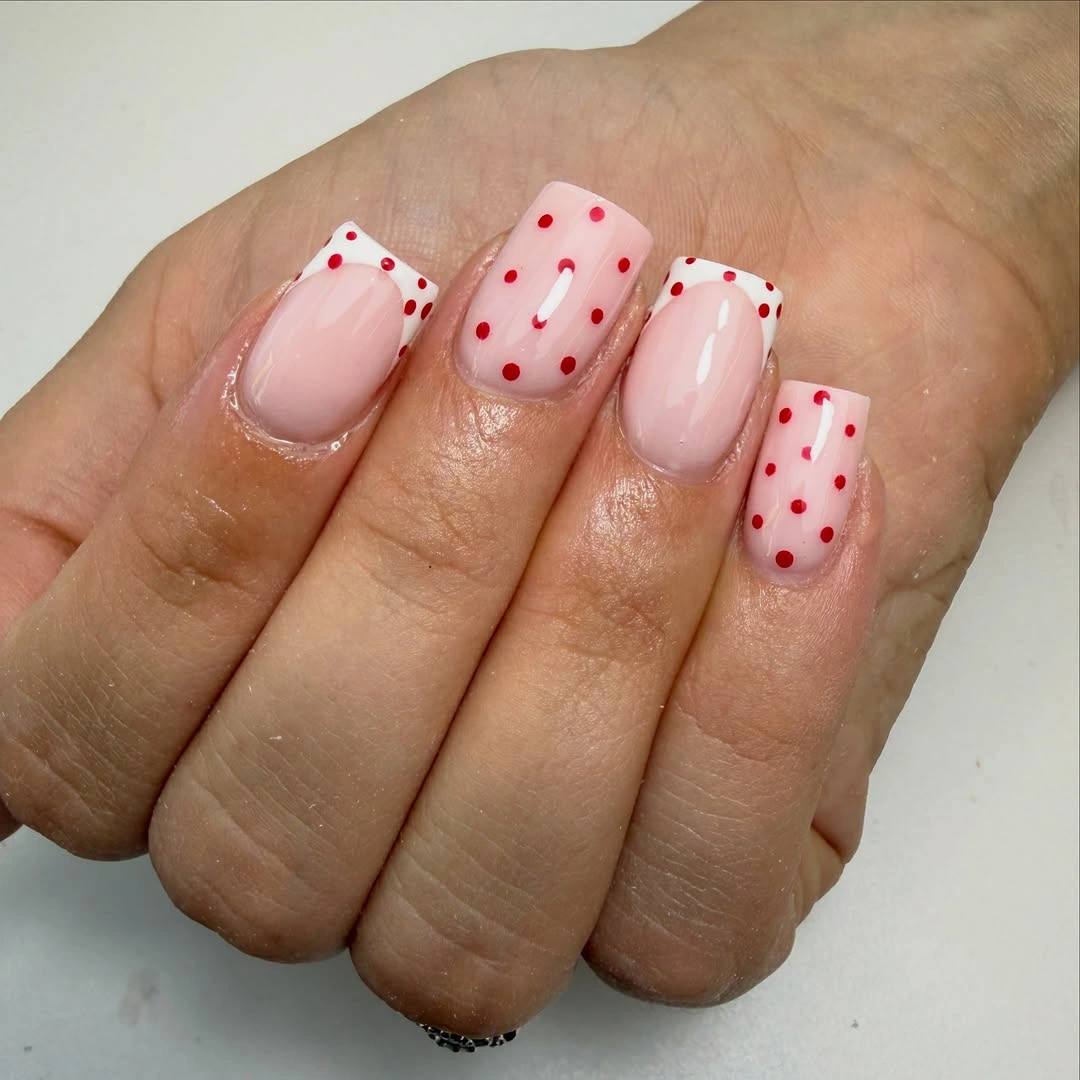
Short rounded pale pink nails use red dots near white or pale tips, with curved red French-style edges appearing on selected fingers. The shorter length gives the red pattern a crisp, contained quality because each dot has little room to drift away from the tip. Rather than covering the nail, the motif follows the curved edge and leaves enough pink visible to make the contrast feel lively but still carefully placed.
On short nails, red dots need a simple partner shape, and the curved French edge provides that anchor. It tells the eye where the pattern belongs and prevents the dots from looking like random marks on the pink base. For a softer version, switch from bright red to a muted rose tone and reduce the dots on one or two nails. The manicure would become more subtle, but the curved-edge idea would remain clear and flattering to the compact rounded shape.
The benefit of this design is its readable scale. You do not need a large accent nail, flower, or full-color panel to make the red visible; the tip placement already gives it enough structure. If you add a ring, choose something slim and neutral so it does not compete with the small high-contrast dots near the fingertips. Let the base remain pale and keep the red limited to edges and circles. That restraint is what makes the manicure feel playful rather than overloaded on a shorter length.
Deep Red and Gold Give Dots More Drama
Pale pink nails mix red polka dots and white tips with deeper red full or half accents and curved gold-like details on selected nails. The deeper red has more visual weight than the lighter dot pattern, so it is wisely concentrated on only a few fingers. That creates a clear hierarchy: pale pink and dots establish the base, deeper red provides focal contrast, and the small gold-like curves add a final decorative line without covering the whole set.
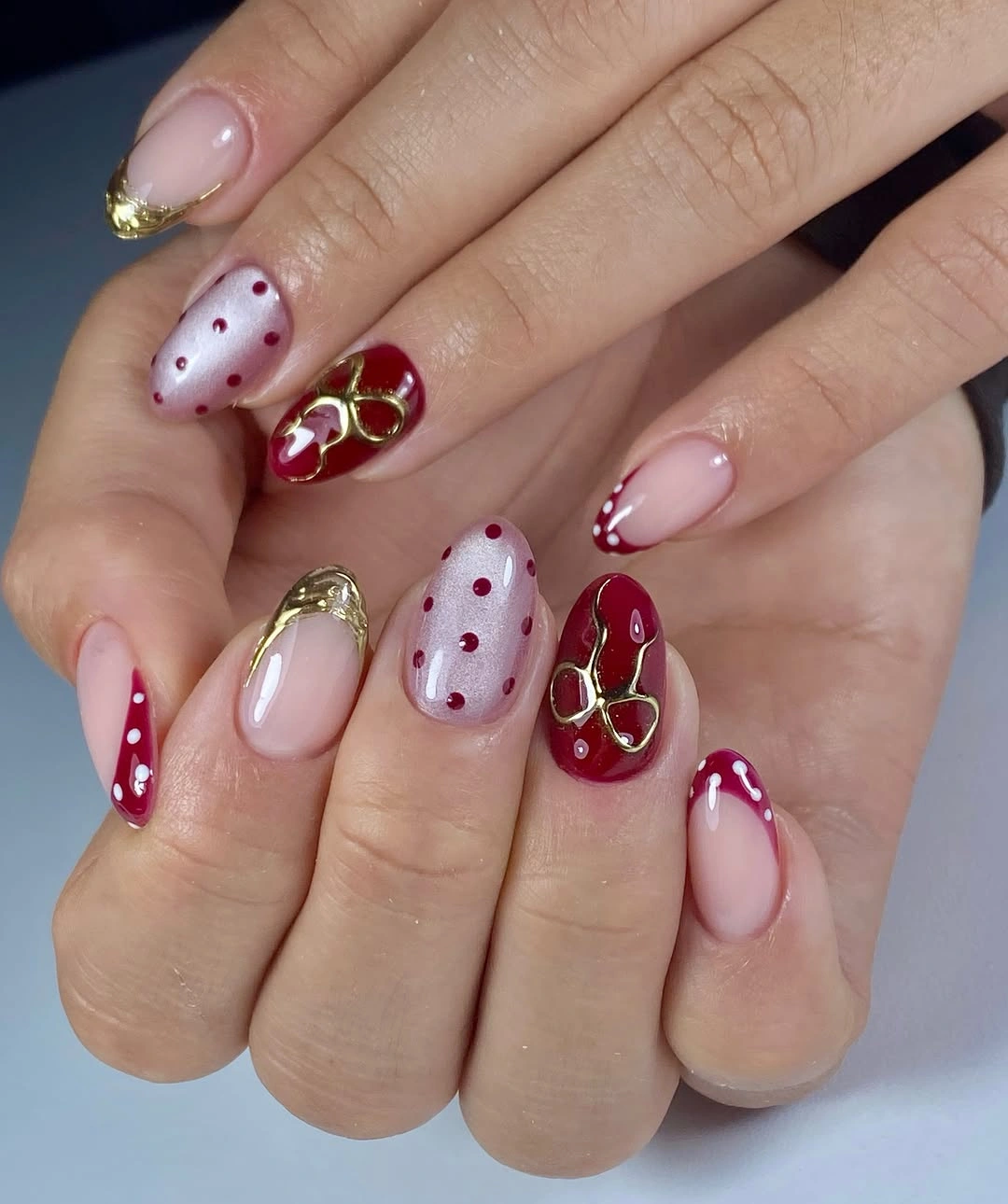
Concentrating the ornate details on a limited number of nails is what lets the pale dotted ones stay visible. If every finger received a deep red panel and curved gold-like line, the manicure would lose the negative space that makes the dots feel intentional. For a less dressy version, retain one deep red accent and remove the gold-like curve from the second. The palette would still have depth, but the red dots would regain more of their light, repeated role across the hand.
There is a useful contrast between the round dots and the curved gold-like details: one is small and repeated, the other is longer and reserved for focal nails. Keep that contrast in scale if you adapt the idea to a shorter shape by making the deep red accent smaller rather than adding more dots. A neutral outfit will let the red remain the central color story, while a matching red accessory could make the result feel more coordinated. The detail to preserve is selective richness, not maximal decoration on every nail.